-
-
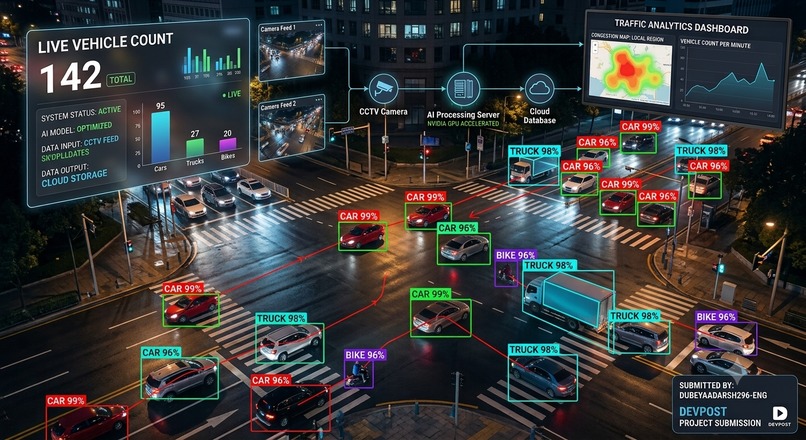
Vehicle detection on the chauraha
InspiratioInspiration
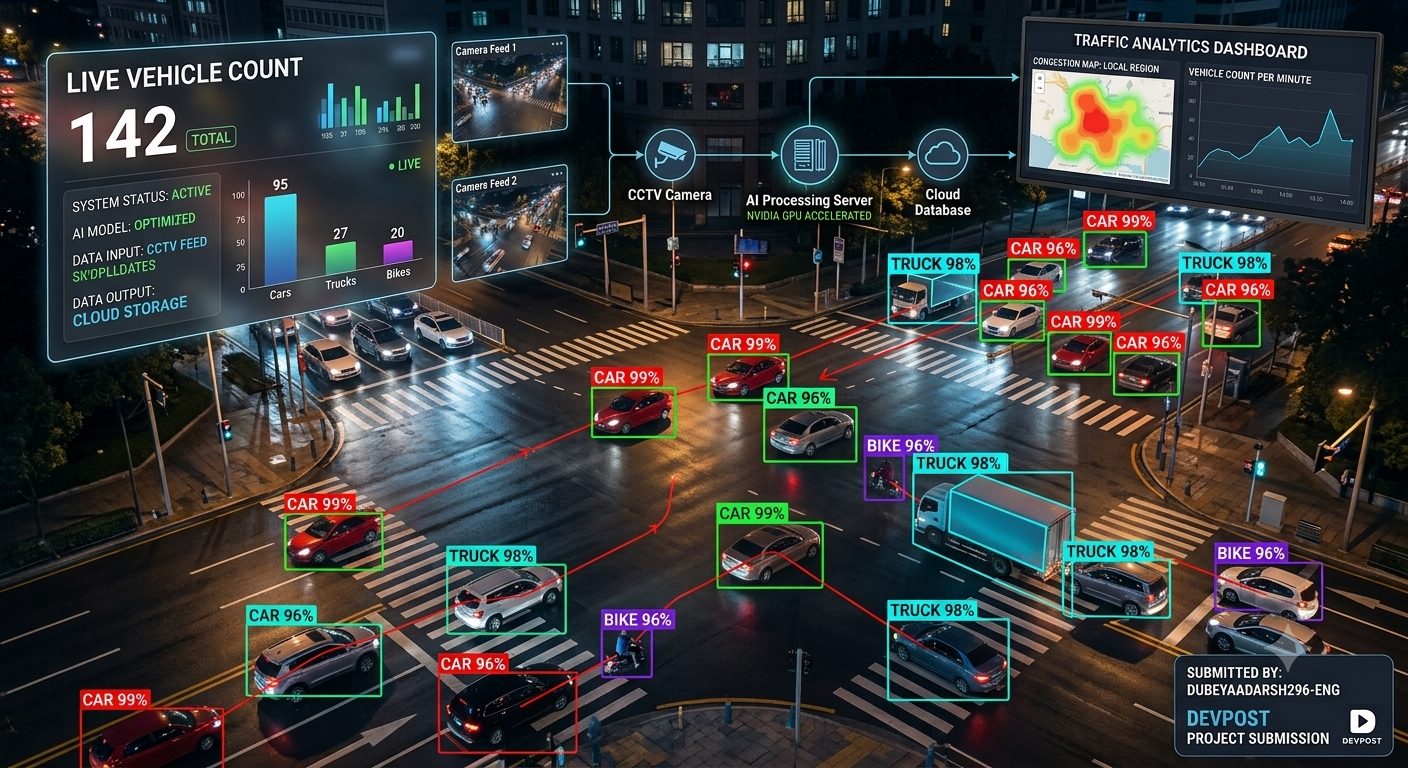
With the rapid growth of urban populations, traffic congestion has become a critical challenge for modern cities. Traditional traffic monitoring relies heavily on manual observation or rudimentary hardware sensors. The inspiration behind this project was to leverage Artificial Intelligence and Computer Vision to create a scalable, smart-city solution capable of providing real-time traffic insights to reduce congestion and improve road safety. What it does The system processes live video feeds from CCTV traffic cameras to detect, track, and count various types of vehicles (such as cars, trucks, and motorcycles) in real-time. It categorizes the vehicles and calculates live traffic density, feeding this data into a centralized surveillance dashboard. This enables traffic authorities to monitor peak flow metrics, identify bottlenecks, and make data-driven decisions for urban planning. How we built it The core detection engine is powered by advanced object detection models (such as YOLO) and OpenCV for real-time video frame processing using Python. The model was optimized to accurately recognize and bound vehicles even in dense, fast-moving traffic scenarios. The analytics are then visualized on a web-based dashboard, providing a clear, interactive interface for live vehicle counting and system status monitoring. Challenges we ran into A major hurdle was maintaining high inference speeds without sacrificing detection accuracy, especially when processing high-resolution video streams in real-time. Handling occlusions—where larger vehicles block smaller ones like bikes—and dealing with varying environmental lighting conditions (glare, shadows, nighttime) required careful threshold tuning and model optimization. Accomplishments that we're proud of We successfully built a low-latency pipeline capable of running real-time inference seamlessly. Achieving a high confidence score in categorizing different vehicle classes under dynamic, unpredictable street conditions was a major technical milestone. What we learned This project deepened our practical understanding of applying deep learning models to real-world continuous data streams. We gained valuable experience in optimizing computer vision algorithms for computational efficiency and effectively bridging the gap between a heavy AI backend and a clean, user-friendly frontend visualization. What's next for Traffic Vehicle Detection The next phase involves integrating Automatic Number Plate Recognition (ANPR) using Optical Character Recognition (OCR) to automatically flag traffic violations. We also plan to incorporate GIS mapping to visualize city-wide congestion hotspots dynamically and implement predictive algorithms that can directly automate traffic signal timings based on live vehicle density.
Built With
- artificial-intelligence
- computer-vision
- git
- machine-learning
- opencv
- python
- vscode
- yolo

Log in or sign up for Devpost to join the conversation.