-
-
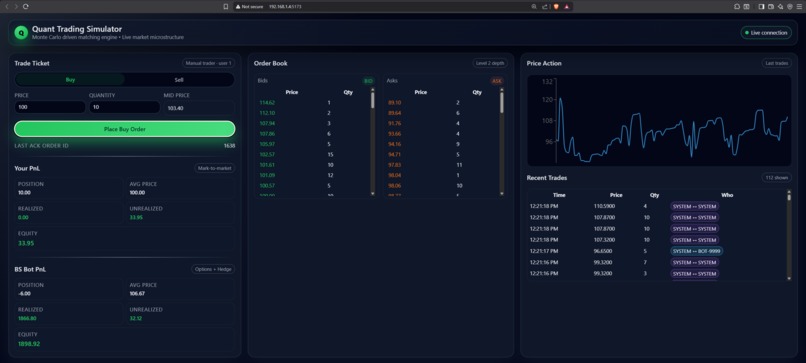
The webui

Here's the corrected version with improved formatting and LaTeX support:
Inspiration
Modern algorithmic trading platforms are often inaccessible, expensive, or too complex for newcomers. I wanted a fast, hands-on way to:
- Learn market microstructure
- Test quantitative ideas
- Validate trading strategies
without waiting for real market data.
I built a compact, realistic trading simulator that behaves like a simplified exchange but is intuitive enough to experiment with in minutes.
What It Does
This project simulates a live market environment with:
- A C++ matching engine that processes orders like a real exchange
- A Python strategy layer to test algorithms
- A WebSocket bridge for real-time updates
- A simple UI to visualize trades, book updates, and P&L
It's a plug-and-play sandbox for experimenting with quant ideas quickly.
How We Built It
- Built a lightweight C++ limit-order matching engine
- Connected it to a Node.js WebSocket backend
- Added a Python client so strategies can place orders automatically
- Designed a minimal frontend to display live market state
- Integrated everything into a single flow:
$$ \text{Strategy} \rightarrow \text{Engine} \rightarrow \text{Execution} \rightarrow \text{Analytics} $$
What We Learned
- How real exchanges match orders using price-time priority
- Challenges of synchronizing multiple components in real time
- How to design low-latency communication between C++, Python, and JavaScript
- The importance of reproducibility and clean architecture in simulation systems
Challenges We Faced
- Keeping communication fast and consistent across different languages
- Designing a simple but realistic order book structure
- Ensuring system stability as multiple components communicate simultaneously
- Balancing performance with ease of development during the hackathon
Key Features:
- Realistic order book dynamics with $bid$ and $ask$ spreads
- Portfolio P&L tracking: $PnL = \sum (P_{exit} - P_{entry}) \times Q$
- Latency measurement between components
- Reproducible simulation seeds for backtesting
Technical Stack: $$ \text{C++ (Engine)} \leftrightarrow \text{Node.js (Bridge)} \leftrightarrow \text{Python/JS (Clients)} $$
