Inspiration
Exporting food and plant products to China is not simply a matter of finding a buyer.
Before a supplier ships anything, they need to answer several connected questions:
Can my product legally enter China?
Where are the applicable regulations and official documents?
Does China actually import this product, from which countries, and at what scale and price?
Does my company, producer or processing facility have the capabilities and registrations required?
What is missing, what could block the shipment, and what should I do next?
Today, the information needed to answer these questions is fragmented across market-access protocols, GACC requirements, phytosanitary rules, food standards, enterprise registrations, China Customs statistics and other official sources.
Finding information is possible.
Turning that information into a reliable business decision is much harder.
That gap inspired TradePilot.
What it does
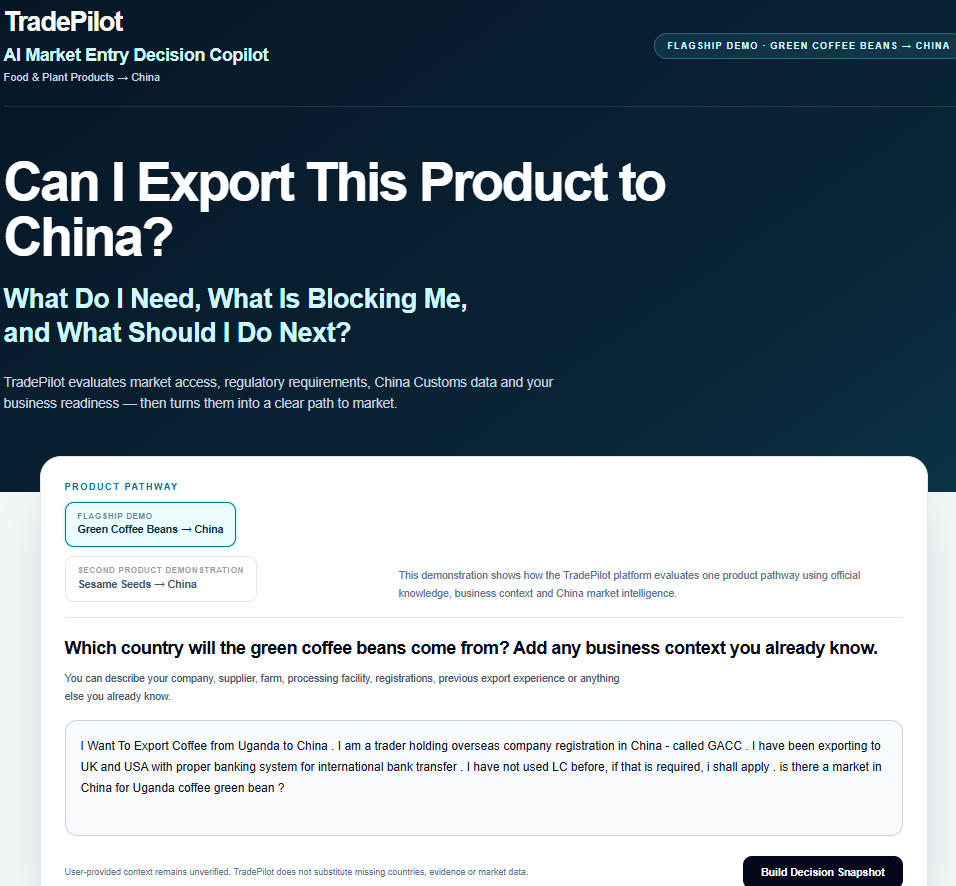
TradePilot is an AI Market Entry Decision Copilot for Food & Plant Products entering China. A supplier can describe their situation naturally: “I grow green coffee beans in Uganda. I have a processing facility and want to export to China.” TradePilot interprets that business context and turns it into four practical answers:
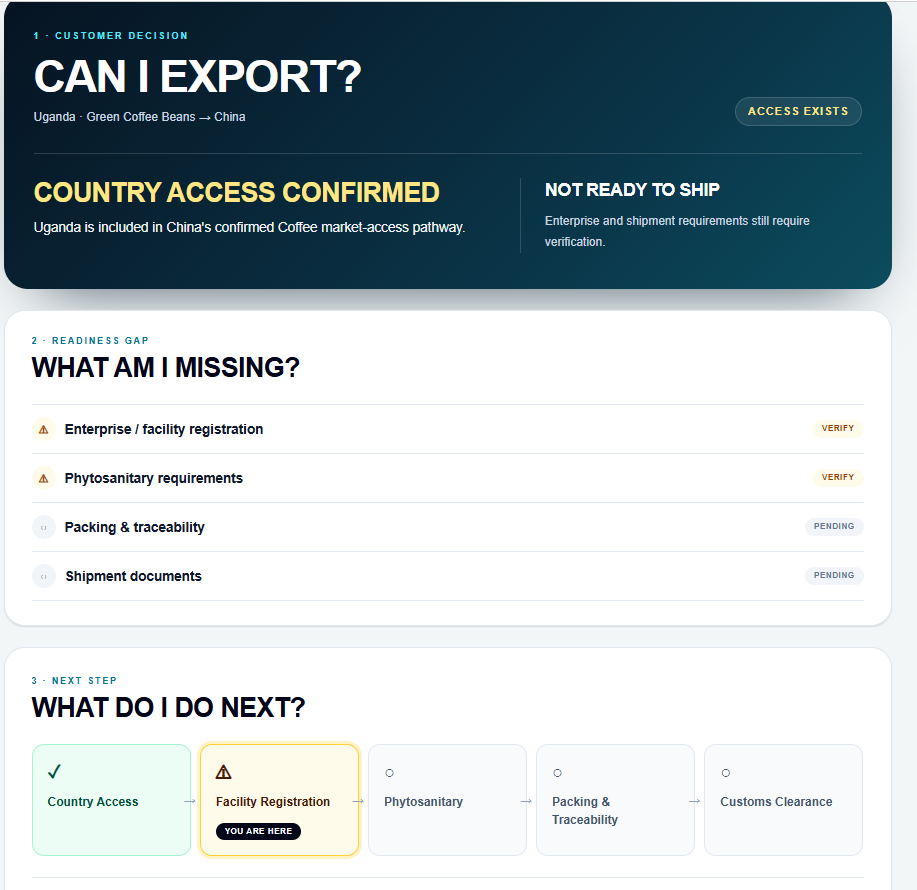
1. Can I export?
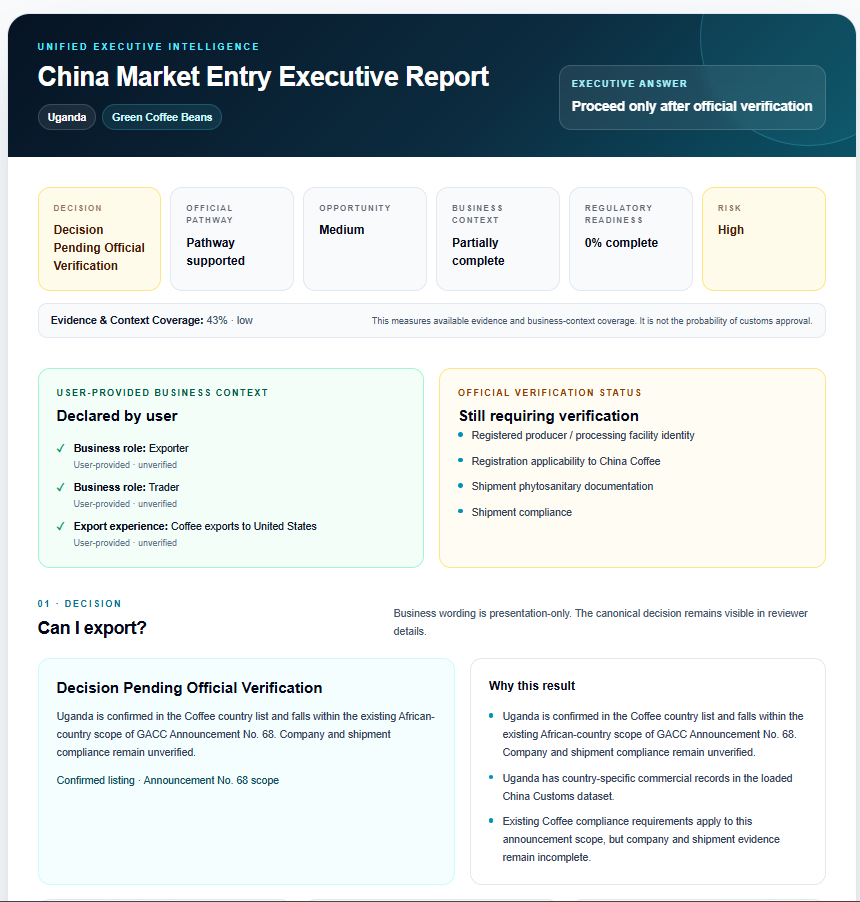
TradePilot checks the country-product market-access pathway and applicable regulatory requirements. It separates country access from company and shipment readiness, so an approved country does not automatically become an approved shipment.
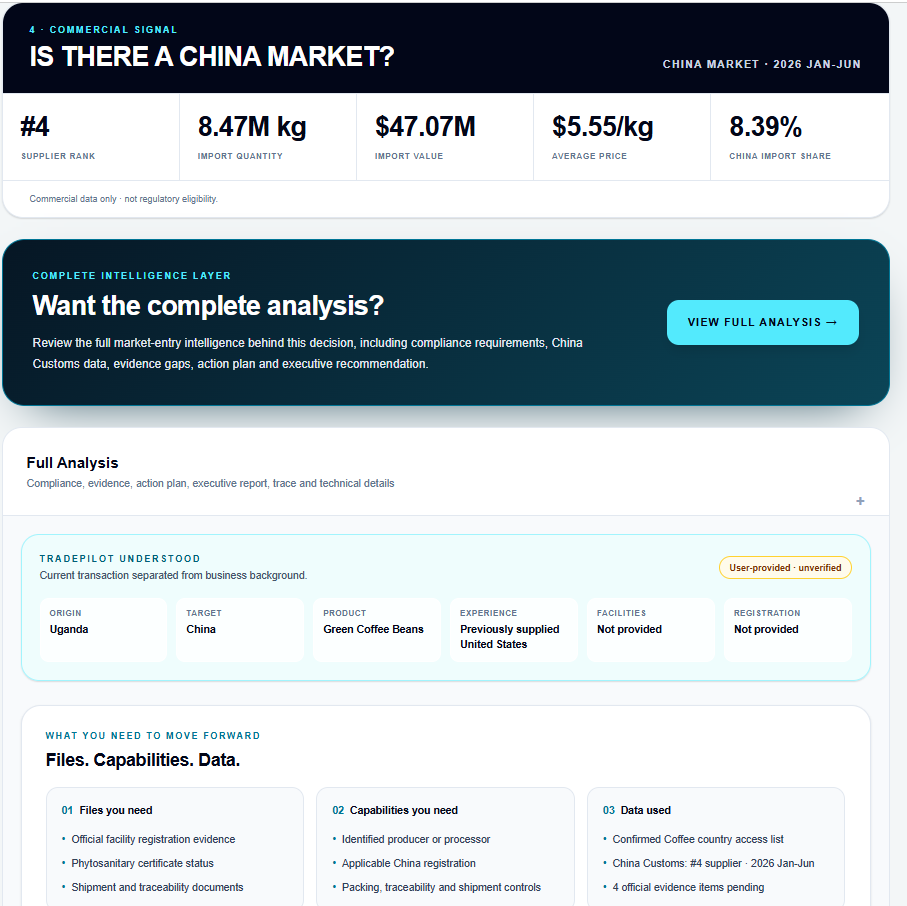
2. Is there a market in China?
TradePilot connects regulatory intelligence with China Customs trade data. For supported products, it can surface actual import volume, value, supplier-country position, market share and unit-price signals. This helps answer not only “Can I export?”, but also “Is this market commercially worth pursuing?”
3. What am I missing?
TradePilot compares the user's current business context with the applicable requirements. It identifies gaps across areas such as:
- producer or processing facility
- GACC registration
- phytosanitary requirements
- traceability
- packaging and labeling
- documentation
- shipment controls
4. What should I do next?
Instead of returning another long regulatory report, TradePilot converts the gaps into a prioritized action plan. The user sees the decision first: Can I export? → What is blocking me? → What do I need? → What should I do next? Detailed regulations, evidence, market data and technical traceability remain available when needed.
How we built it
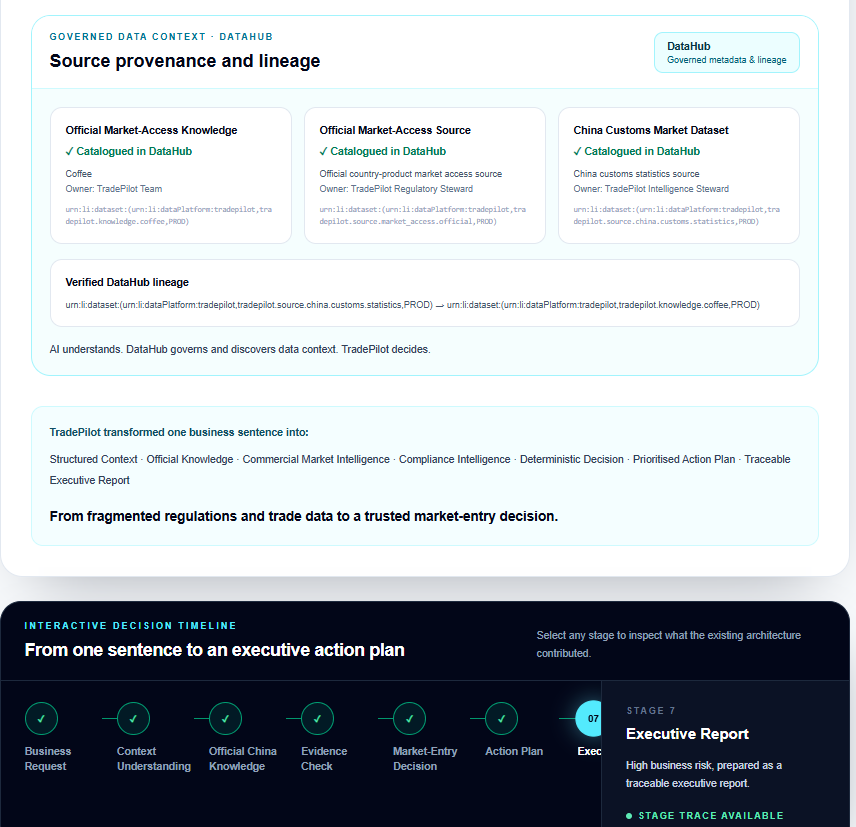
TradePilot separates three responsibilities that should not be mixed together: AI understands. DataHub governs the data context. TradePilot decides. The natural-language layer interprets flexible supplier descriptions and converts them into structured business context. The governed knowledge layer contains product-specific market-access requirements, compliance evidence and China Customs market datasets. DataHub provides metadata governance, discovery and lineage across these sources and knowledge assets, allowing TradePilot to show where decision-supporting information came from and how it is connected. The deterministic decision layer evaluates the structured business context against governed evidence. Finally, an Executive Intelligence layer converts the result into a simple business-facing decision, market assessment, compliance gaps and prioritized actions. For the hackathon, Green / Unroasted Coffee Beans → China is the flagship end-to-end demonstration, with Sesame used as an additional proof that the architecture is product-extensible.
Challenges we ran into
The biggest challenge was not generating more information. It was controlling complexity. Market entry combines regulatory eligibility, company capability, product requirements, shipment evidence and commercial market data. Showing everything at once quickly overwhelms the user. We therefore redesigned TradePilot around progressive disclosure: the user first sees the answer, blocker and next action; deeper compliance, market intelligence, evidence and technical traceability are available through Full Analysis. Another major challenge was natural-language context. Businesses rarely describe themselves using regulatory terminology. A user may say “packing house,” “warehouse,” “my friend's company,” or simply “I have GACC.” TradePilot therefore needs AI-level semantic understanding while ensuring that regulatory conclusions remain controlled by governed evidence rather than assumptions. We also deliberately separated regulatory eligibility from Customs trade activity. Historical import data may indicate commercial activity, but it does not by itself prove current market access.
Accomplishments that we're proud of
We built a working end-to-end decision flow rather than a regulatory search interface. For the flagship Coffee demonstration, TradePilot can connect: Natural-language business request → Structured context → Official market-access knowledge → Compliance intelligence → China Customs market intelligence → Evidence gaps → Deterministic decision → Prioritized action plan → Executive report We also implemented live DataHub integration. The current governed metadata environment contains:
- 9 source entities
- 5 knowledge entities
- 38 lineage relationships
- 0 missing entities
- 0 missing relationships This allows the demonstration to expose real governed metadata and Source-to-Knowledge lineage while keeping the business decision independent from DataHub availability. We are also proud that TradePilot does not silently substitute missing evidence or another country's market data. When reliable evidence is unavailable, the system explicitly reports that limitation.
What we learned
The most important lesson was that access to information is not the same as decision intelligence. AI is already very good at understanding questions and explaining documents. The harder problem is connecting that intelligence to governed, traceable data and converting it into a decision that a business can safely act on. We also learned that market-entry decisions should combine two traditionally separate worlds: Regulatory intelligence tells a company whether and how it can enter a market. Commercial intelligence tells the company whether that market is worth entering. Combining the two creates a much more useful decision system. The goal is therefore not to show users everything TradePilot knows. The goal is to show them the right decision, the reason, the blocker and the next action — with the evidence available underneath.
What's next for TradePilot — Food & Plant Market Entry Copilot
The current flagship demonstration focuses on green coffee beans, while the architecture is designed for a much broader scope.
Expand from flagship products to full food categories
The next stage is to extend governed knowledge coverage from Coffee and Sesame into broader food and agricultural categories, including plant products, processed foods, animal-origin foods and other products subject to China's market-access and GACC requirements. Each product category will retain its own regulatory pathway, evidence requirements and maturity level rather than forcing different products into one generic compliance model.
Build a unified China food import data layer
China Customs datasets will be progressively integrated and standardized across product categories. Instead of analysing one product dataset at a time, TradePilot will build a governed trade-data layer capable of aggregating: HS code → Product → Country → Import volume → Import value → Unit price → Supplier ranking → Market share → Time period This will allow the platform to move from individual market lookups toward systematic market intelligence.
Add cross-product and cross-country analysis
With broader data coverage, TradePilot can answer higher-level commercial questions such as: Which food products from my country already have China market access? Which products show meaningful Chinese import demand? Where is my country competitive compared with other suppliers? Which products have regulatory access but limited commercial penetration? Which market-entry opportunities deserve attention first?
Move from compliance assessment to opportunity discovery
The long-term goal is for TradePilot to identify opportunities before the user even selects a specific product. By combining market access, regulations, China Customs data, supplier-country capabilities and governed evidence, the platform can progressively support: Market Access → Market Intelligence → Opportunity Discovery → Readiness Assessment → Decision → Execution Roadmap TradePilot's longer-term vision is to become a governed Market Entry Decision Intelligence platform — starting with Food & Plant Products entering China, and eventually supporting broader product categories and international markets.
Built With
- china
- customs
- data
- datahub
- docker
- export
- gacc
- next.js
- node.js
- openai
- react
- regulation
- typescript
- vitest

Log in or sign up for Devpost to join the conversation.