-
-
TradeFlowLight
Inspiration
Small contractors often lose revenue not because they lack demand, but because their lead follow-up process is scattered. A garage door company, HVAC business, roofer, plumber, or electrician may receive inquiries from phone calls, referrals, websites, Google, Facebook, and email all at the same time.
Without a simple system, urgent jobs get missed, high-value leads are not prioritized, and follow-ups happen too late.
TradeFlow Lite was inspired by that real-world problem: helping small contractor businesses turn every customer inquiry into a qualified, trackable, revenue-generating opportunity.
What it does
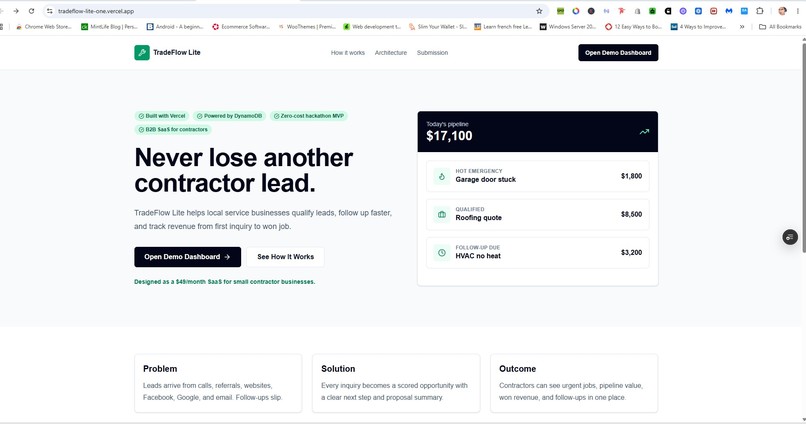
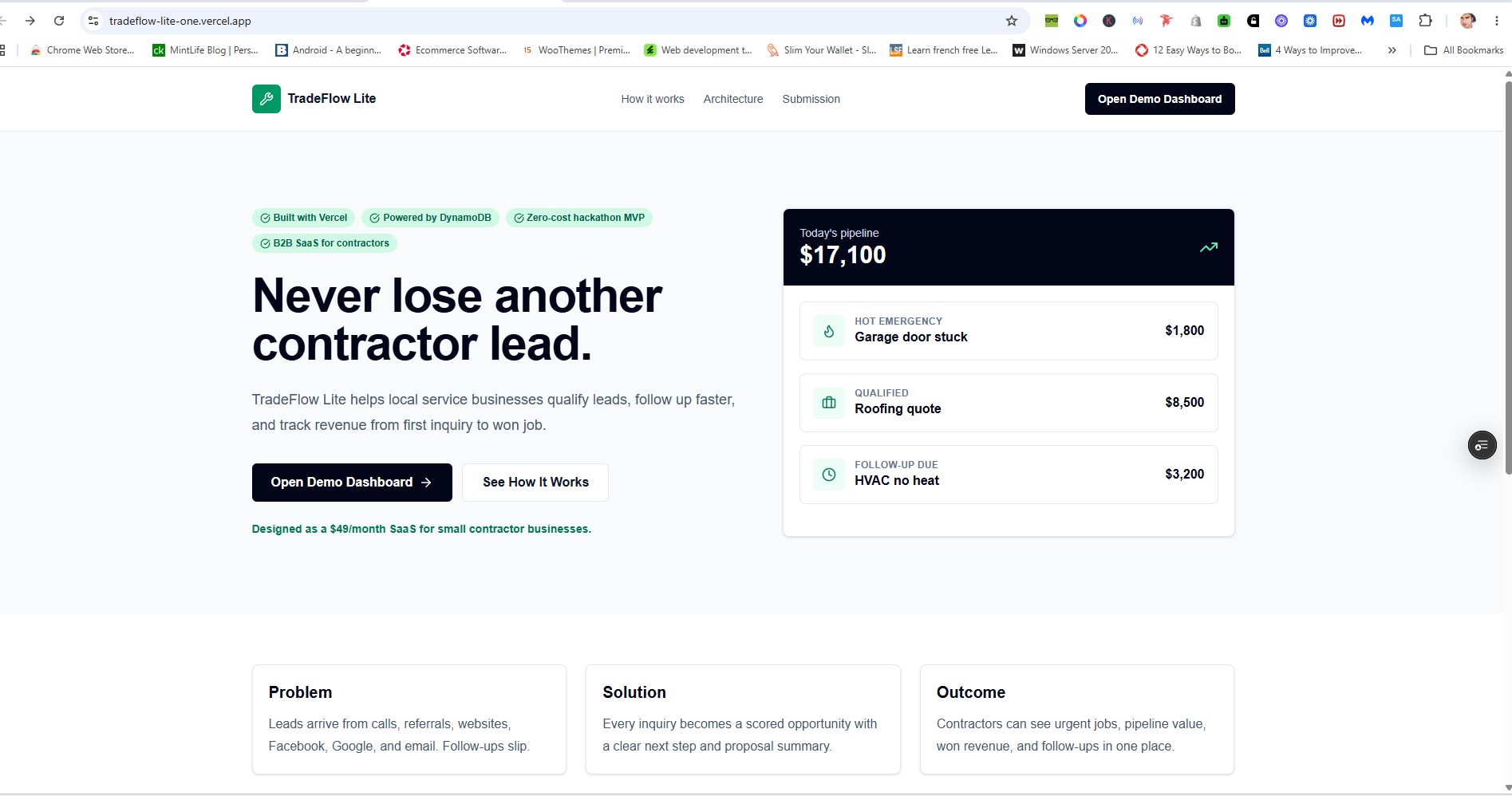
TradeFlow Lite is a lightweight CRM and lead pipeline app for local contractors.
Users can add a new lead with customer details, service type, urgency, estimated deal value, lead source, and notes. The app then calculates a lead score and labels the opportunity as Hot, Warm, or Cold.
The dashboard shows a simple contractor-focused sales pipeline with stages like New, Qualified, Proposal Sent, Won, and Lost. Users can move leads through the pipeline, view revenue metrics, see follow-up recommendations, and generate a proposal-ready summary from the lead information.
The goal is to help contractors know which leads need attention first and what action to take next.
How we built it
TradeFlow Lite was built as a full-stack web app using Next.js, TypeScript, Tailwind CSS, shadcn/ui, and Vercel.
The frontend is deployed on Vercel and designed as a clean SaaS dashboard. The backend uses Next.js server logic connected to Amazon DynamoDB through the AWS SDK v3.
DynamoDB is used as the primary operational database for storing lead records and activity data. The app uses a simple single-table design:
PK = TENANT#demo SK = LEAD#leadId
This structure keeps the MVP lightweight while showing a path toward a future multi-tenant SaaS architecture.
Lead scoring, follow-up plans, and proposal summaries are generated with local TypeScript logic and templates, so the app does not rely on paid AI APIs or external services.
Challenges we ran into
The biggest challenge was building something useful, polished, and database-backed in a very short amount of time.
We had to avoid overbuilding and focus only on the core workflow that matters for the demo:
Lead comes in → lead is scored → lead enters the pipeline → follow-up action is clear → revenue is tracked.
Another challenge was keeping the app free to run. Instead of using paid AI APIs, authentication services, or complex infrastructure, TradeFlow Lite uses deterministic local logic and Amazon DynamoDB as the required AWS database.
The final challenge was designing a data model that was simple enough for a hackathon MVP but still credible as a future SaaS foundation.
Accomplishments that we're proud of
We are proud that TradeFlow Lite feels like a real product instead of a generic demo app.
The app has a clear target customer, a real business problem, a monetization path, and a scalable database story. It combines a polished Vercel-hosted frontend with Amazon DynamoDB persistence and a contractor-specific workflow.
We are especially proud of the simple lead scoring system, the pipeline dashboard, and the fact that the product could realistically become a paid SaaS tool for small contractor businesses.
What we learned
We learned that a strong hackathon project does not need to be huge. It needs to be clear, useful, and shippable.
This project showed how quickly a full-stack application can be built when Vercel handles deployment and DynamoDB provides a serverless database foundation.
We also learned that database design matters even in a small MVP. By using a single-table DynamoDB design with tenant-based keys, TradeFlow Lite can start as a simple demo but still point toward a scalable multi-tenant architecture.
What's next for TradeFlow Lite
Next, TradeFlow Lite could add multi-tenant accounts so each contractor business has its own workspace.
Future features could include email follow-up reminders, SMS notifications, calendar scheduling, estimate templates, team member assignment, lead source analytics, Stripe billing, and website form integrations.
The long-term vision is to make TradeFlow Lite the simplest revenue pipeline tool for local service businesses that do not want the complexity of enterprise CRMs.
Built With
- amazon-dynamodb
- amazon-web-services
- for
- javascript
- lucide-react
- next.js-app-router
- sdk
- shadcn/ui
- tailwind-css
- typescript
- vercel

Log in or sign up for Devpost to join the conversation.