Inspiration
The inspiration came from lectures on several of the innovations recently created by fintech and proprietary trading companies in the domain of algorithmic/ high frequency/ learning-based trading strategies, and my desire to open these technologies up to everyone else, especially those with insufficient capital to be considered for such advanced tech-based finanancial schemes.
What it does
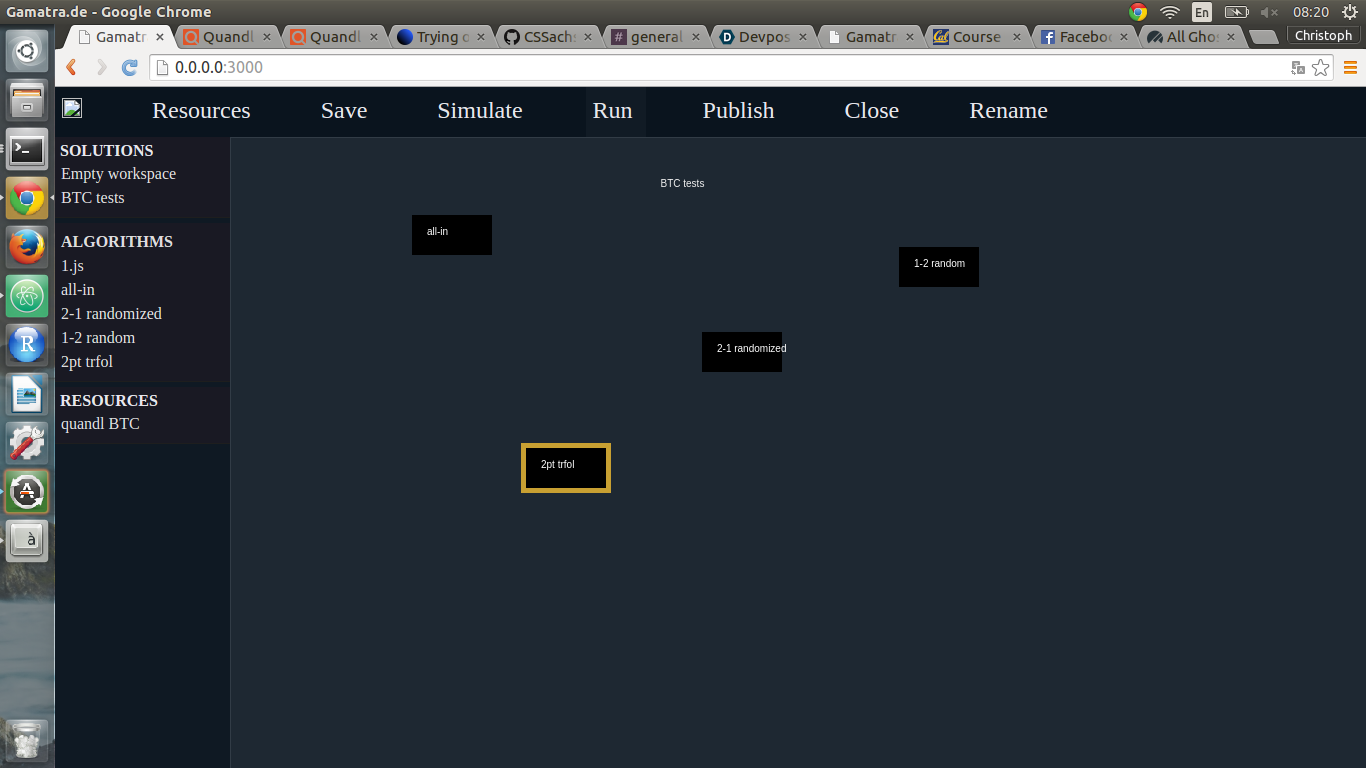
It provides a UI and IDE (originally for Julia, switched over to Javascript for security reasons) for building trading algorithms in an intuitive, iterative manner. It also provides built-in validation for algorithms and pseudo-native incorporation of large sources of relevant data (currently limited to quandl)
How I built it
The platform was built on a nodejs server using express (using shelljs/bash for unsafe calls to Julia)
Challenges I ran into
The first big problem in this hackathon was that my two other group members were not able to make it to the hackathon due to family issues and upcoming midterms. This, I think, dealt a heavy but not insurmountable blow to my progress. The second major problem was trying to come up with a method of effectively sandboxing the inputted julia code: since it has the ability to directly modify low-level structures, there is effectively no way to safely run this server side without setting up a dedicated virtual machine for each process. Ultimately, this was resolved by just switching to javascript, which eliminated a lot of overhead and increased the safety greatly (simply disabling the require() nodejs function makes it very difficult to inject malicious code)
What I learned
I learned quite a bit about nodejs, which I had studied but not used previously for a significant project, and also about some of the challenges of HTTPS and maintaining servers safe against injection when the whole point of the server is to run foreign code.
What's next for Γ trade
Unfortunately, the security issues remain a big deal, and obviously the entire UI/UX needs a rehaul, so the next couple weeks will be spent rewriting the entire system in a safer, more scalable fashion to allow for the system to function as originally planned.


Log in or sign up for Devpost to join the conversation.