-
-
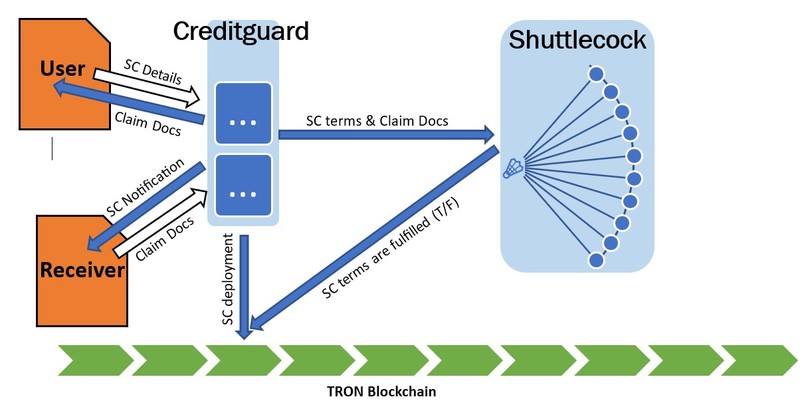
Figure 1: Archietecture of CreditGuard and Shuttlecock
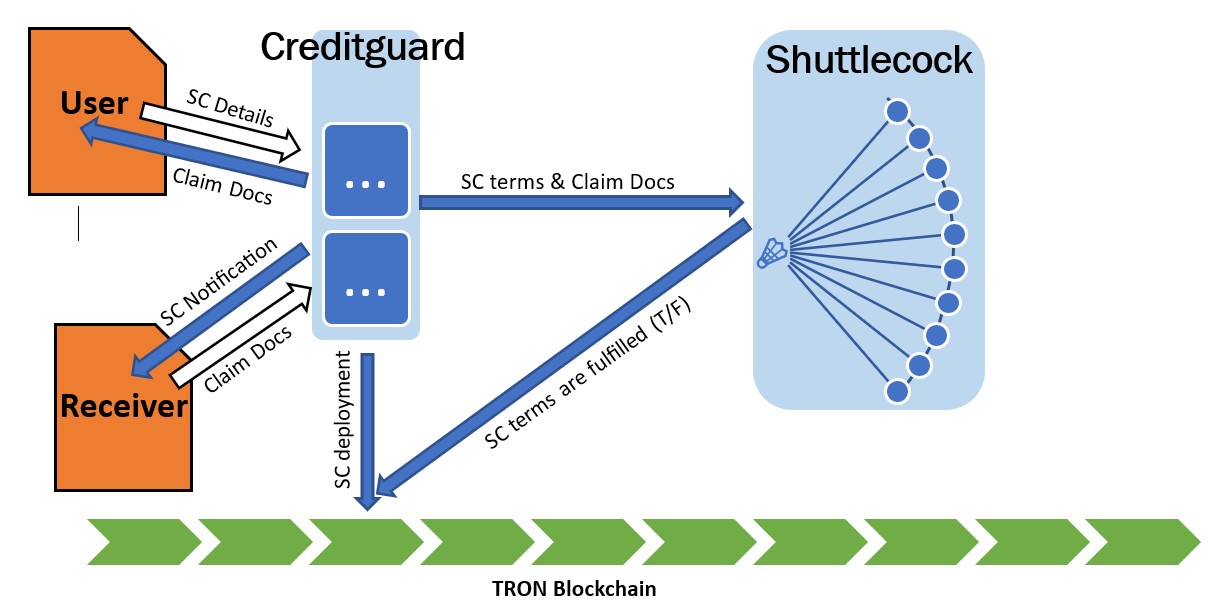
Inspiration
Traditional trade financing process is cumbersome, slow & expensive. Letter of Credit (LC) is a most significant example of trade financing, where the buyer goes to his bank to open LC. Typically, many banks are involved for execution of a LC including issuing bank, advisory bank, and intermediate banks (intermediate banks include confirming bank, reimbursing bank & negotiating bank). Apart from significant fees of all these banks, there are currency exchange fees, and approval of all stakeholders delays the LC completion. Hence DeFi for trade financing is highly demanding. Trading, especially export-import is a huge sector of the sought TRON application.
This inspired us for developing a crypto/blockchain counterpart of LC.
What it does
Our solution facilitates a version of LC directly without involvement of banks & exchanges. It needs all the parties (buyer & seller) to have TRON wallet. A user who is interested to generate an LC can do it through a smart contract generation platform. The smart contract platform is a dApp, let’s call it as the platform for trade financing (Creditguard). CreditGuard generates the smart contract for the user along with coupling to the decentralized human oracles (Shuttlecock). Proposed solution consists of two key components Creditguard & Shuttlecock along with an information sharing protocol as briefly shown in figure 1. There SC stands for smart contract.
Any user can log in to Creditguard and generate desired smart contract (SC) by providing the SC details including receiver’s address, amount (in TRON or BTTC), terms etc. After complete inputs from the user, Creditguard will generate code of the SC which can be deployed on the blockchain. Simultaneously, Creditguard will send notification about generation of LC & related terms to the receiver. Receiver will be requested to provide claim documents as per the user desired claims (e.g. bill or lading, inspection report, quality analysis etc.) in order to receive the amount in his wallet.
Each SC through Creditguard is coded to have triggering mechanism through Shuttlecock. Shuttlecock is a decentralized community of human oracles which provides Boolean output (true or false) based on the claim defined in the SC against the data provided by the receiver. If the Claim Docs provided by receiver satisfy the SC, then Shuttlecock triggers payment to the receiver. In case of complex SC conditions, SC just stores the Shuttlecock response to process the payment at later time. Insurance of the consignment can also be looped in the SC based on Shuttlecock response.
Any TRON user can generate the LC even if other parties (i.e. receiver) don’t have any TRX (or such tockens). As any person can open TRON wallet free of cost, traders can open the wallets for ease of trading if a buyer offers LC through TRON. In this way, the TRON ecosystem can expand by adding new users.
Smart contract generation platform for trade financing (Creditguard)
It provides auto generation of customized SC based on the specification by a user. It provides a simple interface to the user, through which the user can choose format of anticipated SC along with necessary variables. For example, a buyer (of certain goods) can choose the “Letter of Credit” format and enter variables like address of seller, amount of transaction, terms etc. Based on these details, a SC code will be generated by Creditguard back end, which can be directly deployed on TRON (or BTTC) blockchain.
Upon deployment, the receiver (can be multiple) of smart contract gets a notification by Creditguard. This notification informs him about deployment of the SC and suggest him to complete formalities in order to receive the amount in his TRON wallet. When the receiver sends the claim documents as per the SC (e.g. bill of lading), Creditguard forwards the copies to Shuttlecock. Creditguard forwards the Docs to Shuttlecock while referring the SC (object) address on TRON blockchain, and the terms of the SC against which the Docs are submitted. Creditguard also forwards a copy of Claim Docs to original user so that he can process receipt of the consignment.
Creditguard codes the SC with conditionals. The transfer has to be triggered when Shuttlecock sends a certain object to the address (the object & the address are defined in SC code). Upon receipt of the required object in the referred address, transfer to the receiver occurs. The SC also has date limit conditional, i.e. the SC gets aborted when the date is passed without the receipt from Shuttlecock. If multiple parties are involved in the SC, then Creditguard will communicate with all of them through the SC notification and Docs forwarding, along with referring Shuttlecock for specific claim in the SC.
Distributed human oracles (Shuttlecock) Shuttlecock is a network of human oracles for validation (true or false) of claims based on real word documents. Numerous human accounts belong to the Shuttlecock hub from where each person receives the SC terms and the claim documents. The person has to confirm whether the documents satisfy the SC terms in yes/no (T/F) output. All the accounts of Shuttlecock receive the assignment simultaneously, and the response of each account is broadcasted over all the accounts. Any account can monitor the collective decisions. For ease, the execution is done by Shuttlecock hub (has been deployed as Shuttlecock). Shuttlecock hub communicates with Creditguard. It also concludes collective decision of the accounts for a case (i.e. specific SC terms & Claim Docs received). Upon the conclusion of the case, Shuttlecock hub sends the certain object (as directed by Creditguard or in the SC) to the referred address so that the TRON transfer can be triggered or aborted. Shuttlecock hub forwards the Claim Docs & SC terms to all accounts. There is an algorithm for rapid conclusion based on responses and fees distribution. In certain time frame (say, 10 minutes), Shuttlecock concludes whether the Claim Docs satisfy the SC terms, and it sends the input to the SC on TRON blockchain (as an the referred object to the referred address).
How we built it
Creditguard is build with sqlite3 database and simple form UI.
Shuttlecock is built with sqlite3 database and wordpress.
The LCs generated by back-end of Creditguard are nothing but the smart contracts. They are written in solidity. We have developed a python code which automatically drafts the solidity code for LC depending on the Creditguard form inputs.
Challenges we ran into
We find TRON as a better suit as it is a layer 1 blockchain, as well as planning to be layer 2 for Bitcoin blockchain.
What's next for Trade financing on TRON to boost international trades
We are looking forward to commercialize the solution. We have identified following value propositions, and expect a fair business scope for trade financing on TRON or BTTC blockchain.
Traditional LCs involve many banks including issuing bank, advisory bank, and intermediate banks (e.g confirming bank, reimbursing bank & negotiating bank). All these banks incur some fees. Additionally there are currency exchange fees. Our solution offers same service at much reduced cost to the traders.
Approval of all stakeholder banks delays LC opening & execution. Our solution facilitates faster execution and real time transactions through TRON blockchain.
Credit ratings & liabilities of banks keeps changing and hence relations between banks are dynamic. Hence the traditional ecosystem isn’t constant, but our solution would be a firm process. Other parties like consignment insurance, inspection, logistics etc. can also be included in the smart contract solution.
Above value propositions are valid for buyers as well as sellers, international as well as domestic.

Log in or sign up for Devpost to join the conversation.