Inspiration
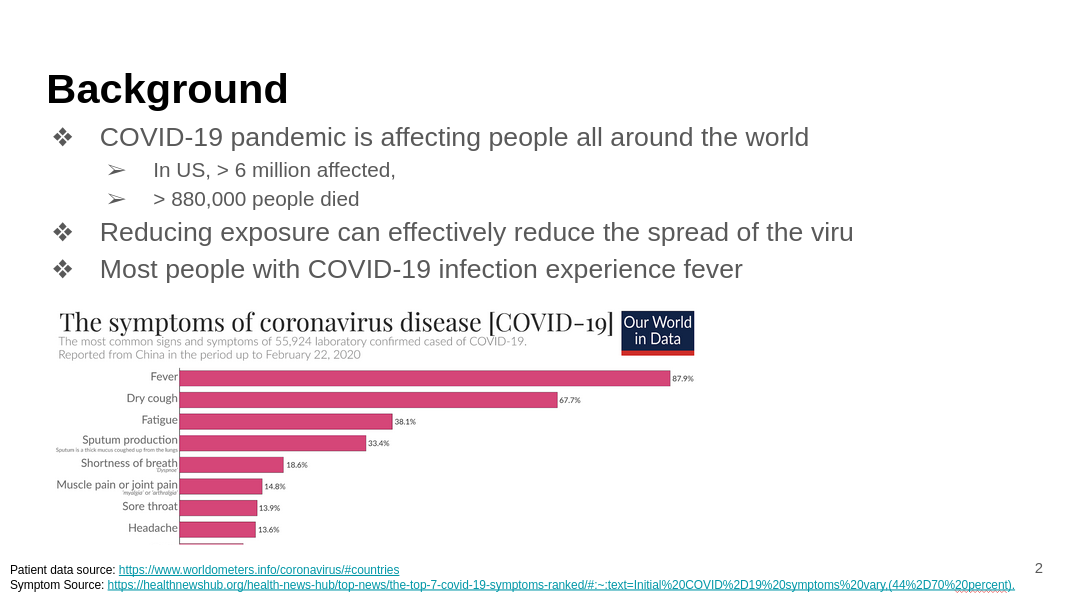
The SARS-CoV-2 pandemic has touched millions of lives across the world. In the U.S., more than 6 million people have been infected and at least 880,000 people have lost their lives to this brutal respiratory disease. People with SARS-CoV-2 infection experience a wide range of symptoms with common ones such as fever, dry cough and fatigue. Despite the fact that some people may be asymptomatic and still able to carry the virus and infect others, body temperature monitoring is still an easy and straightforward way to detect signs of infection.
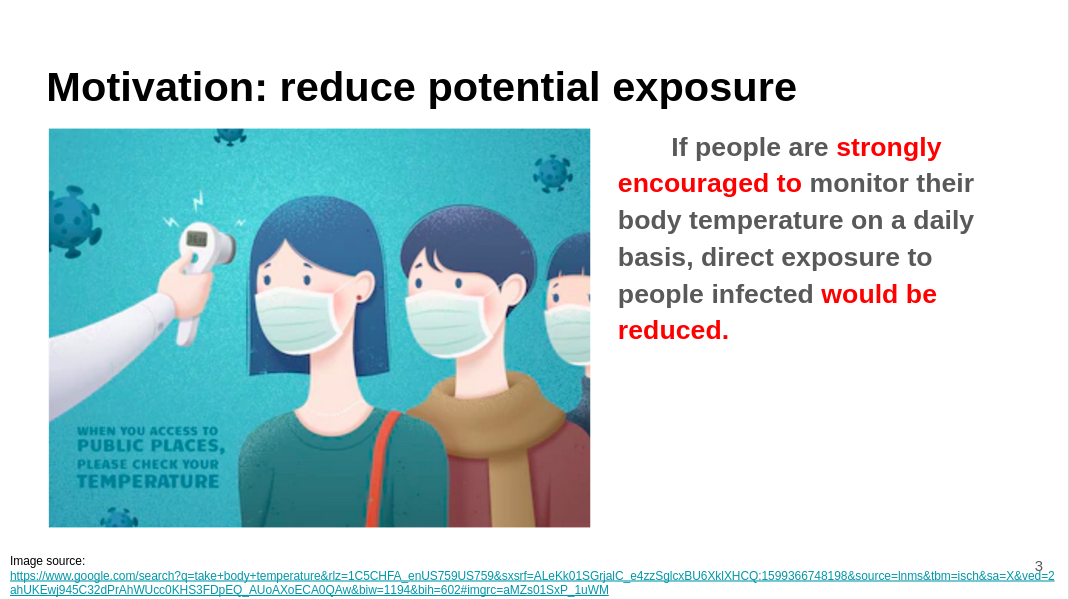
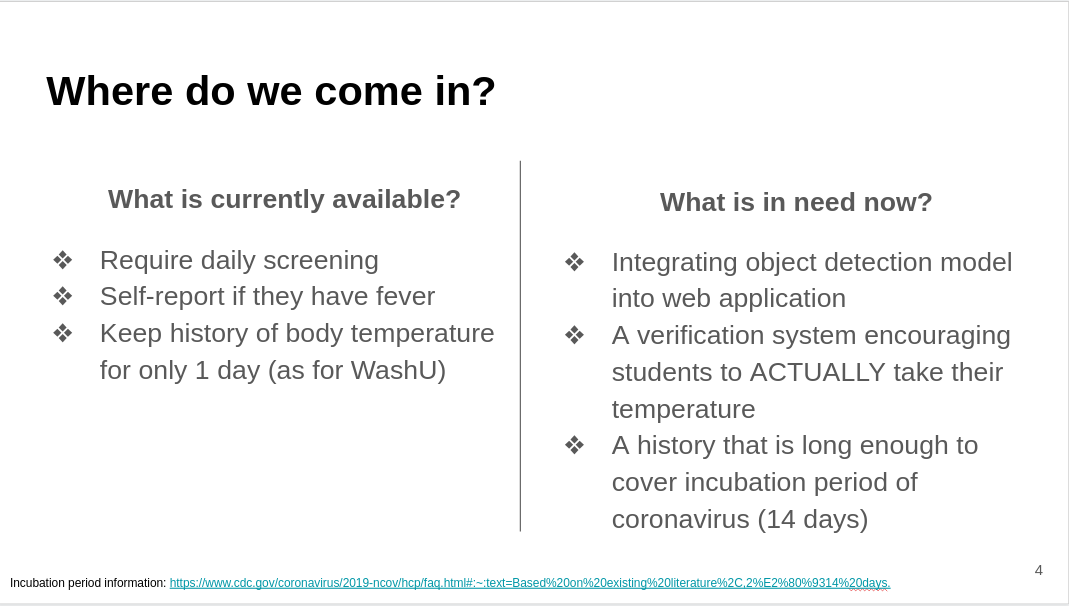
Given the severity of the disease, governments across the world have implemented public health regulations of varying levels of stringency in order to contain the spread of the disease. While students and employees are gradually going back to in-person schooling and work, there is a rising demand for an efficient and accurate way of monitoring the health condition of people in public spaces. Although many self-reporting systems are in place to restrain potentially infected population to quarantine themselves, the effectiveness of such system is highly questionable and is solely based on one’s honor system.
What it does
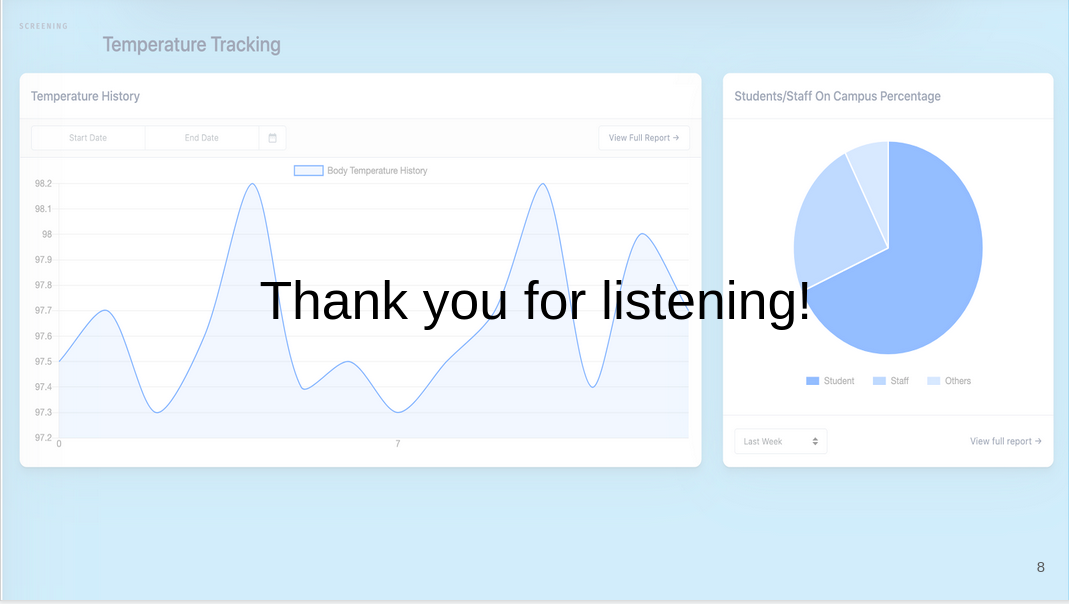
We as engineers propose a web-based application for self-reporting purpose. For the prototype, we chose to focus on college students who are returning to campus for in-person classes. The students will log into the system with their personalized usernames and passwords, asked to report whether they have symptoms such as fever, cough etc, and upload a photo of them taking temperatures. The photo will be fed into an object detection algorithm in order to verify the presence of a thermometer and the temperature readings in the photo. Users will also have access to a dashboard that displays a history of body temperature and whether they have passed the daily screening.
How I built it
The web application is built with a React front end and Firebase backend. The object detection algorithm is a fine-tuned Mask-RCNN built in pytorch, and we intend to integrate the network into the web application using flask.
Challenges I ran into
We are met with many technical challenges, most prominently data collection and cleaning for training the neural network, and environmental setup for bridging react and firebase.
Accomplishments that I'm proud of
We are proud to have built the main backbone of the web application and close to finishing the neural network construction within the short time frame, without much prior experience.
What's next for TrackThyHonor
In the future, we envision to improve the robustness of the model to accurately recognize the presence of thermometer in the photos, or adding live object detection to further ensure that students are actually taking their temperature. At the same time, we would like to include more features in the web application to enforce proper social distancing. For example, the application may ask student users to estimate their approximate time of arrival and departure at the school so that the school can estimate how many students are present on campus at one particular time. Meanwhile, we will do our best to protect individuals privacy over health conditions and daily activities.

Log in or sign up for Devpost to join the conversation.