-
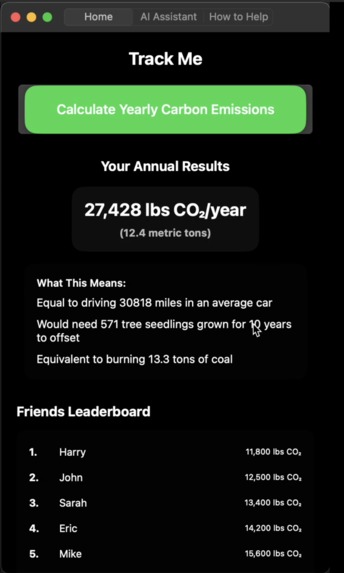
Results from survey and leaderboard
-
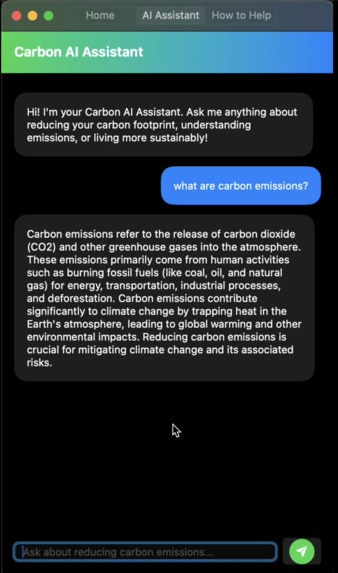
AI Chat Bot to answer Carbon Footprint Questions
Inspiration
Nearly 40 billion tons of CO2 emissions enter our world each year. We were inspired to create this app after learning that our daily actions can severely affect our planet in terms of emissions. Climate change often feels overwhelming or out of our reach, but we understand that every single person matters and every single person can play a significant role when joined together as a community. We created this app to bring awareness to carbon emissions so that, as a society, we can take small but meaningful steps towards a green future. Our mission is simple: we want to turn knowledge into actions and make the world a cleaner place.
What it does
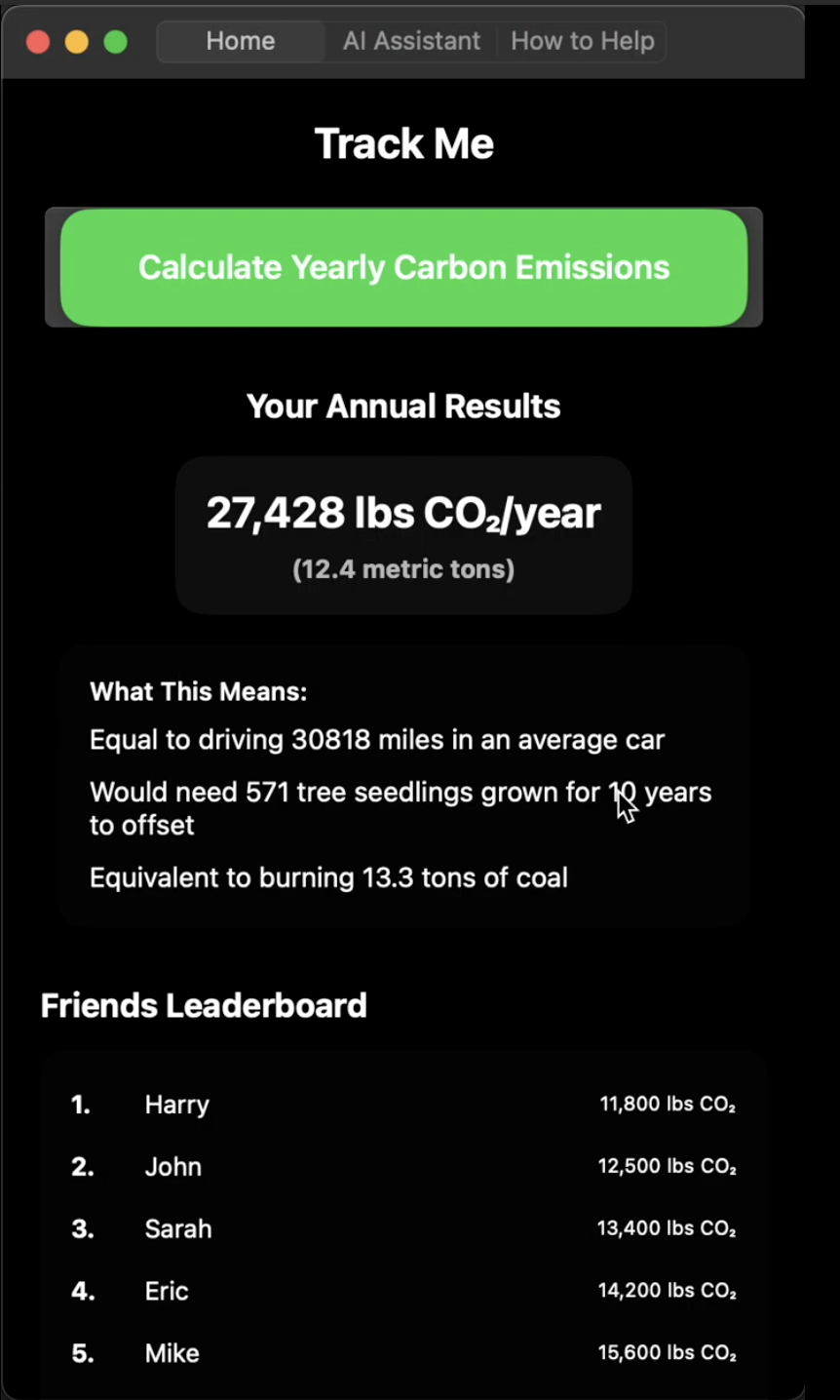
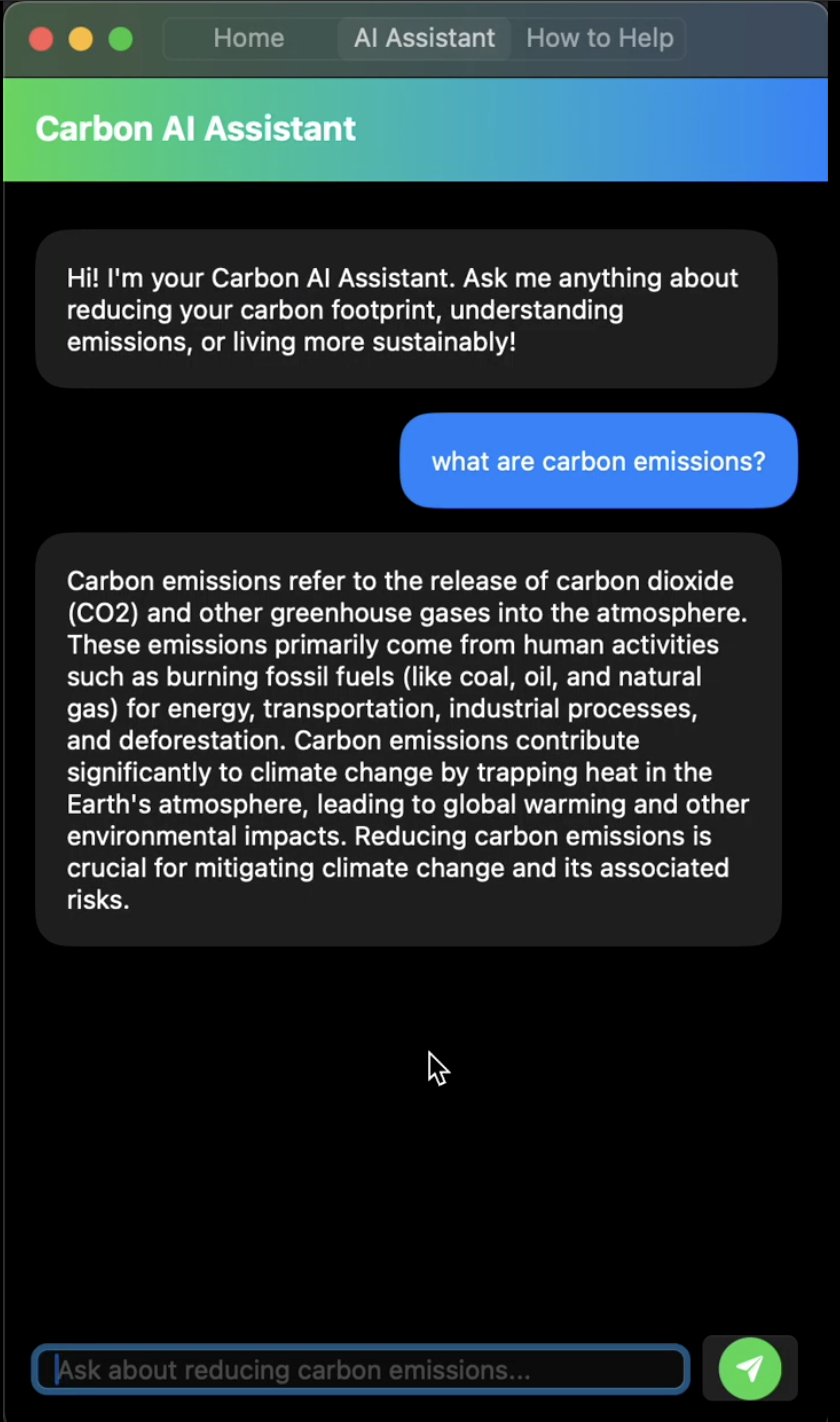
TrackMe is a personal emissions tracking app that lets users log carbon emission data and see their yearly carbon emissions based on monthly electricity bills, natural gas bills, fuel oil bills, propane bills, zip code due to regional differences in utility costs, vehicle fuel type, average miles driven per day, vehicle efficiency through MPG and MPGe, average flights per year, the user's environmental actions, and more thanks to the information from on the USA Environmental Protection Agencies website. This can be important to humans because it can bring awareness to those who don't truly grasp the amount of carbon dioxide one human releases. Our comparison feature compares the user's CO2 emissions to the number of trees needed to offset the emissions, equivalent to how much coal was burned, and how many miles were driven by car to show the true impact. The leaderboard feature can encourage users to reduce their carbon emissions, similar to fitness apps. We also have a trip calculator that allows users to compare CO2 emissions between cars, public transportation, walking, and biking to encourage users to save CO2 emissions by either biking or walking. This app also provides interesting facts about carbon emissions and how users can help to encourage change. Furthermore, there is a chatbot powered by OpenAI that allows users to ask questions relating to carbon emissions.
How we built it
We built the app using Swift, a programming language used for apps in Xcode. We each worked on different parts of the app and then combined our code into one app. We used our knowledge of computer science and a little bit of internet searching and tutorials to construct this app. We also used an API key for the chatbot.
Challenges we ran into
Some challenges we encountered while coding our app were in the chatbot section. We were stuck on this for quite a while. But through YouTube tutorials, we learned about the OpenAI API and how to implement it into XCode with the OpenAISwift package dependency. When we downloaded this, we still faced several issues, as whenever we ran the code, we would get an error about how the OpenAISwift dependency was not in the scope, even though we had downloaded it. To solve this, we looked at Stack Overflow, went into the build settings, and defined the Framework Search Paths to a folder that contains the OpenAISwift package. After hours, we were able to solve the problem!
Accomplishments that we're proud of
We were proud of building an app that is useful for society and encourages the reduction of carbon emissions. In the past, we have done robotics and coding, but have never competed in a hackathon, where we have had a very short amount of time to make a project. This was specifically exciting because we got to see our project completed and successful in just a few hours rather than a full year! Not only that, but we learned a lot in the process. For example, we learned how to use the OpenAI API key for chatbots, which can be useful, and also learned how to do liveshare on Visual Studio, even though we never ended up using that for our IDE. It truly made the whole hackathon process fun and a great learning opportunity.
What we learned
Through this app, we were able to deepen our understanding of Swift. We learned how to make a page cleaner and slicker. Though we did not end up using it, Visual Studio Live Share and Flutter were great tools we hope to use in the future. Lastly, we learned how to implement an AI chatbot through the OpenAI API key, which can be really useful for projects in the future.
What's next for TrackMe: Your Own CO2 Emissions Tracking and Reducer App
When we continue this project and publish it, we plan to integrate a login and signup page, where users can create personal accounts to store information. This would be done so through Firebase, where we can store user data. Furthermore, we plan on integrating location-based emissions. We want to track the user's speed and location to see their transportation to get real-time and more accurate emissions. Partnerships with Apple Watches for activity, PG&E for utility billings, Tesla, and Uber for car usage would make the user's life easier as they won't have to input as much information since it would be done autonomously and it would be more accurate. Also, we plan to add small touches around the user interface so that there is a better experience for users when they use this app.

Log in or sign up for Devpost to join the conversation.