Inspiration
While researching Coinbase's x402 track, we learned Coinbase had revived HTTP's long-dormant "402 Payment Required" code, which got us hunting for other dead protocols. We found TrackBack, the 2002 blogging protocol that let a page notify everything that linked to it; it died of spam because pings were never verified. AI agents now build on each other's work with no way to hear when something upstream breaks, so we revived TrackBack for agents, with pings that only travel along verified read receipts.
What it does
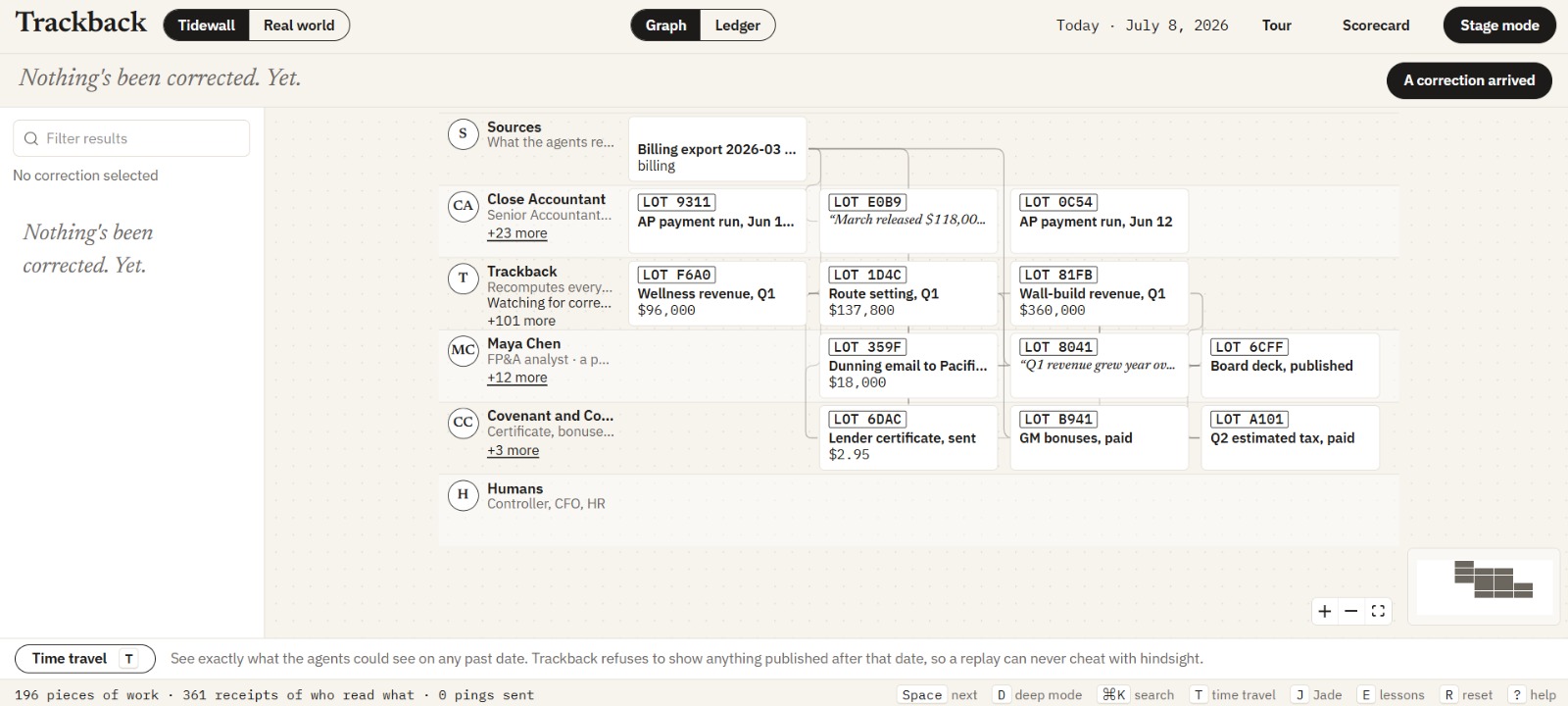
Trackback is TrackBack for AI agents: it records which numbers each agent's work was built on, and when a source turns out to be wrong, it traces the correction forward. It recomputes every affected number in code, proves what's still valid, pings only the agents whose work changed, and drafts the fixes for a human to approve.
How we built it
Claude agents do real finance work through a small set of tools. They can't type numbers, only give formulas our code computes, and every read is pinned to a date and logged as a receipt. Those receipts form the dependency graph, stored in an append-only SQLite store that can replay any past moment. When a source is corrected, deterministic code walks the receipts forward, recomputes every affected number, and pings only the agents whose work changed. A second model reviews the agent's judgment, and the whole demo runs offline from recorded responses.
Challenges we ran into
Models write confident wrong numbers, so we took arithmetic away from them entirely. The standard way of fetching a past version of a document quietly hands an agent documents from its future, so we built a stricter version that refuses anything published after the decision. Flagging everything downstream was easy but useless; proving what's still valid took real recomputation and materiality rules. A ping network between agents can also loop or spam, so we capped it at one ping per agent per wave, with limits on waves and hops and cycle detection.
Accomplishments that we're proud of
A full offline demo where one corrected number ripples across three agents, flipping a loan covenant while leaving untouched work alone, with every result scored against an answer key. Our reviewer caught all 13 planted agent mistakes with zero false overrules, and on Lyft's real 2024 filing, Trackback blocks the "500 basis points" release before it goes out.
What we learned
Provenance has to be captured when the data is read, you can't reconstruct it afterward. Models are best kept on words and judgment, with numbers and decisions in code where they can be checked. Proving what's still fine turned out to be harder, and more valuable, than finding what's wrong. And old protocols like TrackBack were good ideas that needed stricter rules for agents than they ever had for browsers. Connect it to real systems, such as ERPs like NetSuite and QuickBooks, and to the agent standards MCP and A2A, so any team's agents can plug in. Then take it beyond finance: the core engine is domain-agnostic, so anywhere agents build on each other's work can use it.

Log in or sign up for Devpost to join the conversation.