Inspiration
Every year, governments and corporations spend hundreds of millions of dollars fighting a losing battle against toxic algae. Watching lakes choke into "dead zones" and killing fish, collapsing biodiversity, and leaving half a million people without safe water (Toledo, 2014) ,this made us ask: why are we still reacting instead of predicting? The $5.3 billion projected cost of inaction in Lake Erie alone convinced us this problem needed a smarter solution.
What it does
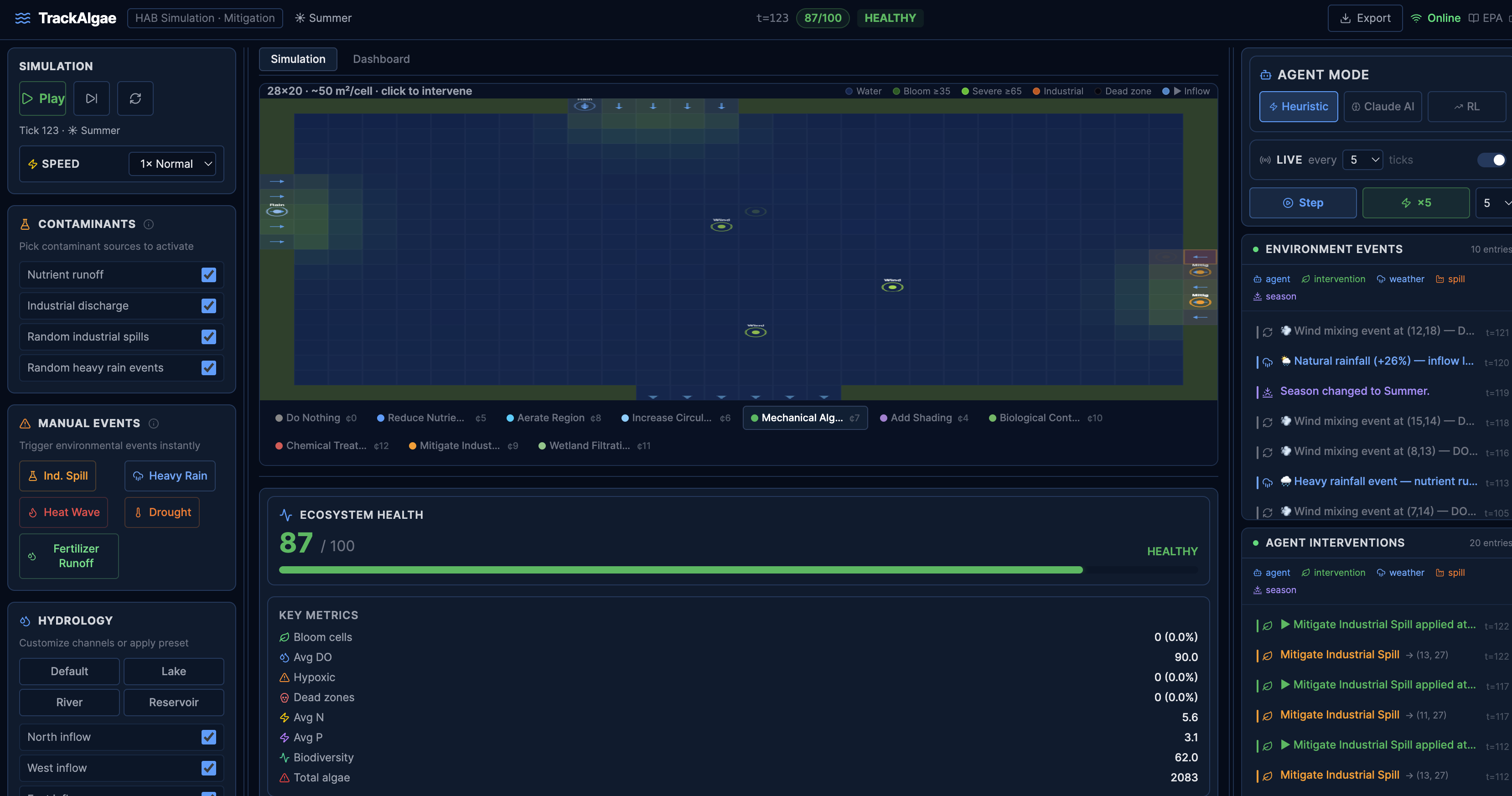
HABguard is an AI agent that optimizes the timing and method of Harmful Algal Bloom (HAB) interventions in freshwater bodies. Rather than waiting for a bloom to become visible, the agent:
Detects algae at the germination stage, before toxins are produced Calculates the minimum effective dose of any chemical treatment using real-time water chemistry (pH, alkalinity, temperature, nutrient levels) Fuses Sentinel-2 satellite imagery with local sensor data to pinpoint nutrient hotspots at the source Continuously learns optimal intervention strategies using a reinforcement learning framework
How we built it
We developed a Predictive Optimization Engine that shifts water management from reactive cleanup to proactive prevention.
Multi-Modal Data Pipeline: We fused Sentinel-2 satellite imagery (for chlorophyll tracking) with IoT sensor data (Nitrogen, Phosphorus, and pH). This allows the system to monitor large-scale surface patterns while maintaining ground-level chemical accuracy.
Life-Cycle AI Agent: Using Long Short-Term Memory (LSTM) networks, we trained an agent to identify the germination stage of algae. By predicting blooms before they are visible, the AI identifies the window where biomass is lowest and easiest to neutralize.
Precision Intervention Modeling: We built a simulation environment that calculates the Minimum Effective Dose (MED) for treatments. This prevents "cell lysis" (the accidental release of toxins caused by chemical overkill) by adjusting recommendations based on real-time alkalinity and flow.
Tech Stack: * Engine: Python & PyTorch for predictive modeling.
Geospatial: Google Earth Engine API for processing satellite rasters.
Interface: A React dashboard that visualizes "High-Risk Hotspots" for municipal decision-makers.
Challenges we ran into
Data scarcity: Real-world labeled HAB germination data is sparse; we had to augment with simulation and synthesized bloom trajectories Intervention side effects: Modeling the downstream consequences of chemical treatments (toxin spikes from cell lysis, phosphorus release) required careful simulation design Multi-objective optimization: Balancing cost minimization, toxicity reduction, and biodiversity recovery in a single reward function was non-trivial Scale mismatch: What works in a controlled pond environment doesn't translate directly to a 600-square-mile lake, spatial generalization was a core challenge
Accomplishments that we're proud of
Built an agent that targets the pre-germination window — a detection stage that current government systems entirely miss Demonstrated projected savings of $2.8 billion in the Lake Erie Basin using established economic models (Smith et al., 2019) Created an intervention optimizer that prevents "chemical overkill", a failure mode responsible for toxin spikes and bloom recurrence in current practice Delivered a compelling, research-backed presentation that communicates a complex ecological crisis accessibly
What we learned
Current HAB management is fundamentally reactive, the systems in place are designed to respond to crises, not prevent them The biology of algae blooms (the lysis-toxin-phosphorus cycle) means that bad interventions actively make the problem worse RL is a natural fit for this problem: the reward signal (water quality metrics) is observable, interventions have delayed consequences, and the cost of trial-and-error in simulation is negligible compared to real-world damage Economic framing matters, translating ecological collapse into dollar figures ($5.3B, $132M plant upgrade) is what moves decision-makers
What's next for TrackAlgae
Pilot deployment on a monitored freshwater body with live sensor integration Expanded sensor fusion — incorporating drone-based hyperspectral imaging for sub-meter bloom mapping Municipal API, a dashboard for water authorities to receive bloom risk forecasts and intervention recommendations in real time Model generalization, extending from Lake Erie to other high-risk basins (Lake Winnipeg, Lake Okeechobee, Baltic Sea inlets) Carbon accounting, quantifying the CO₂ sequestration benefit of restored aquatic vegetation as an additional value metric for policy adoption
References: Smith et al. (2019), Harmful Algae Vol. 87 · NOAA Coastal Science · WHOI (2025) · The Guardian (2020) · PubMed (2026)
Built With
- claude
- python
- typescript


Log in or sign up for Devpost to join the conversation.