-
-
Passport Revoked
-
Shared Information
-
Operational Data
-
Simple and Agentic Asks
-
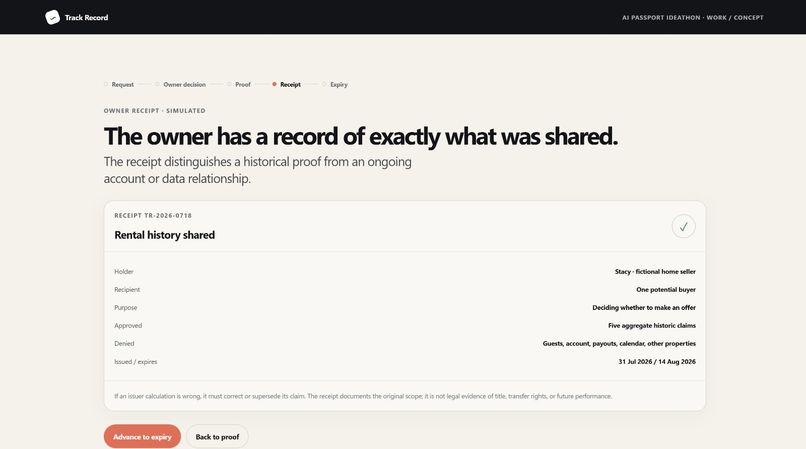
Reciept
-
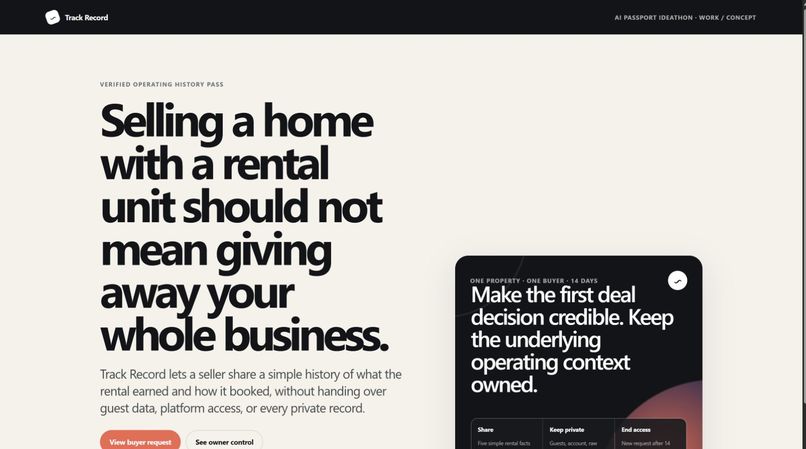
Landing Page and Problem Statement
Track Record
Work track · Concept lane
In one sentence
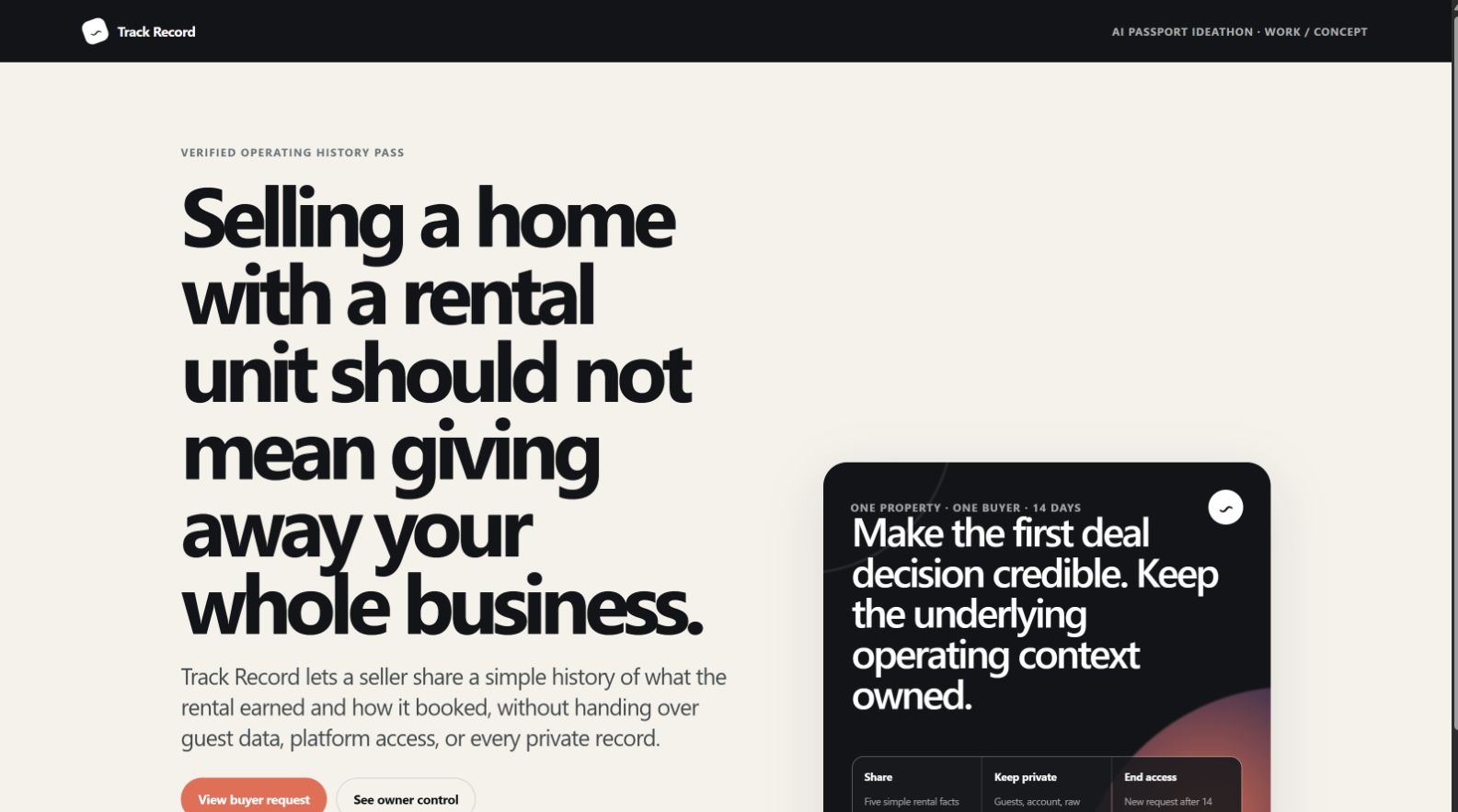
Track Record lets a homeowner share a time bounded, source backed history of one short term rental unit with one potential buyer, without transferring accounts, guest data, or the rest of their rental business.
The problem
Short term rental hosts run real businesses across booking platforms such as Airbnb and Vrbo, direct booking channels, rental-management tools, accounting systems, and local registration requirements.
When a homeowner sells a property with a rental unit, its operating history can matter to a buyer. The buyer may reasonably want to know how the unit performed during a past period before deciding whether to make an offer.
But that proof is scattered. Today, a host often has two bad options:
- Send screenshots, exports, and raw records that expose guest messages, payouts, calendars, account access, other properties, and private business context.
- Share too little evidence for a buyer to understand the rental’s past performance.
The property has an operating history. That does not mean the host’s entire account, guest relationships, reviews, reservations, permits, or future bookings should travel with it.
The story behind Track Record
Track Record came from talking with my mom, who hosts short term rentals and is selling a home with rental units. She described wanting a better way to convey the property’s revenue and operating history without handing a prospective buyer her full platform records or visibility into every other property she operates.
That made the problem concrete: a buyer should be able to ask, “Did this property operate credibly during a specific past period?” A host should be able to answer that question without exposing guest information, platform access, or the full context of their business.
What Track Record is
Track Record is an AI Passport concept for short term rental operating history.
It creates an owner controlled permission layer between a buyer’s request and the systems that hold rental records. Rather than giving a buyer or buyer agent access to those systems, the owner can approve a small set of historical claims for one recipient, one purpose, and a limited amount of time.
The Passport is necessary because an export or PDF cannot naturally express:
- Who is requesting the information
- Why they need it
- Which facts may travel
- What must remain private
- Which property the proof applies to
- How long future verification may continue
- What was shared and rejected
- When a new request requires fresh owner approval
The first user and moment
The first user is a homeowner selling a home with a short term rental unit.
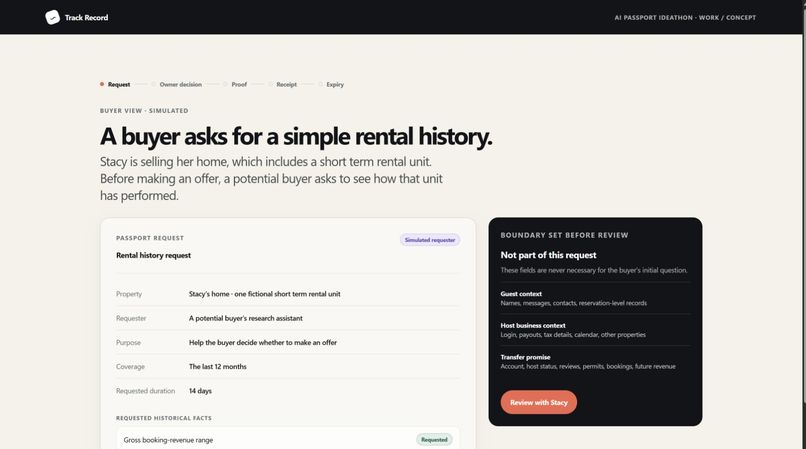
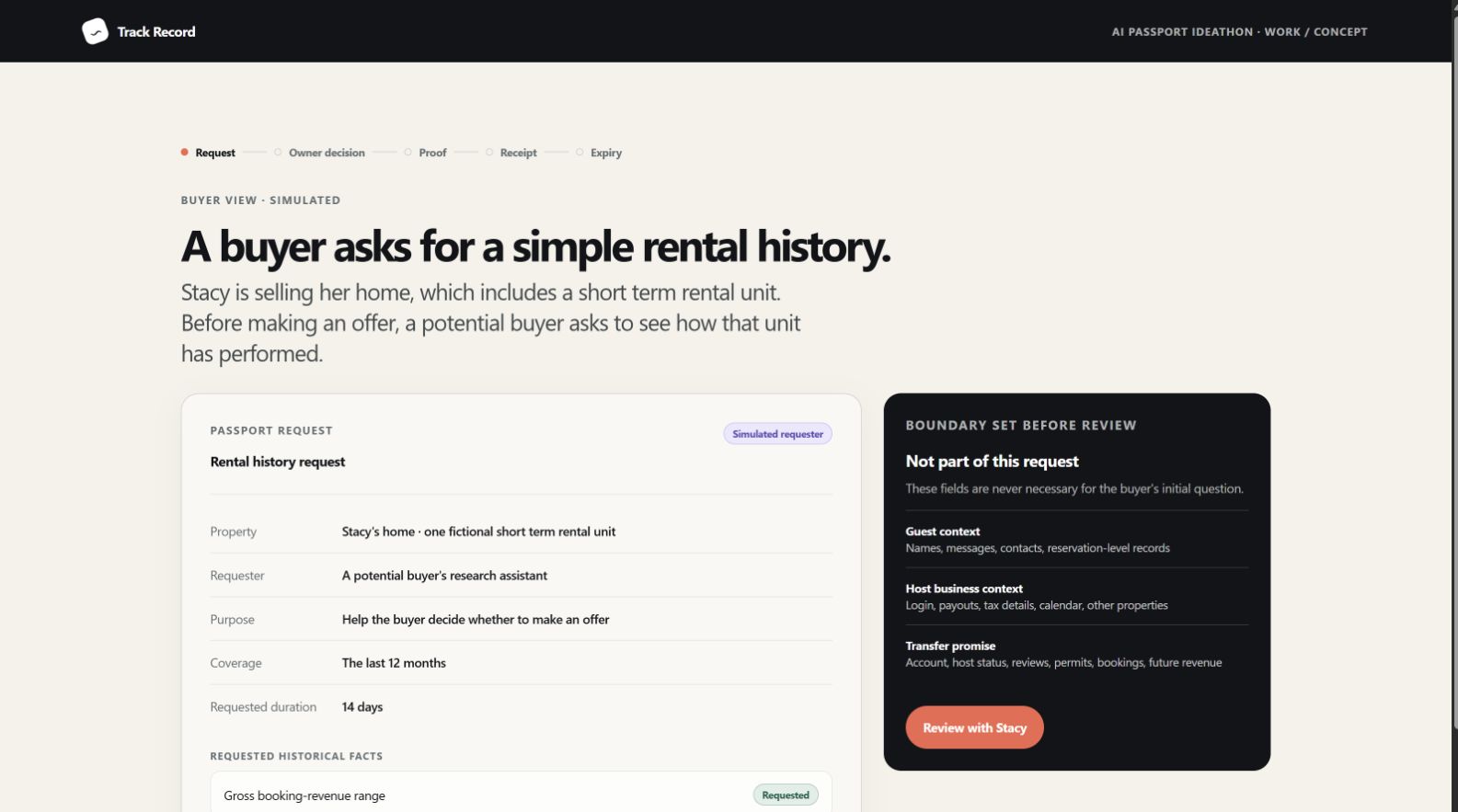
A potential buyer wants enough evidence to decide whether to make an offer. Their research assistant requests a small set of historical facts about one property, not access to the host’s accounts or business.
The Passport claim
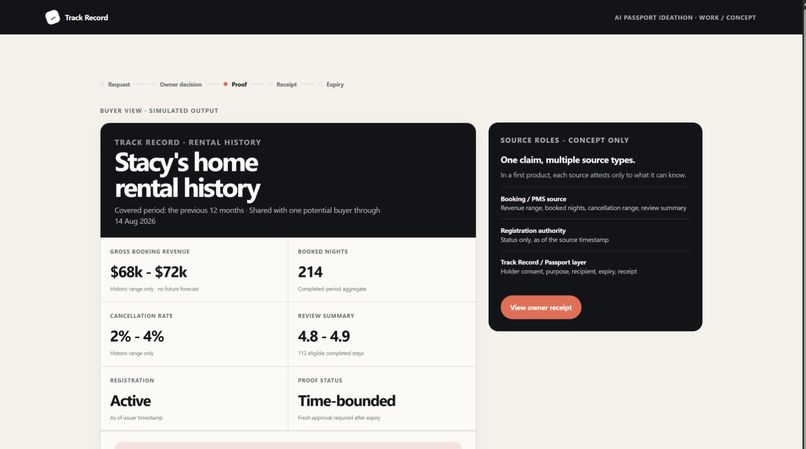
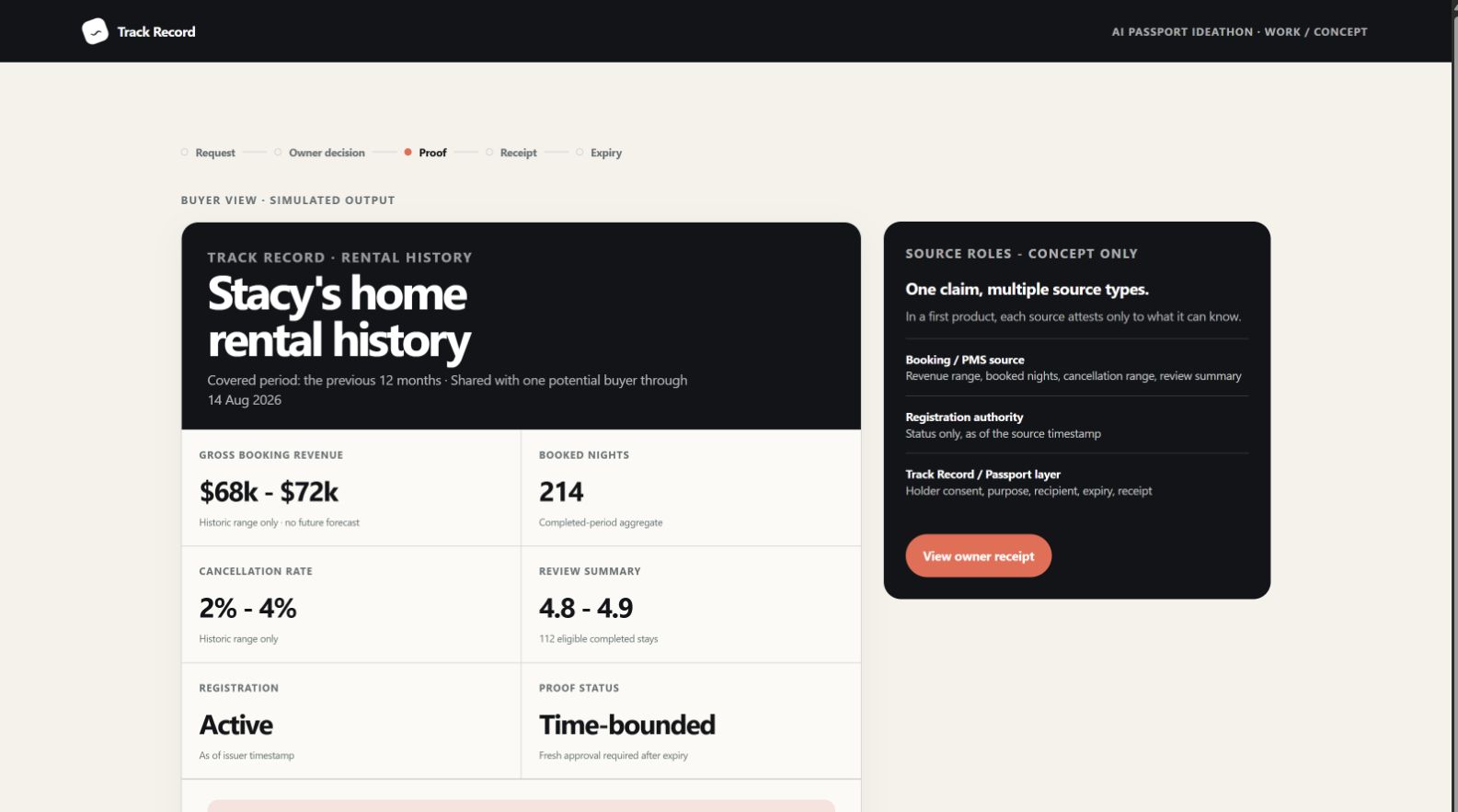
For one named rental unit and one completed twelve month period, a future participating source could attest to:
- A gross booking revenue range
- Total booked nights
- A cancellation-rate range
- A review-summary range
- Registration status as of a source timestamp
The request is limited to one potential buyer, one purpose of deciding whether to make an offer, and a fourteen day verification window.
The agentic moment
AI will make these requests more frequent and more detailed.
In the demo, the buyer’s agent asks for deeper evidence about the unit:
- Average stay duration
- Booking lead-time range
- Weekday versus weekend stay mix
Those can be useful aggregate facts for evaluating the rental.
The agent also asks for raw guest messages and guest profiles. Those requests are not automatically granted. AI Passport turns them into a separate, visible access decision for the owner.
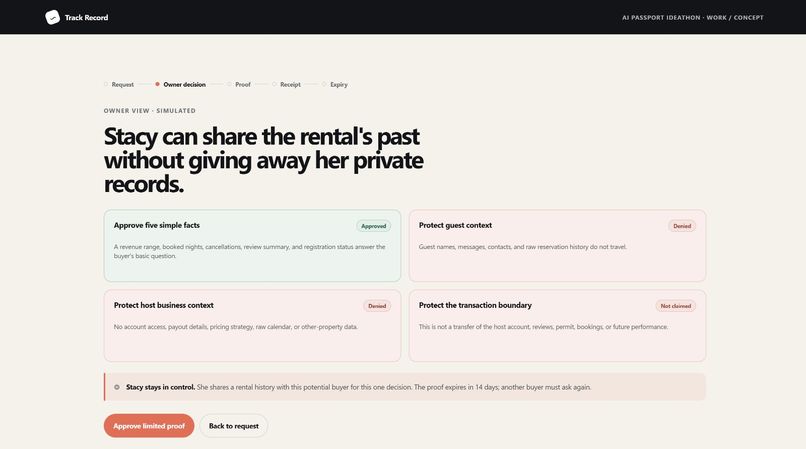
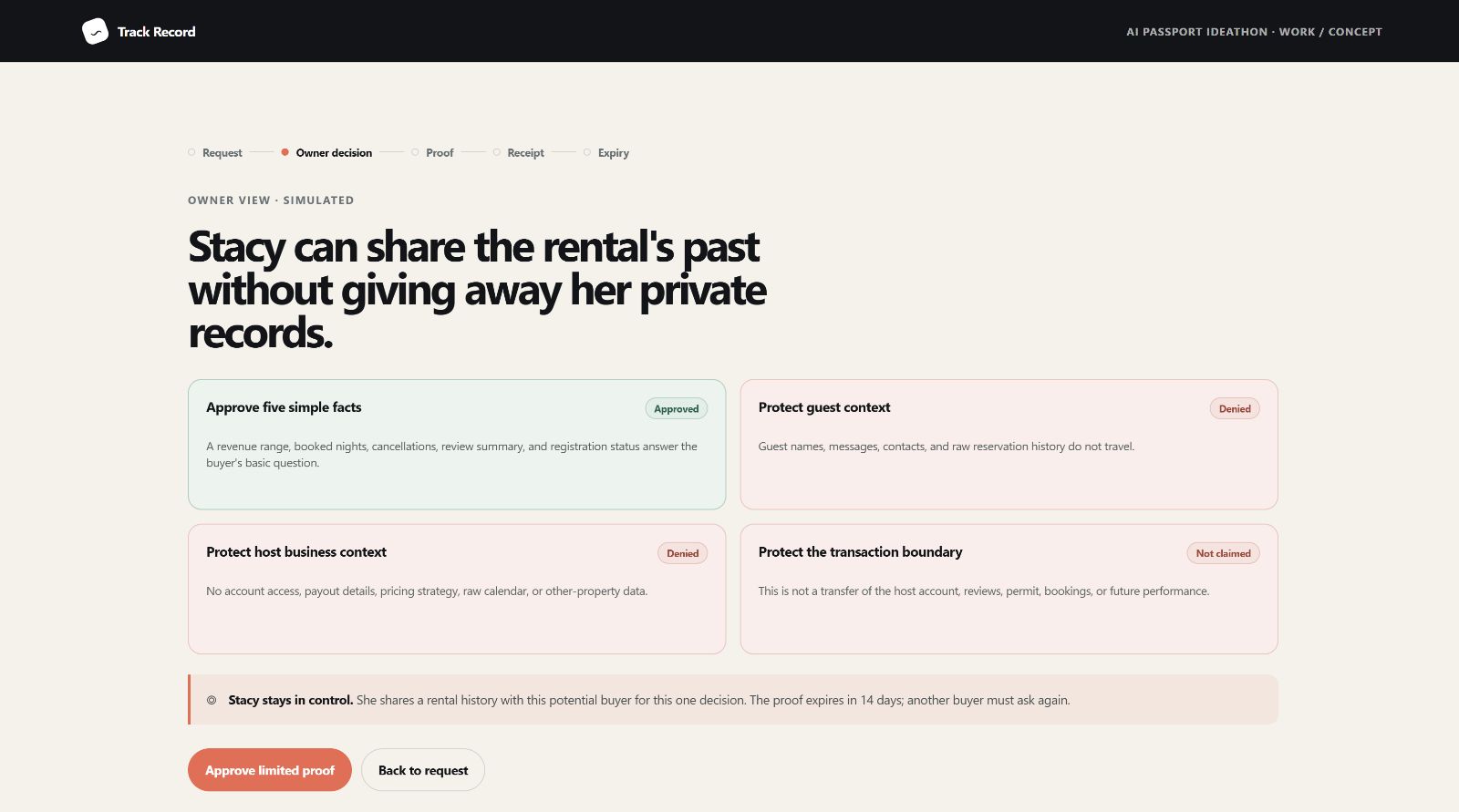
The host approves the useful stay-pattern aggregates and rejects raw messages and profiles.
The buyer’s agent can ask for more. But asking is not access.
How AI Passport is used
- A potential buyer’s research assistant requests five historical property facts.
- The request states the recipient, purpose, property, coverage period, and fourteen day duration.
- The agent makes a follow-up request for deeper stay-pattern information and for private guest context.
- The host reviews each request separately.
- The host approves aggregate stay-pattern claims and rejects raw guest messages and profiles.
- Participating booking or rental-management sources issue only the approved aggregate claims they can support.
- AI Passport carries the owner controlled scope, recipient, purpose, expiry, and receipt between those sources and the buyer.
- The buyer receives a dated historical proof, not direct access to the host’s accounts or underlying records.
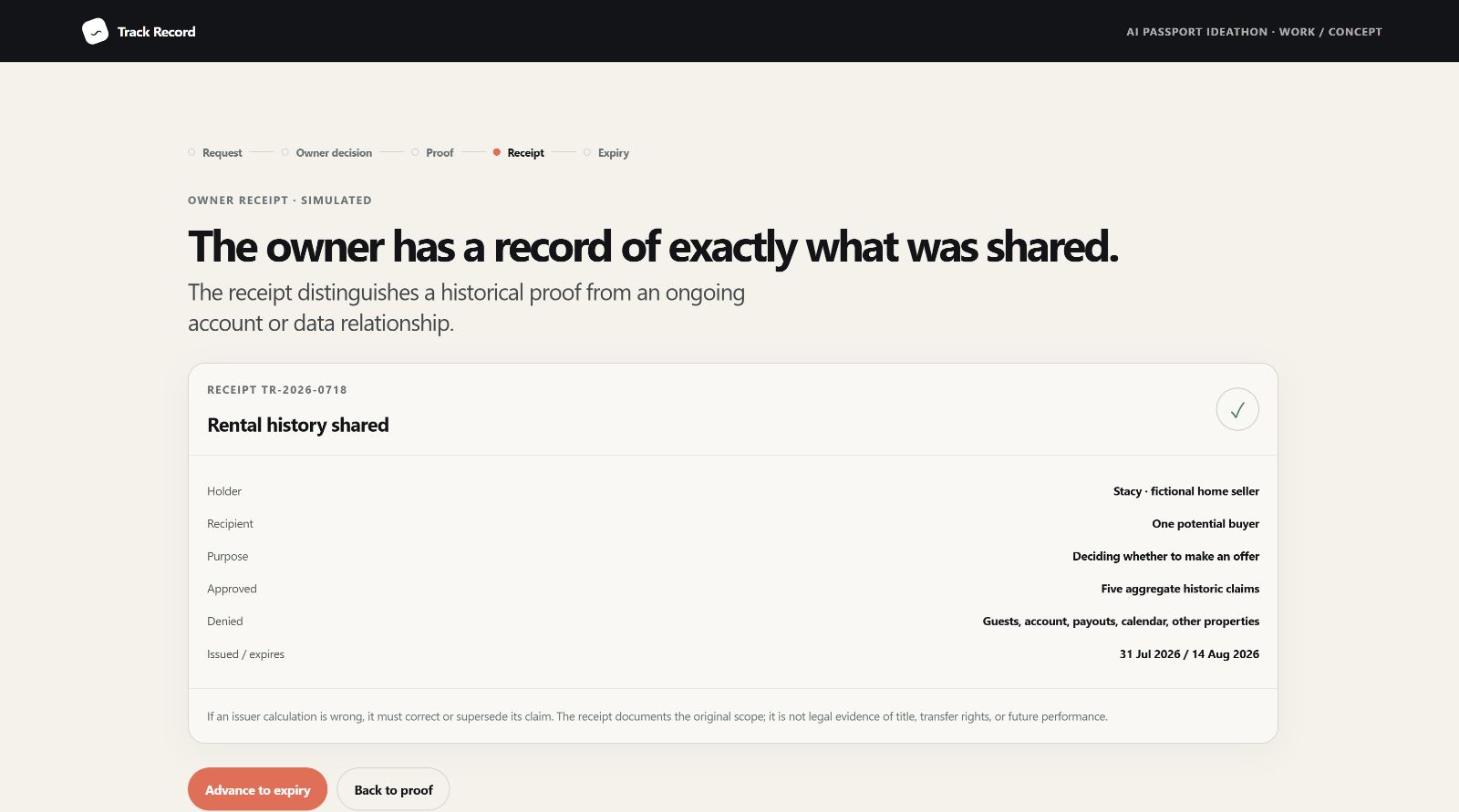
- The host receives a receipt showing what was approved, rejected, shared, and when future verification ends.
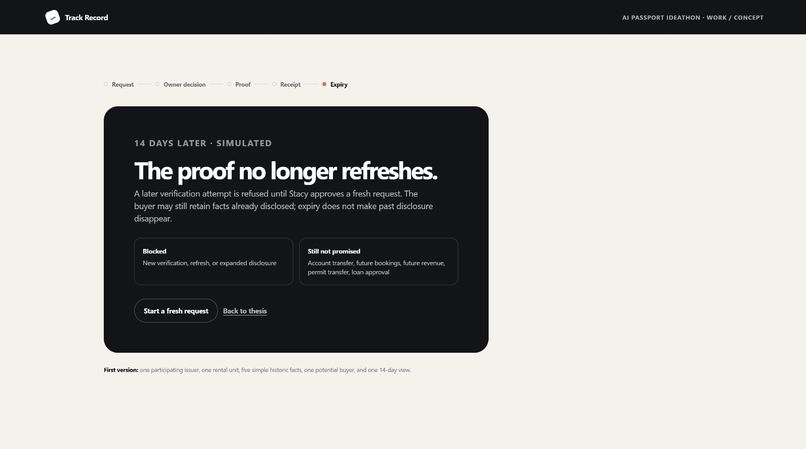
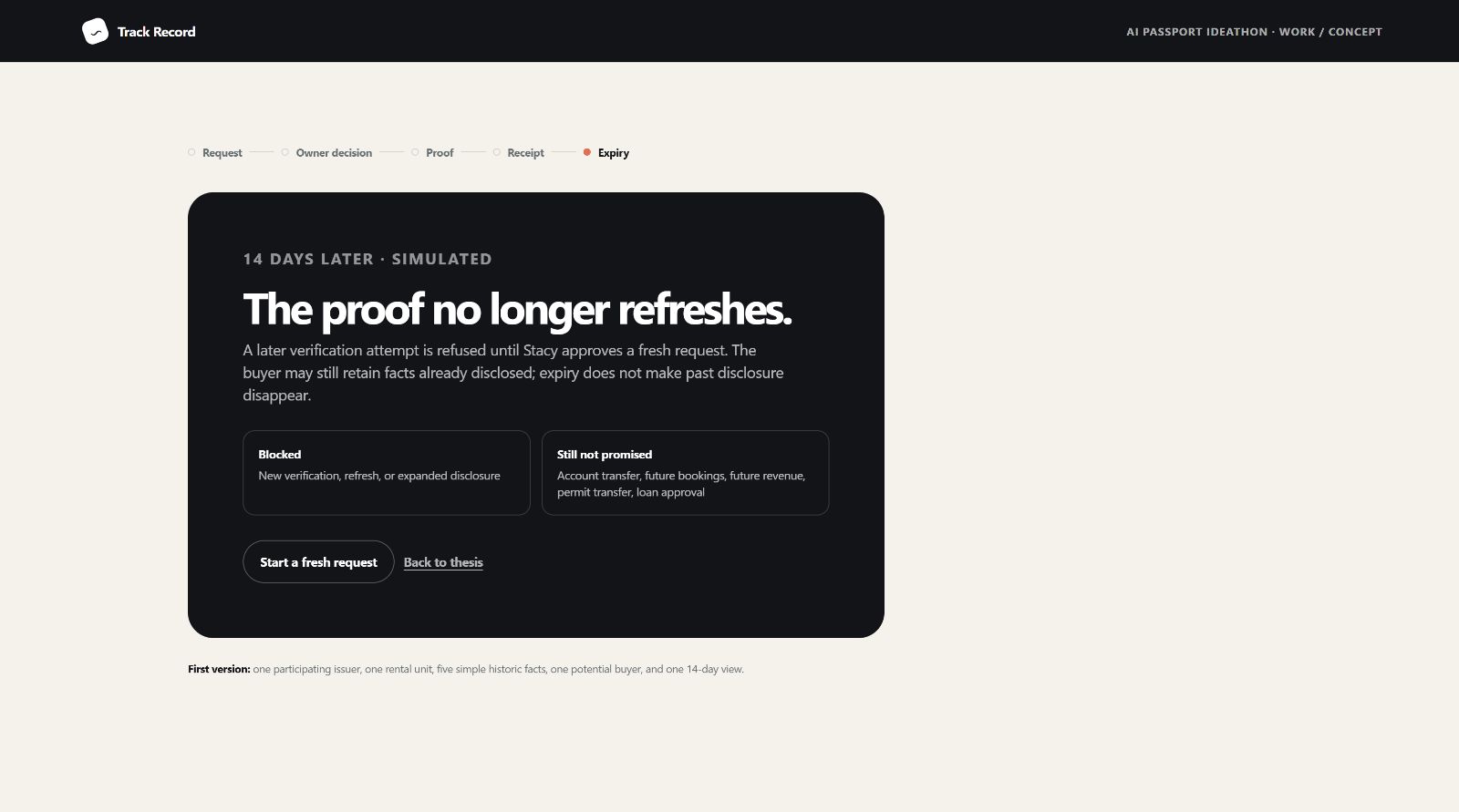
- After expiry, a later verification or refresh requires a fresh request and owner approval.
What does not travel
Track Record is designed around minimal disclosure. The buyer does not receive:
- Guest names, contact information, profiles, or messages
- Reservation-level history or raw booking calendars
- Host account credentials or platform access
- Payout methods, bank details, tax information, or pricing strategy
- Performance data from the host’s other properties
- A transfer of the host account, host status, reviews, permits, reservations, title, or future revenue
The seller is proving a small set of historical facts about one asset. They are not handing over their entire rental business.
Why this benefits both sides
For hosts, Track Record makes it possible to tell the operating story of one property while maintaining ownership of the business context behind it.
For buyers, it provides a clearer and more credible starting point than screenshots or unsupported claims. They can decide whether the property deserves a closer look without demanding access that is unnecessary for the first decision.
For future AI systems, it provides a way to make requests legible and enforceable. An agent does not inherit every connected account just because it can ask a useful question.
What I built
I built a simulated browser demo that shows:
- A buyer’s exact request
- A buyer agent asking for deeper information
- The host approving useful aggregates
- The host rejecting raw guest messages and profiles
- A draft AI Passport grant that updates with the owner’s choices
- A buyer-facing historical proof containing only approved claims
- An owner receipt
- The proof expiring and a later refresh being blocked
Live demo:
https://track-record-sepia.vercel.app/app/
Source code:
https://github.com/CalebMorse06/Track-Record
Risks and limits
This is a fictionalized concept demo. It does not connect to Airbnb, Vrbo, rental-management systems, accounting tools, registries, lenders, Egoist, or AI Passport today.
A real first version would require participating sources to attest only to the records they are responsible for. The seller should not self-attest to the proof.
Expiry or revocation stops future verification and refresh. It cannot erase information a buyer has already viewed, copied, or exported.
Track Record does not prove title, future occupancy, future revenue, loan eligibility, legal compliance, permit transferability, or a buyer’s right to receive existing reservations. Those remain part of normal legal, financial, and closing diligence.
Conclusion
This entry is for a homeowner selling a home with a short term rental unit, who needs to prove a time bounded set of source backed rental history facts to a potential buyer so they can decide whether to make an offer without giving away more context than necessary.

Log in or sign up for Devpost to join the conversation.