-
-
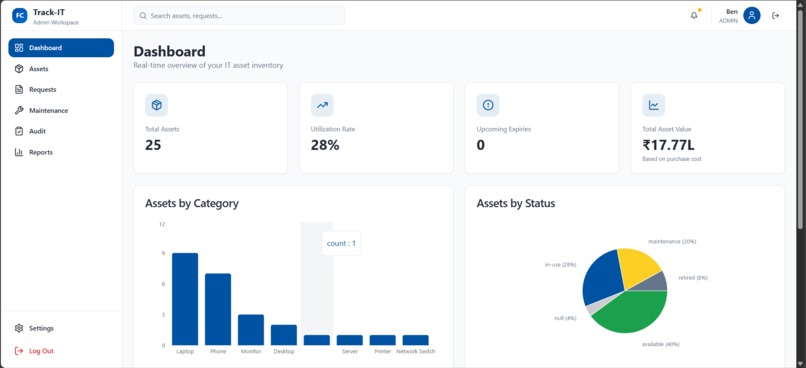
Dashboard Overview – Admin Workspace
-
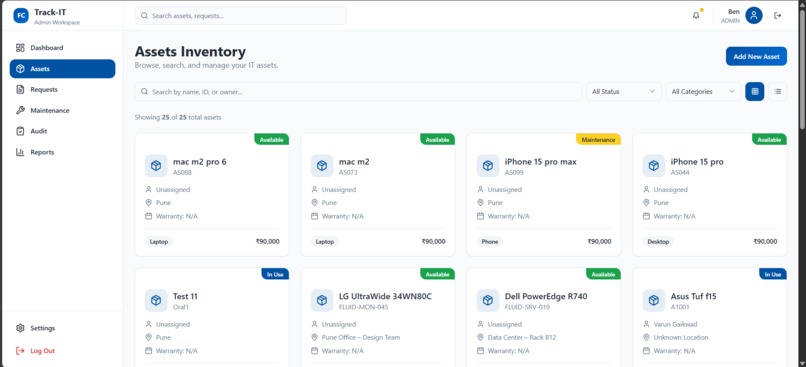
Assets Inventory – Admin Workspace
-
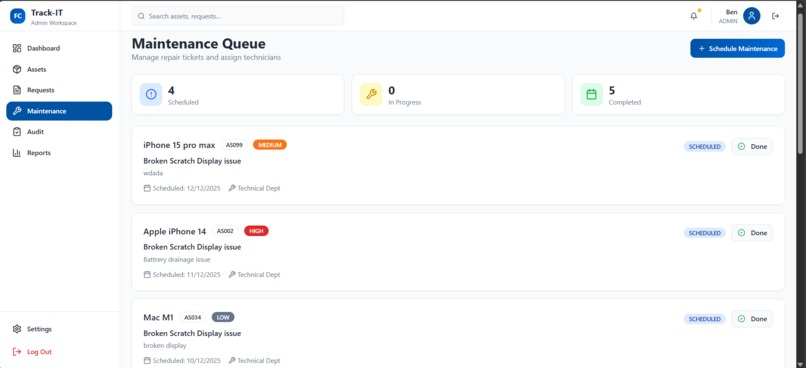
Maintenance Queue – Admin Workspace
-
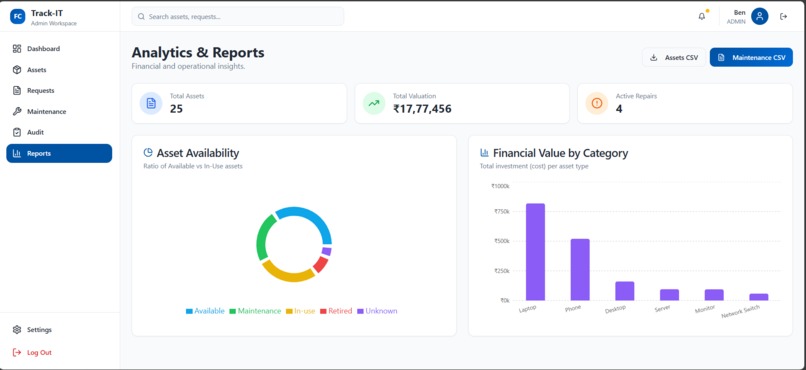
Analytics & Reports – Admin Dashboard
-
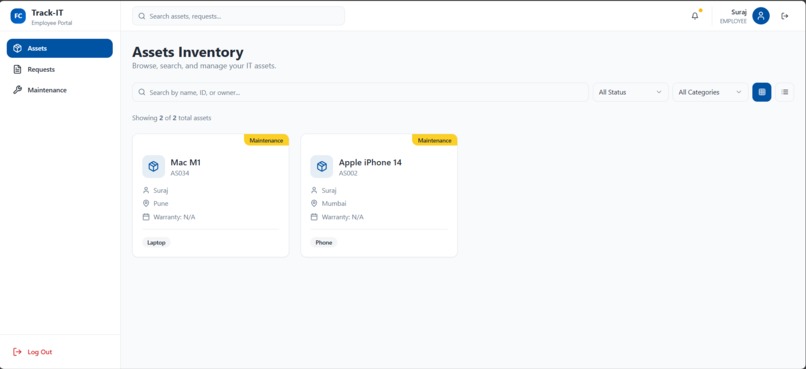
Assets Inventory (Employee Portal)
-
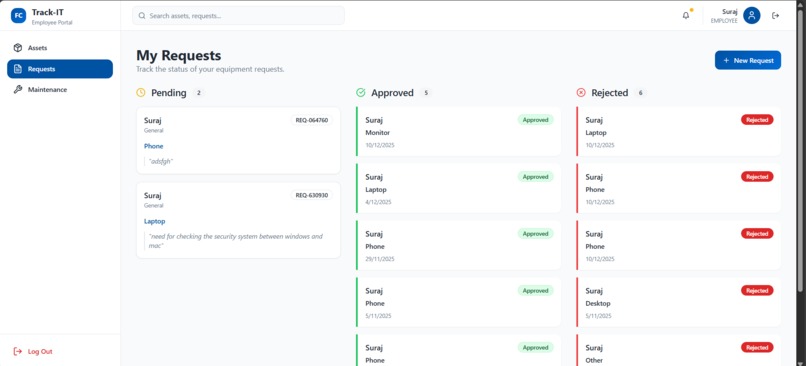
My Requests – Pending, Approved, Rejected (Employee Portal)
-
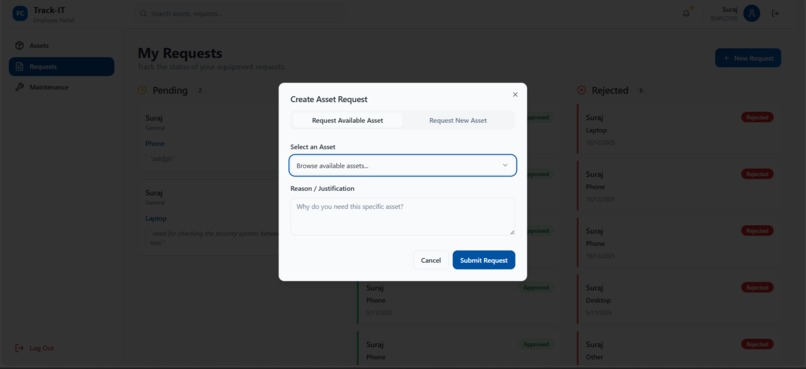
Create Asset Request Modal (Employee Portal)
-
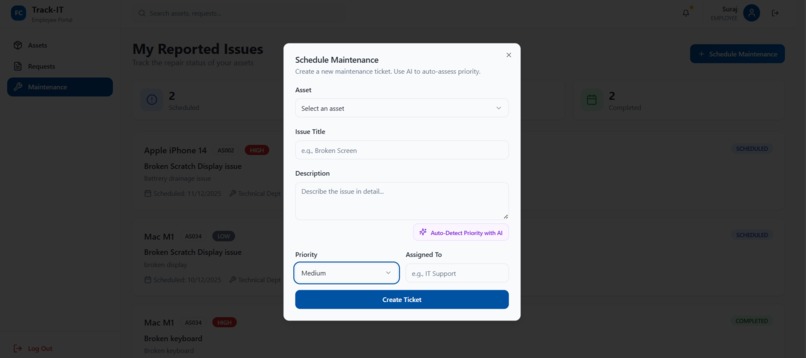
Schedule Maintenance Modal (Employee Portal)


Inspiration
Track-IT was inspired by a real situation faced by a mid-sized manufacturing firm that was managing over ₹50 Lakh ($60,000+) worth of IT assets using cluttered Excel sheets. This led to ghost assets (equipment that was purchased but missing), no proper maintenance tracking, and no audit trail for employee-issued hardware.
Most available IT asset management tools were either too expensive or too basic. There was no middle ground. We wanted to build a solution that was modern, simple, and intelligent—a financial control system for IT teams rather than just another CRUD application.
What it does
Track-IT serves as a centralized system to manage an organization’s IT assets. It provides: Real-time inventory statistics (total valuation, category distribution, asset status) Complete lifecycle tracking: procurement → assignment → maintenance → disposal A check-in/check-out system tied to specific employees for accountability Predictive maintenance alerts to prevent unexpected failures JWT-based authentication and role-based access control (Admin / Viewer) Clean, responsive, and modern interface for seamless management
How we built it
Track-IT was built using a production-first architecture: Frontend:React + Vite, styled with Tailwind CSS and shadcn/ui, deployed on Vercel Backend: Node.js + Express using a Controller–Service architecture, deployed on Render Database: Relational schema with support for flexible metadata based on asset type Full stack language: TypeScript to ensure type safety across frontend and backend Authentication: JWT tokens with protected routes
Challenges we ran into
Cold start delays: Render free tier caused backend sleep, leading to slow initial load times. Solution: Added a keep-alive mechanism and frontend caching.
CORS issues: The frontend (Vercel) and backend (Render) were on different domains. Solution: Implemented proper CORS configuration and handled preflight requests correctly.
Flexible data modeling: Software licenses and physical devices require different fields. Solution: Built a base schema with extendable metadata.
Deployment alignment: Matching frontend form fields, backend validation, and database schema required multiple adjustments.
Accomplishments that we're proud of
Full-stack TypeScript implementation with strict interfaces A clean, modern UI built with Tailwind and shadcn/ui Production-like system including JWT authentication, role-based access, protected routes Robust asset schema capable of handling multiple categories Successfully deployed full-stack application with real API and persistent database Scalable architecture following Controller–Service pattern
What we learned
How to design flexible and scalable asset schemas How to resolve deployment challenges like cold starts and CORS Best practices for authentication, authorization, and secure APIs Importance of clean architecture and consistent interface definitions Building polished UI components under strict time constraints
What's next for Track-IT
AI-based depreciation prediction Automated ghost asset detection using anomaly analysis OCR-powered invoice scanning for automatic asset creation QR or barcode scanning for fast check-in/check-out Multi-organization (multi-tenant) support Improved analytics dashboard with cost forecasting

Log in or sign up for Devpost to join the conversation.