-
-
Tracewell: audit-ready traceability for regulated software teams
-
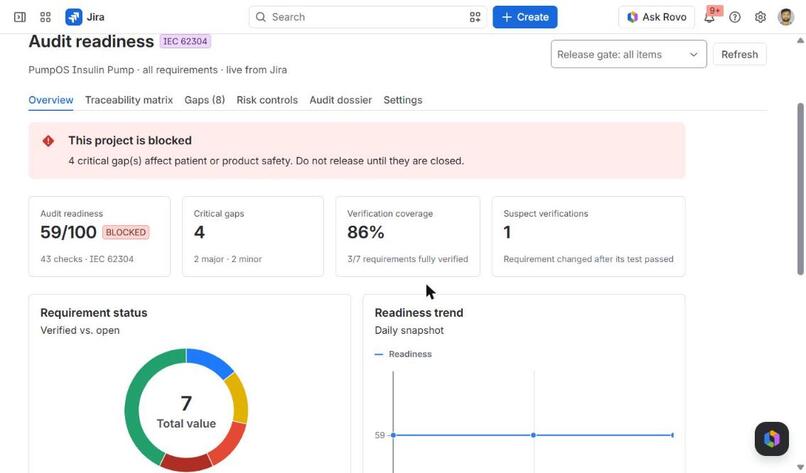
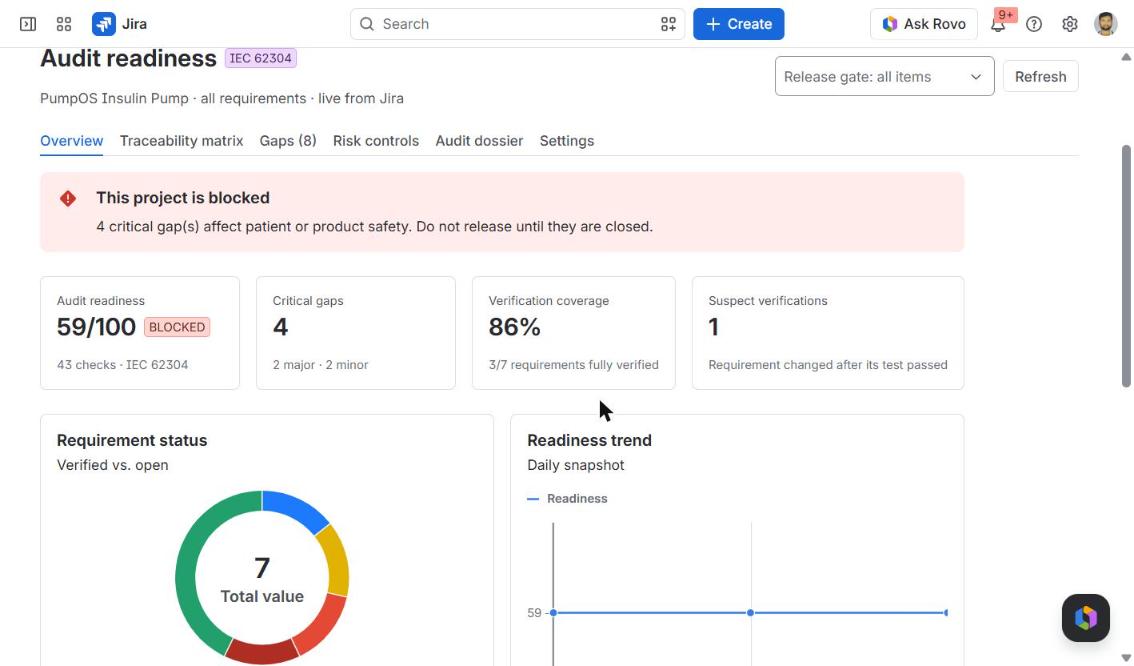
Live in Jira: audit readiness score, verdict, coverage, suspect verifications and daily trend
-
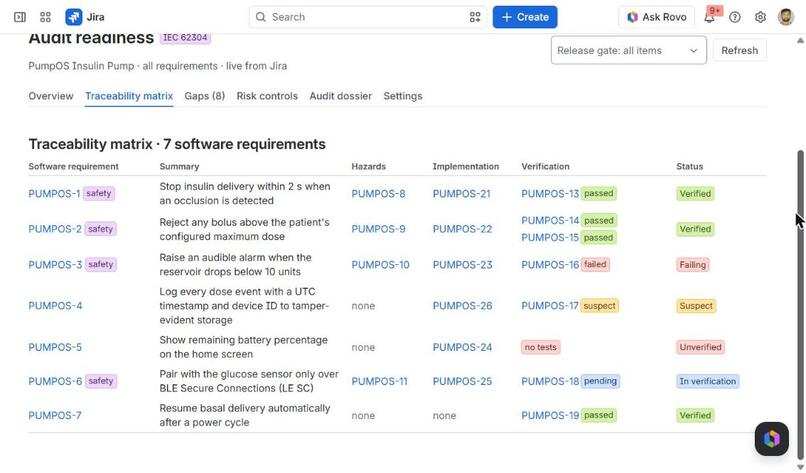
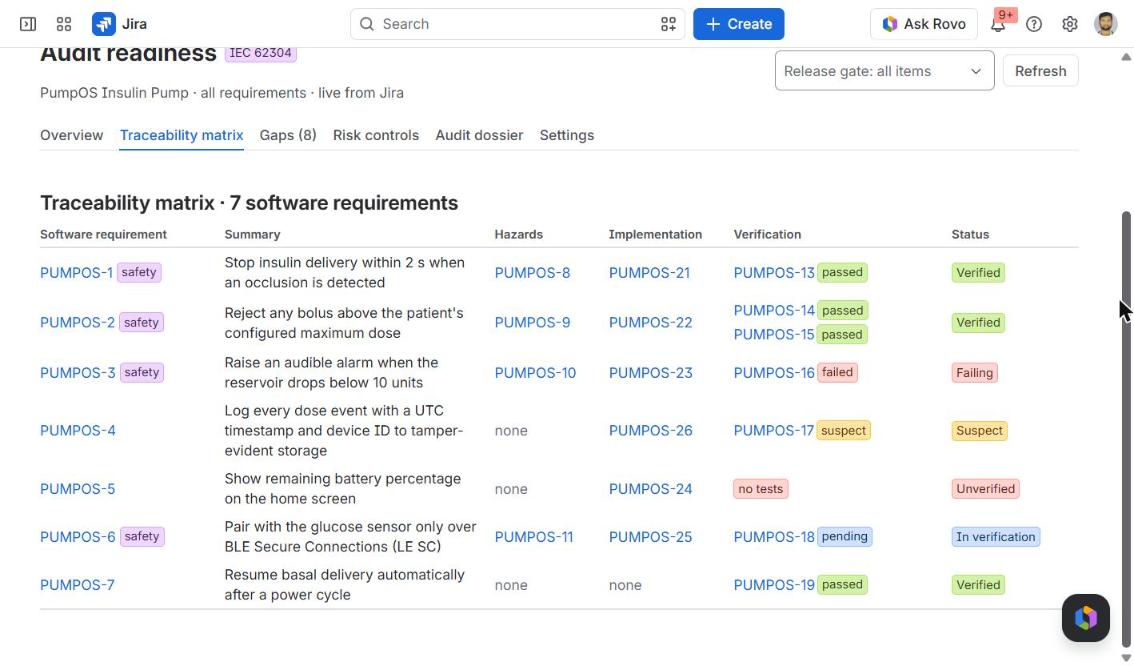
Traceability matrix: requirement → hazard → implementation → verification, with failing and suspect tests flagged
-
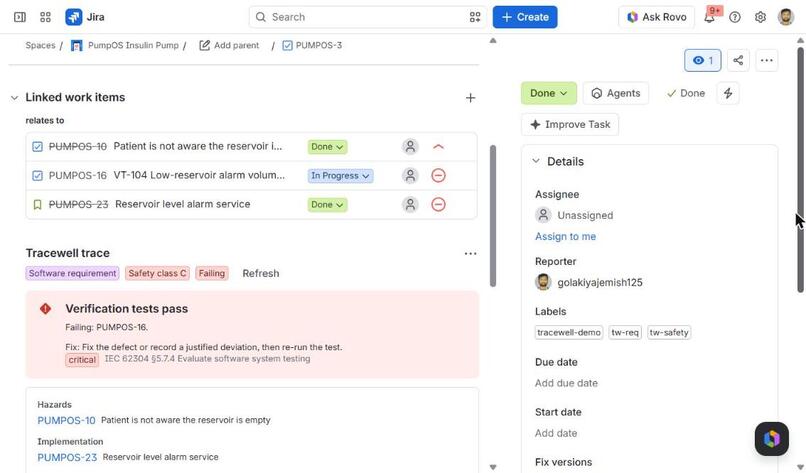
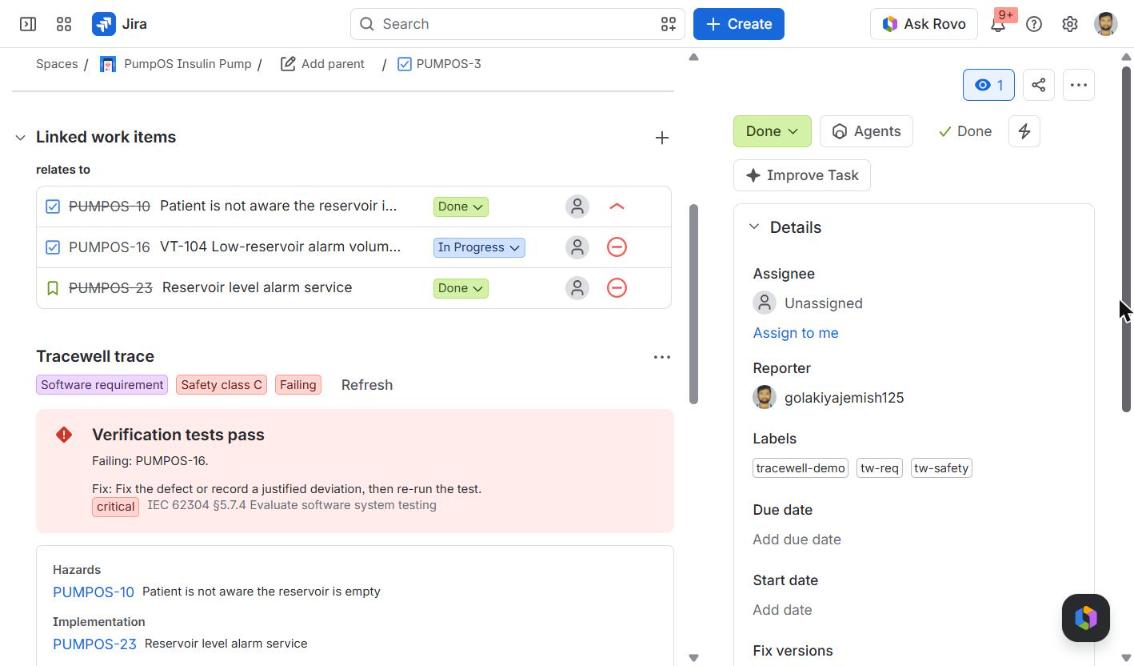
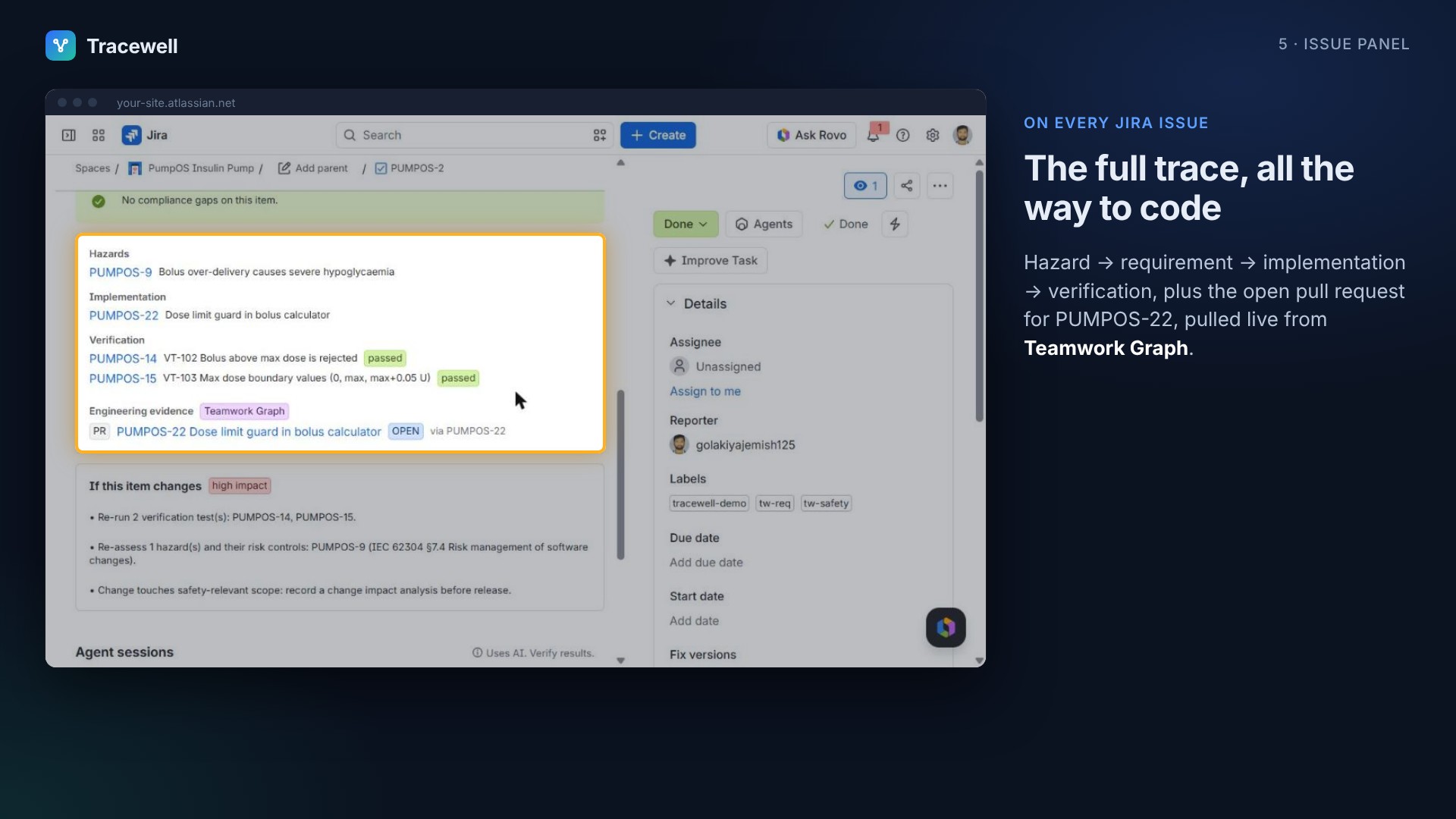
Issue panel: gaps with IEC 62304 clause and fix, full trace and change impact on every requirement
-
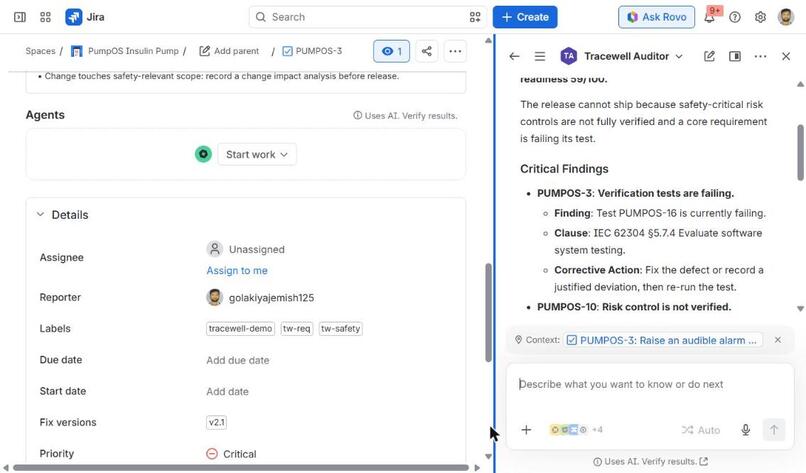
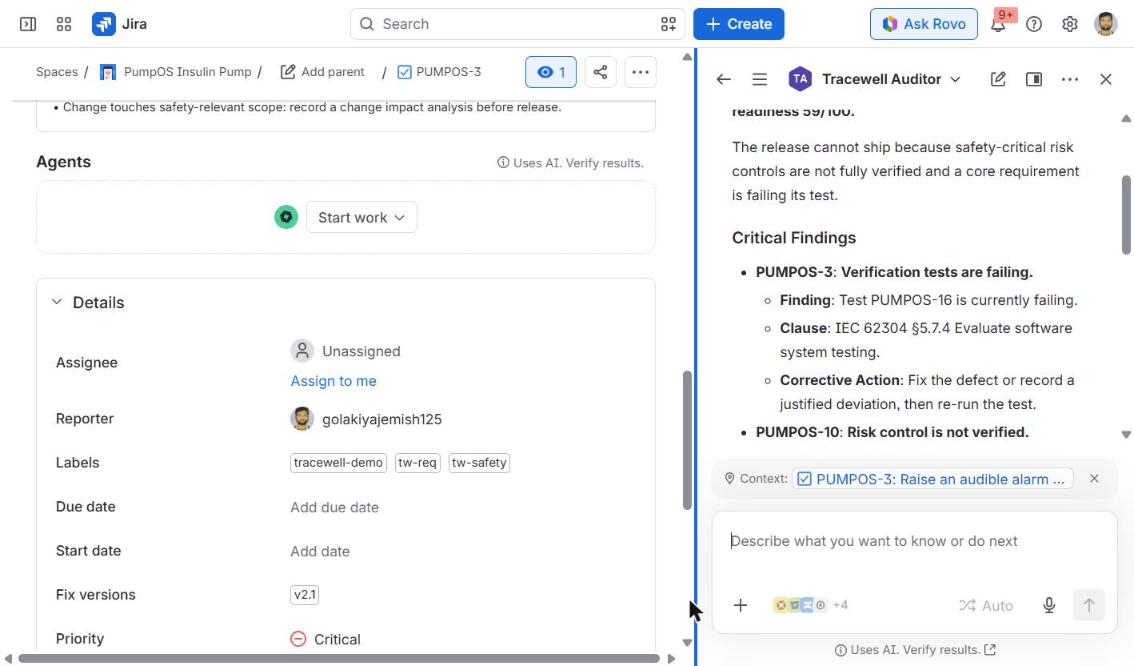
Rovo agent "Tracewell Auditor" answers "Can we ship release v2.1?" with live evidence
-
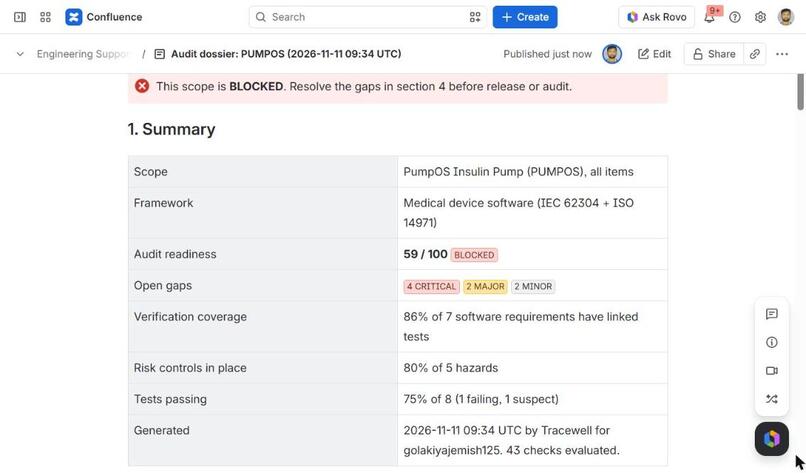
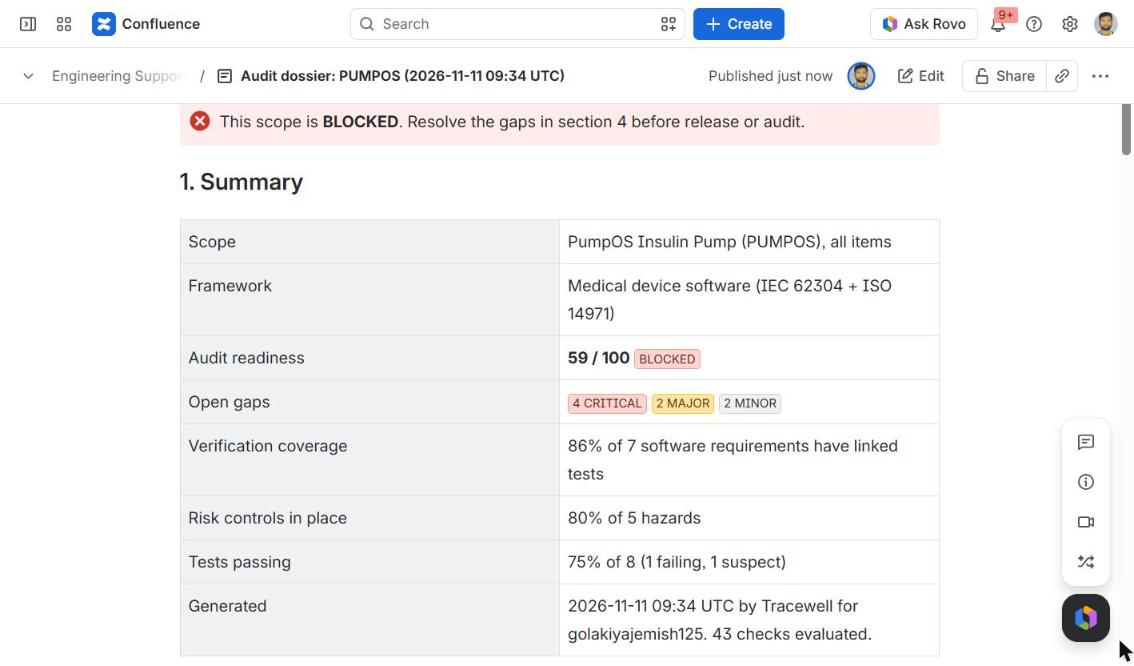
One-click audit dossier written to Confluence: verdict, matrix, risk controls, gaps, sign-off
-
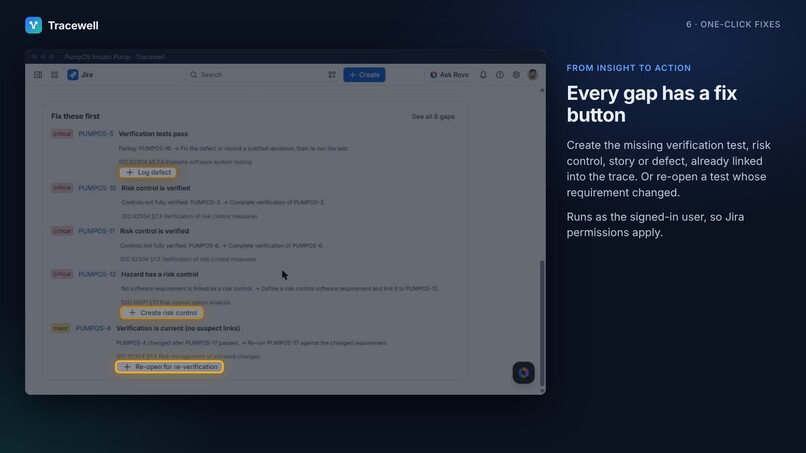
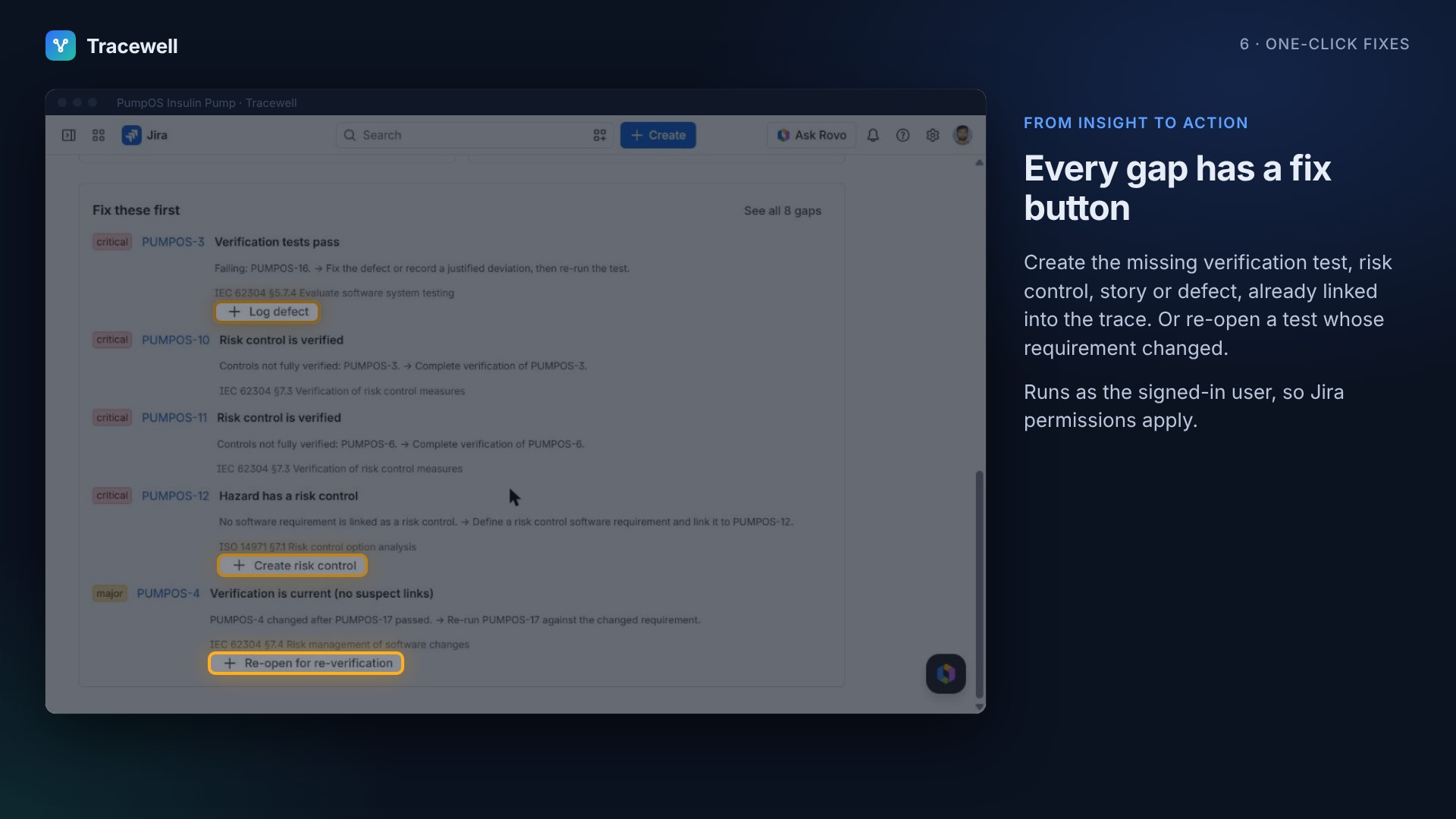
One-click fixes: every gap has a button that creates the missing linked Jira work
-
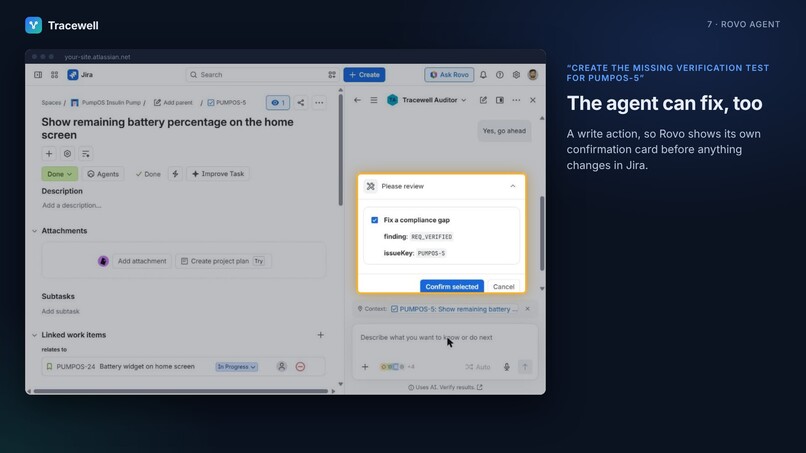
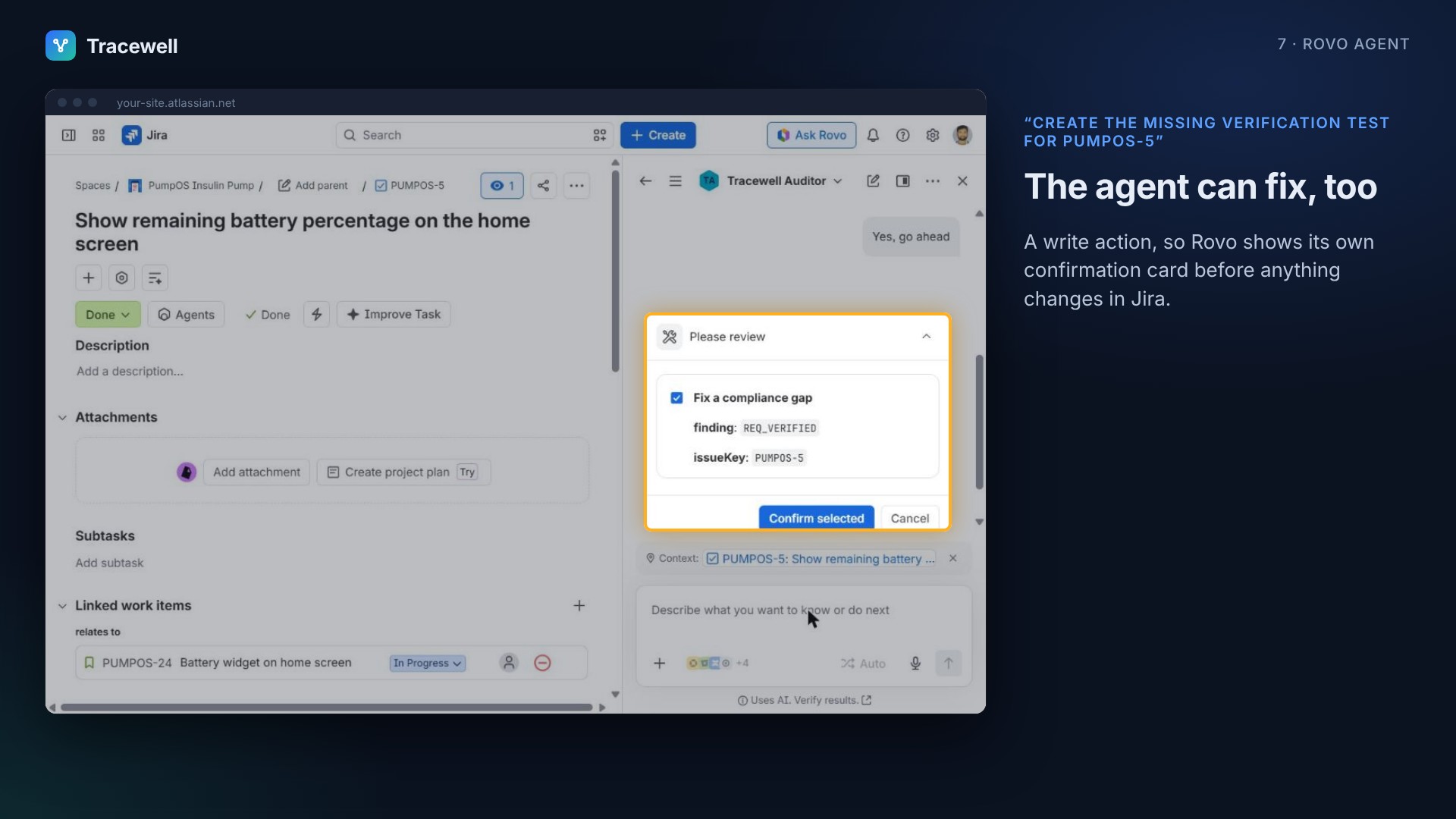
Rovo agent fixes a gap on request, after Rovo's own confirmation card
-
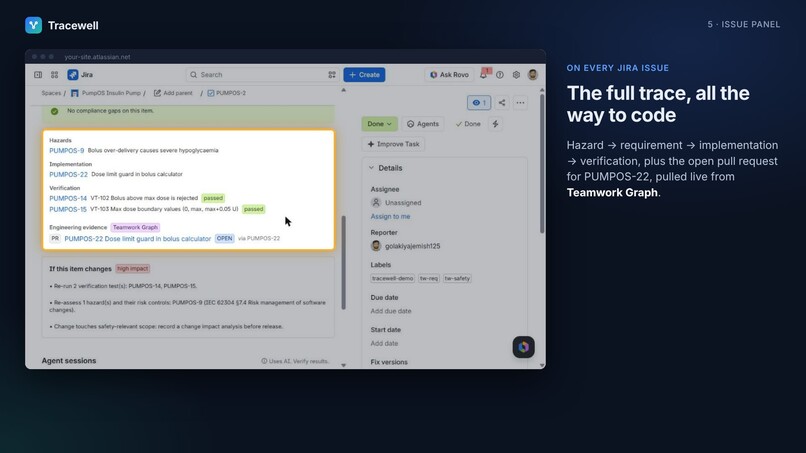
Full trace to code: the open pull request for PUMPOS-22, live from Teamwork Graph
Inspiration
In medical-device software, "show me the verification evidence for this requirement" is the most expensive sentence in the building. IEC 62304 and ISO 14971 require proof that every requirement is verified, every hazard is controlled, and every change is re-assessed. Most teams still produce that proof as a hand-built spreadsheet traceability matrix in the weeks before an audit. It is stale the day it is finished, and it misses the most dangerous gap: a requirement that changed after its test passed.
The data to answer all of this already lives in Jira. It just isn't connected as context. That is exactly the Codegeist theme: build with context, ship with confidence.
What it does
Tracewell turns the requirements, hazards, tests and stories a team already tracks in Jira into a live trace graph. It continuously runs seven checks mapped to the clauses an auditor cites:
- unverified requirements, and failing verification tests
- suspect verifications: the requirement text changed after its test passed (detected from the Jira changelog)
- hazards with no risk control, and risk controls that aren't verified
- unimplemented requirements and orphan tests
It surfaces this as:
- An audit-readiness score and verdict (READY / AT RISK / BLOCKED) on a Jira project page, with charts, a daily trend, the full traceability matrix, a prioritized gap list (clause + corrective action + owner) and a risk-control table.
- A release gate. Choose a fixVersion to answer "can we ship v2.1?" with evidence.
- An issue panel on every issue: upstream and downstream trace, gaps, "if this item changes" impact analysis, and PRs and deployments from Teamwork Graph.
- One-click fixes that move work forward. Every gap has a fix button that creates the missing Jira work, already linked into the trace. It creates a verification test for an unverified requirement, a risk control for an unmitigated hazard, a story for unimplemented scope or a defect for a failing test. It can also re-open a test whose requirement changed. It runs as the signed-in user, never creates duplicates, and stays honest: a new risk control immediately shows up as needing its own verification.
- A one-click audit dossier written to Confluence (summary, matrix, risk controls, gaps, sign-off table), plus a live readiness macro for release pages.
- Tracewell Auditor, a Rovo agent that answers auditor questions with live evidence and fixes gaps on request. Rovo shows a confirmation card before any write.
- A Forge MCP server exposing the same five tools to Claude, Cursor or VS Code, plus a SKILL.md for third-party agents.
- Framework packs for IEC 62304 / ISO 14971 (MedTech), ISO 26262 (Automotive) and SOC 2 / ISO 27001 (Fintech): same engine, auditor-specific vocabulary and clauses.
A one-click PumpOS demo (a fictional insulin pump, 26 linked issues) lets anyone see the full experience in 30 seconds.
How we built it
- Forge UI Kit (
jira:projectPage,jira:issuePanel, Confluencemacro) with native charts, dynamic tables and Atlassian design tokens. - Rovo agent (
rovo:agent) with fiveactionmodules, and the same actions exposed throughrovo:mcp. One implementation serves both surfaces. - Teamwork Graph API curated queries (
jiraWorkItemLinkedExternalPullRequests,jiraWorkItemLinkedExternalDeployments) viaasUser().requestTeamworkGraph. This extends the trace chain from requirement → story → PR → deployment. - Jira REST (
/search/jql, bulk changelog, versions, permissions check), Confluence REST v2 for the dossier, Forge KVS for settings and snapshots, and a scheduledTrigger for the daily readiness trend. - A pure, framework-agnostic compliance engine (
engine.js) with 31 automated tests: engine unit tests on the exact dataset the demo seeds, plus end-to-end tests that drive the real resolvers, seeder, agent actions and dossier export against fakes of the Atlassian APIs. - Security by design: everything runs
asUser(), the four read actions areGET, the single write action isCREATE(confirmed by the user and run only as the user, never as the app), there is no external egress, and the MCP fallback toasApp()happens only after an explicitBROWSE_PROJECTSpermission check for the calling account.
Challenges we ran into
- Avoiding false "suspect" alarms. Jira's
updatedfield changes on every comment, transition or new link. We used the bulk changelog API and only countsummary/descriptionchanges. - Teamwork Graph Preview quirks. HTTP 200 responses can carry errors, operation names must follow
<company>_<operation>, and missing scopes silently drop rows. We built a defensive client with a rich-then-minimal query fallback. - Making the score honest. A weighted pass rate alone gave a "78/100" to a project with an unmitigated hazard. We added readiness bands: any critical gap caps the score below 60.
- Seeding a realistic demo inside resolver time limits. We split it into five idempotent steps with a progress bar.
- Jira search is eventually consistent. A newly created issue or link can take a few seconds to appear in
/search/jql. So after each fix, Tracewell waits (with a time limit) until the change is indexed, and the refreshed score is always honest.
Accomplishments that we're proud of
- A judge or a new user goes from an empty project to a full, believable compliance picture in 30 seconds.
- One engine, six surfaces: project page, issue panel, Confluence dossier, Confluence macro, Rovo, MCP.
- Suspect-link detection, which spreadsheet matrices structurally can't do.
What we learned
Context is the product. Regulated teams don't need another tool to enter data into. They need the links they already have to answer questions. Agents and MCP are what make that context reachable from anywhere people work.
What's next for Tracewell
- Fix in bulk, with an approval workflow and electronic sign-off
- Teamwork Graph connector to publish verification records as graph objects
- Electronic signatures on the dossier (21 CFR Part 11)
- More packs: EU MDR technical documentation, DO-178C (avionics), IEC 61508
- Marketplace launch with a free tier for small MedTech startups
Built With
- confluence
- forge
- javascript
- jira
- mcp
- node.js
- react
- rovo
- teamwork-graph
