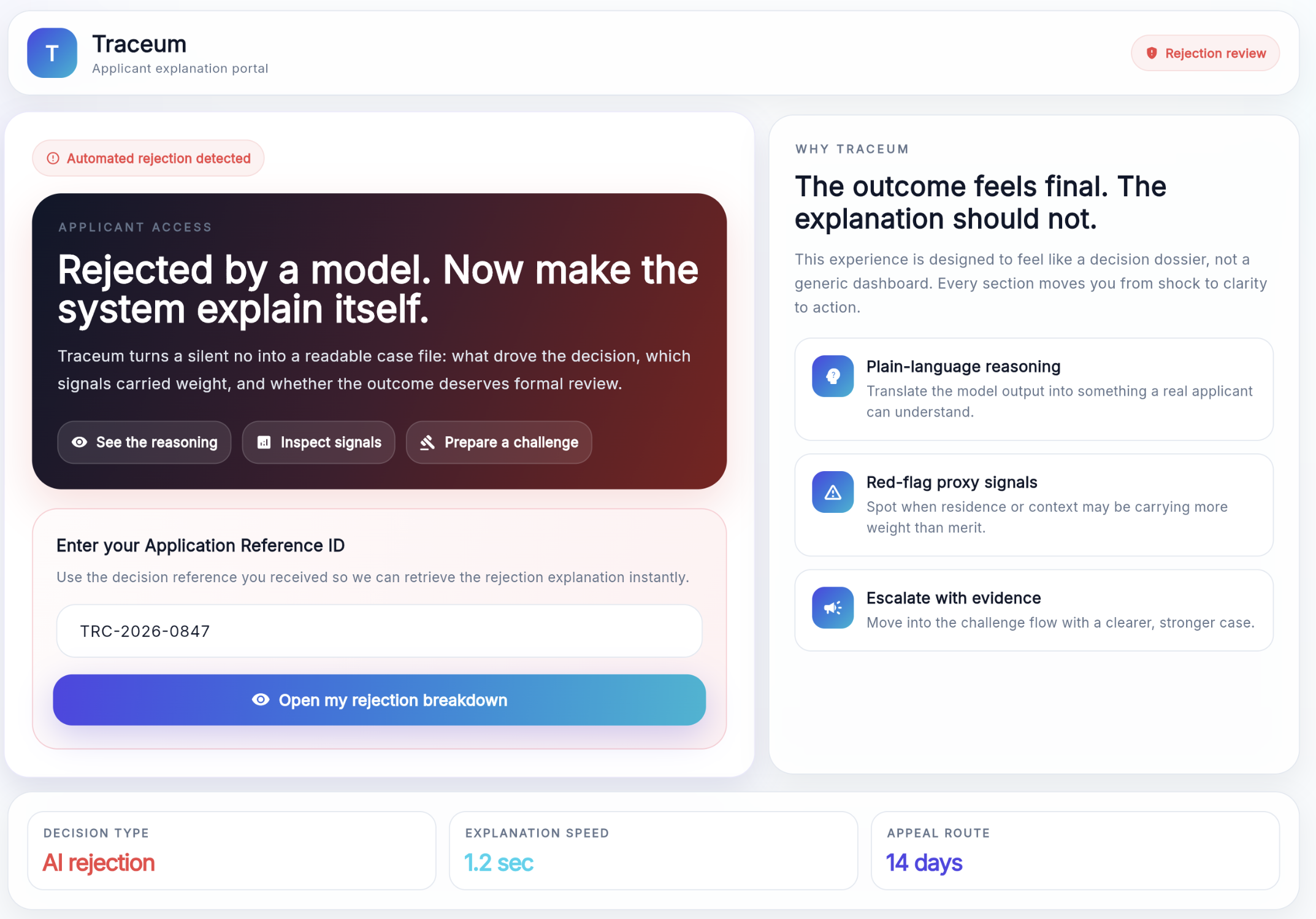
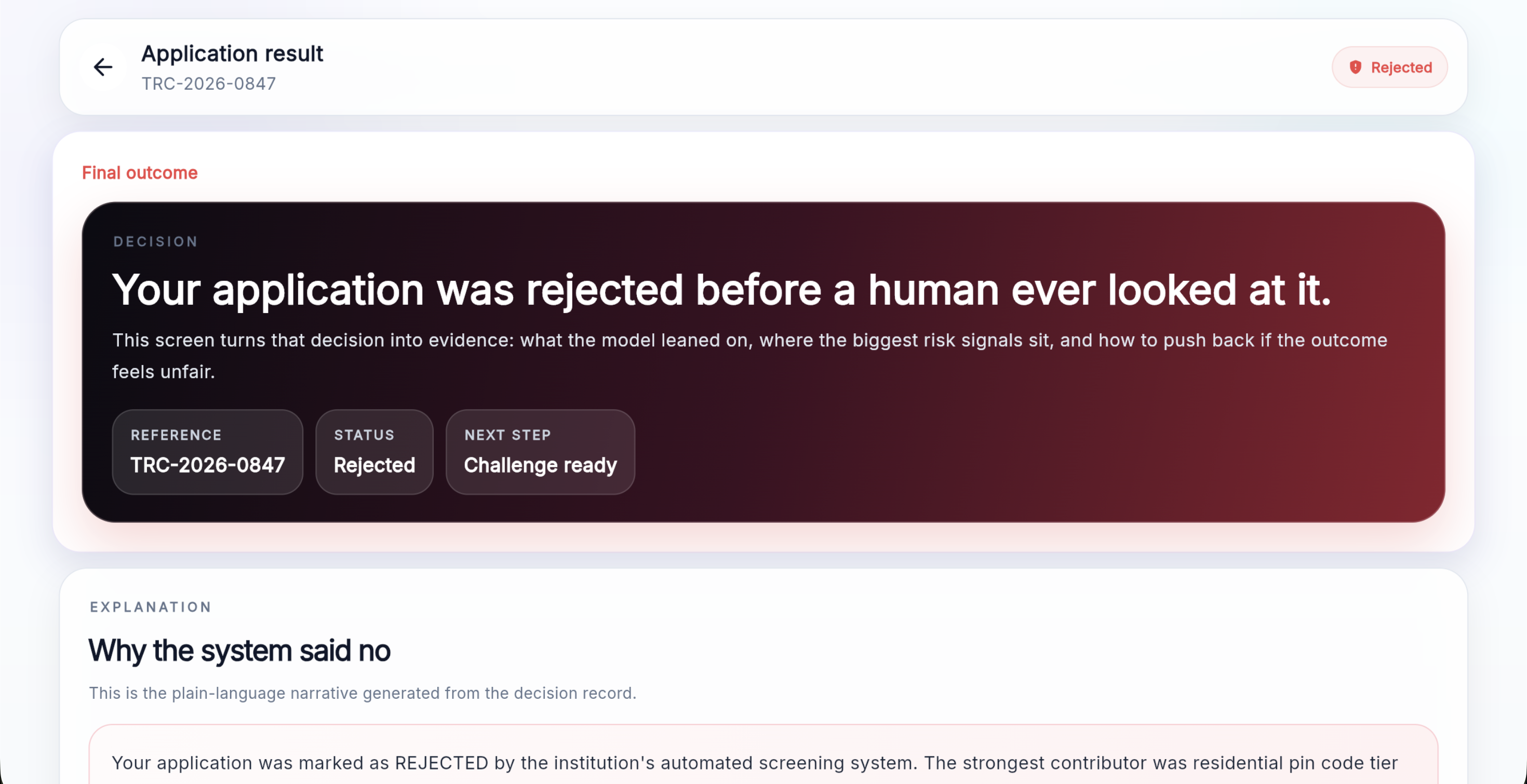
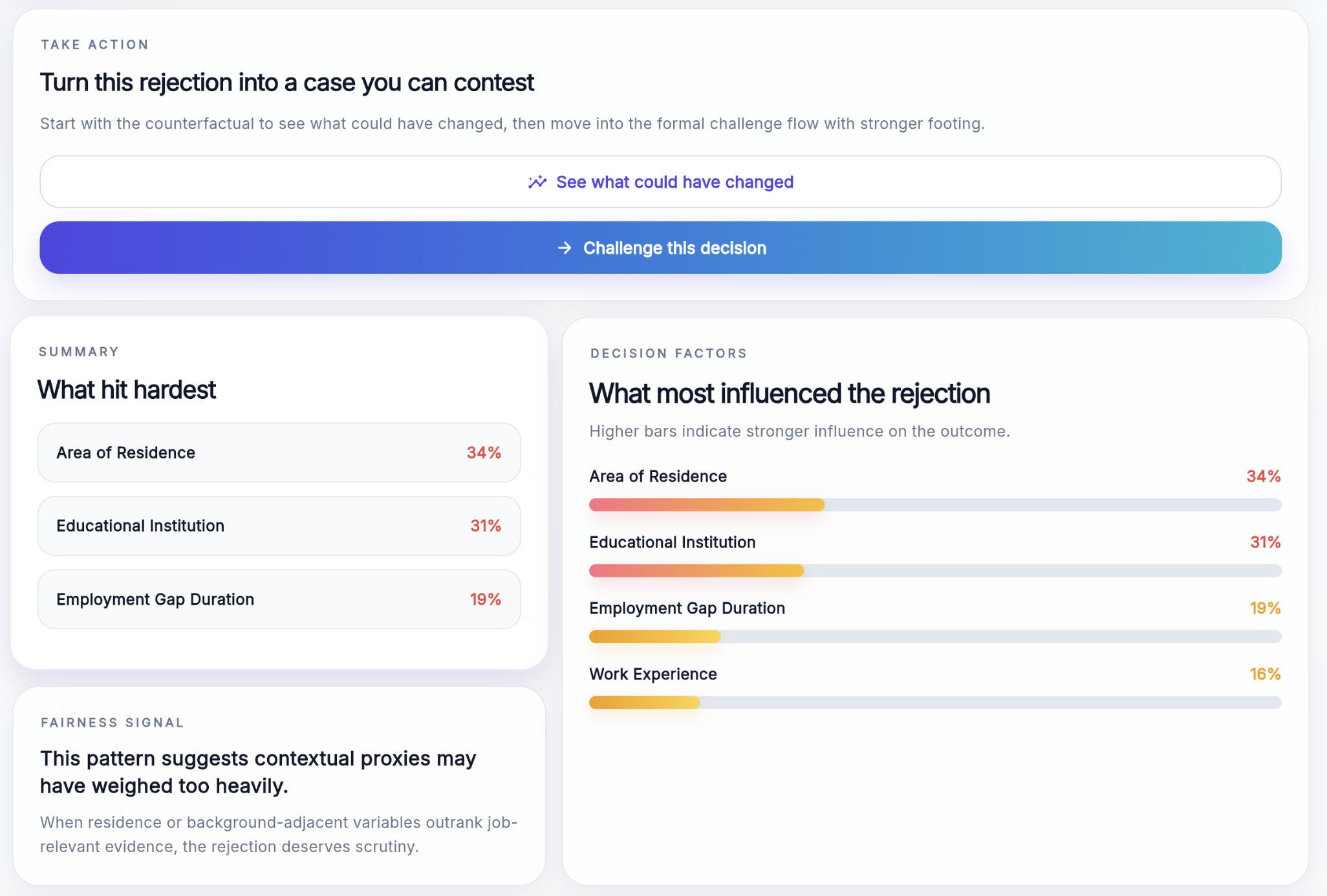
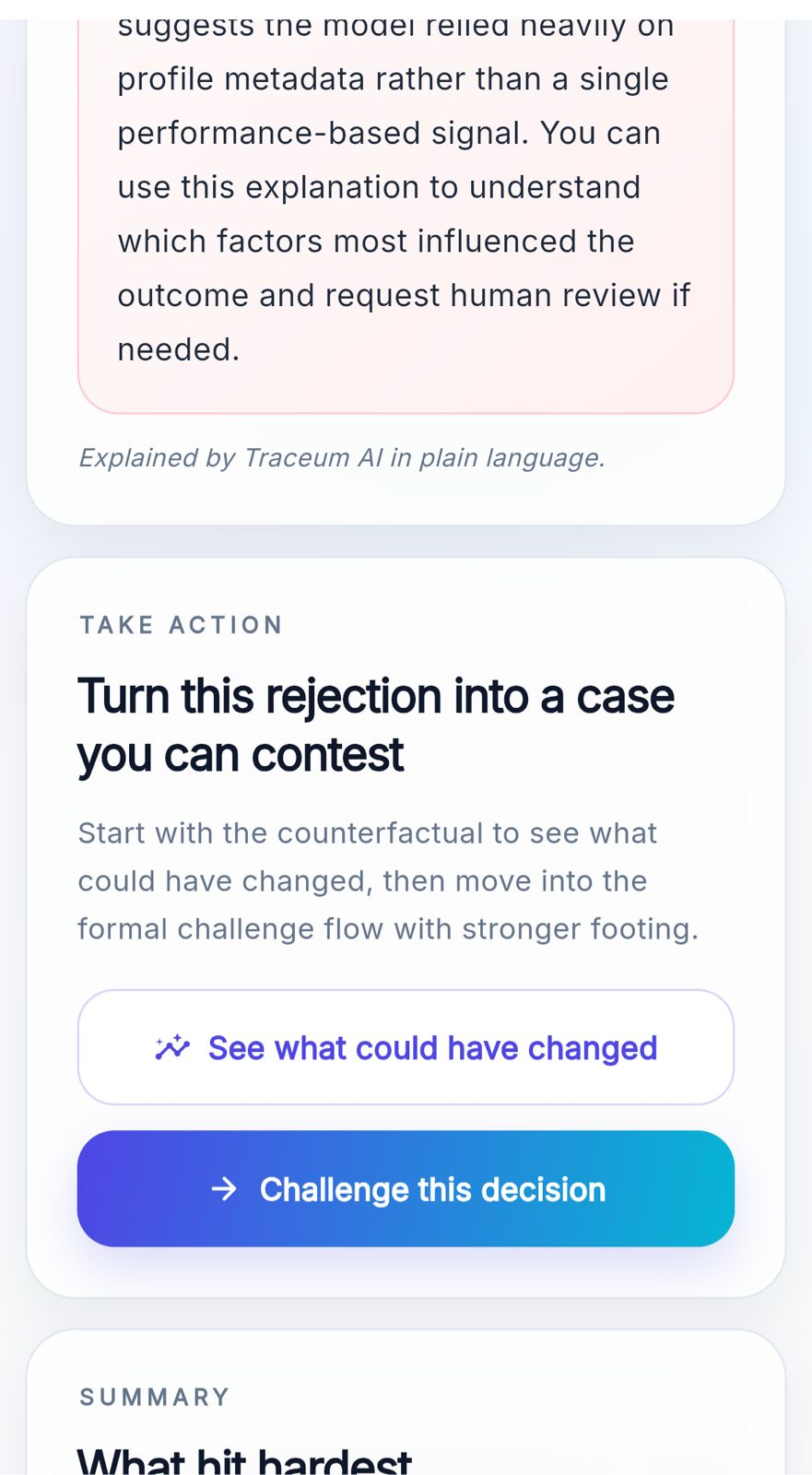
Traceum — AI decided. You deserved to know why.
Overview
Traceum is an AI accountability layer that converts opaque model decisions into explainable, auditable, and challengeable outcomes.
Instead of replacing existing models, it integrates directly into their decision pipeline — capturing each output, generating structured explanations, computing counterfactuals, and producing a tamper-evident audit trail.
The result is a shift from black-box predictions to verifiable decisions.
Why this matters
Automated decision systems are already determining outcomes in hiring, finance, and access to services — often without human review.
When these systems reject someone, the process ends there: no explanation, no visibility, no recourse.
At the same time, regulatory frameworks are moving toward mandatory accountability. The gap is no longer theoretical — it is infrastructural.
Traceum addresses that gap by making every decision:
- inspectable
- attributable
- contestable
What’s Novel
Most work in this space stops at interpretability.
Traceum goes further by introducing a decision accountability pipeline — where explanation is only one part of a larger, enforceable system.
Three ideas define the novelty:
Explanation → Evidence Outputs are not just descriptive; they are structured into records that can be reviewed and acted upon.
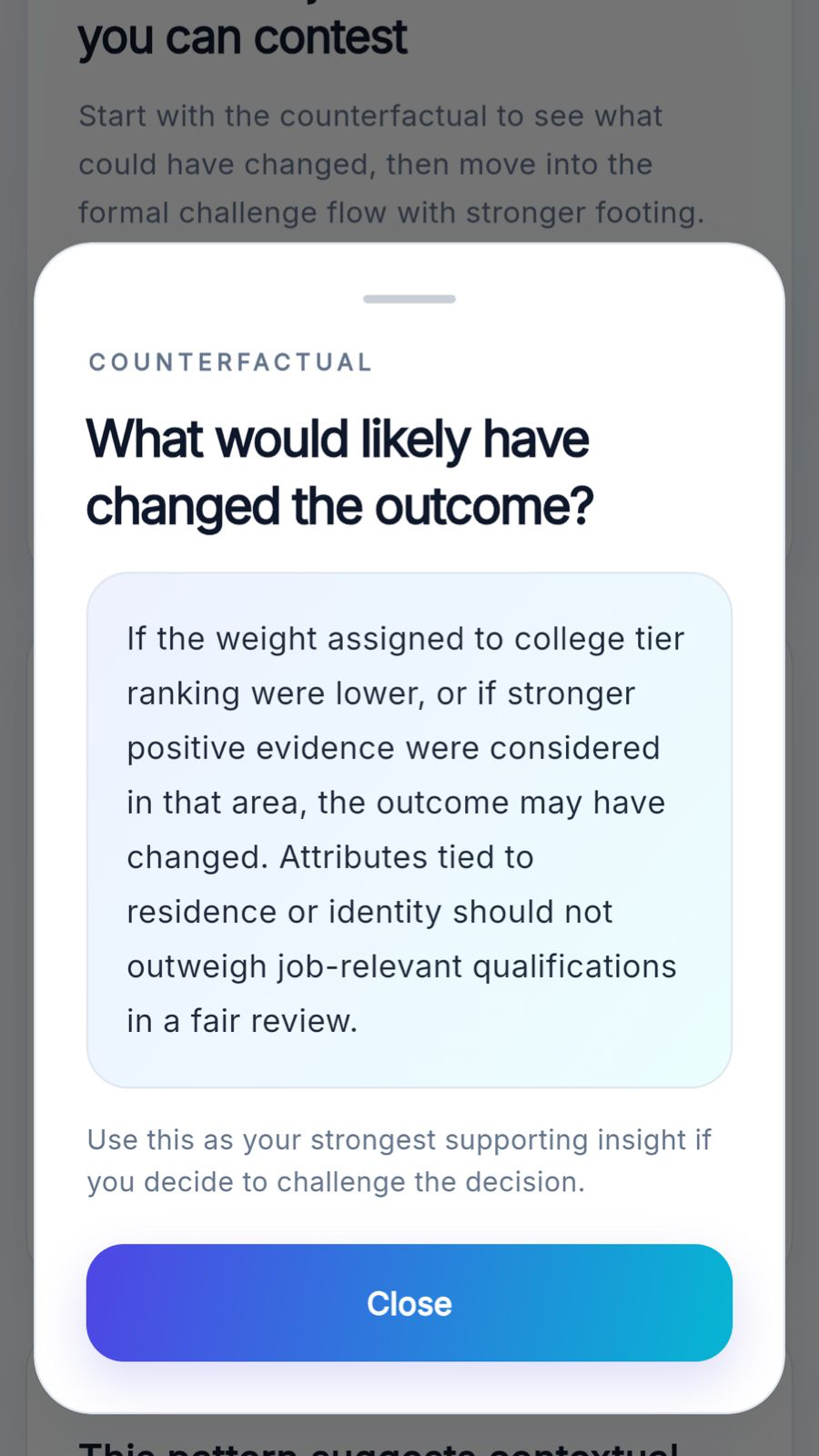
Counterfactuals as first-class objects Instead of static explanations, Traceum computes the minimum viable change required to flip a decision. This transforms interpretability into something operational.
Tamper-evident AI decisions (without blockchain) Each decision is cryptographically signed and written to an append-only store, ensuring integrity without introducing distributed system overhead.
This combination — interception, explanation, simulation, and auditability — does not exist as a unified layer in current tooling.
Technical Depth
Traceum is designed as a non-invasive middleware system, which introduces several non-trivial engineering constraints.
The system must:
- operate in real time within an existing inference pipeline
- generate explanations that are both faithful and readable
- compute realistic counterfactuals under constrained feature spaces
- guarantee that records cannot be altered post-decision
- fail safely if any component breaks
Counterfactual Generation
The hardest component is generating counterfactuals that are:
- minimal (smallest change required)
- valid (respect real-world constraints)
- non-trivial (not flipping protected attributes)
This requires explicitly constraining the search space and aligning it with model behavior — otherwise outputs become mathematically correct but practically useless.
System Flow
A model produces a decision → Traceum intercepts it via API wrapper → the decision is signed using Cloud KMS → stored in an append-only Firestore structure → explanation is generated → counterfactual is computed → full record becomes queryable.
Bias Monitoring
Traceum continuously evaluates fairness metrics across groups.
Demographic Parity Difference: DPD = P(Ŷ = 1 | A = 0) − P(Ŷ = 1 | A = 1)
Threshold breaches trigger alerts, enabling real-time detection of disparity instead of post-hoc audits.
Implementation
The system is built on a modular, production-aligned stack:
- FastAPI on Cloud Run for interception and orchestration
- Gemini 1.5 Pro for structured explanation generation
- Firestore as an append-only audit log
- Cloud KMS for cryptographic signing
- BigQuery for analytics
- Vertex AI for bias monitoring
- React dashboard for system-level visibility
A key design decision was enforcing a fail-closed architecture — no decision is allowed to pass without an associated explanation and record.
Impact
Traceum changes the role of AI systems from decision-makers to decision systems with accountability.
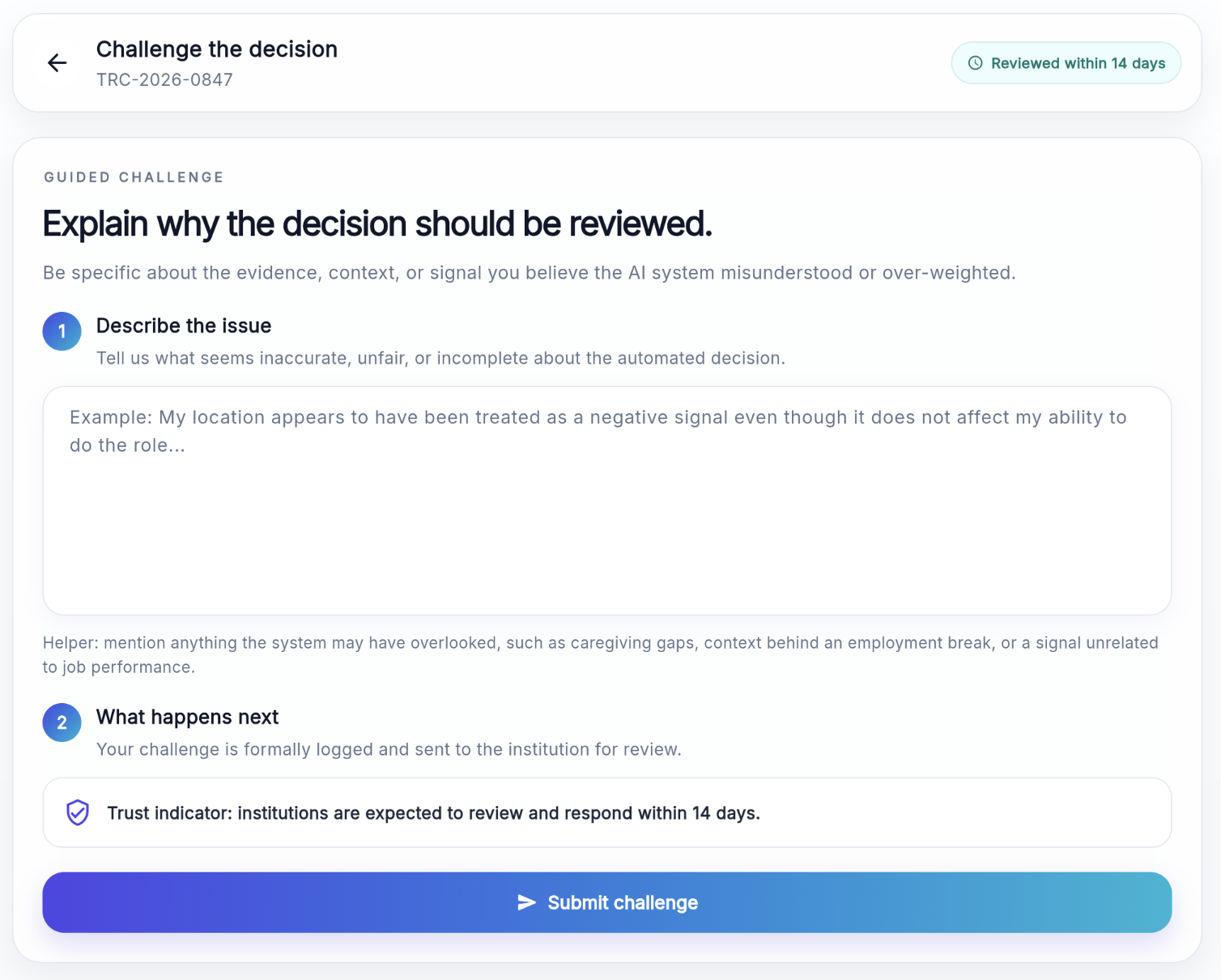
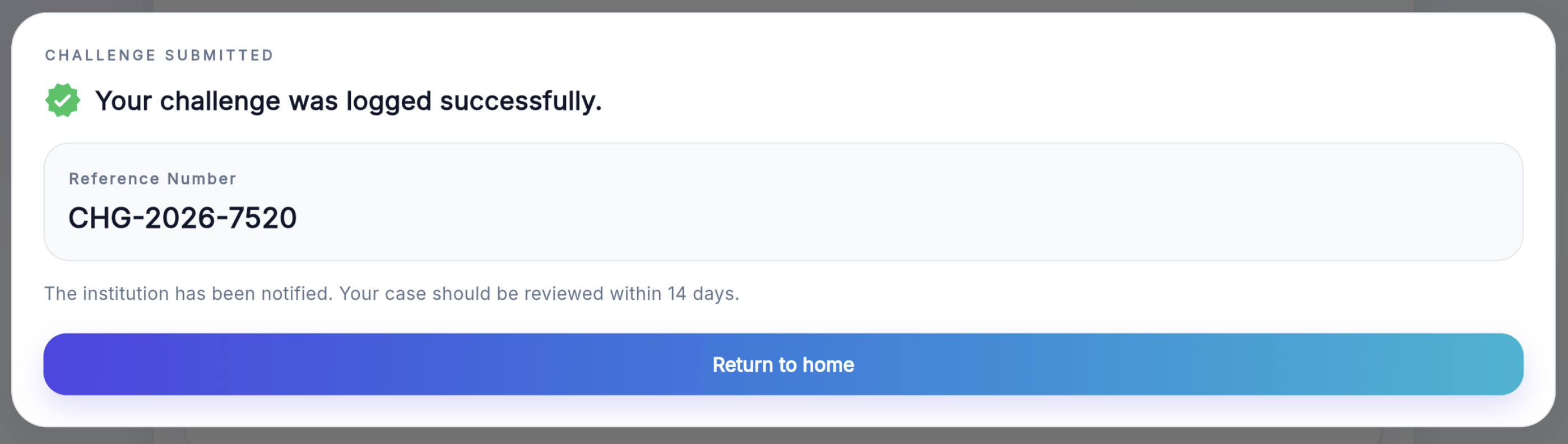
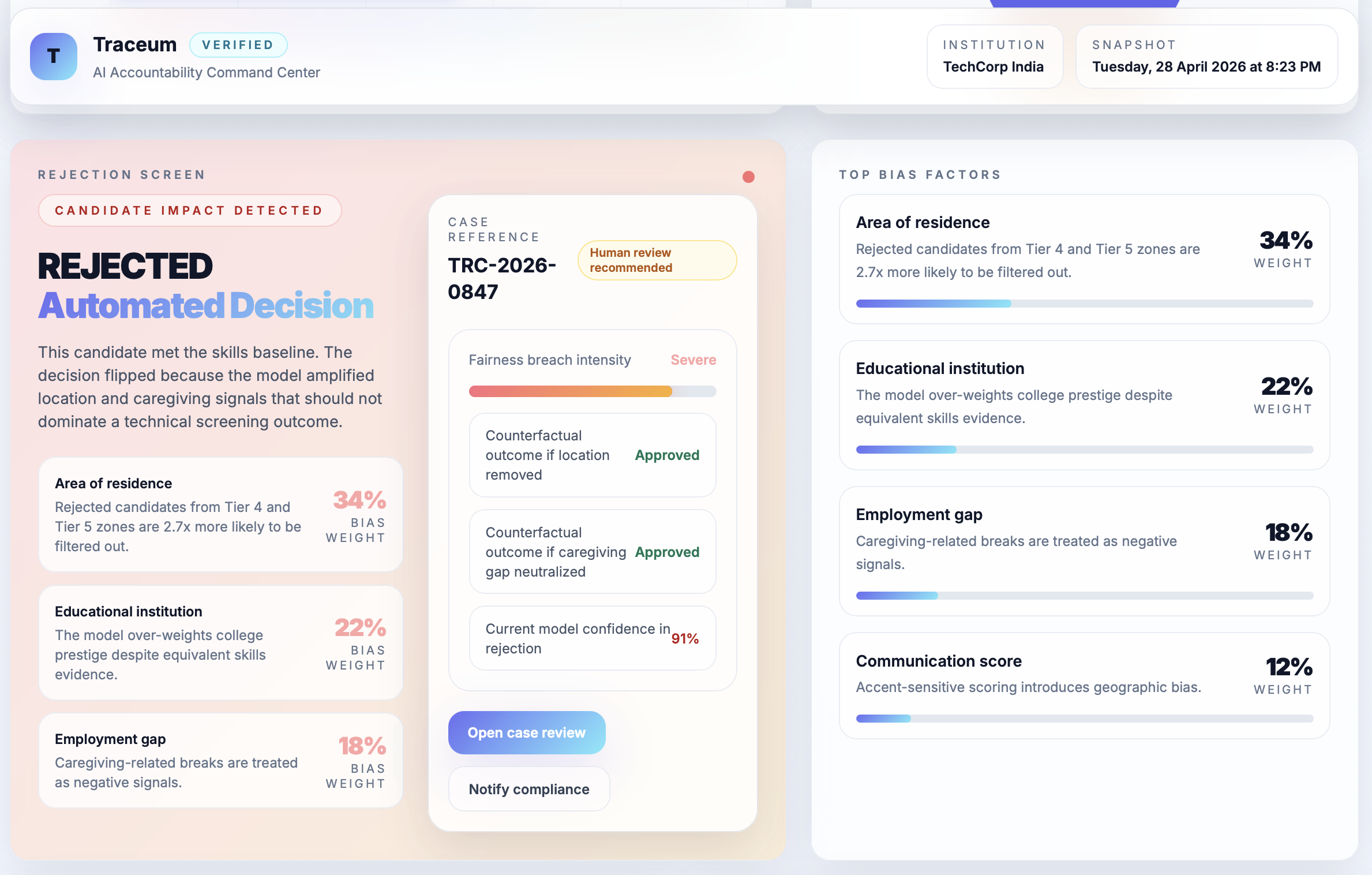
In a hiring pipeline, for example: a rejection is no longer a terminal outcome — it becomes a traceable event with identifiable causes and a defined path for review.
This has three direct effects:
- individuals gain visibility into decisions affecting them
- institutions gain measurable compliance infrastructure
- bias becomes detectable in real time, not retrospectively
Current Prototype
A working prototype includes:
- real-time decision interception
- explanation generation pipeline
- constrained counterfactual engine
- cryptographically signed audit logging
- bias monitoring dashboard
User App Demo - [https://traceum-8aa68.web.app] Institutional Dashboard Demo - [https://traceum-8aa68.web.app/dashboard] GitHub Repository -[https://github.com/axnav28/traceum] Demo Video - [https://drive.google.com/file/d/1wTDtTz7hIYMlIconfHlGX_aZOoEPTior/view?usp=sharing]
Why this stands out
Most projects in this space answer:
“Can we explain model behavior?”
Traceum answers:
“Can we make AI decisions accountable in practice?”
That distinction — from insight to enforcement — is the core contribution.


Log in or sign up for Devpost to join the conversation.