-
-
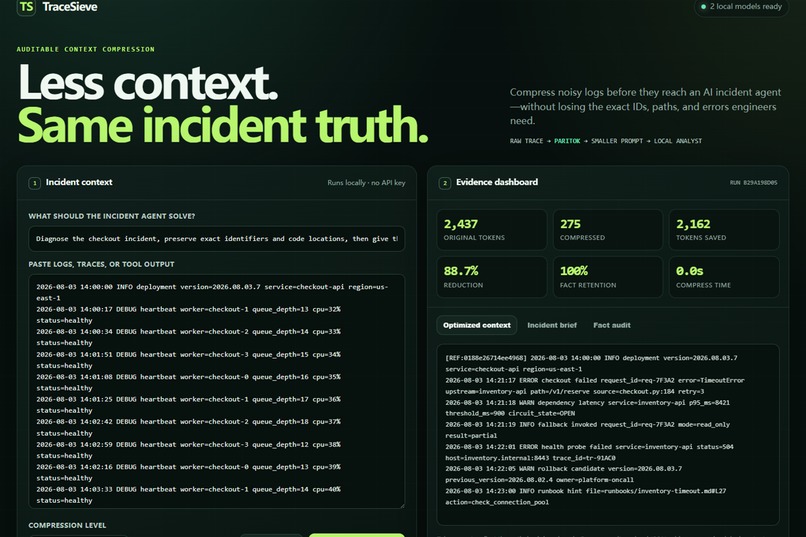
TraceSieve: audit-first token compression for incident agents
-
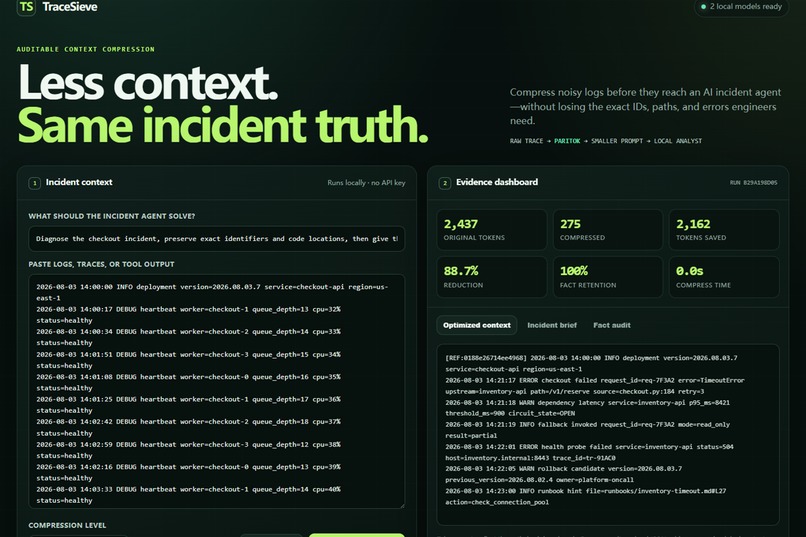
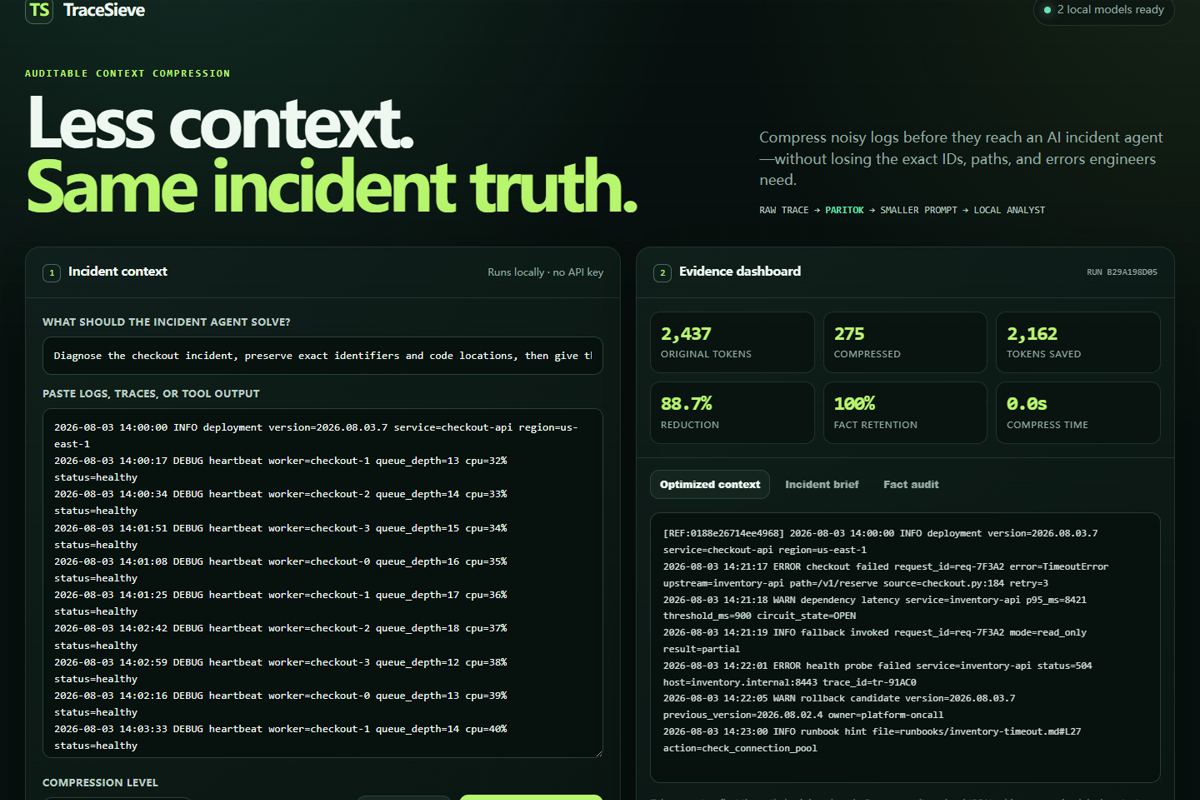
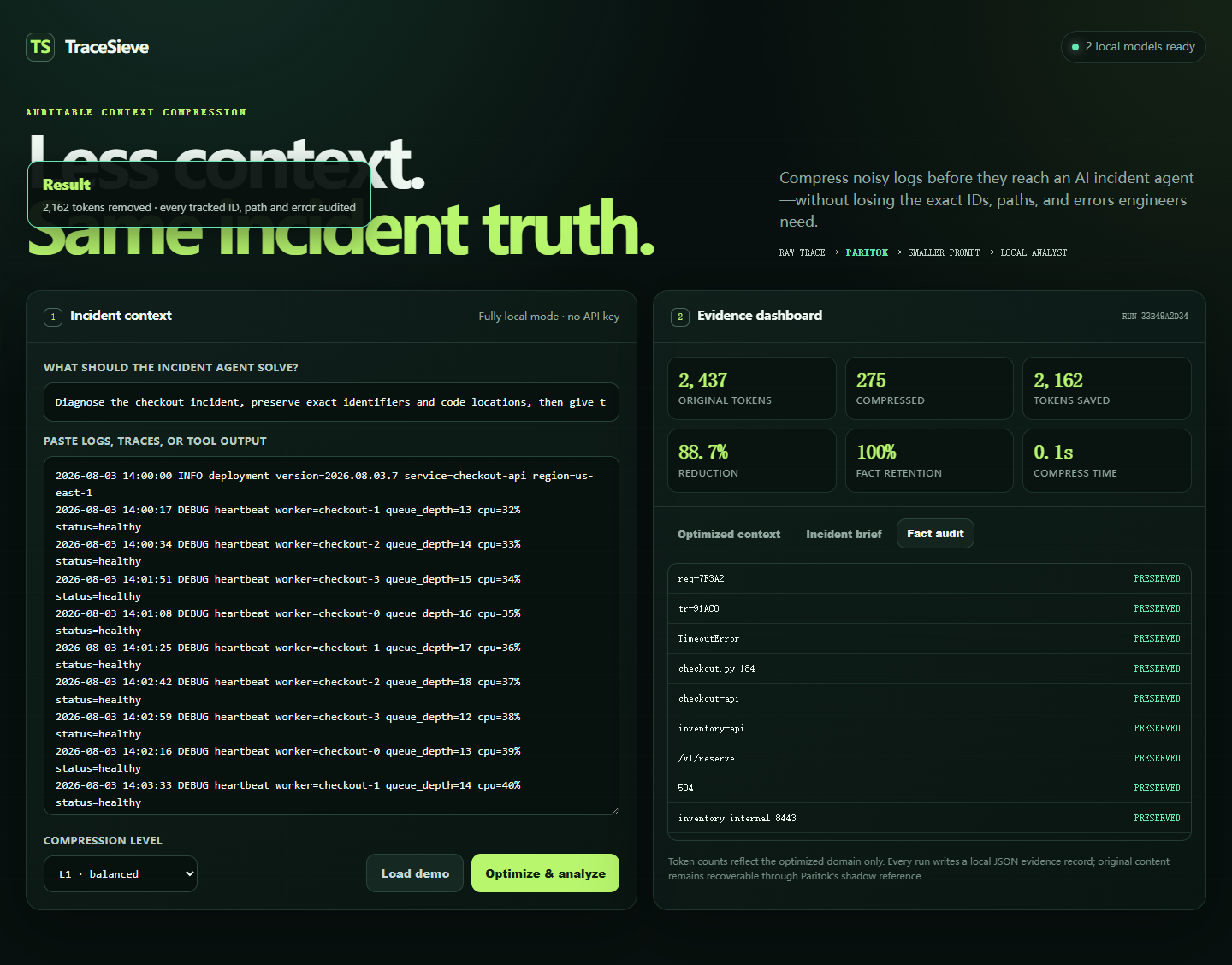
Verified demo result: 2,437 to 275 tokens, with 13/13 exact facts retained
-
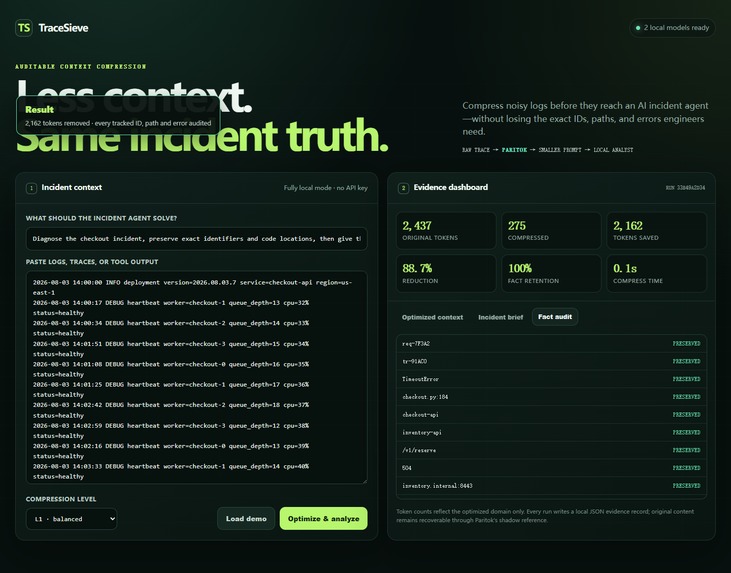
Incident brief and per-fact preservation evidence after Paritok compression
Inspiration
Incident-response agents are often given thousands of tokens of repetitive heartbeats, cache refreshes, and status lines. The real operational truth may be only a request ID, an exception, a path, a host, and a runbook location. A shorter prompt is cheaper and faster, but a summary that drops one identifier can make an incident harder to resolve.
TraceSieve turns token compression into an auditable incident workflow.
What it does
TraceSieve accepts logs, traces, or tool output plus an incident objective. Paritok compresses the noisy context before it reaches a small incident analyst. The app then audits whether exact request IDs, trace IDs, errors, file locations, endpoints, versions, and runbook references survived.
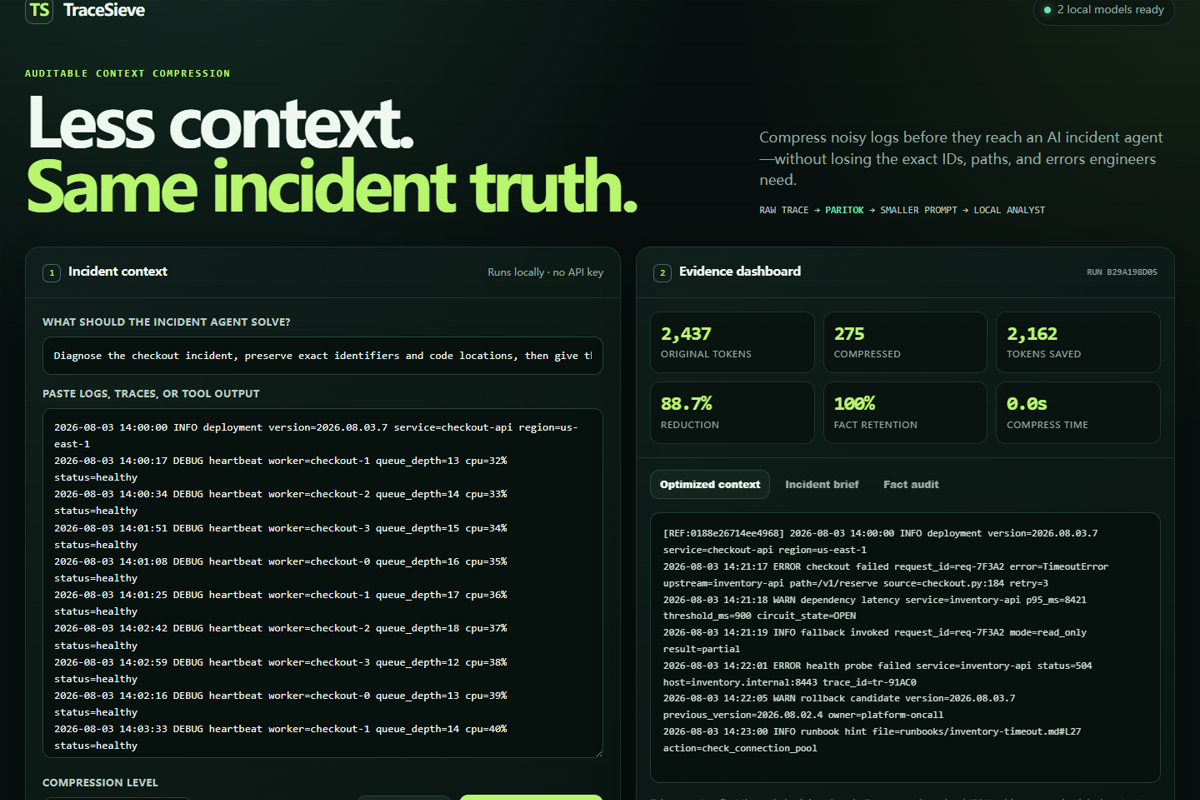
The dashboard shows:
- original, compressed, and saved tokens;
- reduction percentage and compression time;
- the optimized context;
- a three-action incident brief;
- a per-fact preservation audit;
- a shadow reference and local JSON evidence record for recoverability.
How we built it
The backend uses the official Paritok CompressionPipeline. It supports Paritok's hosted GPU strategy through an API key kept outside the repository. A local Ollama fallback is included for reproducibility. Only the Paritok output is sent to a local Qwen 3 0.6B analyst.
The interface is dependency-free HTML, CSS, and JavaScript served by a Python HTTP service. Tests cover configuration, fact extraction, evidence generation, and hosted/local backend selection.
Verified result
On the included deterministic synthetic checkout incident:
- 2,437 original tokens
- 275 compressed tokens
- 2,162 tokens removed
- 88.7% reduction
- 13/13 exact facts retained
- exactly 3 downstream actions generated
This is a reproducible fixture result, not a universal performance claim.
Challenges we ran into
Compression quality and operational correctness are different questions. A compact output can still omit the one identifier an engineer needs. We separated transformation from verification, added literal fact extraction across both domains, and made failures visible instead of hiding them behind an attractive summary.
We also designed a dual backend so the project can demonstrate official hosted GPU usage while remaining reproducible on a laptop.
Accomplishments that we're proud of
- Paritok is the core transformation, not a decorative API call.
- Every tracked identifier is independently audited after compression.
- The demo reduces context by 88.7% while retaining all 13 tracked facts.
- The project is Apache-2.0 licensed and includes Paritok credit, tests, setup scripts, and reproducible evidence.
What we learned
Token efficiency becomes much more useful when paired with evidence. Measuring prompt reduction alone is not enough; downstream agents need a way to prove that exact incident truth survived.
What's next for TraceSieve
Next we would add batch trace ingestion, configurable fact schemas, multi-run comparison, hosted dashboards, and integrations for common incident platforms. We also want semantic completeness checks to complement the current exact-fact audit.
Built With
- css3
- hosted-gpu
- html5
- javascript
- machine-learning
- ollama
- paritok
- python
- qwen3
- rest-api

Log in or sign up for Devpost to join the conversation.