-
-
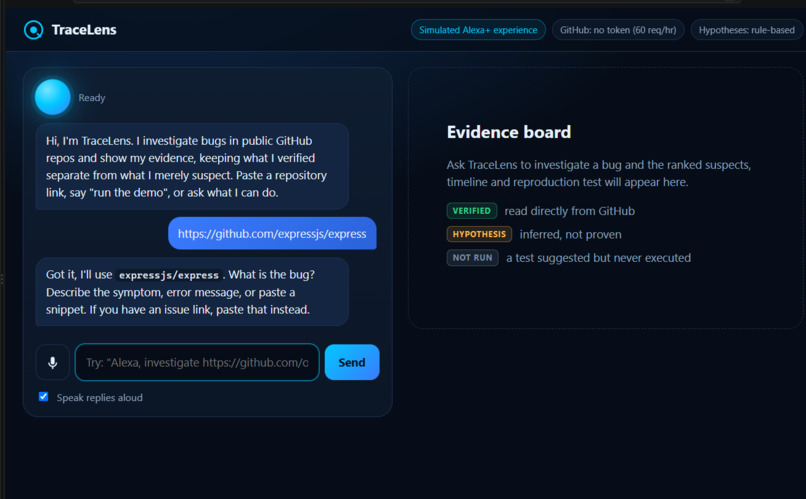
an evidence-first AI debugging agent that investigates potential bugs, presents supporting evidence
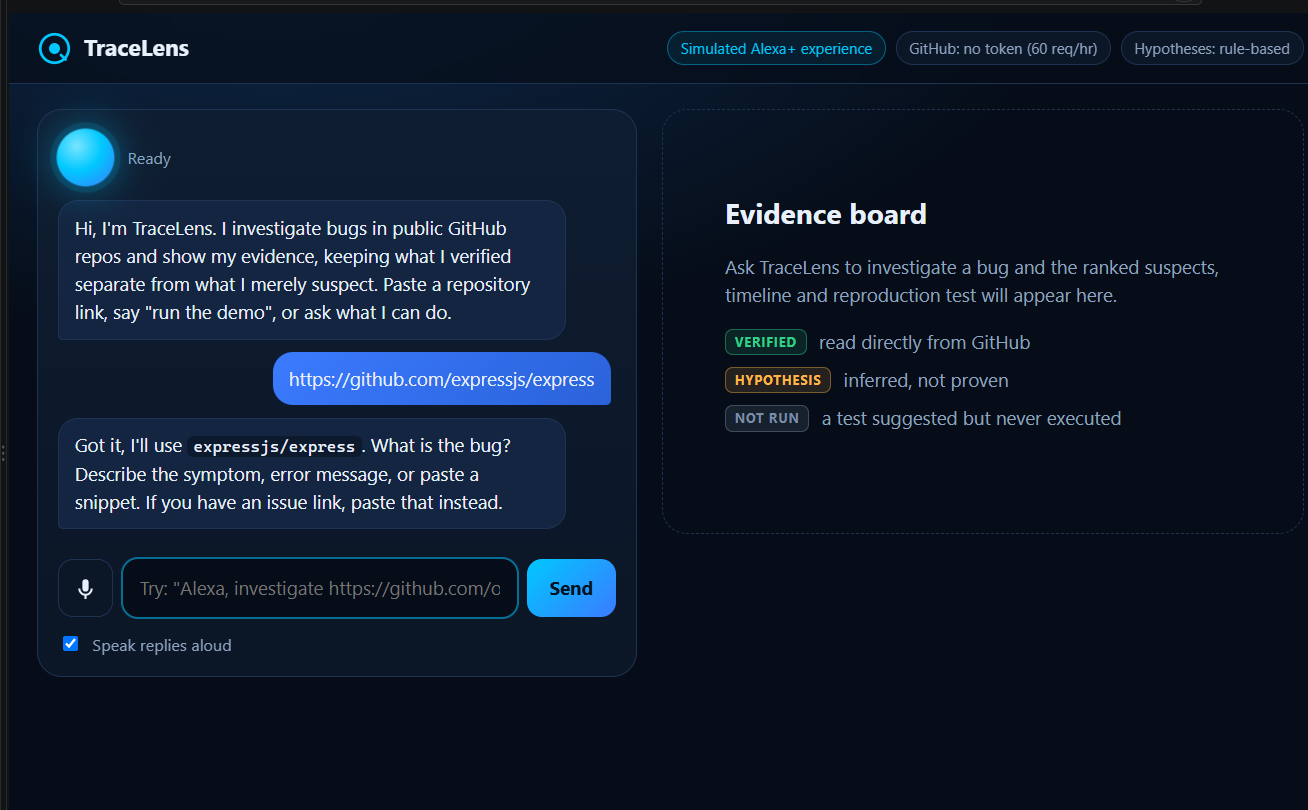
TraceLens — Stop Guessing. Start Tracing.
Inspiration
Debugging is often more than finding an error message. Developers need to understand what went wrong, which code changes may have introduced the issue, and whether a proposed fix actually solves it. Searching through files, commits, and logs can be time-consuming, especially when working with unfamiliar codebases.
We created TraceLens to make debugging more systematic, evidence-driven, and easier to understand.
What It Does
TraceLens is an AI-powered debugging agent designed to investigate software bugs and connect potential root causes to concrete code evidence.
Its goal is to help developers move from a bug report to a clear investigation:
- Bug Investigation: Analyze a reported issue and the relevant source code.
- Root Cause Analysis: Identify and rank plausible explanations for a bug.
- Evidence-Based Findings: Connect hypotheses to relevant code snippets and commit history.
- Bug Timeline: Explore code changes that may have contributed to the issue.
- Reproduction Tests: Help developers reproduce a reported problem.
- Verification: Distinguish between a suspected fix and one supported by successful tests.
How We Built It
Our approach centers on turning debugging into a structured investigation rather than simply asking an AI model to suggest a solution.
TraceLens is designed around a workflow that connects repository context, code analysis, commit history, root-cause hypotheses, and test-based verification. The interface brings these findings together so developers can inspect the evidence behind each conclusion.
We aim to make every investigation understandable and actionable, keeping the developer in control of decisions and code changes.
Challenges We Focused On
One of the biggest challenges in AI-assisted debugging is reliability. A plausible explanation is not necessarily the correct explanation, and generated code is not automatically a verified fix.
TraceLens addresses this challenge by emphasizing evidence, traceability, and reproducibility. It is designed to separate likely explanations from confirmed findings and encourage validation through tests rather than relying on AI confidence alone.
Another challenge is presenting complex debugging information in a way that is useful without overwhelming developers. Bringing code changes, investigation results, and verification into one workflow helps make the debugging process easier to follow.
What We Learned
Building TraceLens reinforced an important engineering principle: a useful debugging tool must explain not only what it thinks is wrong, but also why it thinks so and how that conclusion can be tested.
AI can accelerate investigation, but trustworthy software development still requires evidence, reproducible experiments, and human judgment.
What's Next
We want to evolve TraceLens into a practical debugging companion that can investigate real repositories, generate reproducible test cases, trace regressions through commit history, and help developers validate fixes with greater confidence.
Our vision is simple: less time guessing, more time understanding and fixing bugs.
Built With
- ai
- amazon-bedrock
- developer
- github-api
- javascript
- react
- software-debugging
