-
-
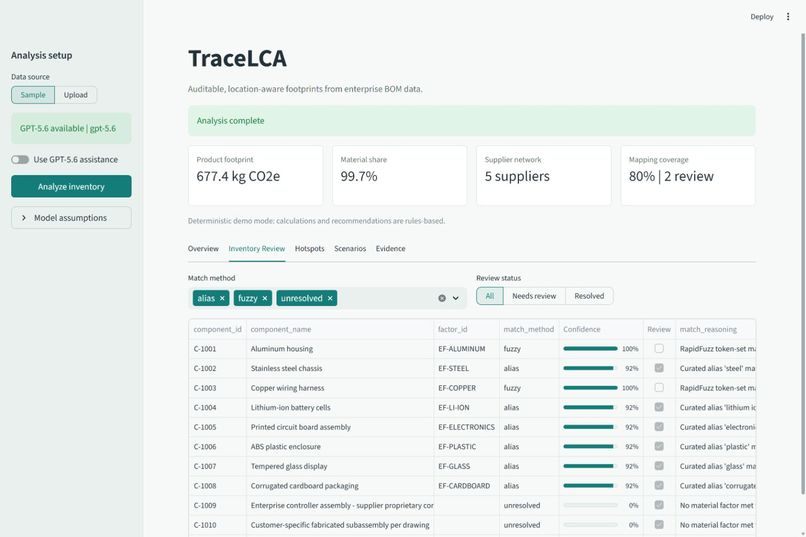
Overview: footprint metrics, component hotspots, and supplier geography
-
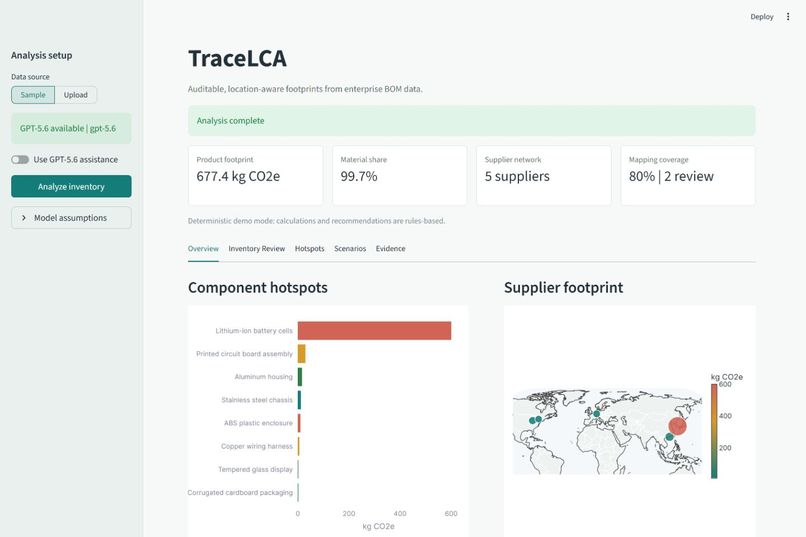
Inventory Review: factor matching, confidence, and unresolved rows
Inspiration
Product sustainability teams often begin with enterprise component descriptions, fragmented supplier data, and emissions factors that use a different vocabulary. The hard part is not displaying a carbon number. It is preserving a defensible chain from each BOM row to its factor, location, transport assumption, uncertainty, and reduction opportunity.
What it does
TraceLCA validates BOM, supplier, and emissions-factor CSVs; maps enterprise component descriptions to bounded factor IDs; calculates material and inbound transport emissions; and exposes component hotspots, supplier geography, review flags, source evidence, and downloadable audit records. Users can compare recycled-content, cleaner-electricity, distance, and freight-mode scenarios without changing the baseline.
The app runs fully in deterministic Demo Mode. With explicit user opt-in, GPT-5.6 can assist only with unresolved semantic matches and evidence-grounded recommendations. It cannot change the calculation engine.
How we built it
TraceLCA is a Python and Streamlit application using pandas for data processing, RapidFuzz for deterministic matching, Plotly for interactive charts, Pydantic for structured contracts, and the OpenAI Responses API for optional GPT-5.6 assistance. The code separates validation, matching, calculations, scenarios, recommendations, AI integration, and presentation.
Codex supported the end-to-end engineering workflow: turning the initial sustainability research concept into a specification, dividing it into focused implementation tasks, writing and running tests, reviewing changes, and checking the finished interface in desktop and mobile browser viewports.
Challenges
The largest design challenge was using AI where semantic interpretation helps without allowing it to create unsupported carbon claims. TraceLCA solves this by offering only known candidate factor IDs, validating structured responses, rejecting unknown evidence IDs, omitting raw files and coordinates from prompts, and keeping all arithmetic deterministic. Another challenge was making uncertainty useful in the interface, so unresolved rows stay visible and are excluded rather than guessed.
Accomplishments
- A complete no-key demo path with auditable calculations
- Aggregated validation errors for all three input files
- Bounded GPT-5.6 structured outputs with deterministic fallback
- Five working views for overview, review, hotspots, scenarios, and evidence
- Downloadable scenario and audit trails
- 87 passing automated tests plus responsive browser QA
What we learned
Reliable sustainability AI is less about generating a polished answer and more about enforcing boundaries around evidence, identifiers, arithmetic, and uncertainty. Separating semantic assistance from deterministic calculation made the workflow both more useful and easier to test.
What's next
Next steps include governed lifecycle inventory databases, primary supplier-data exchange, factor versioning and approvals, uncertainty propagation, configurable system boundaries, cost and feasibility overlays, multi-product portfolios, and independent methodology review.

Log in or sign up for Devpost to join the conversation.