-
-
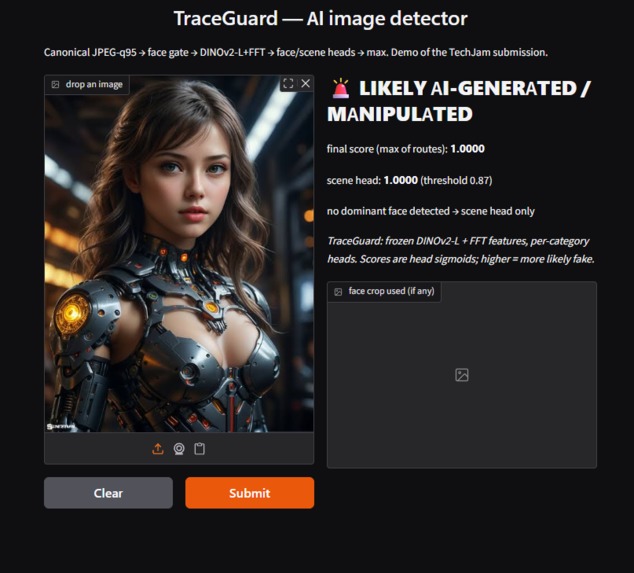
AI generated image
-

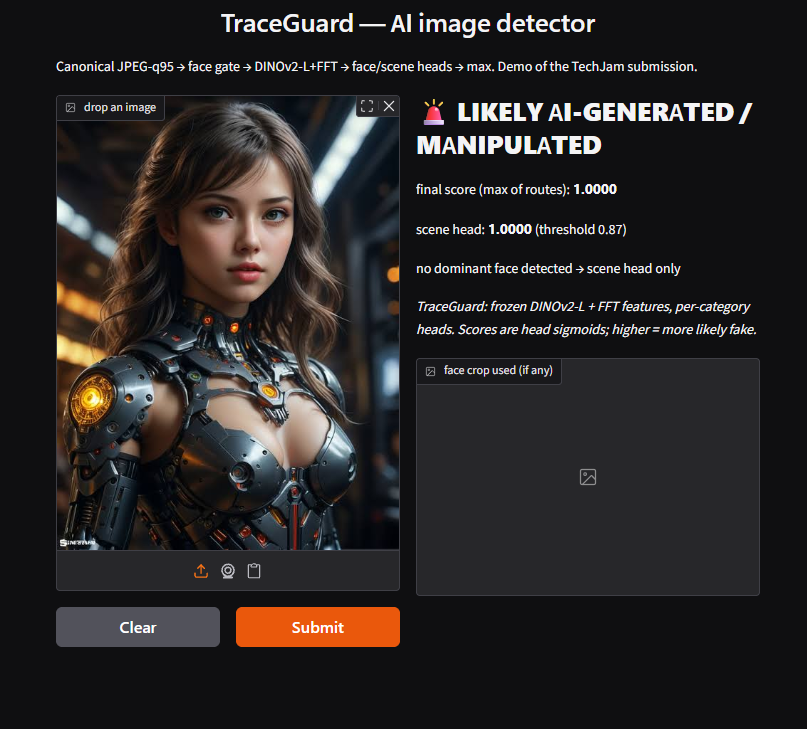
Real image

Inspiration
AI-generated images are becoming easier to create and harder to recognize. However, many detectors that report near-perfect validation accuracy fail when tested on images from a different generator, dataset, resolution, or compression pipeline.
While developing TraceGuard, we saw this problem directly: a detector could achieve over 99% validation ROC-AUC and still reverse its predictions on an unfamiliar dataset. That inspired us to build something more transparent than a simple “real or fake” classifier—a forensic screening tool that also reveals when its own decision is unstable.
What it does
TraceGuard analyzes an uploaded image and returns:
- A detector score and real/AI-generated verdict
- The exact decision threshold used by the model
- A stability test across JPEG compression, blur, resizing, and cropping
- A warning when the result is sensitive to redistribution
- Batch scoring with downloadable JSON results
- Optional multi-model and frequency-analysis experiments
TraceGuard is designed as a research and screening tool, not as proof that an image is authentic or AI-generated. Its purpose is to surface forensic evidence and uncertainty instead of hiding them behind a confident label.
How we built it
TraceGuard is built with Python, PyTorch, timm, Hugging Face datasets, and Gradio.
We implemented and compared three main architectures:
- DINOv2 with register tokens using its native class-token representation
- DINOv3-S/16 using the class token, patch-token mean, and patch-token standard deviation
- DINOv3 with an explicit frequency branch containing radial FFT and color statistics
The models are fine-tuned end-to-end using a low learning rate of (10^{-6}). To preserve forensic traces, images are cropped at their native resolution instead of always being resized before entering the backbone.
Our training pipeline also includes label-symmetric JPEG, blur, scaling, noise, color, and cutout augmentations. These transformations are applied equally to real and generated images so the detector cannot simply learn that one compression format means “fake.”
We created a balanced research subset of Community Forensics-Small containing:
- 8,000 real images
- 8,000 generated images
- 256 generator groups
- At most 32 images from any single generator
- No corrupt files or duplicate image hashes
Generator-disjoint validation prevents images from the same fake-image generator from appearing on both sides of the train/validation split.
The most important result
Our experiments showed why AI-image detection remains difficult.
DINOv2 achieved 0.9985 validation ROC-AUC, but only 0.3542 AUC on an unfamiliar SID/WildFake holdout. The model had learned highly effective in-domain signals that did not transfer.
DINOv3 generalized better:
- 0.9955 AUC on Community Forensics validation
- 0.5723 AUC on the SID/WildFake holdout
- 0.6896 AUC on an unseen CIFAKE subset
The frequency branch slightly improved one holdout but reduced CIFAKE AUC to 0.618. This demonstrated that frequency evidence can also become dataset-specific.
We also discovered that ranking and threshold calibration are separate problems. DINOv3 ranked CIFAKE images reasonably well, but its training-domain threshold classified almost every CIFAKE image as generated. TraceGuard therefore displays the threshold and stability behavior instead of treating the score as universally calibrated.
Challenges we faced
Dataset bias
The detector frequently learned differences in image source, resolution, encoding, or semantic content instead of generation artifacts.
Generator diversity
Hundreds of model names did not guarantee coverage of different generation mechanisms. Many were closely related diffusion checkpoints, while architectures such as MAGE, VQGAN, and VQVAE remained difficult.
Limited compute and storage
We trained end-to-end transformer models on an 8 GB RTX 4060. Native crops, mixed-precision training, bounded datasets, and resumable streaming allowed the experiments to fit locally. We also reclaimed approximately 51 GiB by safely removing obsolete training copies.
Honest evaluation
It was tempting to report only the near-perfect validation result. Cross-dataset evaluation revealed a much more important and realistic picture of the detector’s behavior.
What we learned
- High validation accuracy does not guarantee cross-dataset generalization.
- More generators are useful only when they represent different generation mechanisms.
- A better backbone cannot compensate for biased or unpaired training data.
- Frequency artifacts can help, but can also become source-specific shortcuts.
- ROC-AUC can transfer while the decision threshold fails completely.
- A responsible detector needs uncertainty, stability testing, and an abstention mechanism.
What’s next
Our next iteration will:
- Balance training data by generator architecture, not just model name
- Include semantically paired real and generated images
- Add an out-of-distribution detector that can abstain on unfamiliar domains
- Calibrate thresholds using untouched multi-domain datasets
- Report fixed false-positive-rate operating points
- Explore localized patch-level forensic explanations
- Combine semantic and pixel-level evidence without relying on static fusion weights
Responsible use
TraceGuard is a non-commercial research prototype. Its output should never be treated as definitive proof or used alone to accuse a person of generating or manipulating an image.
Community Forensics-Small is used under its CC-BY-NC-SA-4.0 license.
Built With
- amazon-web-services
- clip
- computervision
- dinov2
- dinov3
- efficientnet
- fastfouriertransformation
- git
- gradio
- huggingface
- machine-learning
- numpy
- pillow
- python
- timm
- torchvision

Log in or sign up for Devpost to join the conversation.