-
-
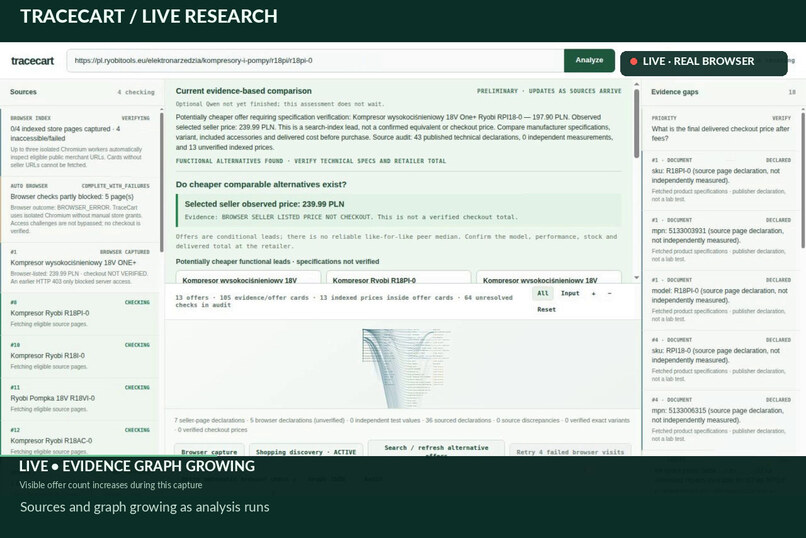
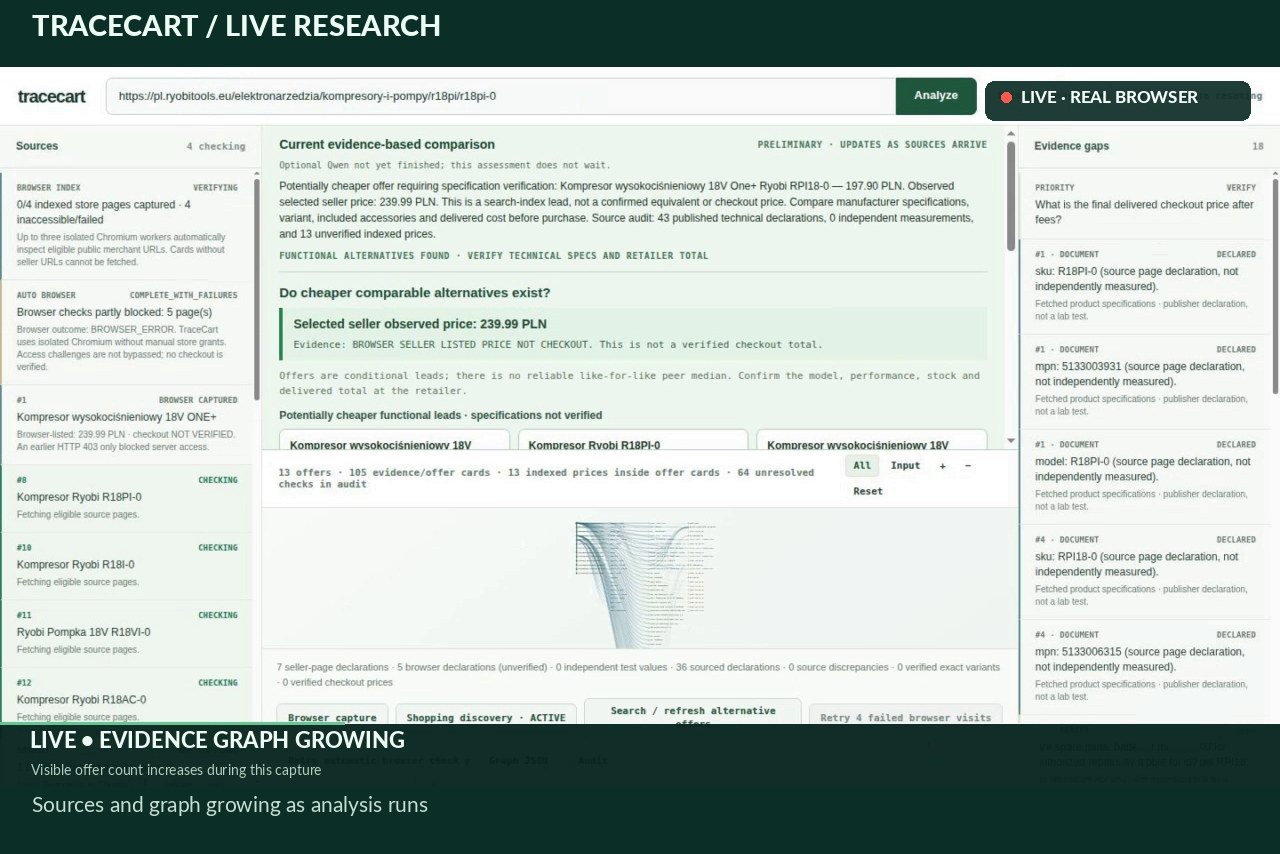
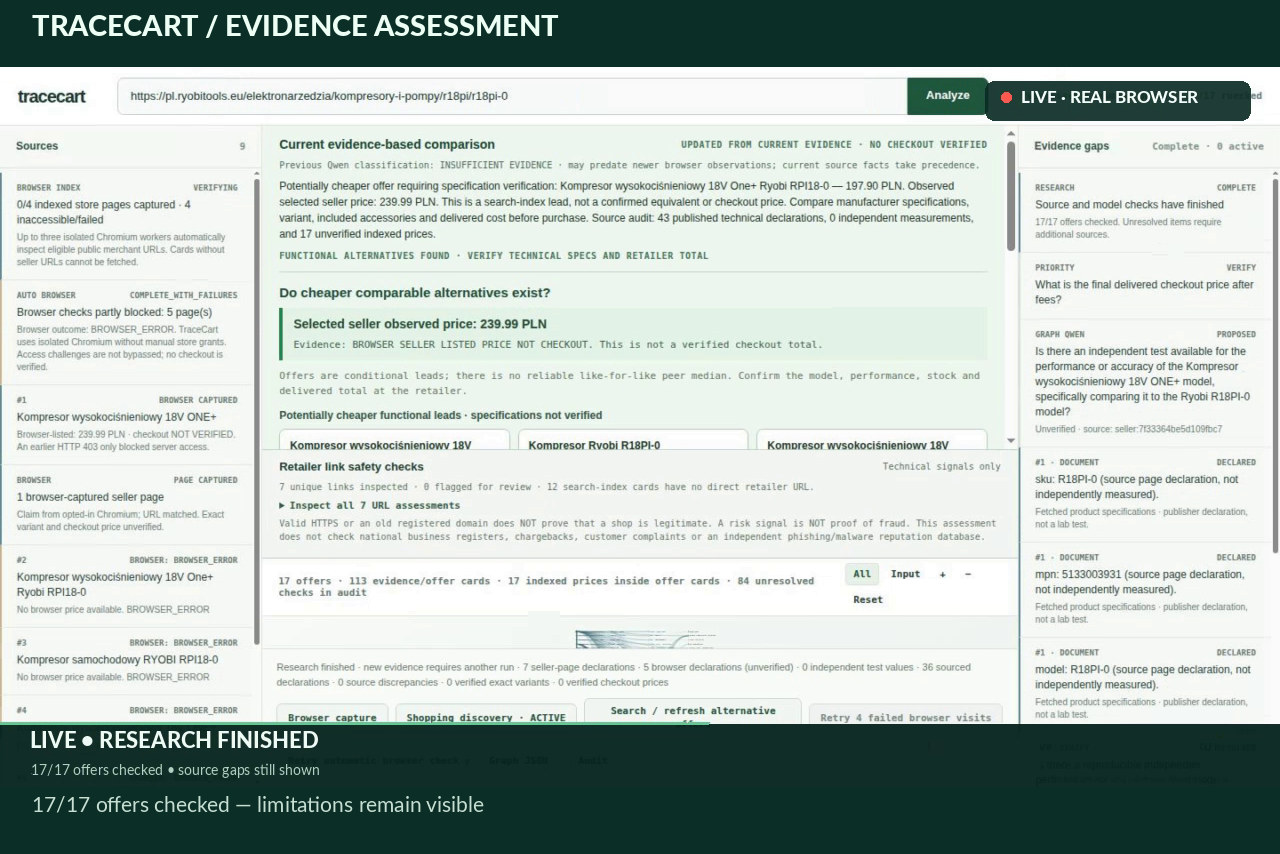
Live browser research: offers, source checks and evidence graph update progressively.
-
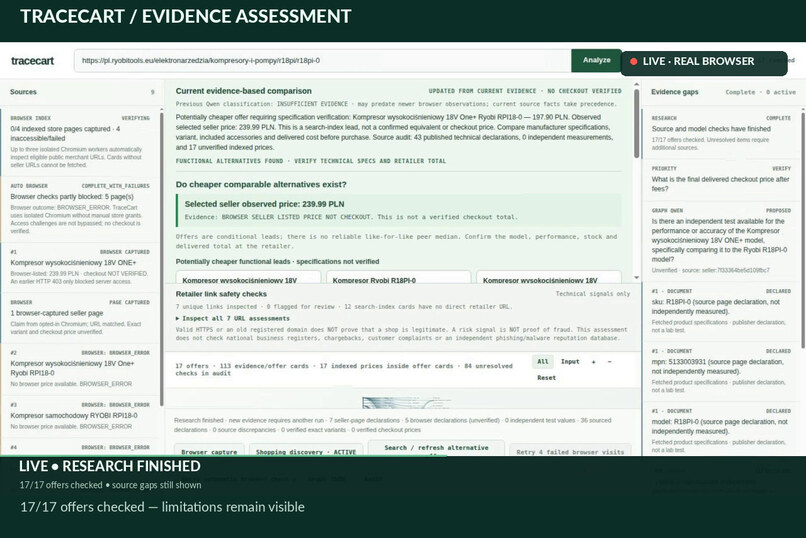
Research outcome: 17 indexed offers assessed; missing evidence and checkout uncertainty remain visible.
-
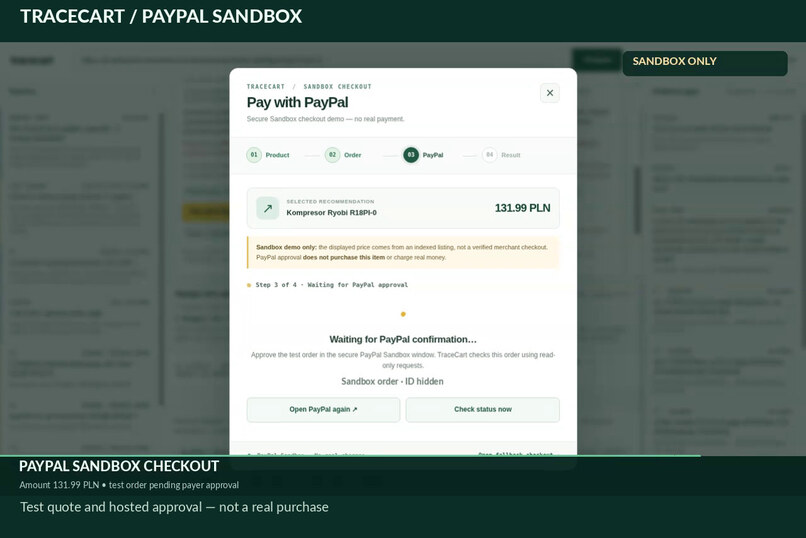
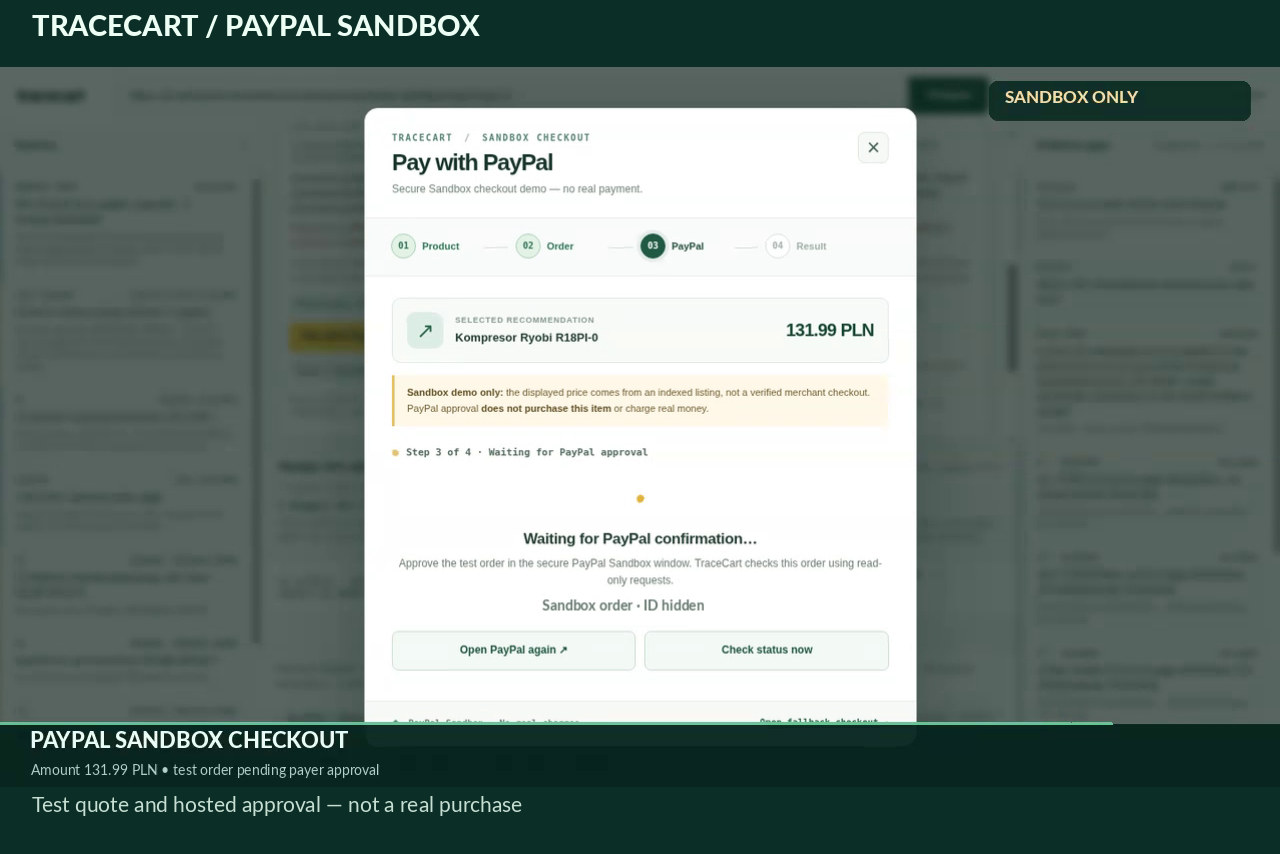
PayPal Sandbox: test order with buyer approval pending; no real payment or external retailer purchase.
Inspiration
The modern shopping journey has an accountability problem. Shopping agents can compare product offers in seconds, but search results and merchant descriptions can overstate equivalence, omit delivery costs and encourage checkout before a buyer has seen the evidence. A generative model also shouldn't decide both what to recommend and how much money to send. TraceCart was built to test a different approach: AI for analysis, deterministic software for amounts and buyer consent, and PayPal Sandbox for auditable approval.
What it does
TraceCart starts from an actual shopping-cart event or a product URL. It progressively researches product claims and potentially cheaper listings, arranges sources, offers and unanswered verification questions in an interactive evidence graph, and produces an evidence-limited recommendation. As the browser checks complete, the live interface updates rather than waiting for a single opaque AI response. It explicitly distinguishes manufacturer claims, search-index prices and incomplete web pages from independent measurements and verified checkout totals.
The one-click demonstration storefront starts the same research workflow. A small local Qwen model prepares an advisory risk plan; a trusted Python catalog independently computes the fixed demo amount. The user must approve that amount before the server can create a PayPal Sandbox Orders v2 order. The payer uses PayPal-hosted approval. TraceCart performs read-only order verification before allowing a fictional store to mark its simulated order as accepted. No money is captured and no actual external merchant is paid.
A separate real-product example uses a RYOBI inflator URL. In a fresh live recording TraceCart examined 17 potential offers and displayed the source checks and gaps. A 131.99 PLN same-model-code search-index card became the lowest conditional lead, not a verified retailer price: the seller URL, product equivalence and delivered total remained unconfirmed. The demonstration shows an explicitly sandbox-only PayPal quote for that amount, without pretending a purchase took place.
How we built it
- Backend: Python 3.8+ standard library, local HTTP server, source-specific research jobs, SQLite persistence, bounded concurrent evidence workers, strict validation and safety policy.
- AI: local Ollama + Qwen 2.5 1.5B Instruct for constrained product selection, risk/explanation and sourced advisory questions. Qwen does not set amounts, override evidence or approve spending.
- Front end: browser-native JavaScript and interactive SVG knowledge graph; progressive same-origin live updates expose the status of each source, offer and unanswered question.
- PayPal: Sandbox OAuth 2.0 and Orders v2 create/get/hosted approval links; server-side amount validation, quote expiration, idempotency and strict host/reply checks. No live API configuration, no capture endpoint, and no uncontrolled retry after an uncertain create-order response.
- Testing: Python unittest and Node tests for authorization, graph contracts and fail-closed paths; actual browser evidence and a historical real PayPal-hosted Sandbox buyer approval were separately verified.
Challenges we ran into
Prices are not facts simply because an API returns a number. Search index listings may represent the wrong model, missing accessories, old prices or sellers that cannot be accessed for verification. We expose the provenance of each claim and keep missing information visible. We also had to prevent an asynchronous AI worker from blocking an evidence-limited decision the UI could already make, and ensure PayPal order POST uncertainty does not cause duplicate attempts.
Accomplishments
- A working cart → live research → evidence graph → conditional comparison interaction, using a real browser.
- A unified fictional cart event → local Qwen risk advisory → trusted price → explicit user consent → PayPal Sandbox path.
- Verified actual PayPal Sandbox buyer approval for a recommended offer
on 2026-11-04 via a separate historical run, followed by read-only
APPROVEDstatus and matching reference/amount/currency. - The payment API cannot be redirected to live PayPal and no payment capture exists. An AI assertion or search-index price is never sufficient proof of buyer authorization.
What we learned
Showing uncertainty is useful product design. The most important output may be a precise missing question, not a product suggestion. Payment is safer when the model can only advise while the server controls the catalog, amount, beneficiary, one-time consent and subsequent sandbox verification.
What's next
Extend to authorized merchant integrations, independent variant verification, real shipping/checkout totals and user-initiated order flows — only with merchant authorization. No third-party purchase, shipping arrangement, completed real payment or universal equivalence claim is made by the current MVP.
AI tools and disclosures
The application uses local Ollama/Qwen 2.5 1.5B Instruct to suggest catalog items/quantities and classify evidence and risk under strict server-side constraints. Retrieval and price comparisons are primarily deterministic and source-driven; not all results are AI-generated. The English demo voiceover was synthesized using ElevenLabs TTS through fal. Audio generation is a presentation tool, not the production application's decision engine.
Impact and intended users
Consumers buying complex products or comparing unfamiliar sellers; small retailers exploring AI-powered checkout without handing pricing authority to a model; and developers building transparent agentic-commerce safeguards. The demonstration is an MVP and does not establish measured customer savings or conversion uplift.
Demo and source
- Public English demo (2:10): https://www.youtube.com/watch?v=SSsUvSXVhCk
- Open-source MIT code: https://github.com/issueslinux/tracecart
- Judge quick start: https://github.com/issueslinux/tracecart/blob/main/docs/PAYPAL_HACKATHON_JUDGE_QUICKSTART.md
Payment scope: Only PayPal Sandbox orders are created. The demo is not an actual retailer checkout or real payment capture. Indexed prices are not verified checkout totals.
Built With
- ai
- apioauth
- javascript
- ollama
- paypal
- python
- qwen
- rest
- sqlite
- svg
