-
-
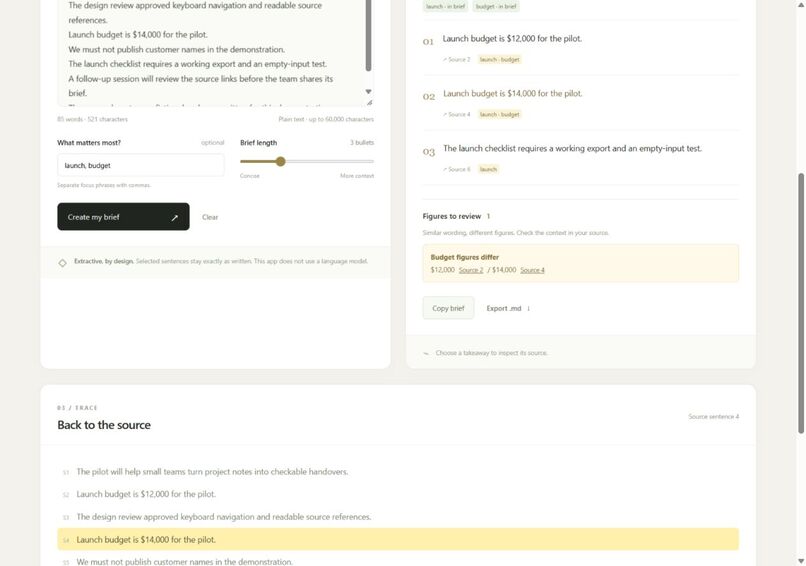
Actual application capture with fictional notes; deterministic extractive selection.
-
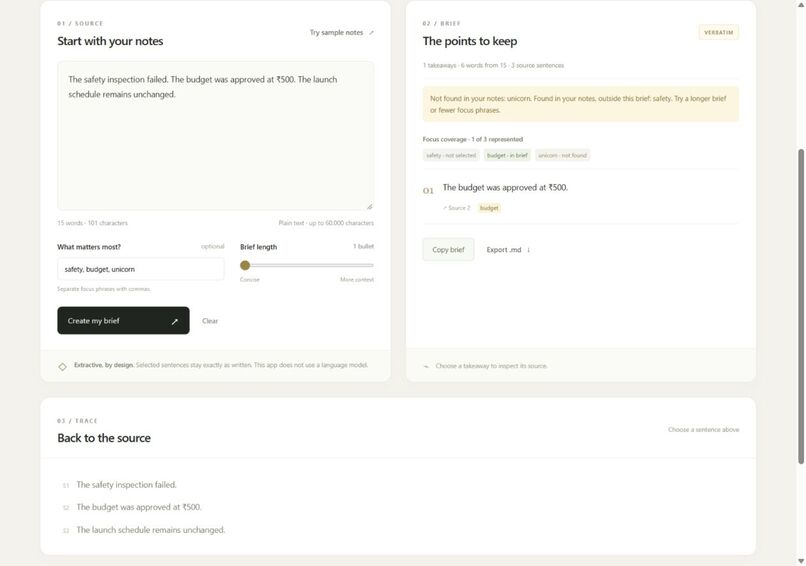
Source context remains inspectable. This capture uses fictional demonstration notes.
Try TraceBrief
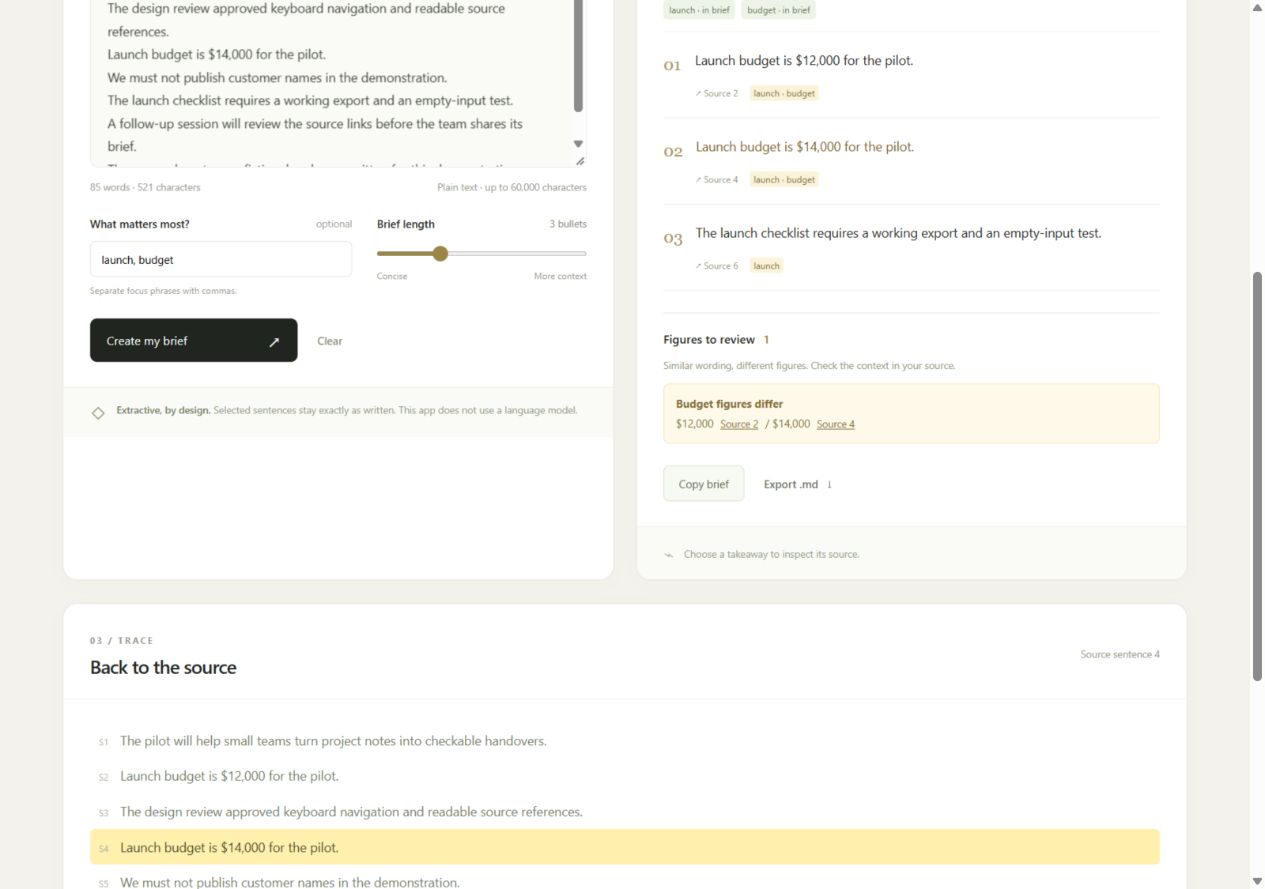
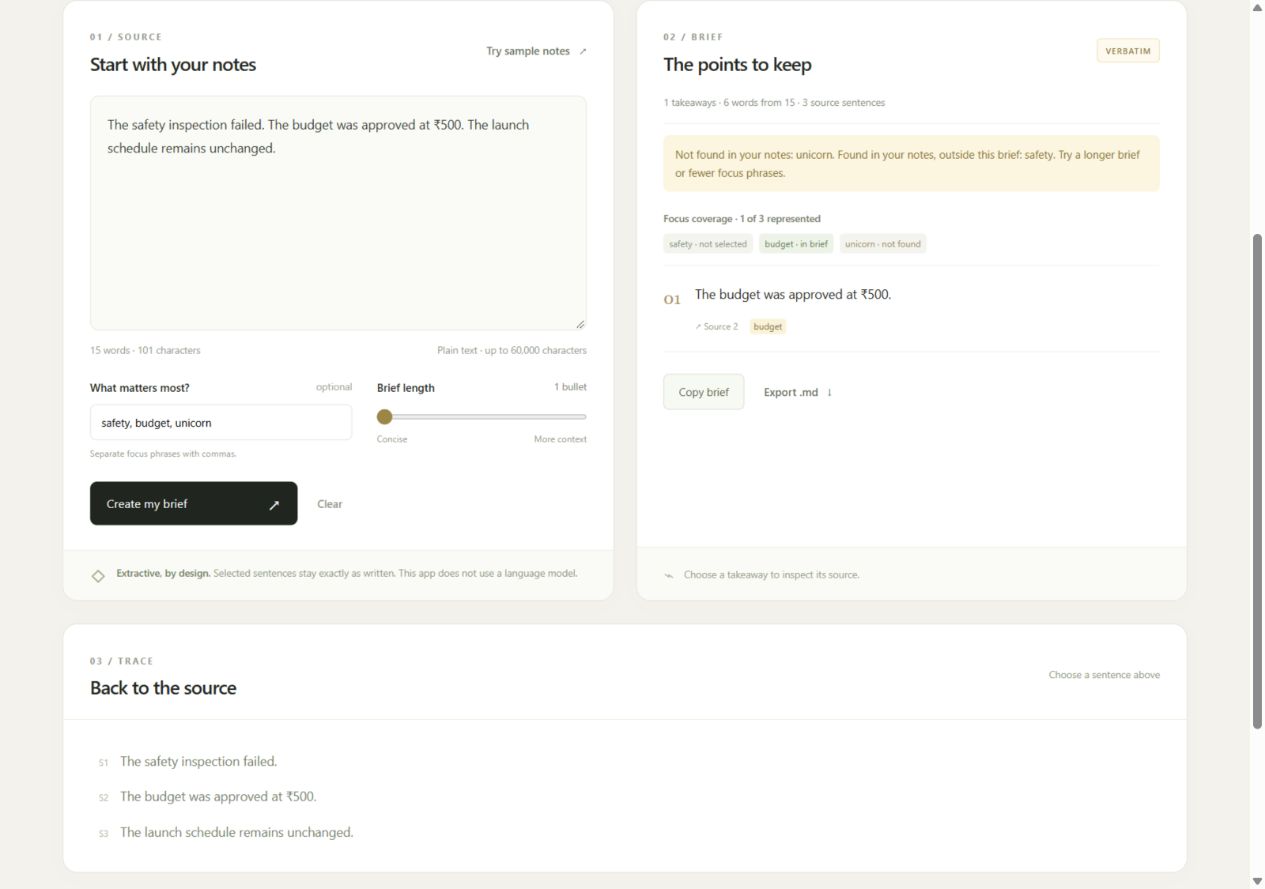
Open the working app — no account or installation needed. Choose Try sample notes, inspect the two budget statements through Source 2 and Source 4, then change a focus phrase to see stale exports disabled. Regenerate and export the Markdown brief with its source appendix. The sample notes are fictional; pasted notes are processed in your browser.
Inspiration and audience
A project lead preparing a handover needs a short account of the notes without losing the wording behind a decision or a number. A compact brief can conceal context: which statement supports a takeaway, whether a requested topic was left out, or why two similar budget statements differ. TraceBrief makes checking the brief part of the same workflow. The intended audience is a solo builder or project lead working with plain-text notes.
What it does
Paste notes, choose focus phrases and a bullet count, and create a brief of distinct verbatim source sentences. Each takeaway opens its original source. Focus coverage distinguishes a topic found in the notes but omitted from the brief from one not found at all.
Similar wording with different figures or supported deadline dates can produce a review hint linking both statements. Hints prompt a context check; they do not establish contradictions or truth. Editing notes or settings marks the output out of date and disables copy/export until regeneration. Markdown export includes the brief, coverage, review hints and a numbered source appendix.
How it was built
Built with AI assistance using the real Devpost Learn Skill Pack. The repository includes scope.md, prd.md, spec.md, a build checklist, code map and curriculum revision provenance. Routine product and technical decisions were explicitly delegated to Pro research and the coding agent; personal interviews, human testing and learning reflections are not claimed.
HTML, CSS and JavaScript implement the complete workflow without third-party runtime dependencies. The deterministic extractive engine preserves sentence offsets, scores content words and focus matches, and reduces repeated selections. It does not call a language model. Notes stay in browser memory: no accounts, API keys, model downloads, telemetry or automatic note storage. Open index.html directly, or use the optional loopback-only Node static server.
Challenges and development lessons
An ordinary Pro code critique supplied adversarial fixtures. Regression tests drove repairs for contextual headings and numbered lists, comparisons between different phases, revised deadlines across years, and omitted focus topics. Turning a vague concern into a failing fixture made those defects inspectable. These are documented development outcomes, not an invented personal learning reflection.
Verification and limits
All 17 files in the public source download match the audited snapshot, and 14/14 Node tests pass on that download. Saved agent browser checks cover source inspection, stale-result controls, clipboard/download behavior, empty input, literal HTML and mobile layout. These are engineering checks, not a summary-quality benchmark or human usability study.
The 128-second demo is a captioned sequence of actual internal-browser captures of the app and its public build documents, not continuous recording. Notes are fictional.
Sentence splitting, ranking and review hints are heuristics. Exact quotations can omit surrounding context. Limits: 60,000 characters, 300 source sentences, six focus phrases and eight bullets. Date review supports validated English month-name and ISO dates. No semantic truth verification, customer interviews or measured time saving is claimed.
Next steps
Evaluate selection quality with consenting users and documented handover tasks before expanding formats or algorithms. That evaluation has not occurred.

Log in or sign up for Devpost to join the conversation.