Inspiration
Educational publishers already own thousands of valuable math questions, but turning each question into a complete visual lesson requires mathematical reasoning, scene design, narration, captioning, rendering, delivery, and asset management.
Most AI tools return a single opaque answer or video. Publishers need something different: a reviewable production workflow where the source, reasoning, visual scenes, narration, captions, final lesson, and delivery files remain connected and reusable.
What it does
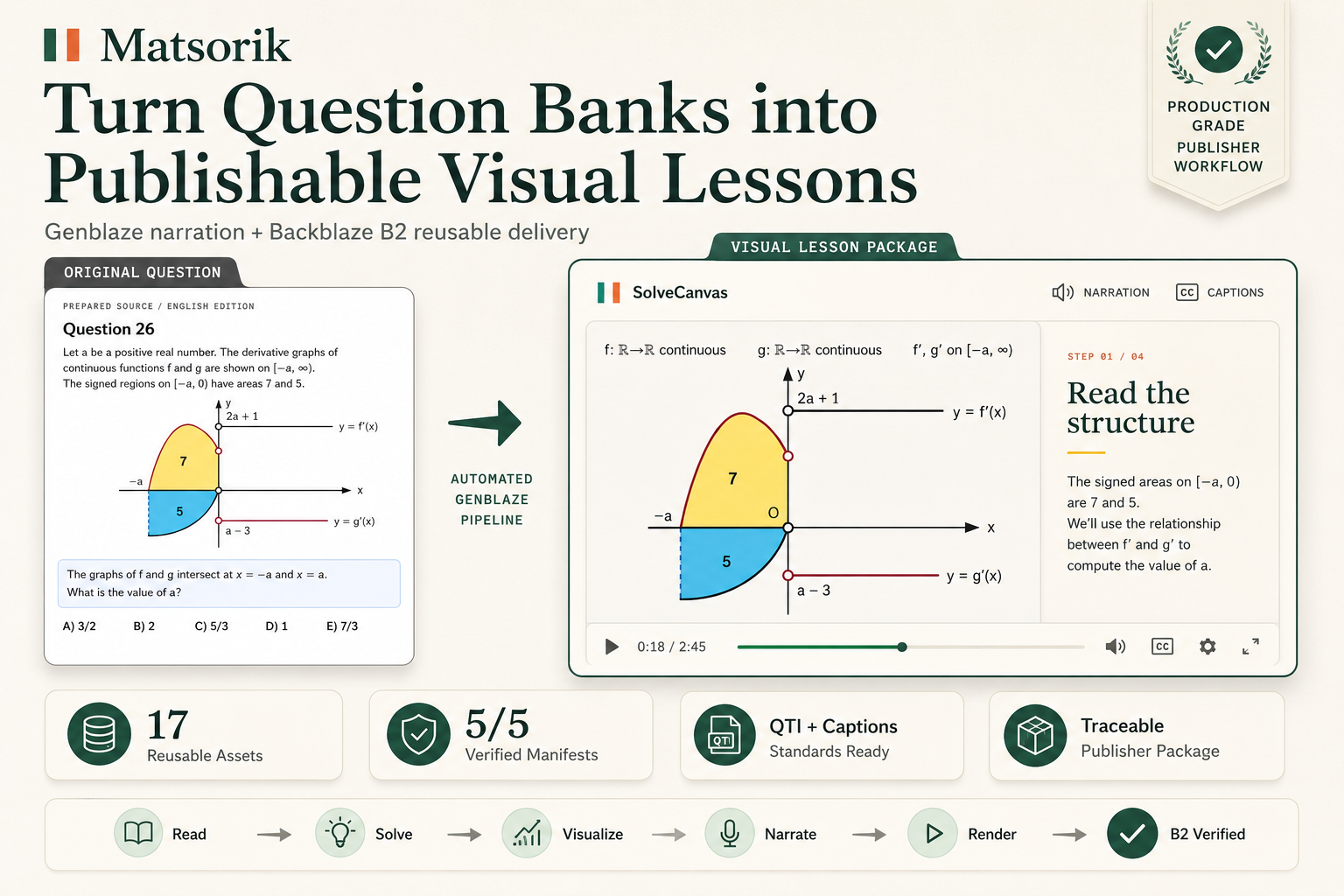
Matsorik transforms a publisher-owned math question into a complete visual lesson package.
For each question, the system produces:
- A grounded representation of the original source
- A structured step-by-step solution
- Editable SVG teaching scenes and PNG posters
- Narration audio
- Timed WebVTT captions
- A playable MP4 visual lesson
- A QTI 3.0 assessment export
- Accessibility metadata
- Provenance manifests and integrity records
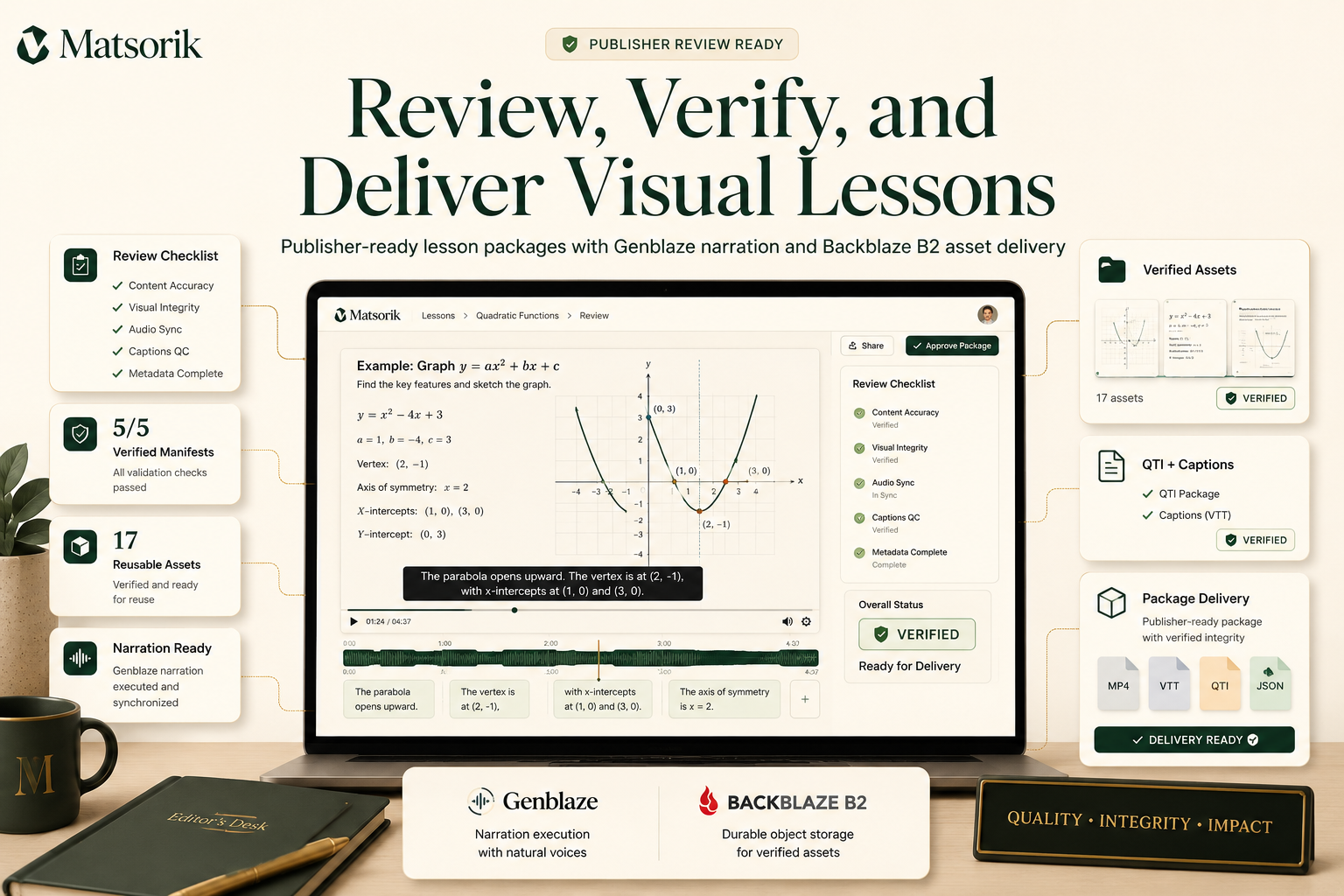
Editors can compare the original question with the reconstructed lesson, replay the production stages, inspect the Genblaze execution receipt, browse the Backblaze B2 package, and independently verify the stored files.
Real-world utility
The target users are educational publishers and content production teams that need to convert large question banks into digital learning materials.
The existing Matsorik product has already served more than 30,000 question-solving sessions and reached more than 2,500 app downloads. These metrics belong to the existing Matsorik product, not to the new Genblaze pipeline.
During this hackathon, I built a new publisher-oriented production and delivery layer on top of that validated need.
How we built it
The workflow contains five production stages and one B2 delivery gate:
- Read — Ground the original source question and its mathematical structure.
- Solve — Build a structured teaching and reasoning path.
- Visualize — Reconstruct the question as deterministic, editable SVG teaching scenes.
- Narrate — Execute narration through a native Genblaze pipeline boundary.
- Render — Compose synchronized scenes, narration, captions, and the final MP4.
- Verify and deliver — Store and remotely verify the complete publisher package on Backblaze B2.
The existing Matsorik core handles source grounding, mathematical reasoning, deterministic SVG rendering, and video composition.
The challenge-specific layer adds native Genblaze narration, linked execution lineage, content-addressed B2 storage, remote SHA-256 verification, QTI/accessibility delivery files, and a prepared judge replay.
How we use Genblaze
Matsorik implements Google Gemini TTS as a custom Genblaze SyncProvider inside a retryable Pipeline.
Genblaze executes the real narration call. The generated narration is a required input to the final lesson, rather than a record created after generation.
The Genblaze layer provides:
- A native provider execution boundary
- Retry and execution controls
- Run metadata and production lineage
- Canonical provenance manifests
- Delivery through an ObjectStorageSink
- A stable abstraction that allows the narration provider to be replaced later
The prepared judge replay uses stored outputs from a verified production run, while live generation uses the same production path.
How we use Backblaze B2
Backblaze B2 is not used as a final-video dump.
Every approved lesson is stored as a content-addressed package containing the source image, normalized source data, structured reasoning, SVG scenes, PNG posters, narration audio, timed captions, final MP4, QTI package, accessibility metadata, and provenance manifests.
For the prepared run, Matsorik stores 17 reusable assets and five linked manifests.
The application retrieves the remote B2 objects and verifies their SHA-256 values. This makes the lesson package durable, inspectable, reusable, and independently verifiable.
Production readiness
The application is deployed on Google Cloud Run and includes:
- A public zero-call prepared replay for reliable judging
- Protected live generation with judge access
- Server-side credentials
- Generation quotas and one-job execution controls
- Full MP4 decode validation
- Remote B2 object verification
- Manifest verification
- Explicit error and completion states
- Playable English narration and timed captions
The output is designed as a publisher delivery package rather than a one-off AI response.
Challenges we ran into
The hardest problem was preserving fidelity between a raster source question and an editable visual lesson.
The system needed to keep the original mathematical relationships intact while separating the workflow into reviewable source, reasoning, scene, narration, and delivery boundaries.
A second challenge was integrating deterministic rendering with a generative-media SDK without pretending that Genblaze executed steps it did not execute. The final architecture keeps the existing mathematical and rendering core explicit while making narration a real Genblaze execution dependency.
Accomplishments that we're proud of
- A real Genblaze-executed narration boundary
- A complete content-addressed publisher package on Backblaze B2
- Remote verification of 17 stored assets
- Five linked production manifests
- Editable SVG scenes rather than raster-only outputs
- English narration and timed captions
- MP4, QTI, accessibility, and provenance files from one source question
- A deployed application that judges can test without triggering external model costs
What we learned
Models are replaceable. The durable value is the production workflow: how approved source material becomes reusable media, how each asset is connected, and how the final delivery can be inspected and verified.
Genblaze provides the execution abstraction and provenance boundary. Backblaze B2 preserves the reusable media package after individual model outputs would otherwise expire.
What's next for Matsorik
The next step is to pilot the workflow with educational publishers.
Future work includes answer-key reconciliation, book-level release-readiness reports, permanent QR delivery, additional LMS import testing, and extending the validated workflow beyond mathematics.

Log in or sign up for Devpost to join the conversation.