-
-
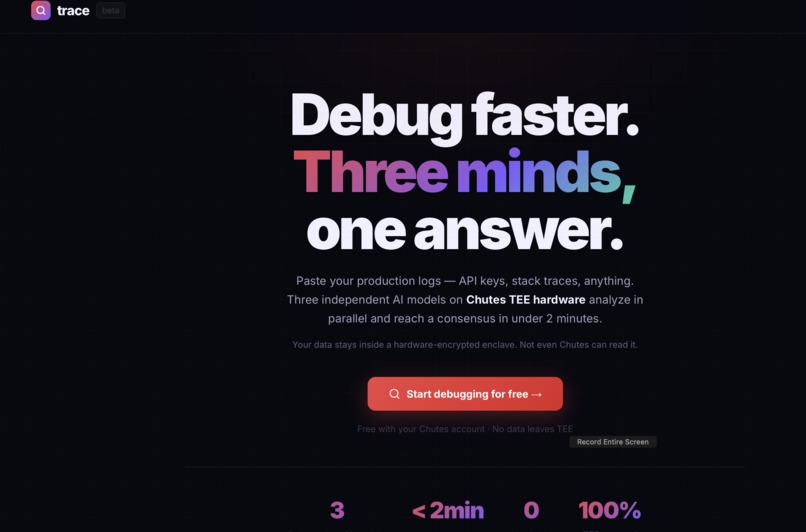
Homepage
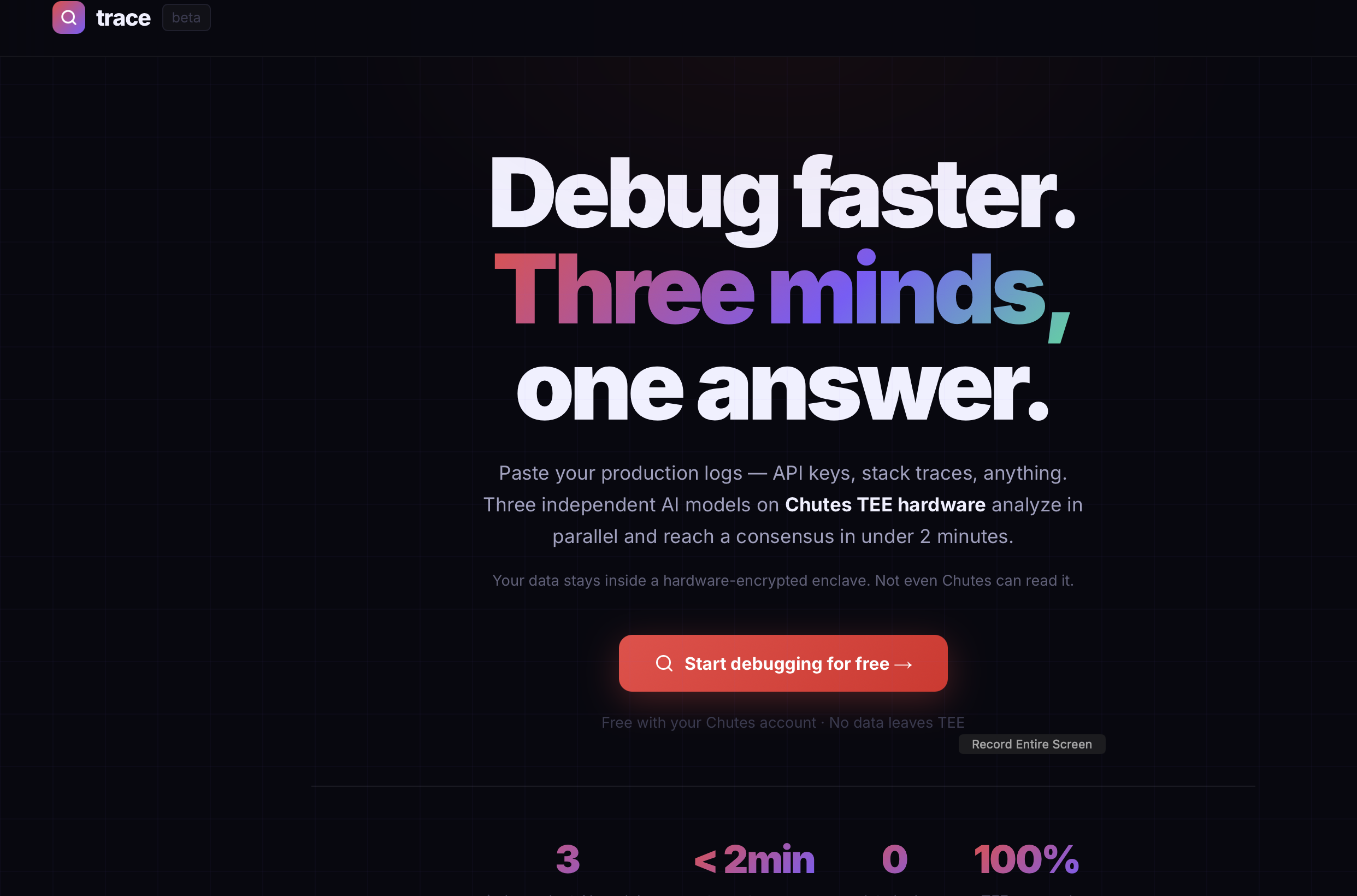
Inspiration
Every developer has done it: your production server crashes, you panic, and you paste the raw stack trace straight into ChatGPT or Claude. But what did you just paste? Database credentials? API keys? PII?
By pasting production logs into public, unencrypted models, developers inadvertently leak highly sensitive company data. We wanted to build a debugging tool that offers the intelligence of state-of-the-art AI, but with absolute, zero-trust privacy.
What it does
Trace is a production-safe debugging platform built entirely on the Chutes Trusted Execution Environment (TEE) network.
Credential Sealing: When you paste a log, file, or GitHub repo into Trace, our ultra-fast parsing agent detects sensitive strings (like Postgres connection strings, Stripe keys, or AWS tokens). It redacts and seals these credentials inside the hardware-encrypted enclave before the main analysis even begins. Parallel Investigation: Instead of relying on a single model (which might hallucinate), Trace leverages a multi-agent architecture. It queries three distinct, state-of-the-art open-weights models provided by Chutes (Qwen3 32B, Gemma 4, and DeepSeek V3). Because their architectures and training datasets differ, they act as genuinely independent investigators. Consensus Verdict: A Chief Synthesis Agent (DeepSeek) reviews the three independent hypotheses, resolves any conflicts, and outputs a final, verified root cause and drop-in code fix.
How we built it
Frontend: Built with Next.js 14, React, and tailored CSS to create a premium, dark-mode enterprise developer experience. Authentication: Integrated natively with Chutes OAuth, ensuring users are authenticated securely and their invocations are tied to their own rate limits. AI Orchestration: We utilized the Chutes Inference API to stream completions from multiple models. We engineered highly specific system prompts to force the models to return structured JSON, which our Next.js backend parses to generate the live chain-of-thought UI.
Challenges we ran into
Orchestrating three massive LLMs simultaneously required careful async state management. We also faced challenges getting different open-weights models to consistently adhere to strict JSON output schemas. Finally, implementing PKCE OAuth in Next.js 14 Route Handlers introduced edge cases with cookie persistence that we had to debug and rewrite from scratch.
Accomplishments that we're proud of
We are incredibly proud of the UI/UX polish. We didn't want this to feel like a quick hackathon project; we wanted it to feel like a premium tool you would pay $20/month for. We are also proud of the parallel consensus architecture—watching three different models "think" about the same problem in real-time is genuinely magical.
What we learned
We learned the immense value of Trusted Execution Environments (TEEs) like Intel SGX and AMD SEV-SNP. Being able to cryptographically prove that host providers cannot read the memory of an AI process is going to change the future of enterprise software.
What's next for Trace
We plan to expand Trace beyond a web interface by building an official VS Code and Cursor extension. This will allow developers to run TEE-secured consensus debugging directly from their IDEs without ever breaking their flow state.
Built With
- chutes-api
- chutes-oauth
- deepseek
- gemma
- next.js
- qwen
- react
- tailwindcss
- typescript