Inspiration
React code reviews are tedious and inconsistent. Junior devs get inconsistent feedback; senior devs waste hours on mechanical checks. We wanted an agent that doesn't just review code — it gets better at reviewing code the more it runs, closing the loop between execution and improvement automatically.
What It Does
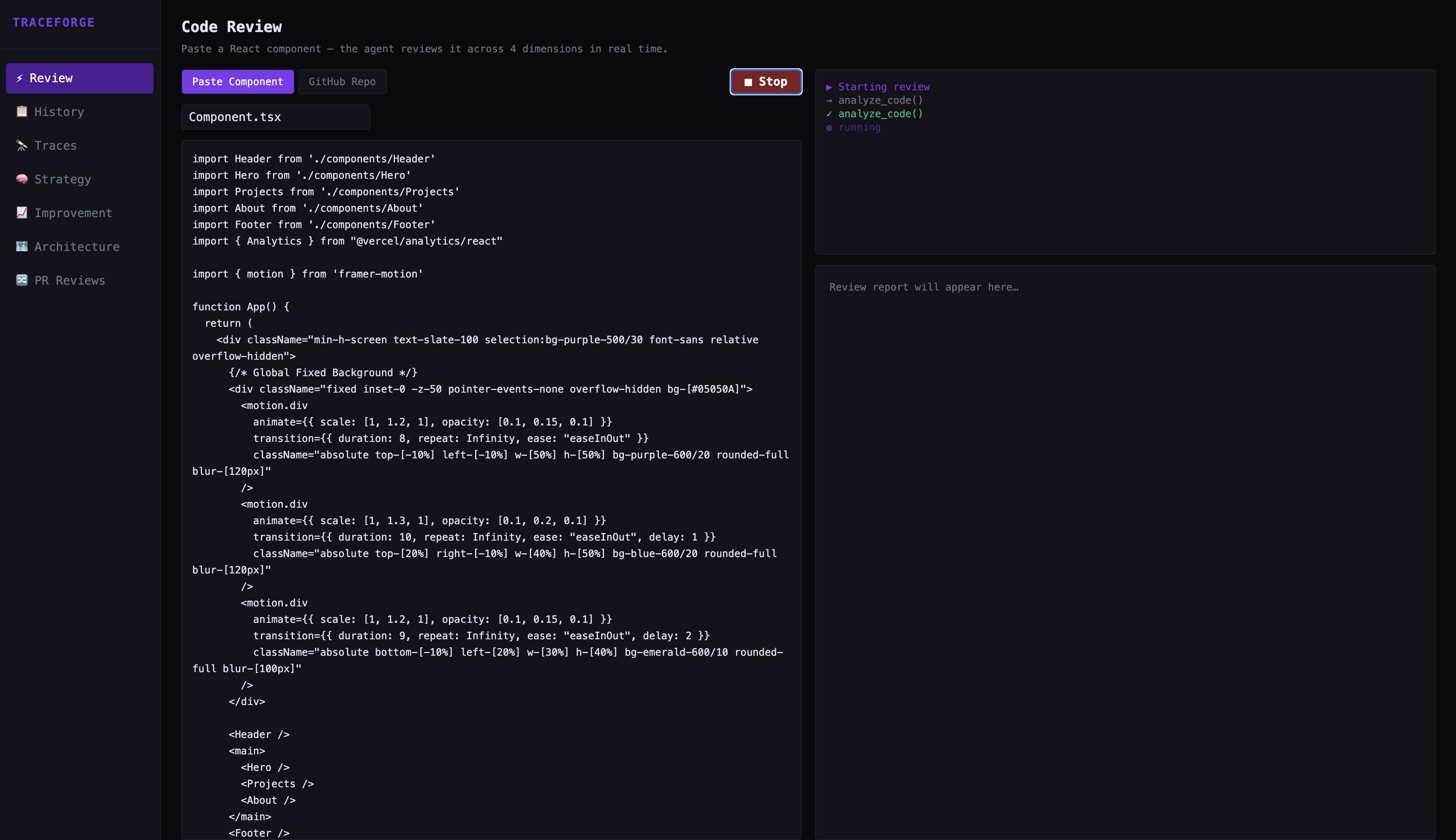
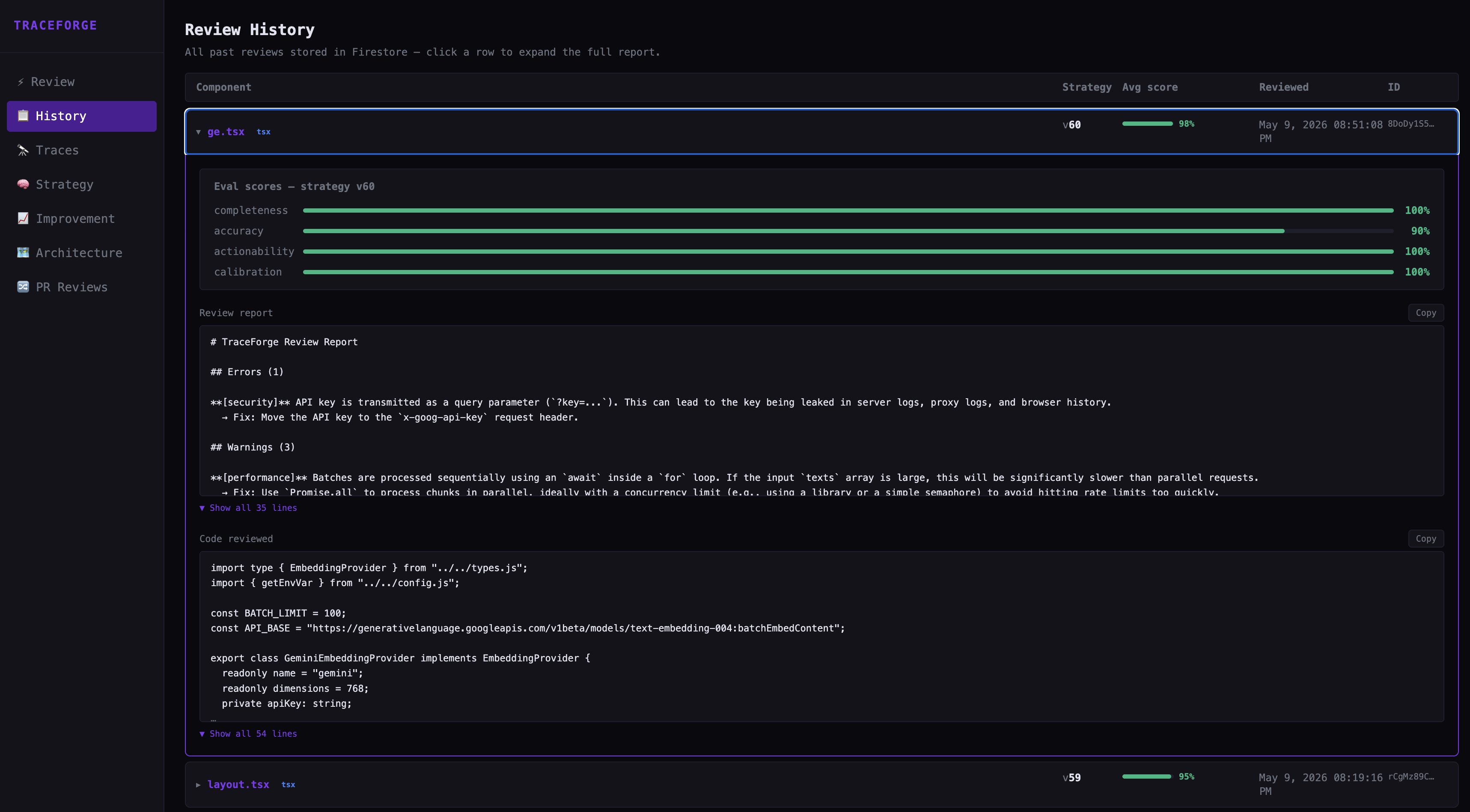
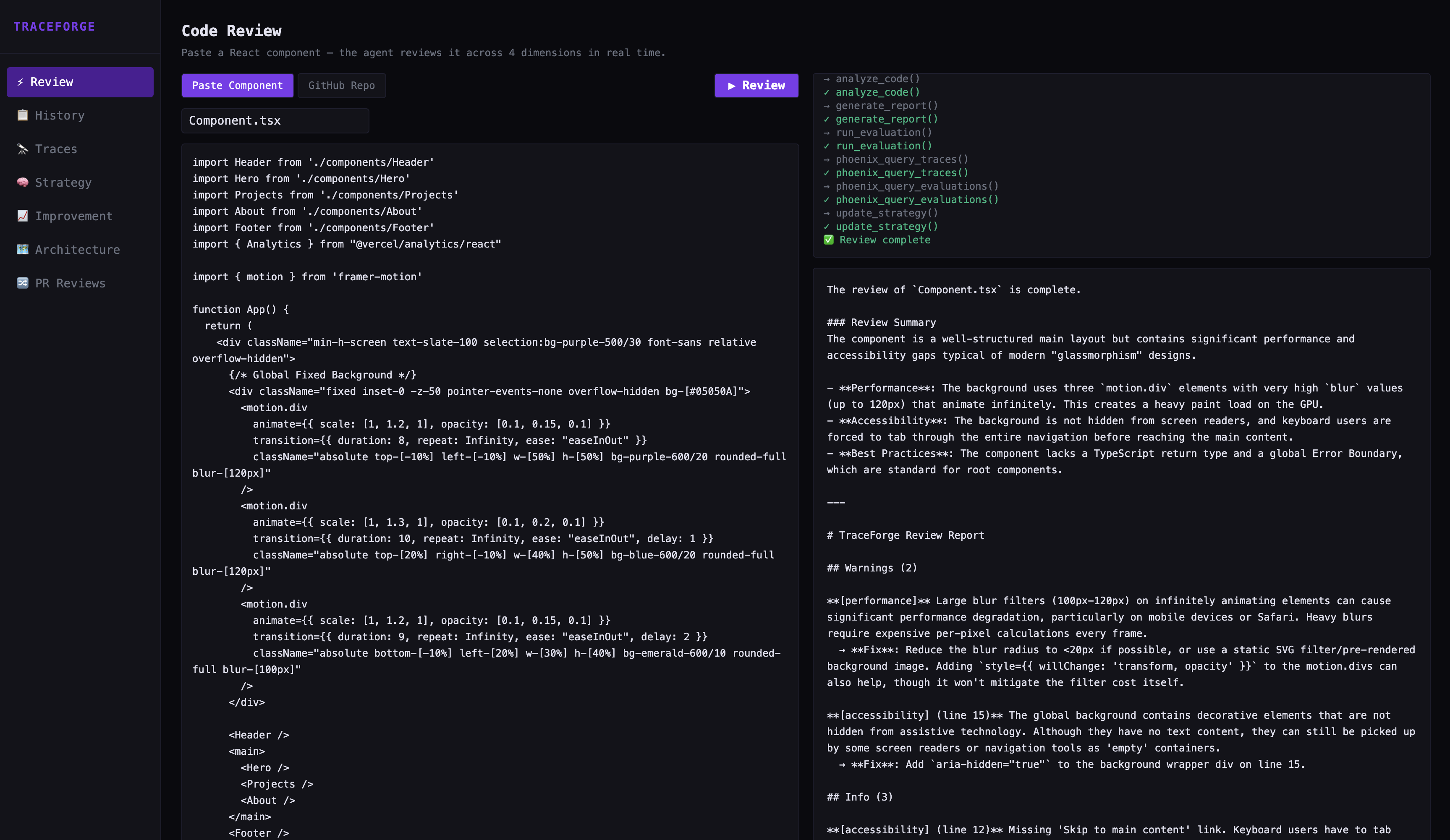
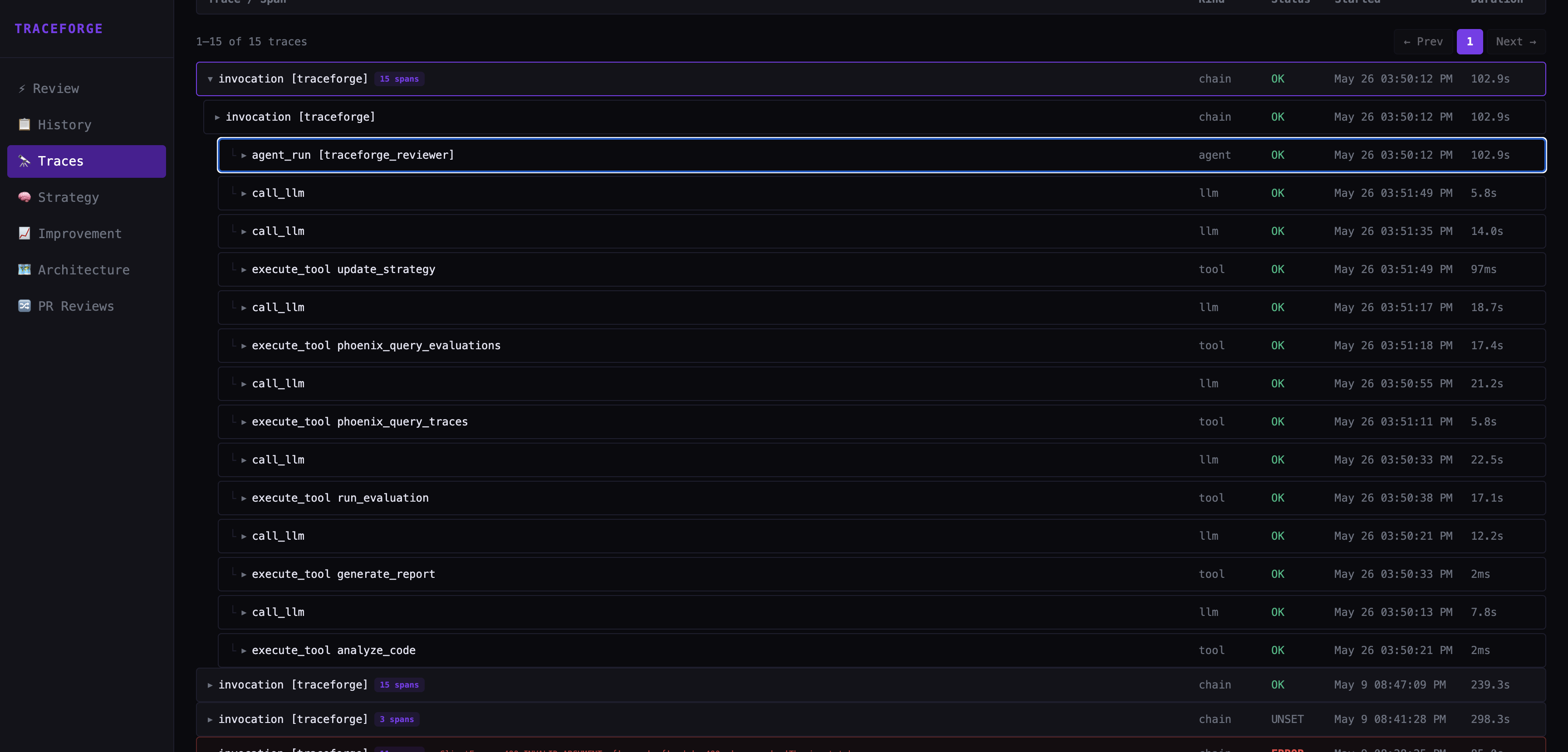
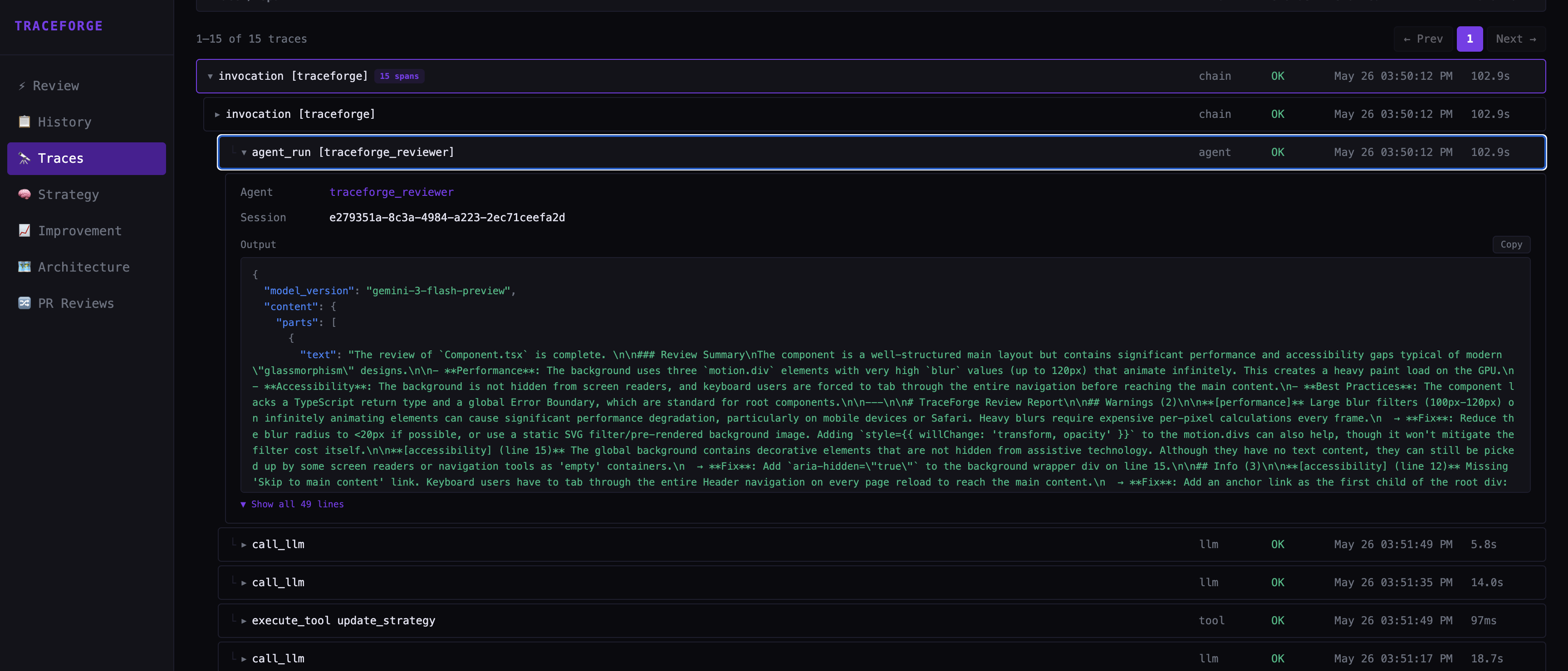
TraceForge reviews React components across 4 dimensions — performance, accessibility, best practices, and security — then evaluates its own output and updates its review strategy after every run. Each review is traced end-to-end in Arize Phoenix Cloud so you can inspect every LLM call, tool invocation, and token count.
The self-improvement loop:
- Review → agent analyzes component across 4 dimensions
- Evaluate → LLM-as-Judge scores completeness, accuracy, actionability, calibration
- Reflect → agent queries its own past traces via Phoenix MCP
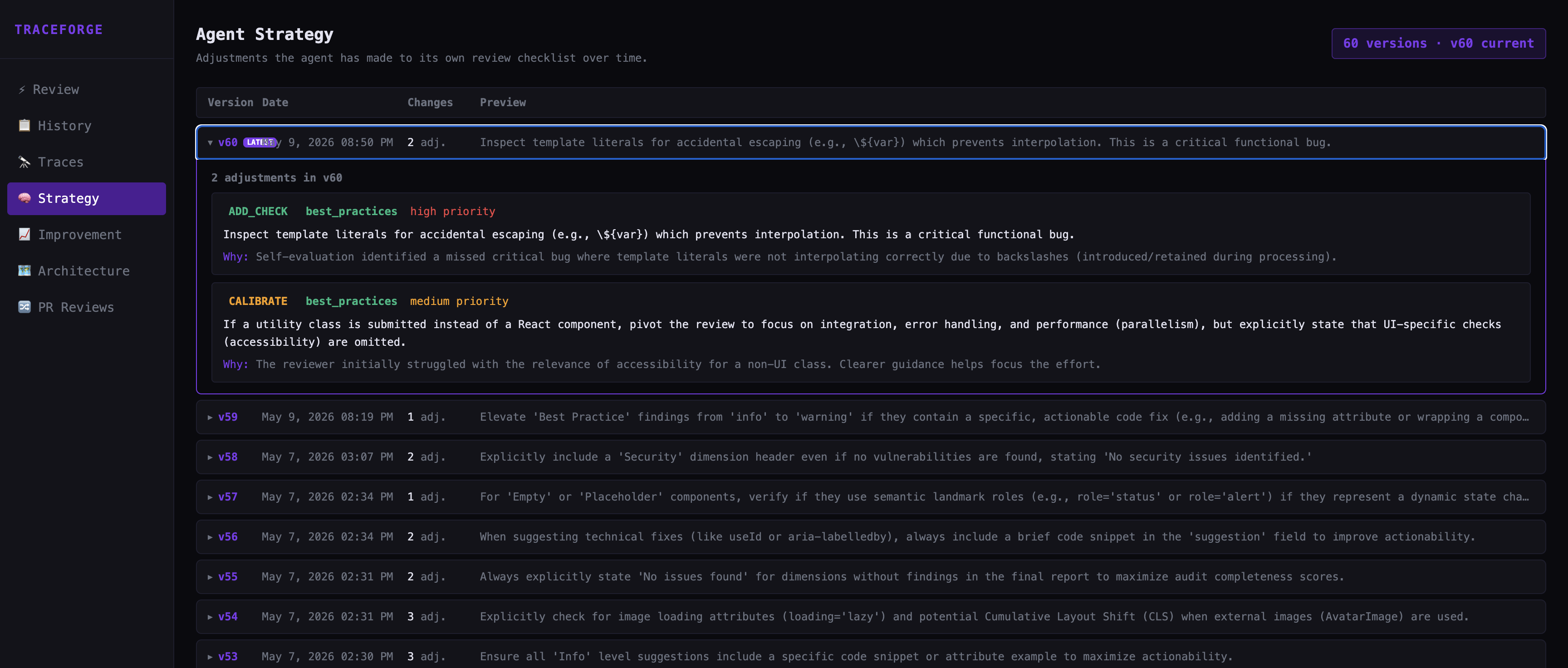
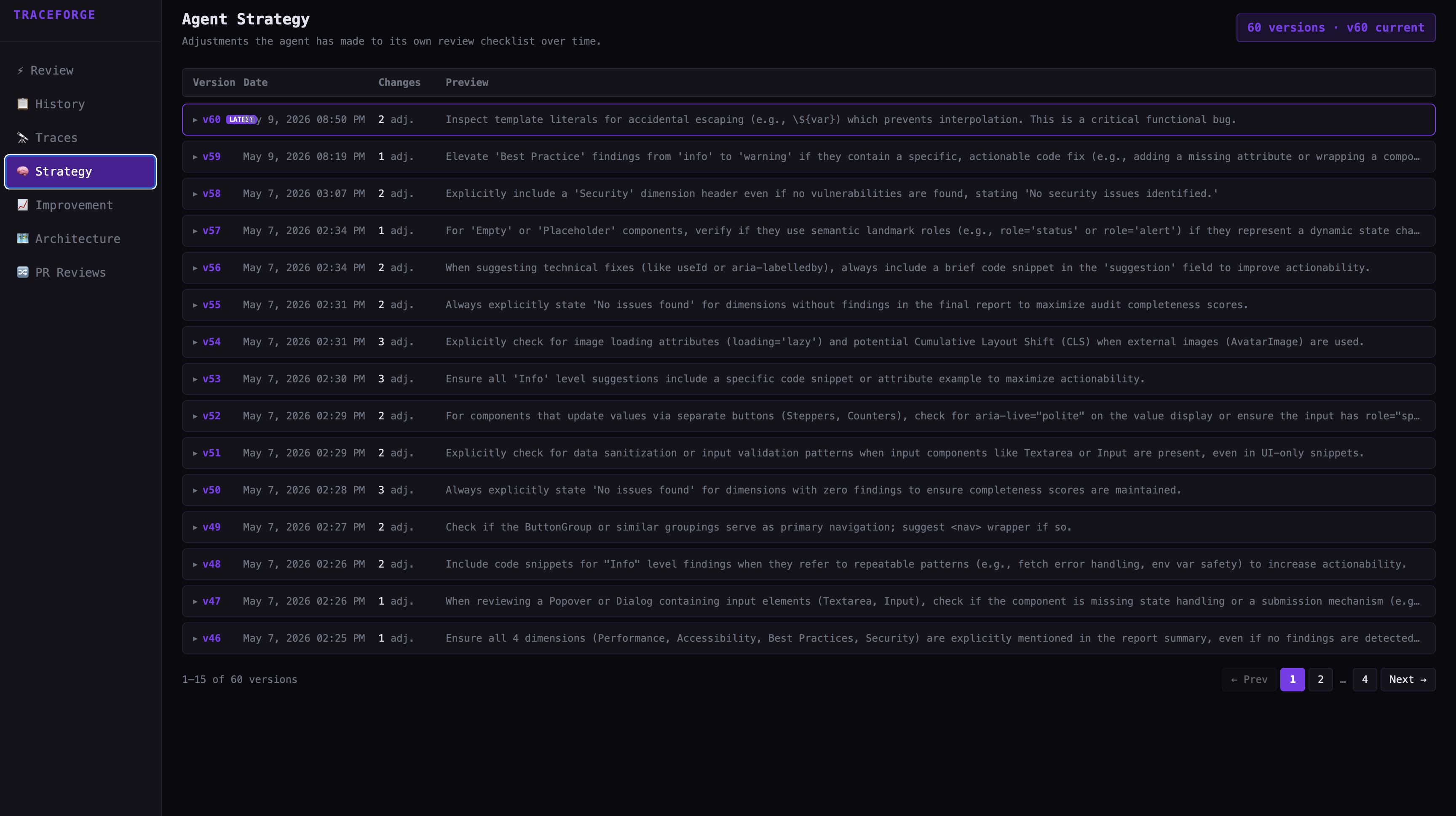
- Update → agent writes strategy adjustments to Firestore (v1 → v2 → v3 ...)
- Repeat → next review loads latest strategy → improved coverage
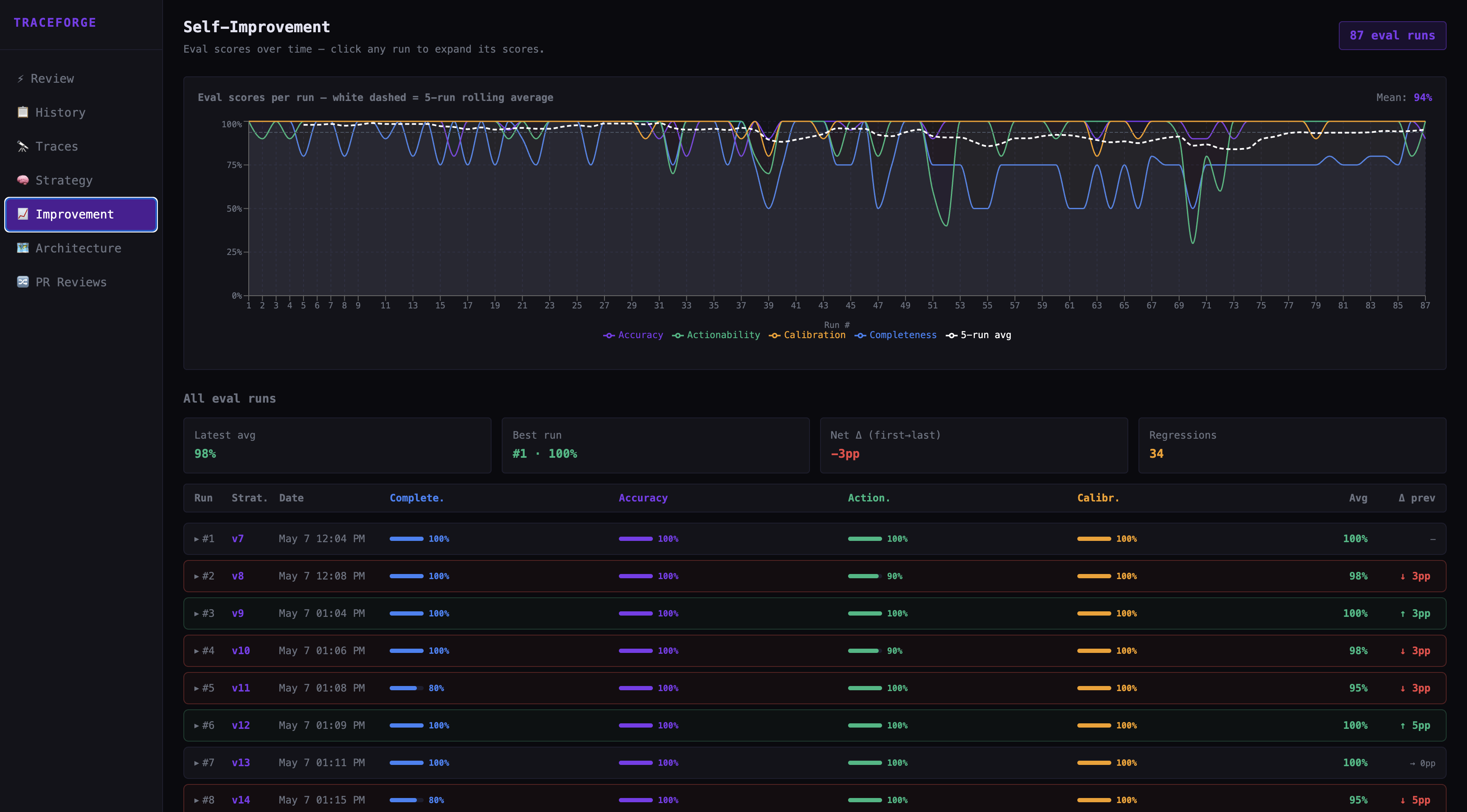
After 50+ reviews the agent has updated its strategy to v58, adding specific checks for icon-only button labels, memoization chain verification, inline style detection, and dozens more — none of which were in the original prompt.
How We Built It
- Agent runtime: Google ADK (Python) with
LlmAgentorchestrating all tool calls - LLM: Gemini 3 Flash Preview via Vertex AI (
location=global— required for Gemini 3) - Tracing:
openinference-instrumentation-google-adk→ Arize Phoenix Cloud for full observability - Self-introspection:
@arizeai/phoenix-mcp— the agent queries its own past traces to reflect on past performance - Web framework: FastAPI + Server-Sent Events for real-time streaming
- Frontend: Next.js 15 App Router + Tailwind CSS v4 + Recharts for eval trend charts
- Persistence: Cloud Firestore (reviews, strategy versions, eval history)
- Hosting: Cloud Run (two services — agent backend + Next.js frontend)
Challenges We Ran Into
- Gemini 3 availability: Gemini 3 models are only available via
location=globalon Vertex AI — standard regional endpoints return 404. Took some digging to discover this. - Sync Firestore in async FastAPI: Firebase Admin SDK is synchronous only. We used
run_in_executorto call Firestore without blocking the async event loop. - SSE through Cloud Run: Getting Server-Sent Events to stream correctly through Cloud Run's HTTP/2 required careful tuning of buffer and flush settings.
- LLM-as-Judge reliability: Prompt-engineering the eval rubric so scores were consistent and actionable — not just a number, but a signal the agent could act on.
Accomplishments That We're Proud Of
- A fully autonomous self-improvement loop that genuinely works: strategy v1 → v58 with measurable gains in eval scores across 50+ runs.
- End-to-end observability via Arize Phoenix — every token, every tool call, every eval score is inspectable.
- Live streaming review UI that shows the agent's reasoning in real time via SSE.
What We Learned
- Google ADK is remarkably expressive for multi-tool agents; the
LlmAgentabstraction handles tool routing cleanly. - LLM-as-Judge is a powerful eval primitive when the rubric is carefully designed — subjective dimensions like "actionability" and "calibration" are hard to measure any other way.
- Arize Phoenix's MCP server is a game-changer: letting the agent introspect its own traces closes the feedback loop without any human in the loop.
What's Next for TraceForge
- Expand beyond React to TypeScript/Node and Python codebases
- Add multi-model comparison (run the same component through Gemini and GPT-4o, compare evals)
- Let users subscribe to strategy updates — get notified when the agent discovers a new class of bug
- Open-source the self-improvement framework as a reusable ADK pattern


Log in or sign up for Devpost to join the conversation.