Inspiration
Modern teams spend most of their day collaborating in Slack. Important decisions, technical solutions, customer insights, and internal processes are constantly being discussed, but much of that knowledge gets buried in message history and becomes difficult to find later.
While researching existing solutions, I noticed that many knowledge management tools focus primarily on questions and answers or rely on continuously scanning conversations. For many organizations, especially those handling sensitive information, that raises concerns around privacy, trust, and control.
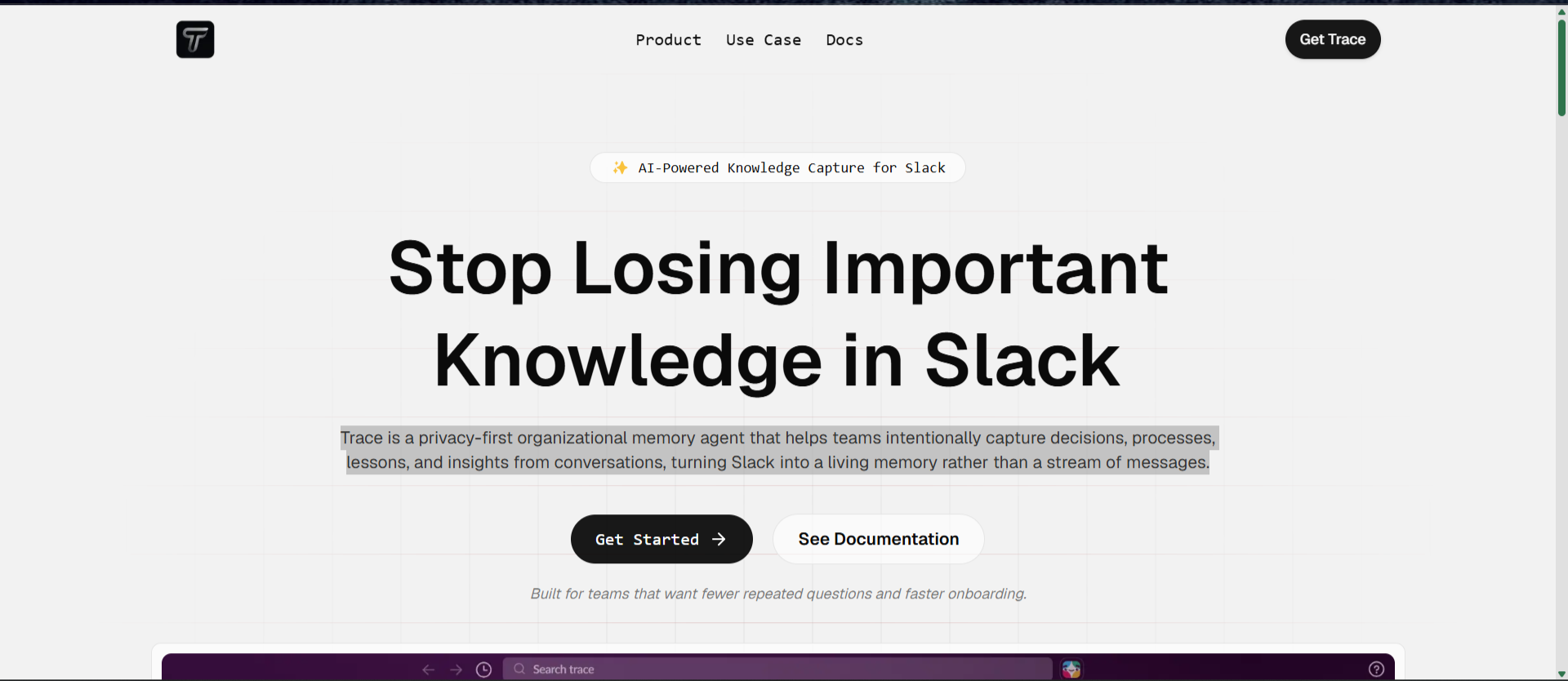
I wanted to build a solution that could help teams preserve valuable knowledge without requiring AI to monitor everything. That idea became Trace: a privacy-first organizational memory agent for Slack.
What it does
Trace helps teams intentionally capture and retrieve knowledge from Slack conversations.
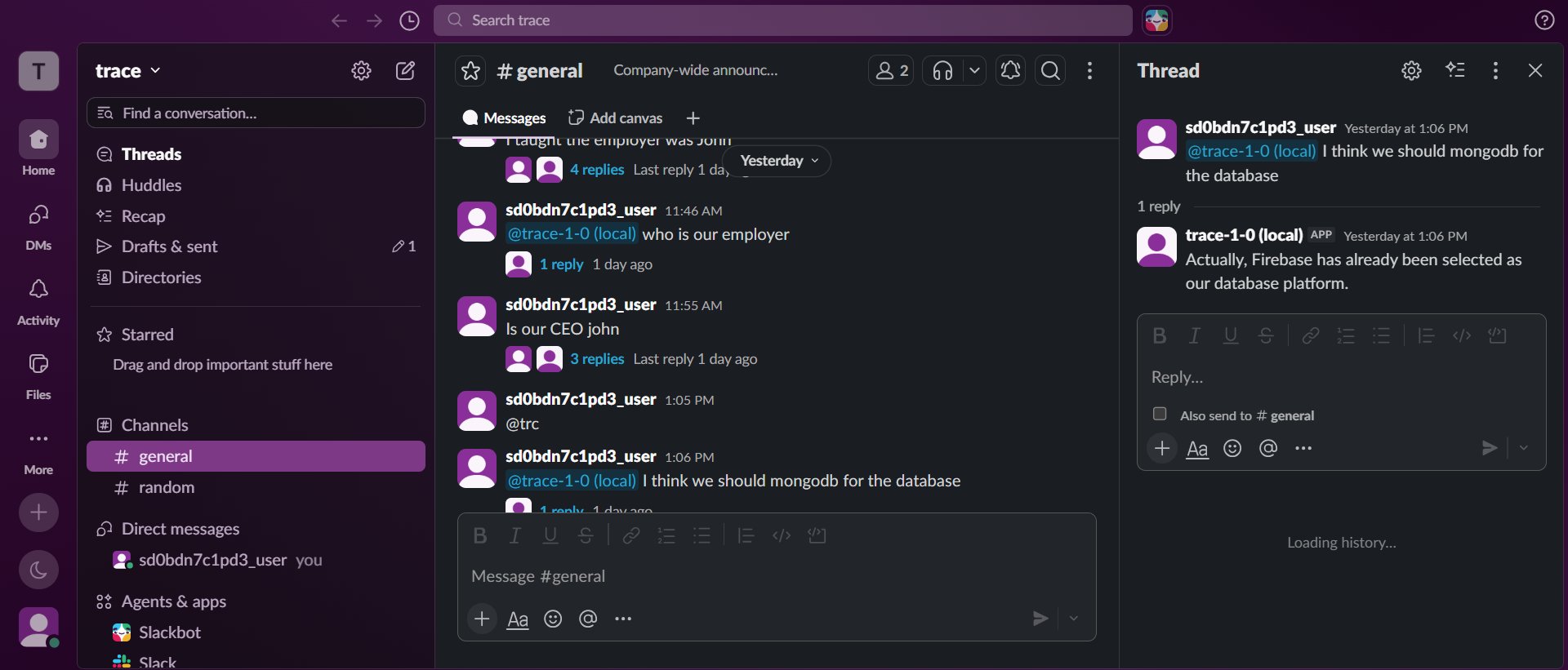
Instead of automatically scanning conversations, Trace only analyzes discussions when users explicitly invoke it using commands such as @trace or @trace save.
When activated, Trace:
- Analyzes conversation context
- Identifies valuable knowledge
- Extracts decisions, processes, lessons, and insights
- Generates structured summaries
- Stores knowledge for future retrieval
- Answers questions using previously captured organizational knowledge
By doing this, Trace transforms Slack from a stream of messages into a searchable organizational memory.
How I built it
Trace was built as a Slack-native AI agent using:
- Slack Platform
- Gemini AI
- Supabase
- Next.js
- TypeScript
The workflow is simple:
- A user invokes
@tracewithin a Slack conversation. - Trace retrieves the relevant conversation context.
- Gemini analyzes the discussion and extracts meaningful knowledge.
- The knowledge is categorized and structured.
- Approved entries are stored in Supabase.
- Users can later retrieve that knowledge directly from Slack.
The Slack App serves as the primary interface, while a companion dashboard provides visibility into captured knowledge and workspace insights.
Challenges I ran into
One of the biggest challenges was deciding how knowledge should be captured.
Initially, I explored automatically scanning conversations, but quickly realized that many organizations would not be comfortable with AI continuously analyzing potentially sensitive discussions. This led to a complete rethink of the workflow and ultimately became one of Trace's strongest differentiators: intentional knowledge capture.
Another challenge was determining what qualifies as valuable organizational knowledge. Not every conversation should be stored. The system needed to identify meaningful information such as decisions, processes, lessons learned, and insights while ignoring casual discussions.
Balancing privacy, usability, and AI accuracy was a major focus throughout development.
Accomplishments that I'm proud of
- Building a fully functional Slack-native AI agent
- Creating a privacy-first approach to knowledge capture
- Designing a workflow that gives users full control over what is analyzed and stored
- Transforming unstructured conversations into structured organizational knowledge
- Creating a system that captures more than just questions and answers
- Delivering a working prototype that demonstrates the complete capture-and-retrieval workflow
Most importantly, I'm proud of creating a solution that helps teams preserve knowledge without requiring AI to continuously monitor conversations.
What I learned
Building Trace reinforced an important lesson: successful AI products are not just about intelligence—they are also about trust.
Organizations need confidence that they remain in control of their data and workflows. By making knowledge capture intentional rather than automatic, Trace demonstrates that AI can provide value while still respecting privacy and user control.
I also learned how important context is for conversational AI. The quality of extracted knowledge depends heavily on understanding the surrounding discussion rather than analyzing individual messages in isolation.
As a solo builder, I gained a deeper appreciation for balancing product design, AI capabilities, user trust, and technical implementation while working within the constraints of a hackathon timeline.
What's next for Trace
The long-term vision for Trace is to become the organizational memory layer for modern teams.
Future plans include:
- Knowledge approval and review workflows
- Advanced search and retrieval capabilities
- Workspace analytics and insights
- Knowledge quality scoring
- Cross-platform integrations
- Team onboarding experiences powered by organizational knowledge
- Rich dashboards for exploring captured insights
My goal is to help teams preserve, discover, and leverage their collective knowledge without changing the way they already work and communicate.
Built With
- gemini
- next.js
- slack-platform
- supabase

Log in or sign up for Devpost to join the conversation.