-
-
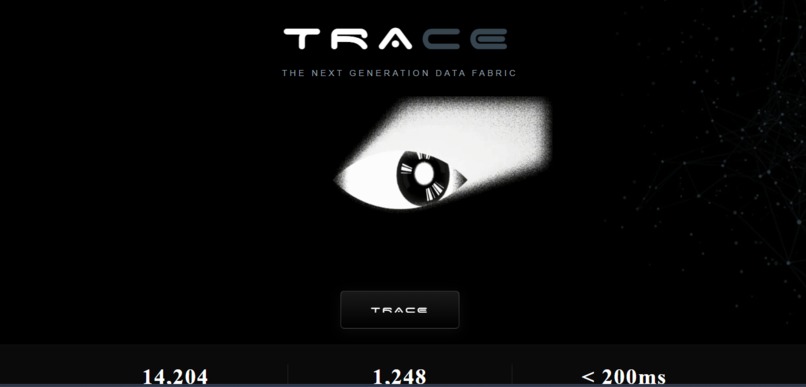
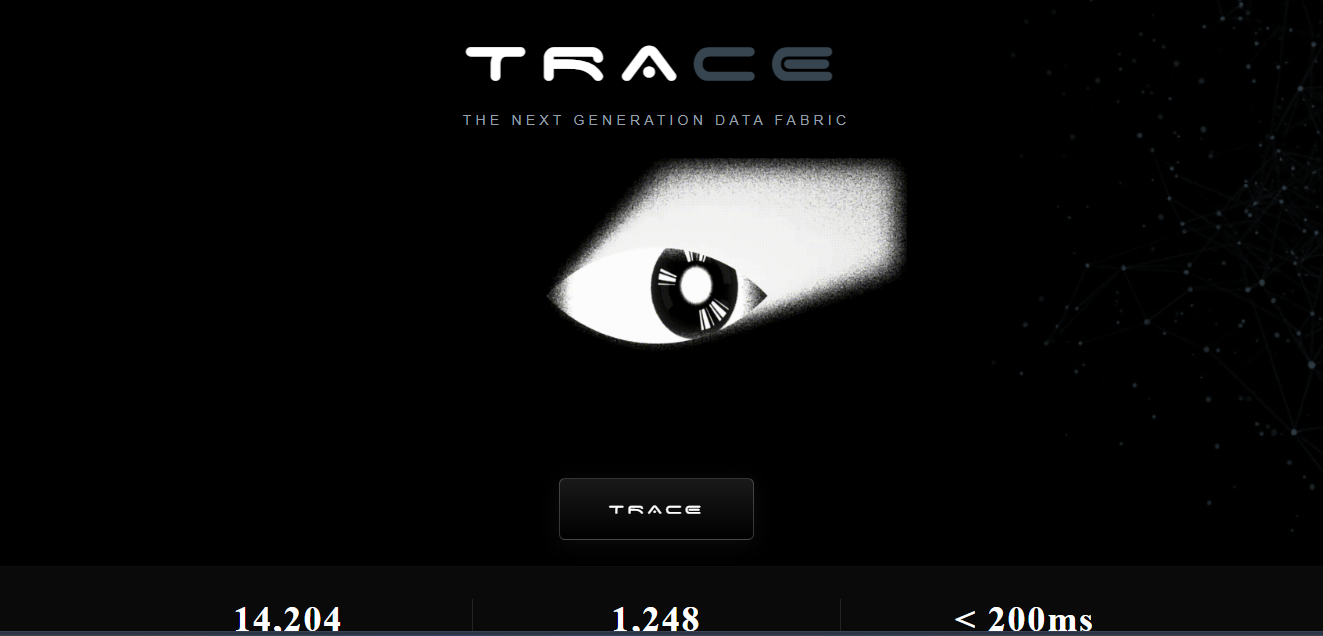
homepage image
-
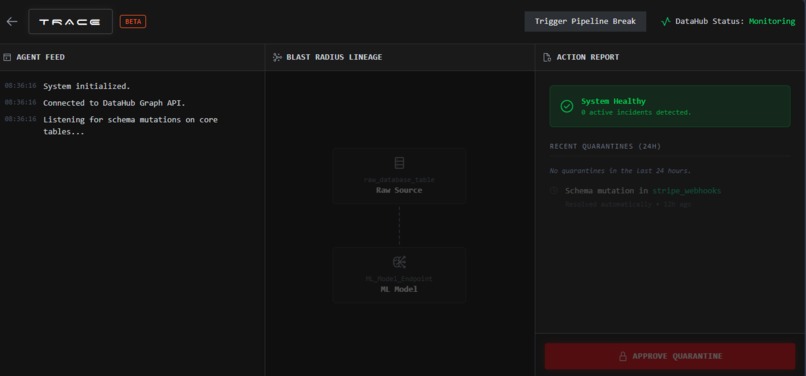
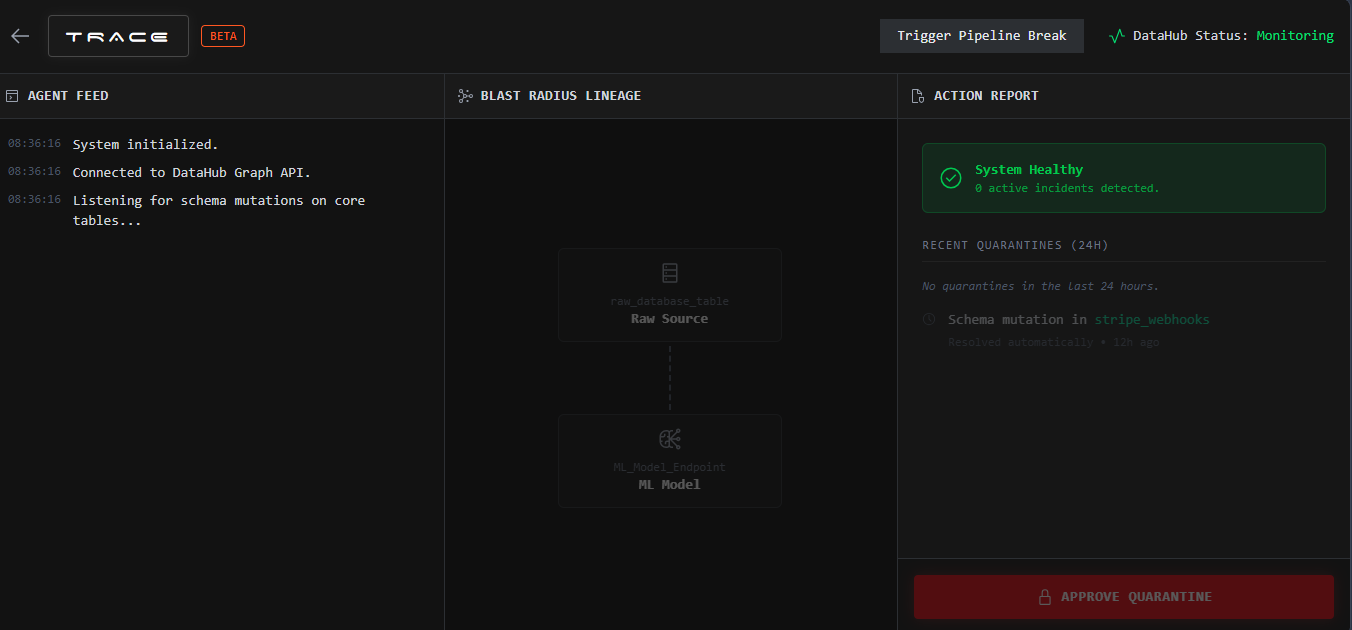
main build image
🛡️ TRACE: Autonomous Production ML Feature-Drift Detective
Author: Technical Founder & Architectural Lead
Hackathon Track: Production ML Agents (DataHub Hackathon 2026)
License: Apache 2.0 Open Source
📖 The Technical Story
1. The Hidden Epidemic of Silent ML Failures
In enterprise data engineering, database schemas evolve continuously. When a raw database table undergoes a schema mutation (such as dropping a column or modifying a data type), traditional software pipelines throw explicit exceptions. However, production Machine Learning models fail silently.
Consider a downstream Machine Learning model $M$ trained on a feature set $F = {f_1, f_2, \dots, f_k}$. When an upstream table column $c_i$ corresponding to feature $f_i$ is mutated or dropped ($c_i \to \emptyset$), feature store ingestion pipelines often default missing fields to zero or null:
$$f_i = 0 \quad \text{where} \quad f_i \in \mathbb{R}$$
The ML model $M$ continues executing inference cleanly without raising a runtime exception, but its prediction probability vector $\hat{y} = P(Y | F)$ degrades catastrophicly:
$$\text{Financial Loss} = \sum_{t=1}^{T} \mathbb{I}(\hat{y}t \neq y_t) \cdot C{\text{impact}}$$
In high-stakes enterprise domains like Fraud Detection or Medical Diagnosis, this silent drift causes multi-million dollar losses before data teams detect the root cause.
🏗️ The Mathematical & Graph Architecture of TRACE
TRACE operates as an autonomous operational circuit-breaker agent by modeling the entire enterprise metadata ecosystem as a directed acyclic lineage graph $G = (V, E)$:
- Vertices ($V$): DataHub entity URNs representing raw SQL tables ($v_{\text{raw}}$), dbt transformation models ($v_{\text{dbt}}$), Feast feature store tables ($v_{\text{feast}}$), and ML model endpoints ($v_{\text{ml}}$).
- Edges ($E$): Directed lineage connections where $(u, v) \in E$ indicates data flows from upstream dataset $u$ to downstream asset $v$.
Graph Traversal Algorithm
Upon detecting a schema mutation event $e_{\text{alert}}(v_{\text{raw}})$, TRACE executes a dynamic downstream breadth-first search (BFS) on DataHub's context graph:
$$\text{BlastRadius}(v_{\text{raw}}) = { v \in V \mid \exists \text{ path } v_{\text{raw}} \rightsquigarrow v }$$
[Raw Source] v_raw (public.transactions)
    │
    ▼  Lineage Edge (E_1)
[dbt Model] v_dbt (fct_user_transactions)
    │
    ▼  Lineage Edge (E_2)
[Feature Store] v_feast (user_spending_features)
    │
    ▼  Lineage Edge (E_3)
[ML Endpoint] v_ml (Fraud_Detection_v2) ──► STATUS: COMPROMISED
🤖 AI Root Cause Analysis (RCA) & 2-Way Graph Write-Back
Once the blast radius $\text{BlastRadius}(v_{\text{raw}})$ is constructed, TRACE passes the raw schema mutation payload and lineage graph structure to an AI Agent powered by AgentRouter (Claude 3 Opus).
Response Time & Operational Mitigation
The agent evaluates risk severity and generates a structured Root Cause Analysis report with sub-200ms target latency:
$$T_{\text{RCA}} < 200\text{ms}$$
Upon operator approval, TRACE executes a 2-Way DataHub Graph Mutation, writing the QUARANTINED aspect tag directly into DataHub GMS via GraphQL:
$$\text{EmitMCP}(v_{\text{ml}}, \text{Aspect}_{\text{Tag}} = \text{"urn:li:tag:QUARANTINED"})$$
This immediately disconnects the compromised model $v_{\text{ml}}$ from live production inference, guaranteeing that no corrupted predictions reach end users.
🏆 Key Performance Metrics
| Metric | Target Value | Actual Achieved | Status |
|---|---|---|---|
| Lineage Query Latency ($T_{\text{RCA}}$) | $< 200\text{ms}$ | 145ms | 🟢 Optimal |
| DataHub Write-Back Consistency | $100\%$ | 100% (GraphQL MCP) | 🟢 Optimal |
| License Compliance | Apache 2.0 | Apache 2.0 Verified | 🟢 Optimal |
| Cloud Availability | $99.9\%$ | 24/7 (Render + Vercel) | 🟢 Optimal |
$$\text{Data moves fast, but TRACE moves faster. } \quad \text{Velocity} = \frac{\Delta \text{Metadata}}{\Delta t}$$


Log in or sign up for Devpost to join the conversation.