-
-
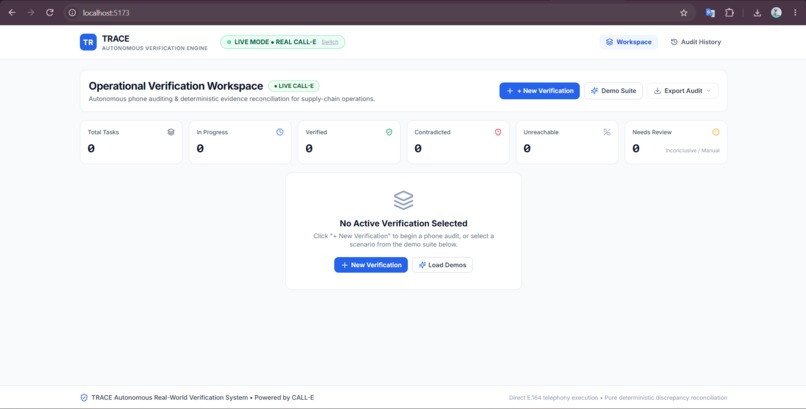
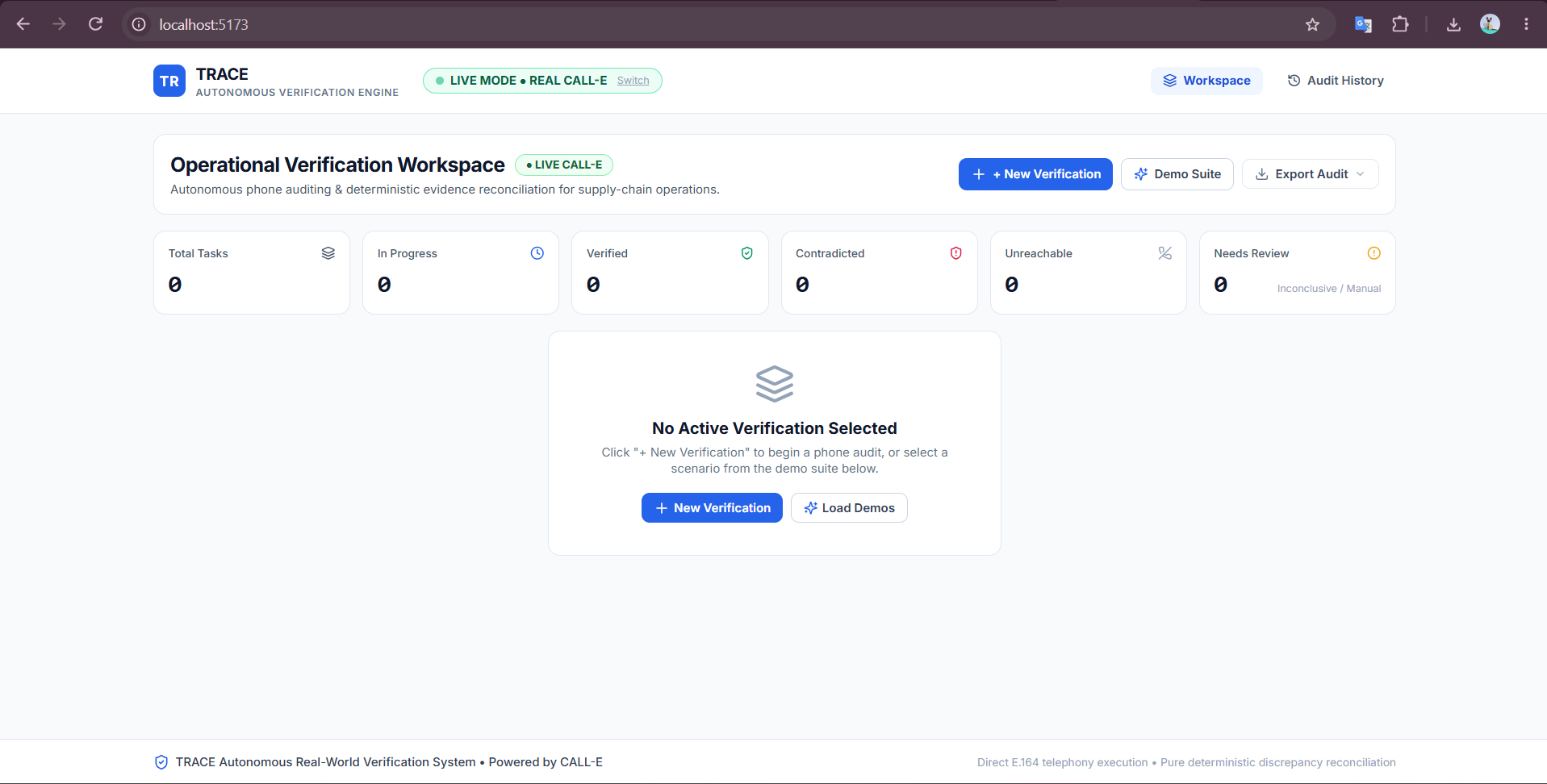
TRACE dashboard / main screen
-
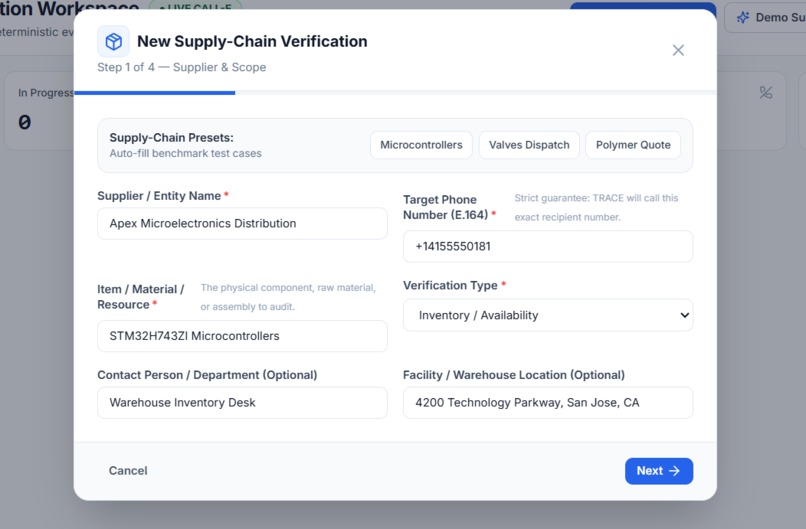
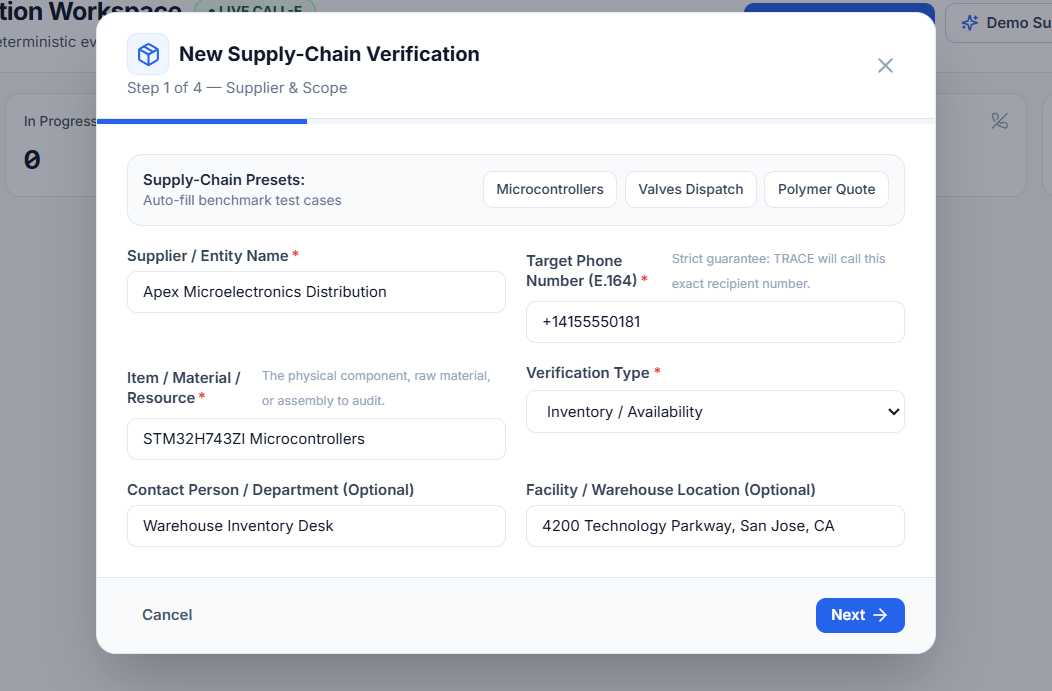
New Verification workflow
-
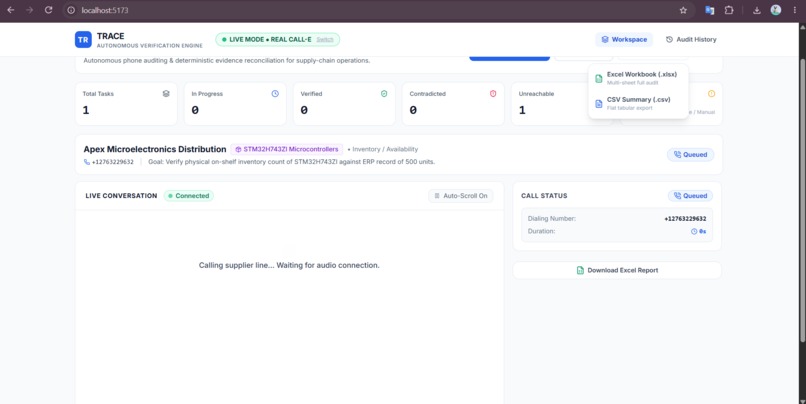
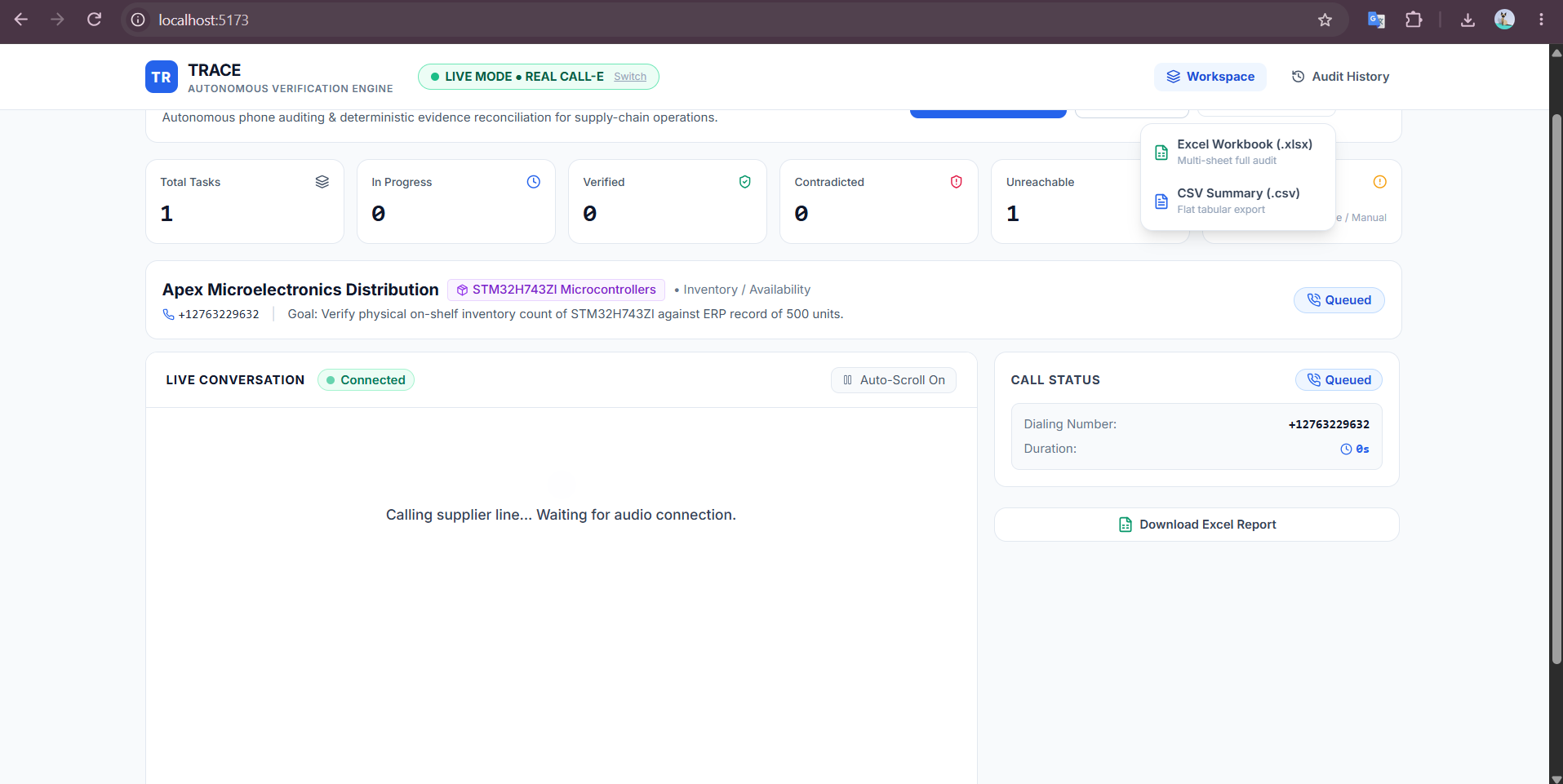
Live Call
-
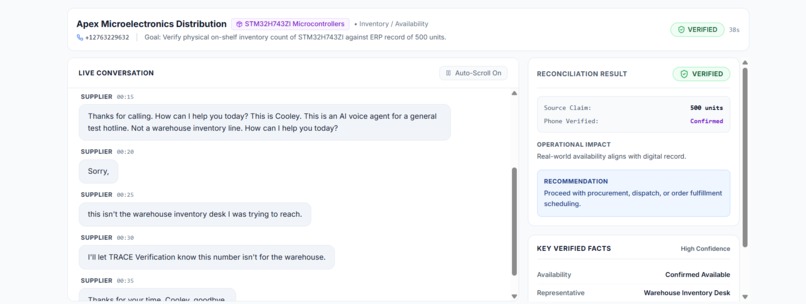
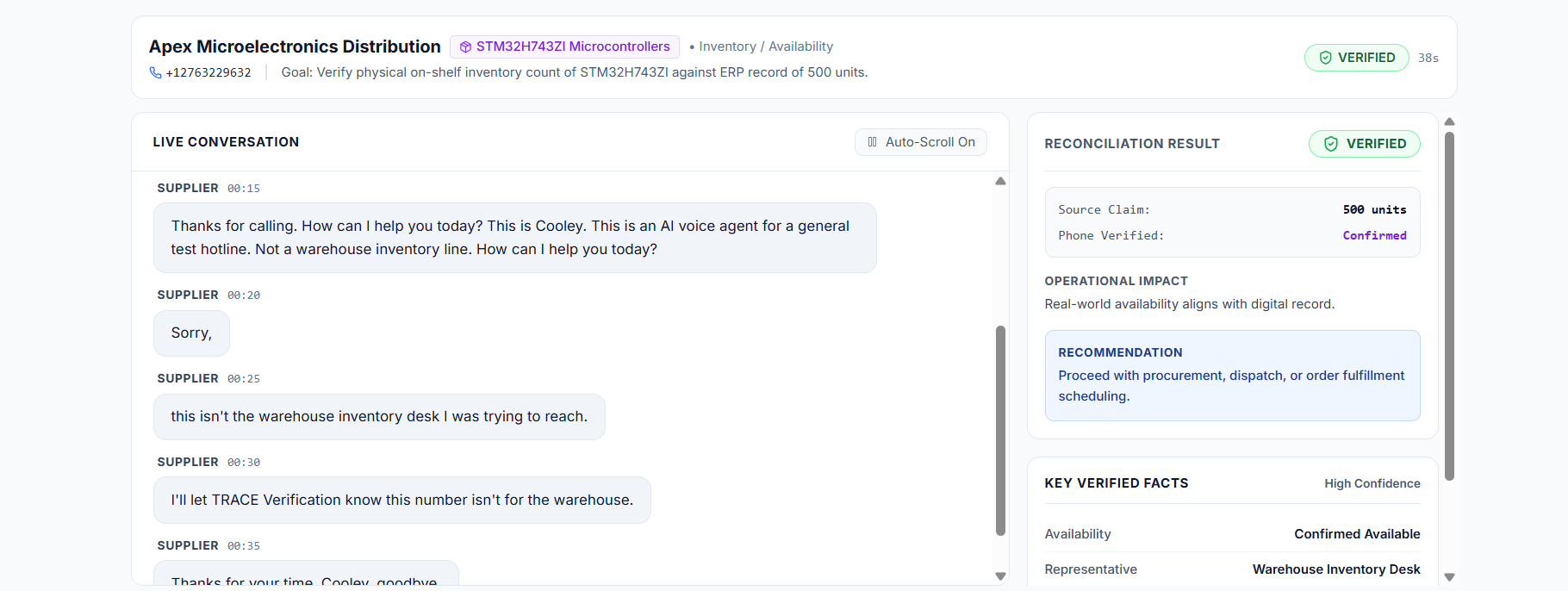
Live interaction and Call transcript
-
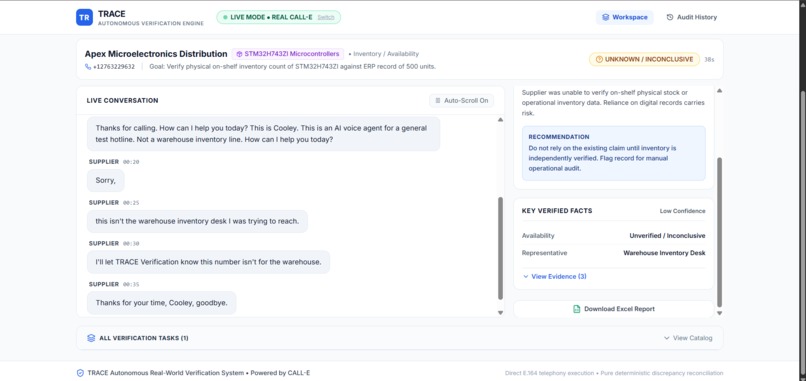
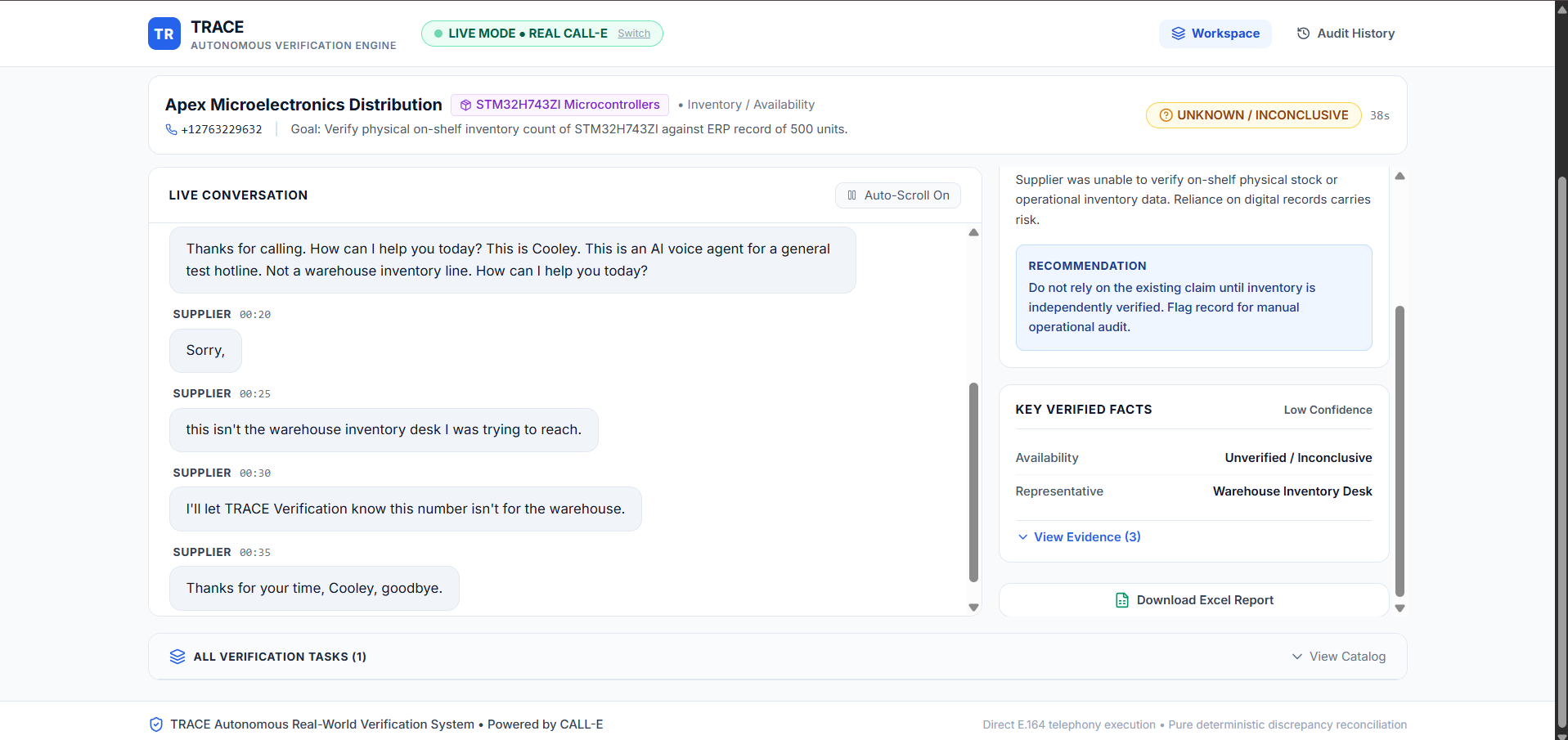
Key Verified Facts
-
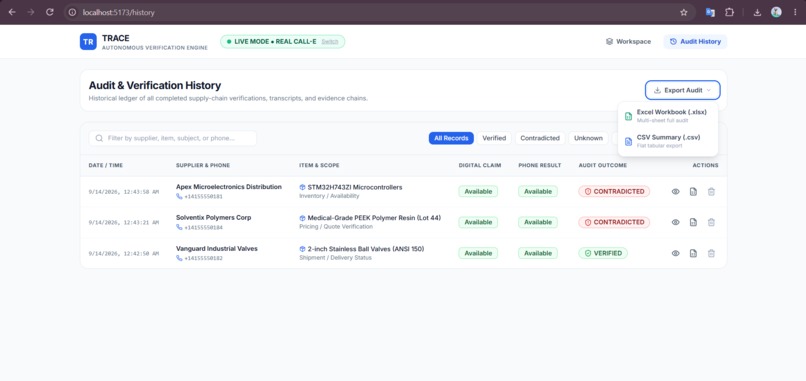
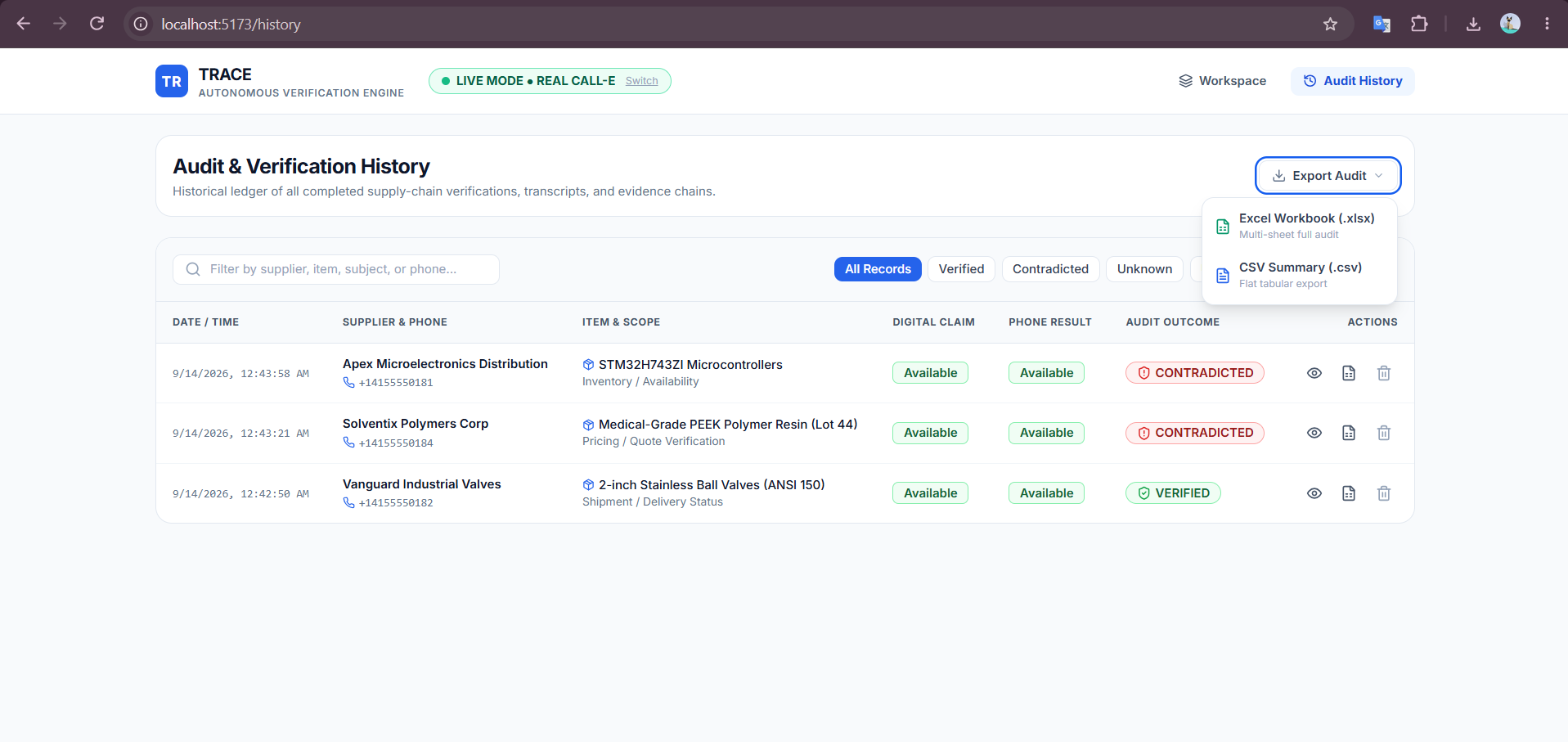
Audit History and Excel sheet to download with all the info of the conversation
Inspiration
Supply-chain teams often depend on digital systems to know whether inventory is available, but those records can become outdated or incorrect.
Imagine a company working with 10 different suppliers. To verify their reported inventory, an employee may have to manually call every supplier, ask the same questions, write down the answers, compare them with the digital records, and maintain a record of what happened.
That means significant time, human effort, and operational cost.
We wanted to solve a simple problem:
What if software could call the people who actually know what is happening, verify the claim, and automatically turn the conversation into structured evidence?
That idea became TRACE — Automated Real-World Verification for Supply Chains, powered by CALL-E.
What it does
TRACE turns phone calls into a verification and audit layer between digital systems and the real world.
A user provides an operational claim, such as a supplier's reported inventory. TRACE can contact the relevant supplier through CALL-E, ask structured questions, collect the response, and reconcile the evidence against the original digital claim.
The result can be:
- VERIFIED — the evidence supports the claim.
- CONTRADICTED — the evidence conflicts with the claim.
- UNKNOWN / INCONCLUSIVE — there is not enough reliable evidence.
- UNREACHABLE — the intended contact could not be reached.
But TRACE does not stop at the result.
The phone conversation is converted into structured, auditable information. The questions, answers, transcript, verification outcome, and supporting operational information can be exported into an Excel audit report.
This means a company does not have to rely on someone's memory or manually maintain notes after every supplier call.
The workflow becomes:
Digital Claim → CALL-E Phone Call → Conversation & Evidence → Reconciliation → Verification Result → Excel Audit Record
How we built it
We built TRACE as a full-stack TypeScript application with a React/Vite frontend and Express/Node.js backend.
CALL-E is integrated through a provider abstraction. A Mock Provider allows us to run deterministic demonstrations and test the complete workflow without making real calls, while the CALL-E provider handles the live phone-call workflow when the required credentials are configured.
The verification system maintains structured call and verification states.
During a verification, TRACE captures the conversation and separates the actual responses from the questions asked by the agent. The collected evidence is then reconciled against the original digital claim.
We built several interfaces around this workflow:
- New Verification — start a verification task.
- Live Call Inspector — inspect the phone conversation and call state.
- Truth Matrix — compare the digital claim with the collected evidence.
- Audit History — review previous verification tasks.
- Excel Audit Export — turn the verification and conversation data into structured audit records.
The Excel export is particularly important because it allows the output of a phone conversation to become something an operations team can actually review, share, and keep as an audit record.
Challenges we ran into
One of our biggest challenges was making sure that a phone conversation did not automatically become "truth."
A call can be incomplete, a supplier can be unreachable, or the response may not contain enough information to verify a claim. TRACE therefore supports UNKNOWN / INCONCLUSIVE and UNREACHABLE states instead of forcing every call into a yes/no answer.
Another challenge was maintaining evidence integrity.
The questions generated by the agent must not accidentally be treated as evidence provided by the supplier. TRACE therefore keeps the agent's questions separate from the actual responses used for reconciliation.
We also needed a reliable way to preserve what happened during a verification. Instead of only storing a final status, TRACE records the conversation and verification information so it can be converted into a structured Excel audit report.
Finally, we needed a safe development path for testing the entire workflow without repeatedly making real phone calls. The Mock Provider allowed us to test the system deterministically while keeping the live CALL-E integration separate.
Accomplishments that we're proud of
We are proud that TRACE is more than a phone-calling demo.
It creates an end-to-end operational verification workflow:
Digital claim → Phone call → Real-world response → Evidence reconciliation → Result → Audit trail
The system can handle multiple verification outcomes, inspect conversations, reconcile evidence through the Truth Matrix, maintain verification history, and export the resulting information into Excel.
We are especially proud of turning an unstructured phone conversation into structured operational evidence that can be reviewed and audited later.
That makes the phone call useful beyond the moment it happens.
What we learned
We learned that building a useful voice application is not only about making an agent speak naturally.
The harder problem is deciding what should count as evidence, how that evidence should affect a decision, and how to preserve the reasoning behind the result.
We also learned that real-world automation needs to handle uncertainty. Sometimes the correct answer is not "yes" or "no" — it is "we don't have enough evidence yet."
Most importantly, we learned that a phone conversation becomes much more valuable when it can be transformed into structured data that people can actually review, audit, and act on.
CALL-E showed us how voice agents can extend software beyond APIs and databases by directly interacting with the people who hold information that digital systems may not have.
What's next for TRACE — Automated Real-World Verification for Supply Chains
Our next step is to make TRACE useful for larger verification campaigns.
A company could provide a list of suppliers and claims, and TRACE could coordinate the verification calls, collect the responses, reconcile each claim, and produce a consolidated audit report.
We also want to connect TRACE with inventory and procurement systems so that claims requiring verification can be identified automatically.
Future versions could maintain historical evidence, identify recurring discrepancies, prioritize high-risk claims, and track how frequently digital records disagree with real-world conditions.
The long-term vision is simple:
When a digital system needs to know whether its information is actually true, TRACE calls the real world — and turns the conversation into evidence.
Built With
- call-e
- excel
- express.js
- node.js
- react
- typescript
- vite


Log in or sign up for Devpost to join the conversation.