-
-
ui
Inspiration
What it does
How we built it# TRACE — Don't Just Believe It. Trace It.
Inspiration
Every day, we come across hundreds of pieces of information through social media, WhatsApp groups, short videos, and online communities. A message can be forwarded thousands of times within minutes, even when nobody has taken the time to verify it.
What inspired us to build TRACE was a simple question:
What if, instead of simply telling young people what is true or false, we taught them how to find out for themselves?
We realized that misinformation is not always obvious. Sometimes it is an old image presented as a recent event, a genuine source taken out of context, a misleading headline, or a claim that looks convincing simply because many people have shared it.
This led us to the idea of TRACE — Don't Just Believe It. Trace It.
Our goal is to make Media and Information Literacy practical, engaging, and accessible, particularly for young people who consume and share information every day.
What We Learned
While developing TRACE, we learned that solving misinformation is not simply a matter of building a better AI fact-checker.
AI itself can make mistakes, lack context, or confidently provide incorrect information. Therefore, we wanted TRACE to use AI as an assistant rather than an authority.
The platform focuses on teaching a repeatable verification process:
- Target the claim — What exactly is being claimed?
- Research the source — Where did the information come from?
- Analyze the context — When, where, and under what circumstances?
- Check the evidence — What actually supports the claim?
- Examine alternatives — What do independent sources say?
- Share responsibly — Is there enough evidence to share it?
This approach taught us an important lesson: the most valuable outcome isn't giving someone the right answer once; it's giving them the skills to find better answers in the future.
We also learned the importance of accessibility. Information literacy should not depend on someone's ability to understand complicated English or technical terminology. That's why we designed TRACE with English, Urdu, and Roman Urdu in mind.
How We Built It
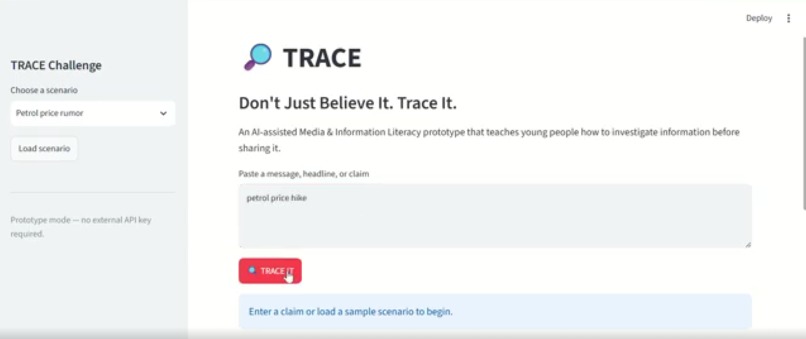
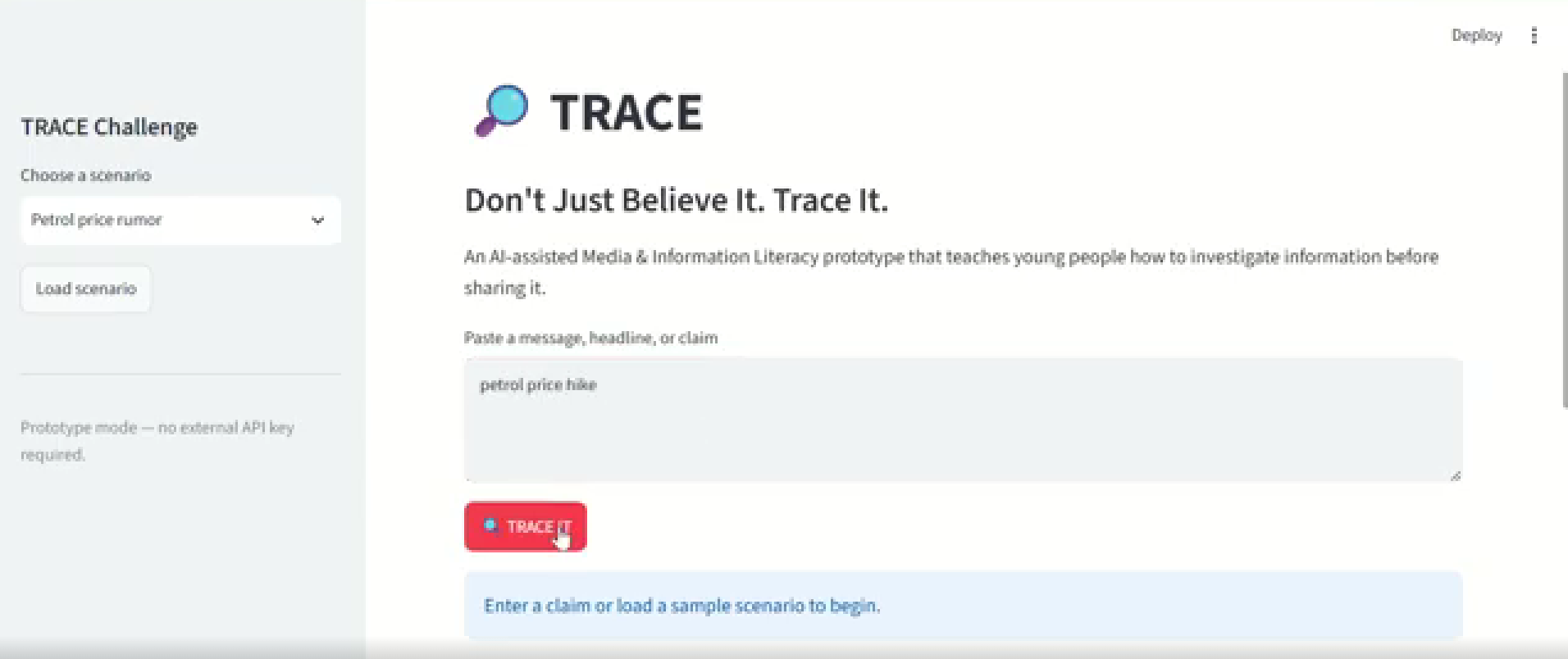
TRACE was designed as an AI-assisted web platform with an educational and gamified layer.
A user can enter a viral claim, message, headline, or link. TRACE then guides the user through the investigation process rather than immediately producing a simple "true" or "false" label.
The conceptual workflow is:
User Input
    ↓
Claim Extraction
    ↓
Source Investigation
    ↓
Context Analysis
    ↓
Evidence Collection
    ↓
Independent Cross-Checking
    ↓
Transparent Assessment
    ↓
Learning / TRACE Challenge
AI can assist with tasks such as extracting the main claim, organizing information, summarizing evidence, and explaining complex findings in simpler language.
However, the platform is designed to keep the evidence visible and the human in the loop.
We also introduced TRACE Challenges, where users encounter realistic social-media scenarios and identify warning signs such as unreliable sources, missing context, emotional language, or weak evidence. Instead of rewarding users simply for agreeing with an AI-generated answer, the challenges reward critical thinking and reasoning.
The initial concept is focused on young people in Pakistan, with a multilingual approach that can eventually be expanded to other communities and languages.
Challenges We Faced
One of our biggest challenges was deciding what TRACE should actually be.
It would have been easy to create another application that simply says:
"This information is fake."
But that would not solve the deeper problem.
We had to think about how to make the platform educational rather than simply authoritative.
Another challenge was balancing AI and human judgment. We wanted AI to make verification easier without encouraging users to blindly trust another algorithm. This led us to design TRACE around transparency, evidence, uncertainty, and user decision-making.
We also had to think about the realities of misinformation in multilingual communities. A solution designed only around formal English would not be as useful for many users in Pakistan. Supporting Urdu and Roman Urdu therefore became an important part of our vision.
Finally, we had to keep the project feasible. Instead of trying to build an enormous fact-checking system, we focused on demonstrating one complete and meaningful user journey — from encountering a claim to investigating it and learning from the process.
Why TRACE Matters
Misinformation moves faster than ever.
We cannot manually fact-check every message, video, headline, or post that reaches every person.
But we can teach people how to think before they share.
That is what TRACE aims to do.
We don't want to create users who simply ask an AI what to believe.
We want to create better investigators, better critical thinkers, and more responsible digital citizens.
Before you believe it. Before you share it. TRACE it.
Challenges we ran into
Accomplishments that we're proud of
What we learned
What's next for TRACE
Built With
- ai
- api
- app
- artificial
- checking
- critical
- database
- education
- fact
- impact
- information
- intelligence
- javascript
- language
- learning
- literacy
- machine
- media
- misinformation
- natural
- processing
- python
- technology:
- thinking
- web

Log in or sign up for Devpost to join the conversation.