
Inspiration
Parkinson’s disease affects over 10 million people worldwide, and many patients struggle to access reliable, ongoing assessments of their motor function. Traditional tests often require in-person visits and don’t provide a clear progression map for both doctors and patients. We wanted to create a tool that not only helps track the effectiveness of Parkinson's treatment but also empowers healthcare providers with data-driven recommendations. This led us to design Trace, an app that transforms a simple task — tracing a spiral — into a powerful diagnostic and progress-tracking tool.
What it does
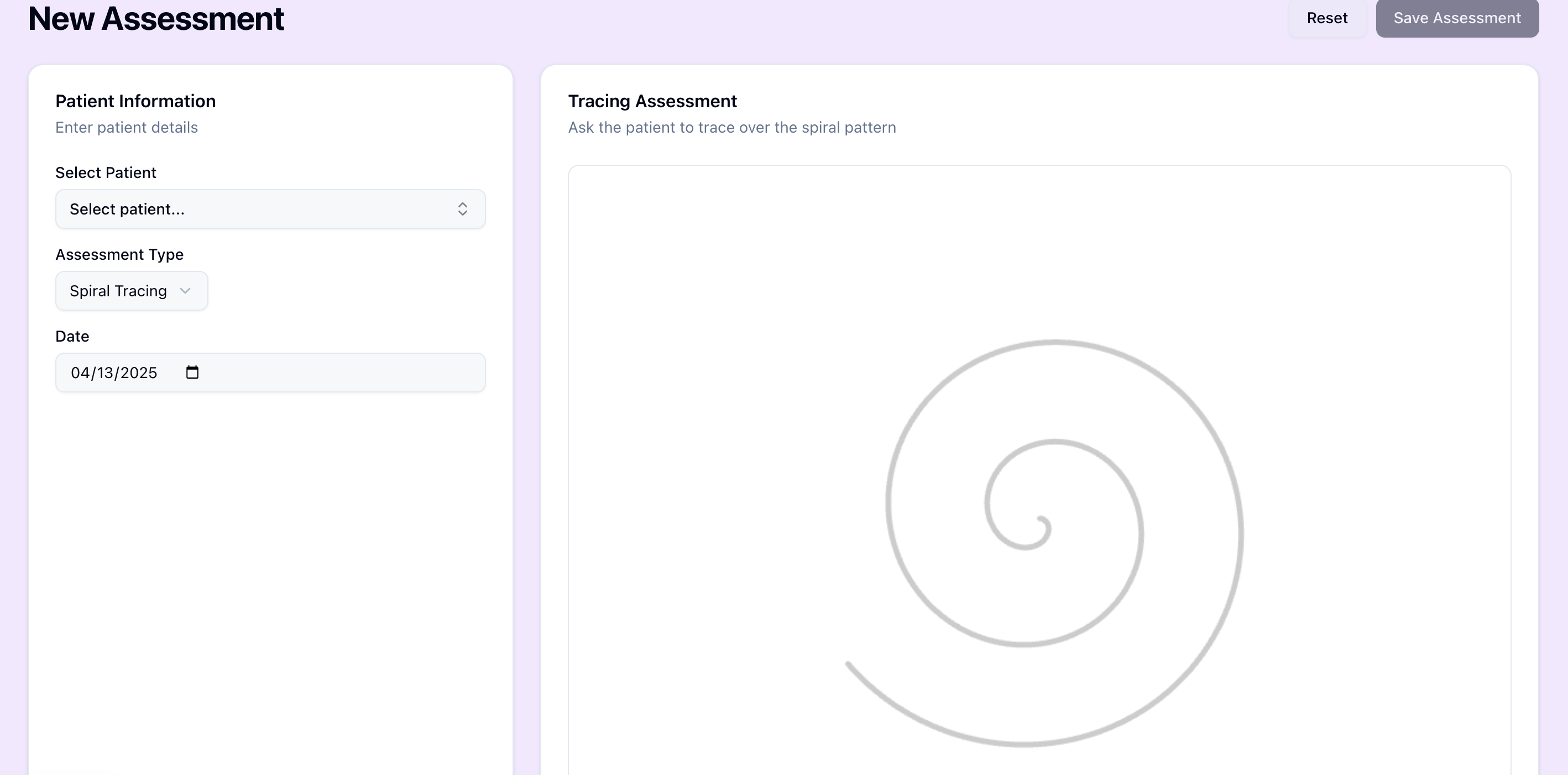
Trace allows users to trace spirals on a canvas using their finger or a stylus. The app then uses machine learning and computer vision to analyze the tracing, measuring deviation from the ideal spiral, tremor intensity, and speed. These metrics help assess the severity of Parkinsonian symptoms. Doctors can monitor patient progress over time, view visualized analytics, and receive treatment suggestions based on severity levels. Patients can continue weekly assessments, enabling longitudinal tracking of their condition.
How we built it
We built Trace with a full-stack approach:
- Frontend: React and Next.js for a clean, interactive user interface.
- Backend: Flask for handling ML processing and data logic.
- Database: MongoDB to store patient information and analysis results.
We used OpenCV to compute the Mean Square Error between the drawn spiral and the template, and also explored integrating tremor detection metrics from ETSD models. Our app currently includes features such as:
- A drawing canvas for spiral tracing.
- An “Analyze” button to compute and display metrics.
- A patient list view where results can be saved and reviewed.
Challenges we ran into
- Calibrating the spiral analysis to work accurately across different devices and input methods (e.g., mouse vs. touchscreen).
- Integrating ML models with real-time frontend interactivity.
- Ensuring the app is intuitive enough for both doctors and patients, while still being technically robust.
- Defining clear thresholds for different severity levels based on existing research datasets.
Accomplishments that we're proud of
- Successfully built a functional prototype that can analyze user input and output meaningful diagnostic data.
- Created an interface that is accessible for both healthcare providers and patients.
- Integrated machine learning and computer vision in a real-time health context.
- Went from concept to demo-ready product within the Bitcamp timeframe.
What we learned
- How to effectively combine frontend UX with backend ML workflows.
- Techniques for image analysis using OpenCV and implementing health-specific metrics.
- The importance of UI design in medical tech, especially when building tools for non-technical users.
- Balancing clinical accuracy with usability when working in healthtech.
What's next for Trace
We plan to:
- Expand our dataset and improve our ML model for higher accuracy.
- Add tremor frequency analysis and longitudinal progress charts.
- Build a doctor-specific dashboard for managing multiple patients.
- Integrate treatment recommendation logic based on severity tiers.
- Explore partnerships with healthcare providers for pilot studies.
We see Trace becoming a key part of remote Parkinson's monitoring, lowering the barrier to diagnosis and treatment tracking globally.


Log in or sign up for Devpost to join the conversation.