-
-

Buffer Screen
-
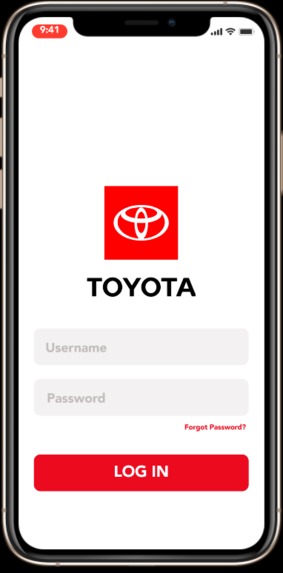
Log In Page
-
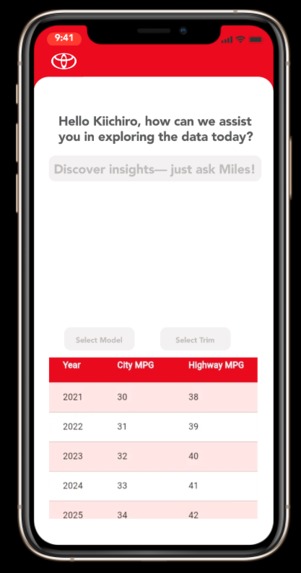
Home Screen
-
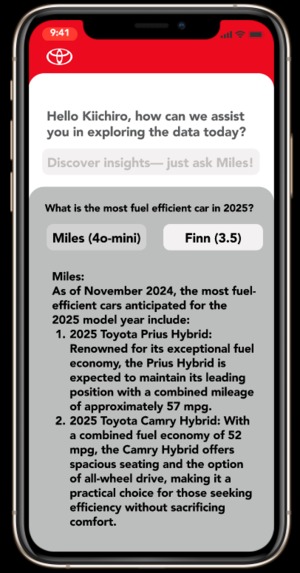
Fine Tuned LLM Page
-


Inspiration
The drive to create a tool that bridges the gap between raw vehicle fuel economy data and actionable insights inspired the development of Toyota EcoGauge. With environmental sustainability becoming a global priority, we wanted to empower users—be it consumers, researchers, or automotive manufacturers—with an intuitive platform to explore, analyze, and leverage fuel economy data from 2021 to 2025. Our vision was to foster better vehicle choices and promote eco-conscious decision-making.
What it does
Toyota EcoGauge is a cross-platform application that allows users to:
- Query and visualize vehicle fuel economy data (city MPG, highway MPG, combined MPG) for Toyota models from 2021-2025.
- Compare different models and trims over the years to spot trends or improvements.
- Leverage AI-powered chatbots (Miles and Finn) to interact conversationally with the data, gaining tailored insights and analysis.
- View interactive graphs and data tables for better decision-making.
How we built it
Frontend: Developed with Flutter to ensure a responsive and consistent experience across mobile and web platforms. Backend: Utilized open government datasets on fuel economy, processed and served via a structured API for querying with Flask Visualization: Integrated libraries for interactive graphing and tabular data representation. AI Chatbot: Incorporated GPT-based chatbots (Miles and Finn) to provide natural language data querying and insights. Modular Architecture: Designed for scalability and easy integration of future datasets and features.
Challenges we ran into
Data Parsing: Extracting and structuring data from static PDFs (2021-2025 datasets) into a format optimized for querying and visualization. UI Consistency: Ensuring a seamless, visually appealing interface across different devices and platforms. AI Integration: Creating a conversational interface that accurately interprets user queries and interacts with the structured data. Time Constraints: Balancing feature implementation and testing within a tight 24-hour hackathon timeline.
Accomplishments that we're proud of
Successfully implemented AI-powered chatbot integration for natural language querying. Developed an intuitive and visually consistent cross-platform interface using Flutter. Processed and visualized large volumes of fuel economy data into meaningful, user-friendly formats.
What we learned
The importance of data cleaning and preparation when working with unstructured sources like PDFs. How to leverage Flutter for building scalable, cross-platform applications efficiently. Best practices for integrating AI tools (GPT-based chatbots) with structured backend systems. The value of teamwork and effective communication when working under tight deadlines.
What's next for Toyota EcoGauge
Expanded Datasets: Integrate fuel economy data for more manufacturers and additional years to broaden the platform's scope. Advanced Analytics: Provide deeper insights, such as predictive trends, CO2 emission comparisons, and energy savings analysis. Gamification: Introduce features to motivate eco-friendly driving habits, such as fuel-saving challenges and rewards. Integration with IoT: Explore compatibility with connected vehicles for real-time fuel economy monitoring. Deployment: Launch Toyota EcoGauge as a public app, accessible to consumers, researchers, and automotive professionals globally.


Log in or sign up for Devpost to join the conversation.