Inspiration
For centuries, scholars and readers have studied the Four Gospels—Matthew, Mark, Luke, and John—to understand their rich, multi-perspective accounts of history. However, exploring them comparatively and chronologically has traditionally required thick, multi-volume physical books (Synopses) and specialized academic tools:
- Complex Multi-Perspective Alignments: The four authors wrote with distinct pastoral emphases and narrative structures, resulting in varied event sequences, omissions, and transposed passages.
- Access Barrier to Scholarly Harmony: Understanding apparent textual differences and historical contexts has historically been confined to academic libraries and scholarly commentaries, out of reach for everyday readers and students.
- Multilingual Comparison Challenges: Comparing ancient Greek roots and historical nuances across modern global translations has required extensive manual cross-referencing.
Years ago, this project started as an experimental side-by-side tablet viewer to make synoptic reading accessible. Yet, bridging physical paper limitations—handling non-linear transpositions on screen without altering canonical text, and delivering instant, deep contextual insights—remained challenging. Today, by combining Flutter's 2D canvas with Google Gemini's multi-token intelligence, Gospel Align democratizes centuries of synoptic gospel scholarship for global readers.
What it does
Gospel Align is a high-performance native mobile & tablet application (iOS, Android) engineered in Flutter—accompanied by an instant-access interactive web demo for live evaluation:
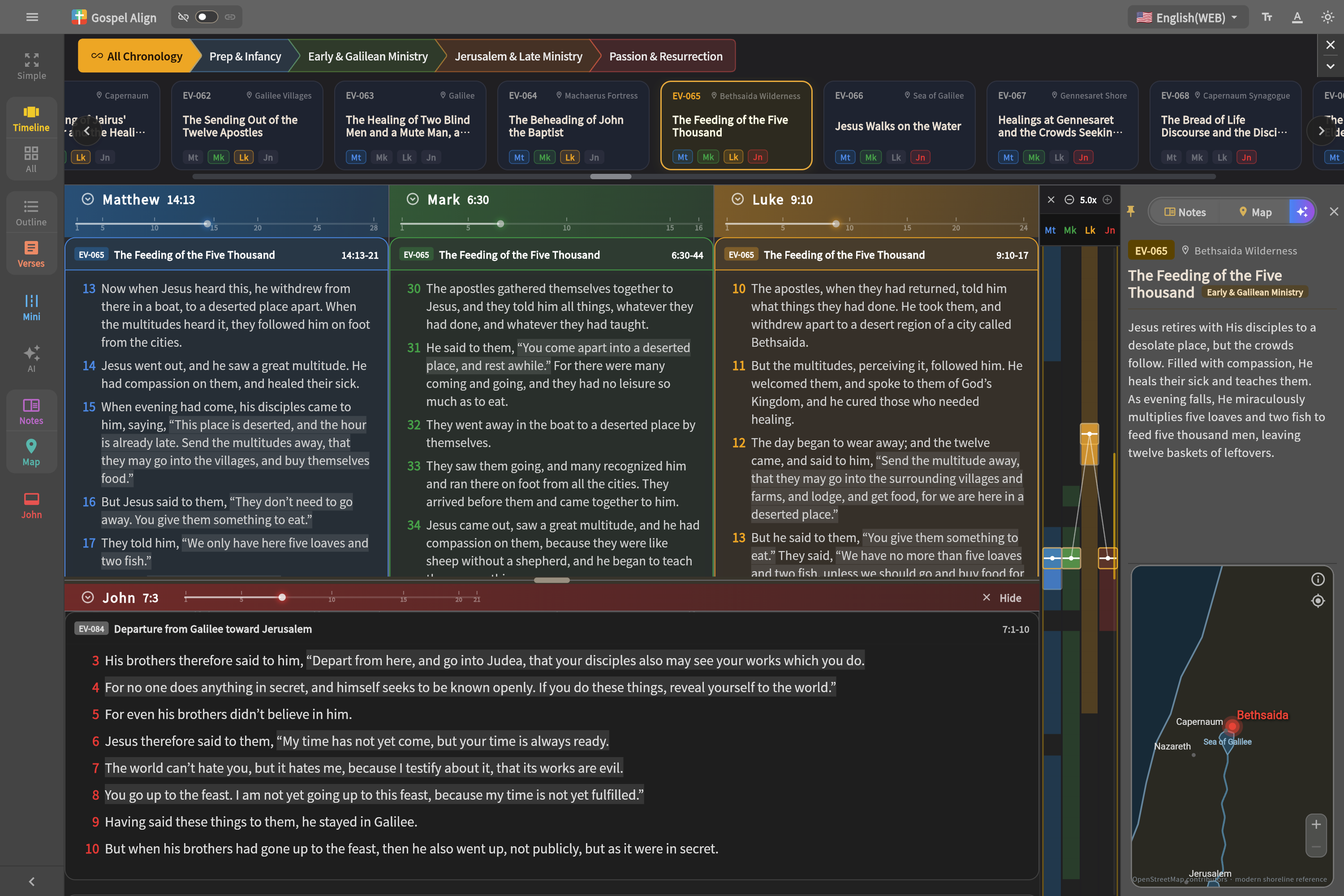
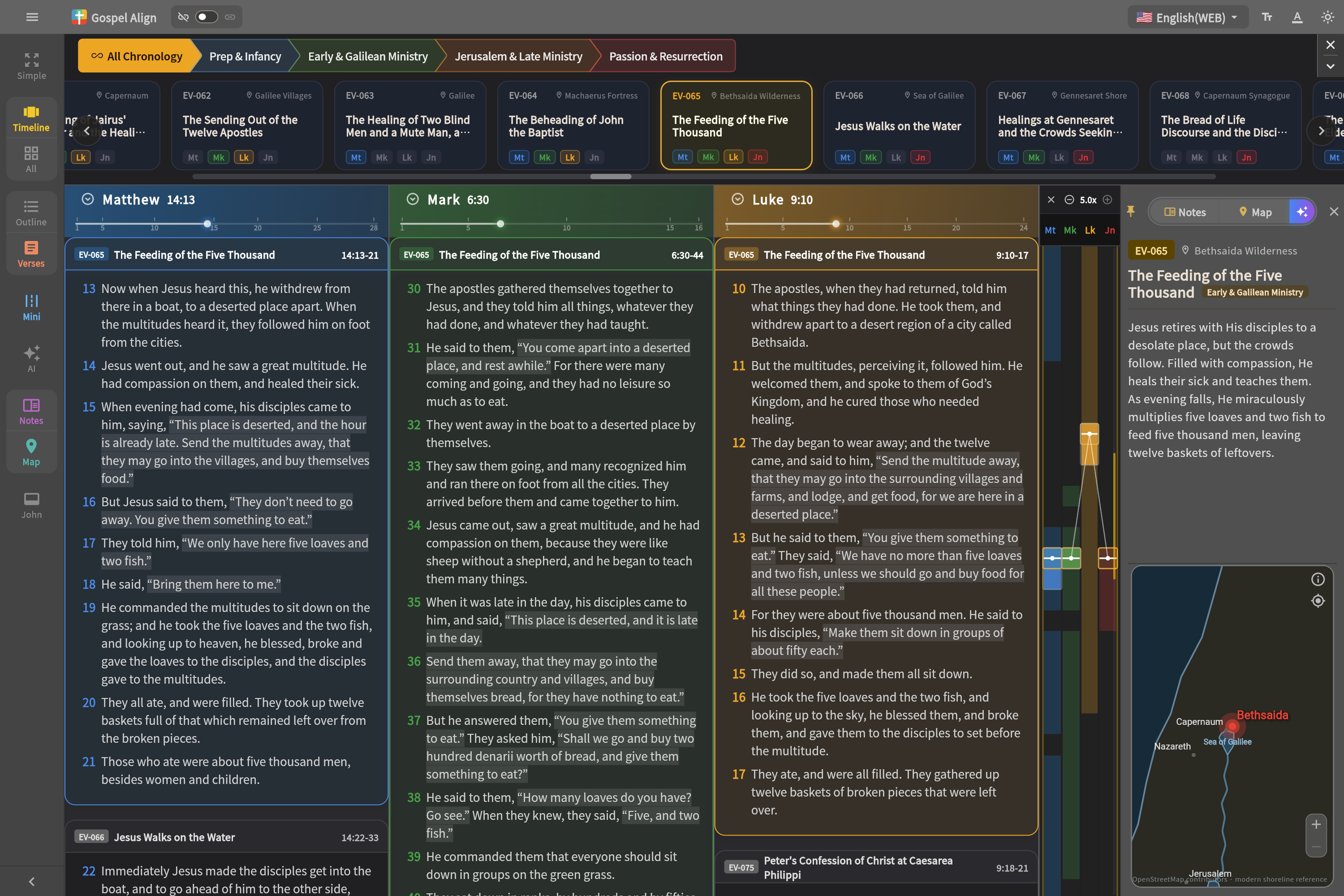
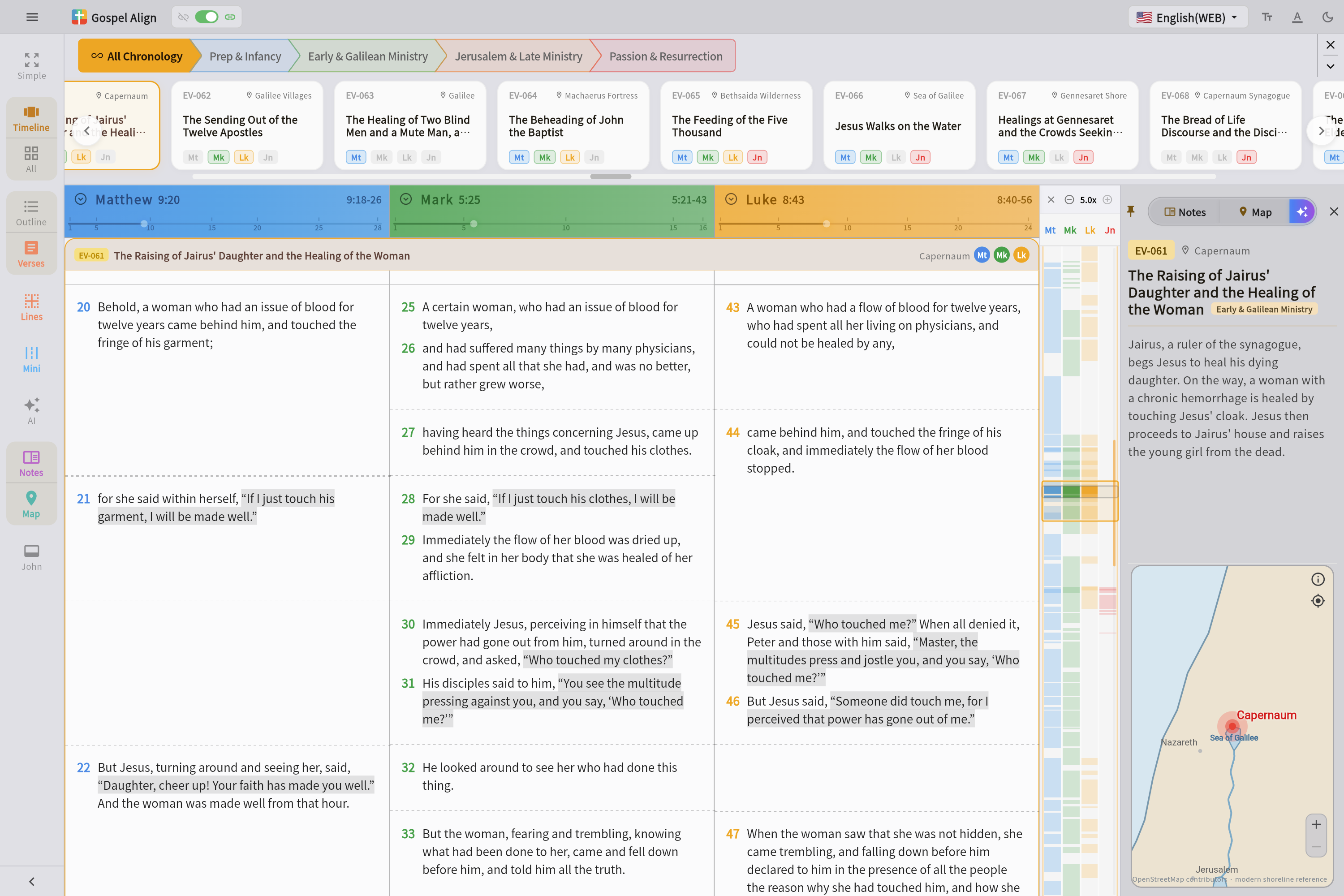
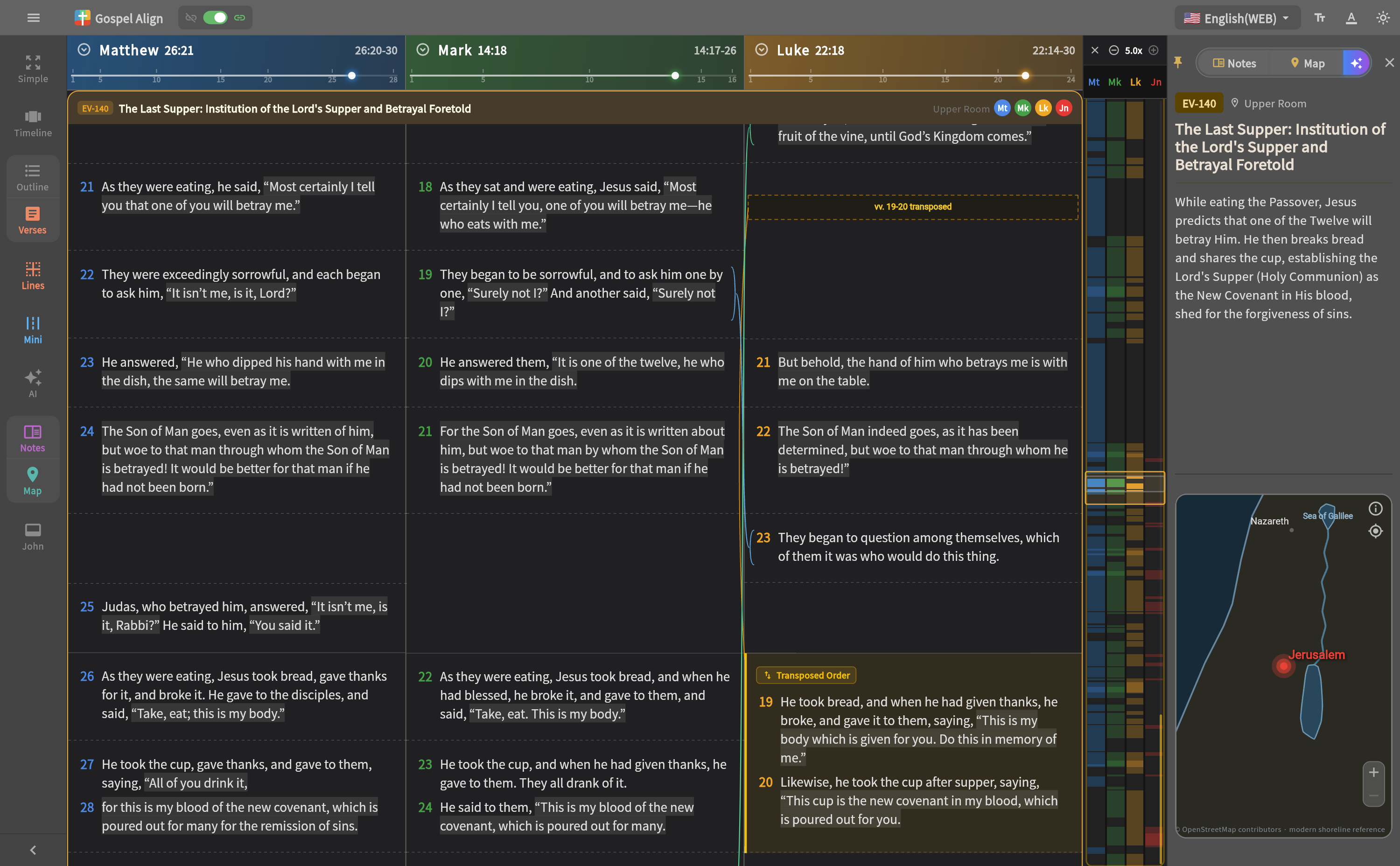
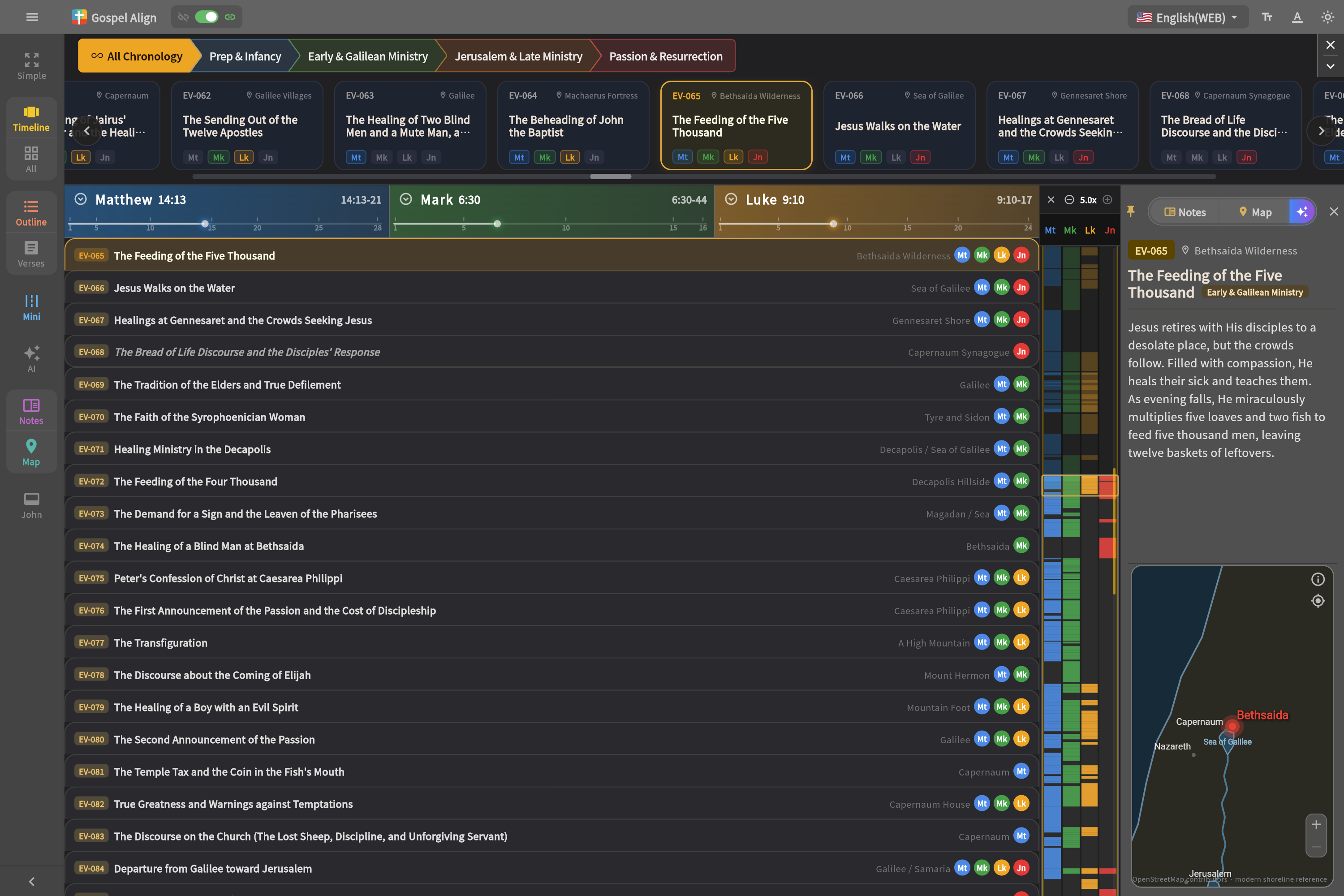
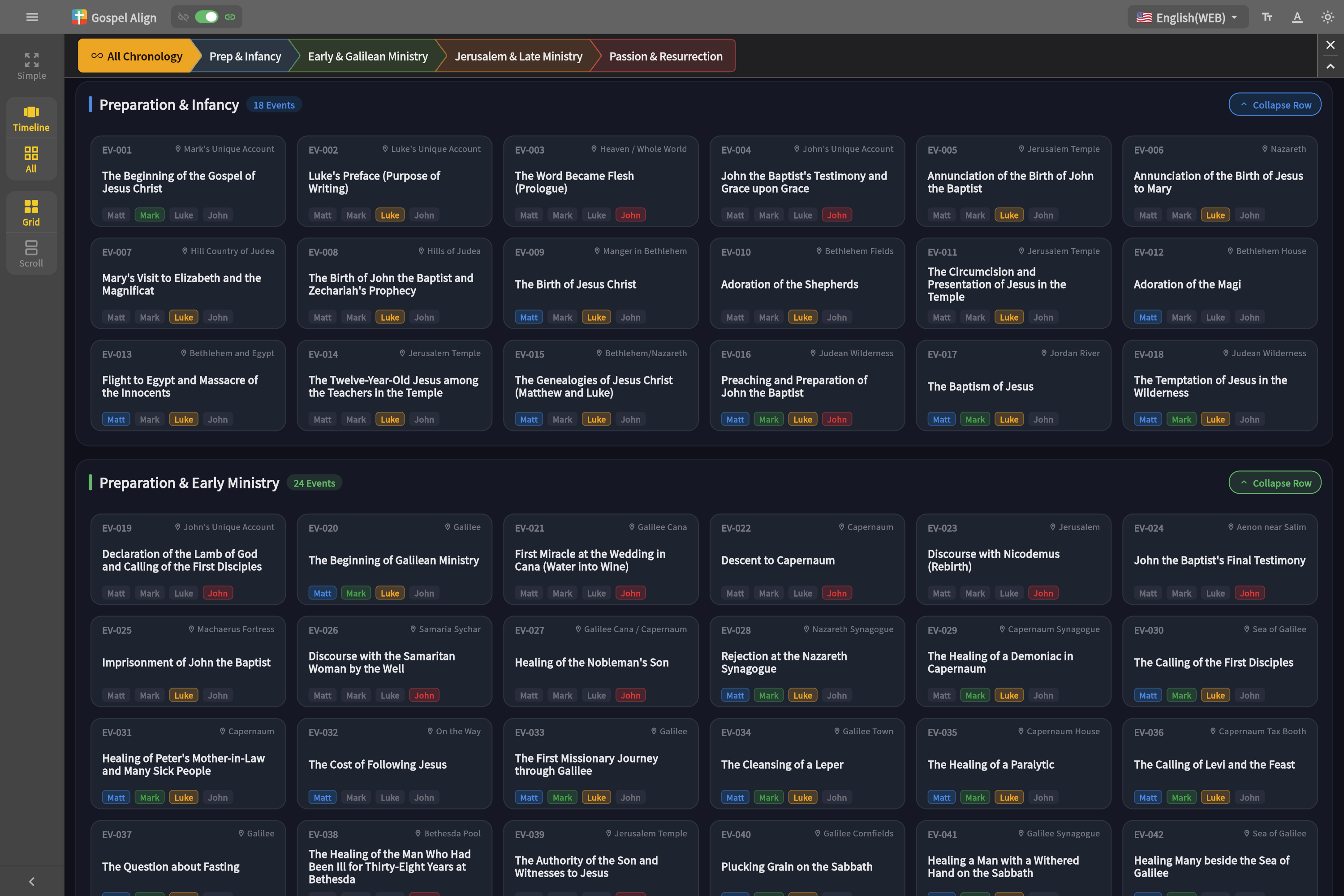
- 157 Chronological Event Synchronizer: Maps all four gospels into 157 canonical events across a responsive 3-column / 4-column synchronized grid at the verse and sub-verse segment level.
- Proprietary Bezier Transposition Braces & Visual Topology:
- Semantic Bezier Links: Smooth quadratic Bezier curves connect 1:1 identical parallel phrases across gospels (e.g., Mark 1:4 ↔ Luke 3:3; Matt 12:41-42 ↔ Luke 11:31-32 Chiasmus).
- Dotted Transposition Gap Boxes: Indicate where verses were moved chronologically to align horizontally without altering canonical sequence.
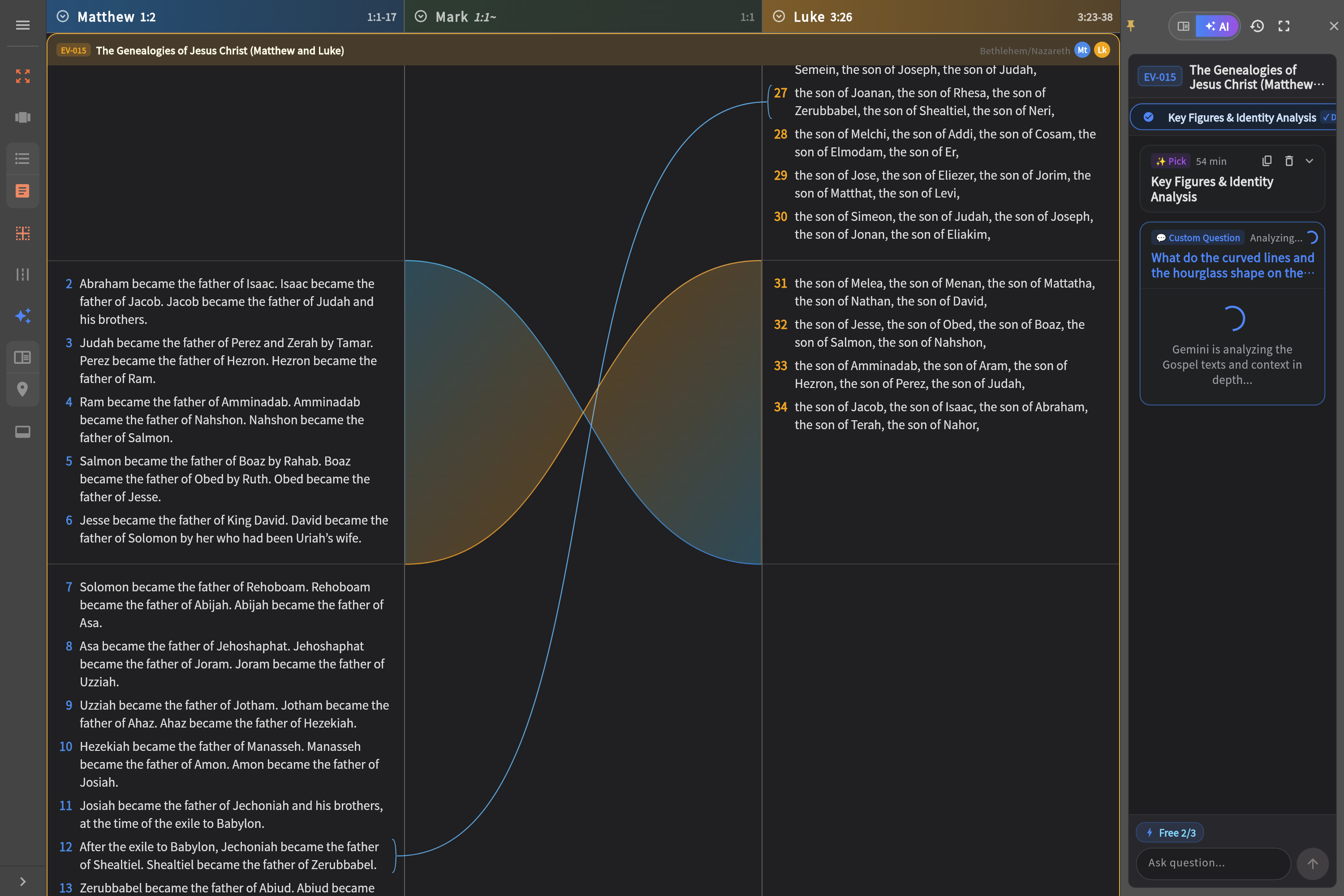
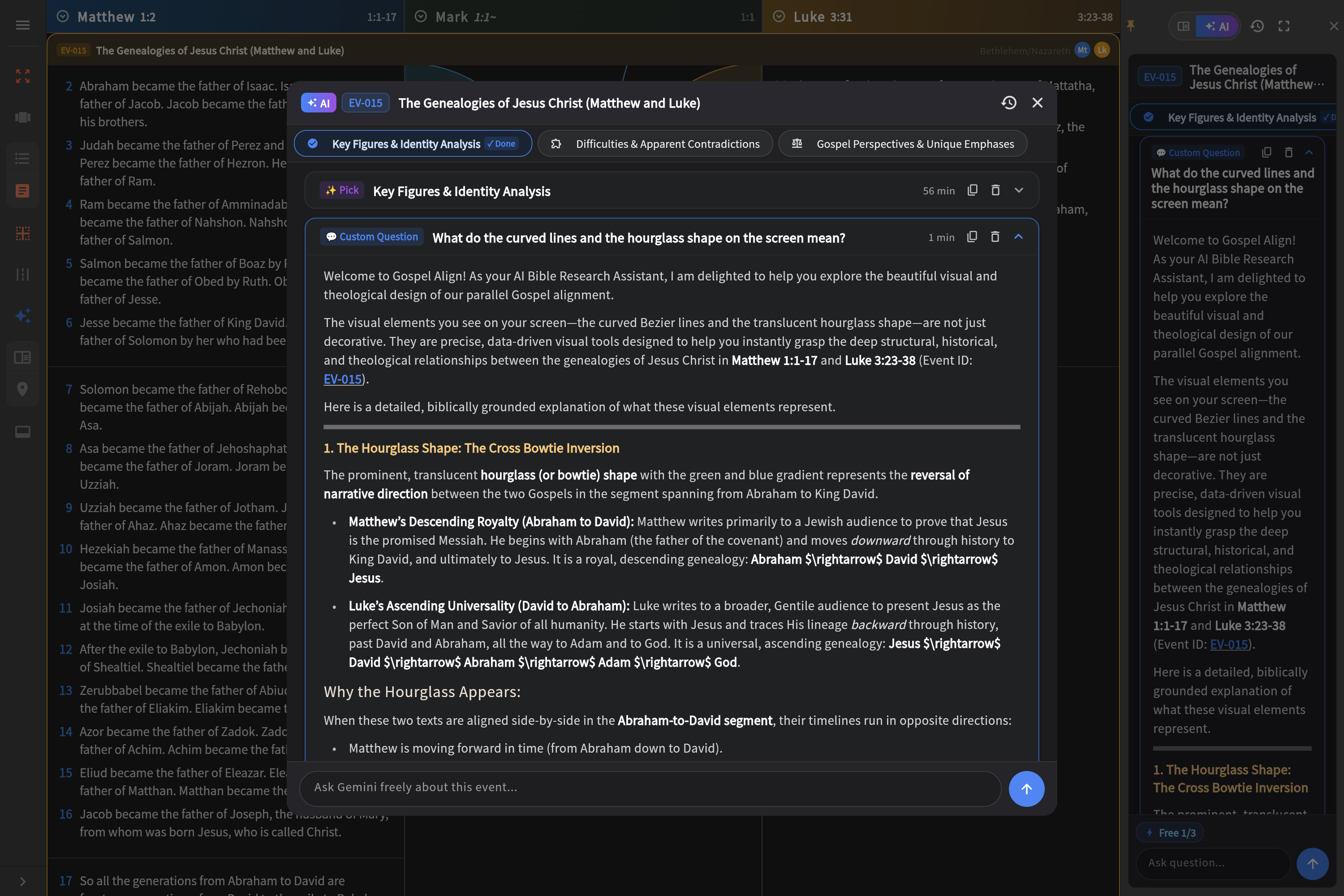
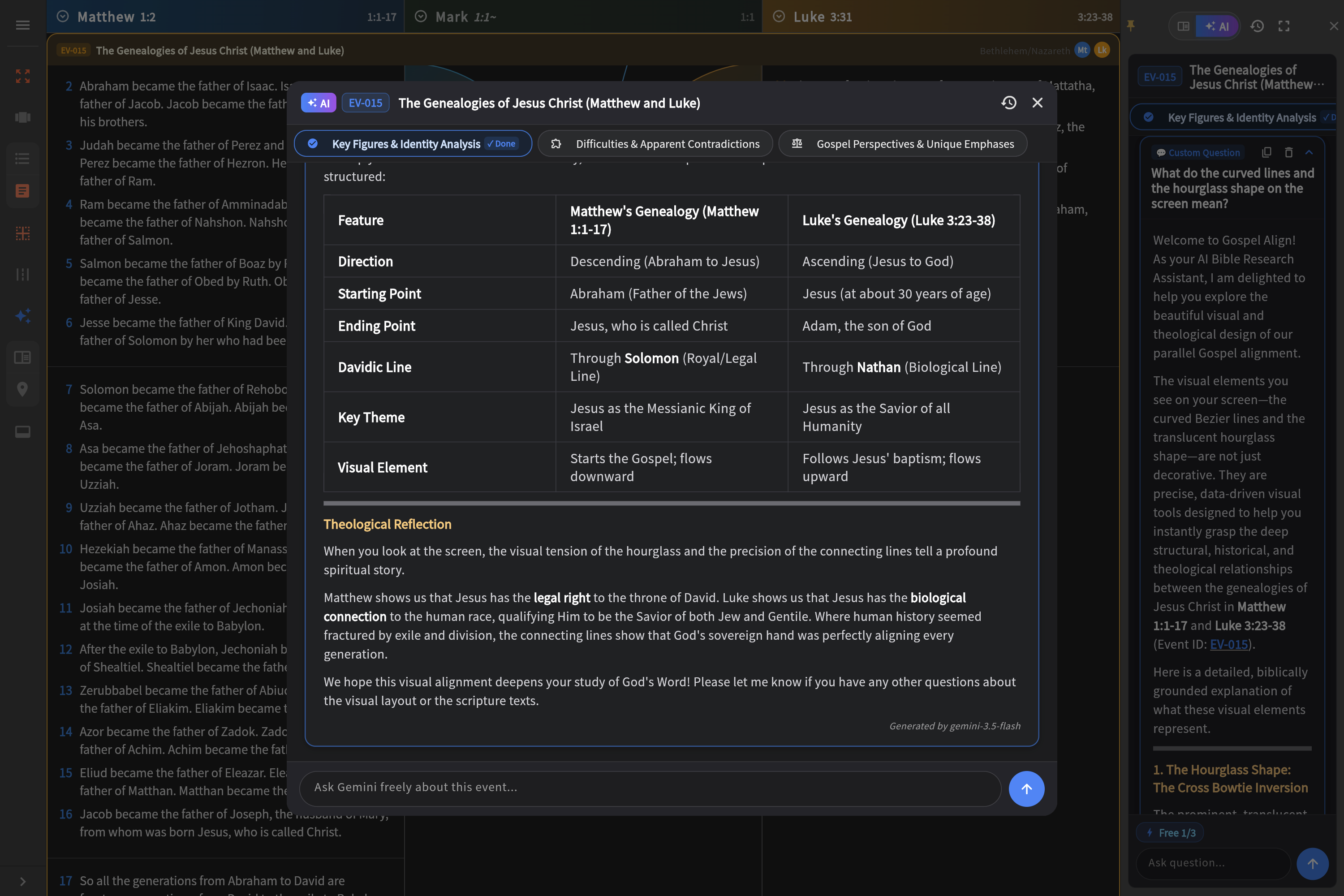
- Genealogical Bowtie Hourglass: Visualizes the inverted directional flow between Matthew's descending lineage (Abraham ➔ Jesus) and Luke's ascending lineage (Jesus ➔ Adam/God).
- AI-Powered Research Workspace (Google Gemini): An embedded multimodal research assistant delivering deep, scholarly, and context-aware insights on demand.
- Interactive Spatial Journey Map: A synchronized GIS map tracing Jesus' travels across Judea, Galilee, Samaria, and Perea for every event.
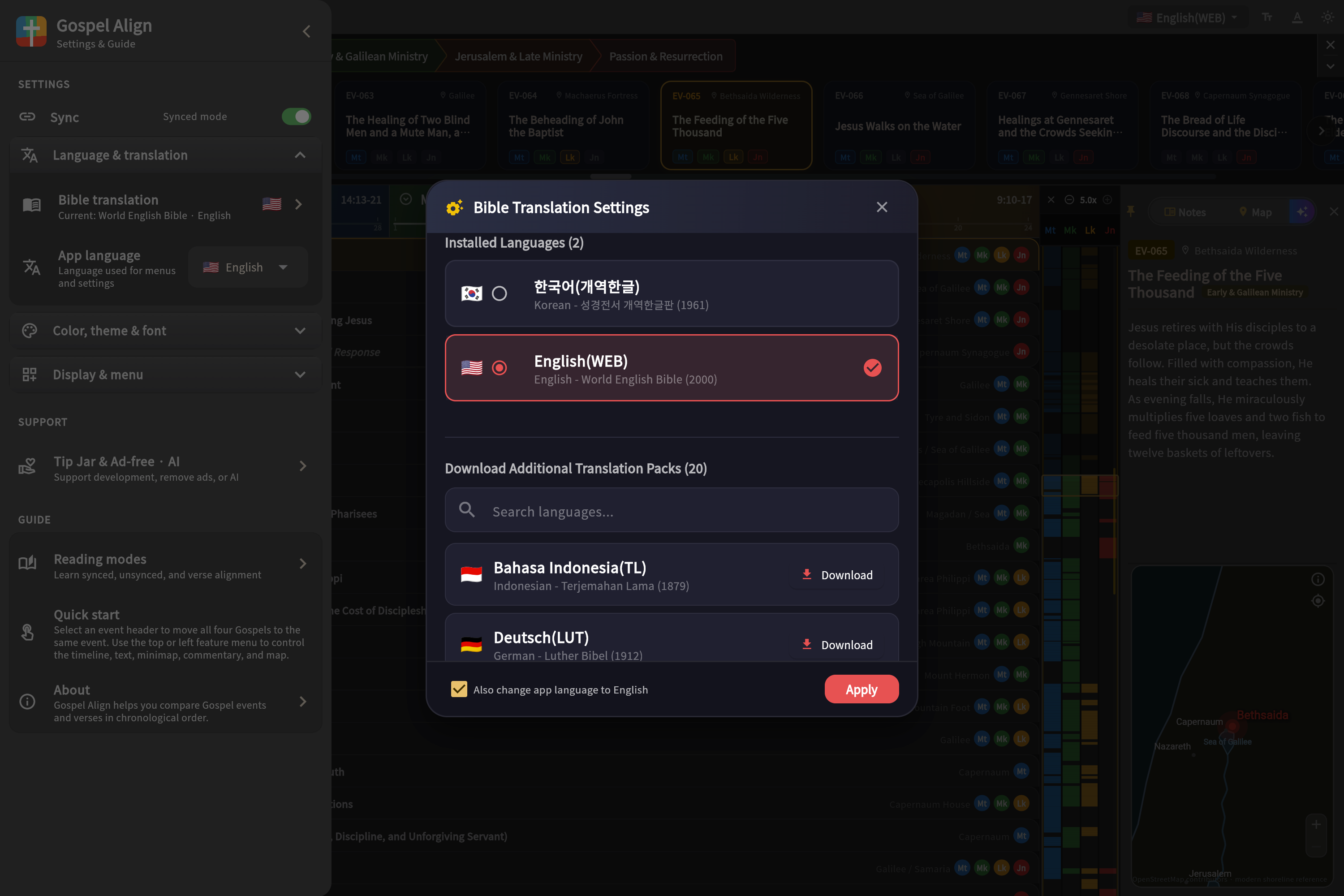
- 22 Global Language Packs: High-performance offline and cloud-streamed localization supporting over 20 languages and 22 public-domain translations (Korean, English, Japanese, French, Myanmar, Amharic, Persian, Swahili, etc.).
How we built it
Gospel Align is powered by a sophisticated integration of Flutter 3, Firebase, and Google Gemini (Flash & Pro):
- World-First "Topological Visual RAG": Traditional RAG only injects flat text. When a user asks about visual UI elements (e.g., "Why is there a blue curve between Mark 1:4 and Luke 3:3?" or "Why is the genealogy rendered as an hourglass?"), flat RAG fails. Gospel Align injects 2D Visual Topology Knowledge Graph metadata into Gemini's context window. Gemini understands the 2D layout geometry, linguistic parallels, and transposition reasons, providing 100% coherent answers matching what the user sees on screen.
- Dual-Context Grounding Architecture: Injects both a Global Standard Text (English WEB) to activate Gemini's vast corpus of international scholarship and a Local Target Text to enforce 100% adherence to local canonical names and terminology.
- Deterministic Recommendation Engine & Old Testament Prophecy Mapping: Analyzes the structural metadata of all 157 events and maps 48 direct Old Testament citation events across the Gospels with keyword auto-detection to suggest relevant research topics instantly.
- Zero-Language-Bleeding Isolation: Uses an isolated English Master Prompt for non-Korean languages with strict output directives, achieving 0% language pollution in low-resource scripts like Amharic, Burmese, and Persian.
- Accordion Research Panel with Smooth Scroll Focus: Supports multi-response comparison, single-expansion focus, automatic header scrolling, horizontal chip synchronization, and local JSON backup/restore.
Challenges we ran into
- The Visual-Textual Disconnect: Users visually interacting with Bezier curves needed AI explanations for graphical artifacts. We solved this by developing a Topological Knowledge Graph that serializes 2D layout relationships into semantic prompt metadata.
- Denominational & Translation Terminology Drift: LLMs often substitute local Bible names with other denominational variants. We enforced strict dual-context rules, requiring AI to mirror local canonical terms 100%.
- Mobile Layout Readability: Complex tables with 4+ columns distorted on phone screens. We designed prompt formatting rules enforcing 2-column comparative tables and structured bullet points.
Accomplishments that we're proud of
- 100% Canonical Integrity: Synchronized 157 events and hundreds of transposition links without modifying a single word of ancient canonical texts.
- True Multimodal Harmony: Bridged 2D spatial canvas rendering with LLM reasoning, creating an unprecedented "Visual-AI" collaborative experience.
- Production-Ready Mobile & Tablet Performance: Engineered with clean Flutter architecture running at 60+ FPS across iOS (iPhone/iPad) and Android (Phone/Tablet/Foldable), backed by a live evaluation web demo.
What we learned
- Injecting spatial UI topology into LLM context dramatically elevates user trust and comprehension compared to simple text retrieval.
- Dual-context prompting (Global Master + Local Target) is an exceptionally powerful paradigm for domain-specific multilingual AI applications.
What's next for toyoboaz
- Hands-free Voice AI Research (Gemini Live): Real-time conversational voice interaction allowing users to speak their questions naturally while reading and listen to instant spoken explanations.
- Contextual AI Follow-up Chips: Dynamic generation of deep follow-up exploration chips based on the user's ongoing inquiry.
- Exportable Study Notes & Sharing (Image/PDF): One-click export of AI-assisted comparative commentaries as beautifully formatted study notes for educators, small groups, and students.


Log in or sign up for Devpost to join the conversation.