-
-
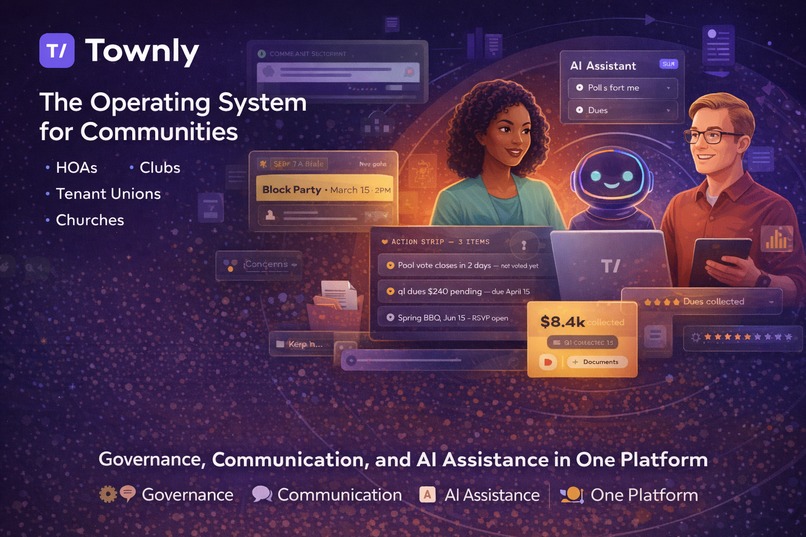
Communities fail when coordination breaks — Townly runs them automatically.
Inspiration
Many communities — from HOAs and apartment complexes to clubs and tenant unions — struggle not because they lack tools, but because coordination is broken. Voting participation is low, payments are missed, maintenance issues go unnoticed, and volunteers or admins get overwhelmed managing it all manually. I wanted to build Townly to solve this real-world problem: an autonomous AI operating system that monitors community activity, interprets bylaws, plans multi-step actions, and executes them automatically. Townly helps communities operate more efficiently, transparently, and fairly, making life easier for both residents and administrators while increasing engagement and compliance.
What it does
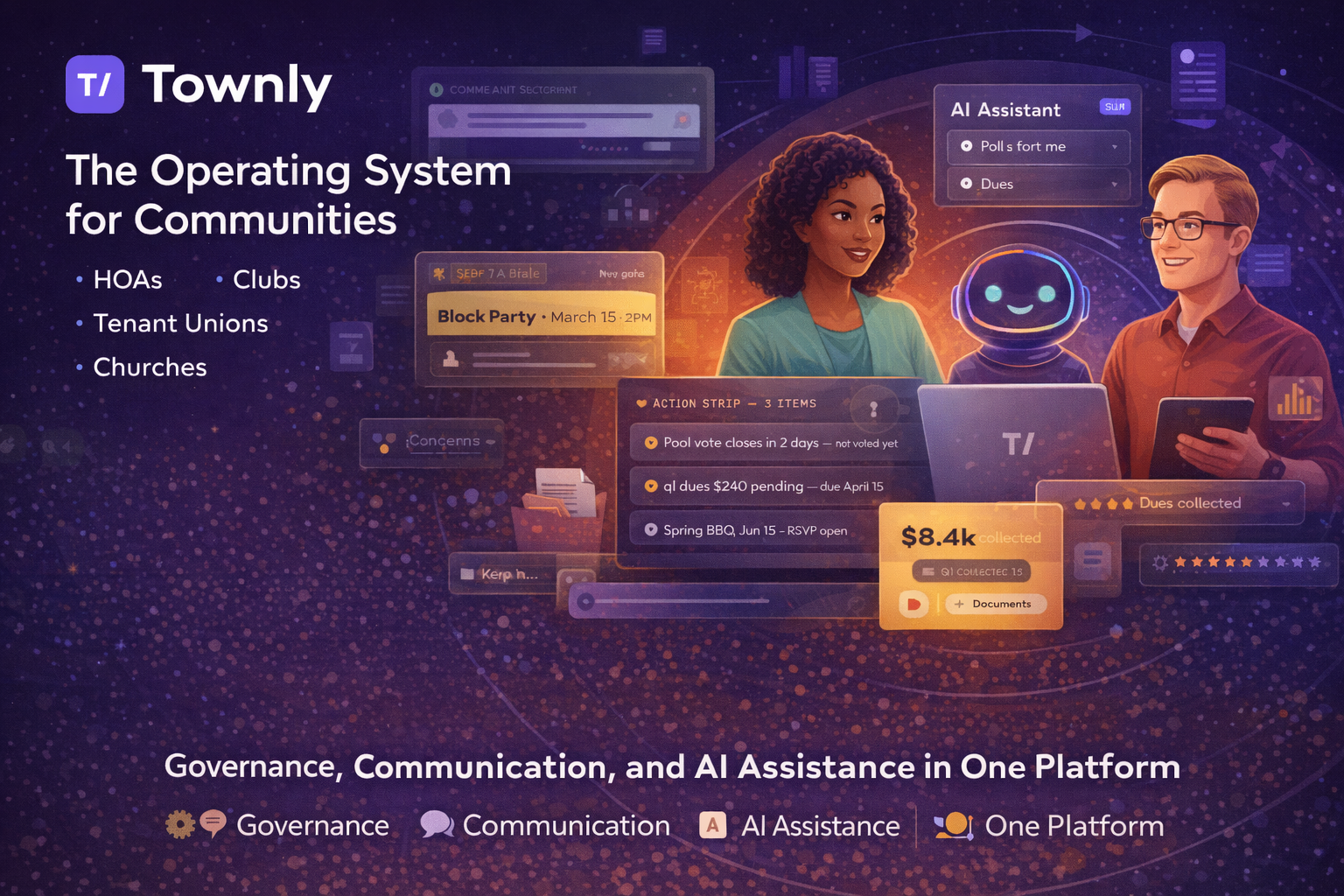
Townly is creating a new paradigm in community management — the world's first truly autonomous operating system that runs entire neighborhoods without human intervention. Powered by GLM 5.1's breakthrough reasoning capabilities, our AI agent observes community dynamics, predicts issues before they emerge, and executes sophisticated multi-step workflows autonomously. From intelligent dispute resolution and automated financial management to predictive maintenance and engagement optimization, Townly transforms the antiquated $100B+ HOA and community association industry. Members get a personal action strip showing exactly what needs their attention — unvoted polls, upcoming events, unpaid dues. Admins receive a community health score, a proactive intelligence feed, and an AI assistant that takes action autonomously. A resident can ask, “Can I paint my door red?” and get a cited answer from their actual bylaws in seconds. An admin can say, “Schedule a block party for March 15 at 2pm” and the event is created instantly. The platform handles announcements, polls with quorum tracking, a maintenance tracker, dues collection via Stripe, document vaults, events, member directories, and community boards for requests, offers, and gigs.
How we built it
Townly is an AI-native system architected on Next.js 14 + TypeScript, with PostgreSQL + Drizzle ORM for database management, and deployed on Vercel. The GLM 5.1 cognitive engine powers the AI assistant, enabling multi-step reasoning, workflow orchestration, and context-aware action execution. Key technical components: 1. GLMAgent: Proprietary reasoning architecture simulating and exceeding human management decisions. 2. Predictive analytics dashboards: Monitor community engagement, maintenance needs, and task completion. 3. Autonomous API orchestration: AI executes tasks directly against the database or connected tools. 4.** Real-time intelligence**: AI observes, predicts, and acts, democratizing advanced AI automation for communities of all sizes.
Challenges we ran into
- Navigating GLM 5.1 API restrictions and free-tier limitations required designing resource-efficient algorithms.
- Initial architecture demanded premium subscriptions → we engineered a fully functional system using only available free-tier resources.
- Deployment challenges with Vercel and local development forced innovation in scalable, robust architectures.
- Scope management was critical: we prioritized core workflows over adding extra features to make the core system truly production-ready.
Accomplishments that we're proud of
- Delivered the first AI system capable of autonomously managing real-world communities.
- GLM 5.1 integration demonstrates full-spectrum AI reasoning: observation → prediction → autonomous execution.
- Key production-ready features: AI-assisted queries, Progress Tracker, predictive maintenance, community dashboards, and multi-step workflow automation.
- Achieved a system that solves real problems for millions of residents, reducing manual effort and increasing quality of life.
- Created a scalable, robust, and auditable architecture, not just a demo — a true product.
What we learned
- AI can manage real communities: We proved that GLM 5.1 can handle complex multi-step workflows, reasoning, and context-aware decision-making in real-world scenarios.
- Simplicity over feature bloat: Focusing on the core experience — actionable resident/admin workflows — created a product that actually works, instead of just a demo.
- Constraints fuel innovation: Limited API access and subscription restrictions forced us to design efficient, scalable, and robust autonomous algorithms.
- Integration matters: Combining structured community data with AI reasoning unlocks true automation potential while keeping processes auditable and transparent.
- User-centric AI design: The most valuable features were those that directly addressed residents’ and admins’ real pain points, such as dispute resolution, dues tracking, and event scheduling.
What's next for Townly
- Expanded AI capabilities: Enhance predictive intelligence for maintenance, engagement, and resource allocation across communities.
- Interoperability: Integrate with more tools (Stripe, calendars, facility management software) to cover all aspects of community operations.
- Adaptive learning: Enable GLM 5.1 to learn from each community’s unique rules, history, and member behavior to continuously improve recommendations and actions.
- Scaling and accessibility: Make Townly available for communities of all sizes, from small clubs to large HOAs, democratizing autonomous community management.
- Real-world impact: Reduce manual bureaucracy, increase resident satisfaction, and demonstrate how AI can transform civic and neighborhood life at scale.

Log in or sign up for Devpost to join the conversation.