-
-
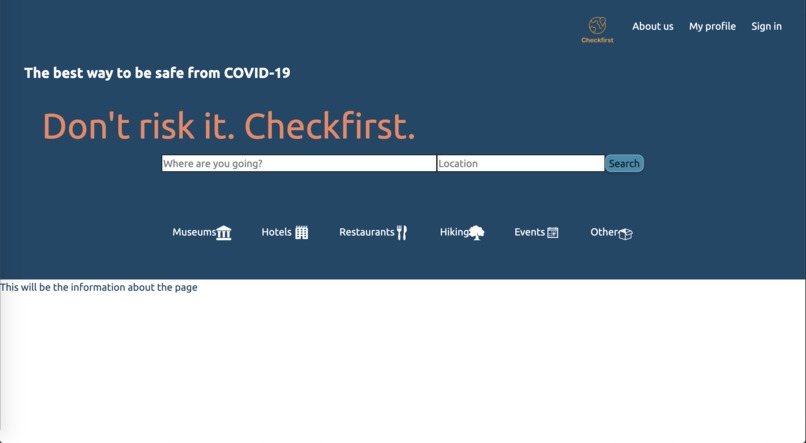
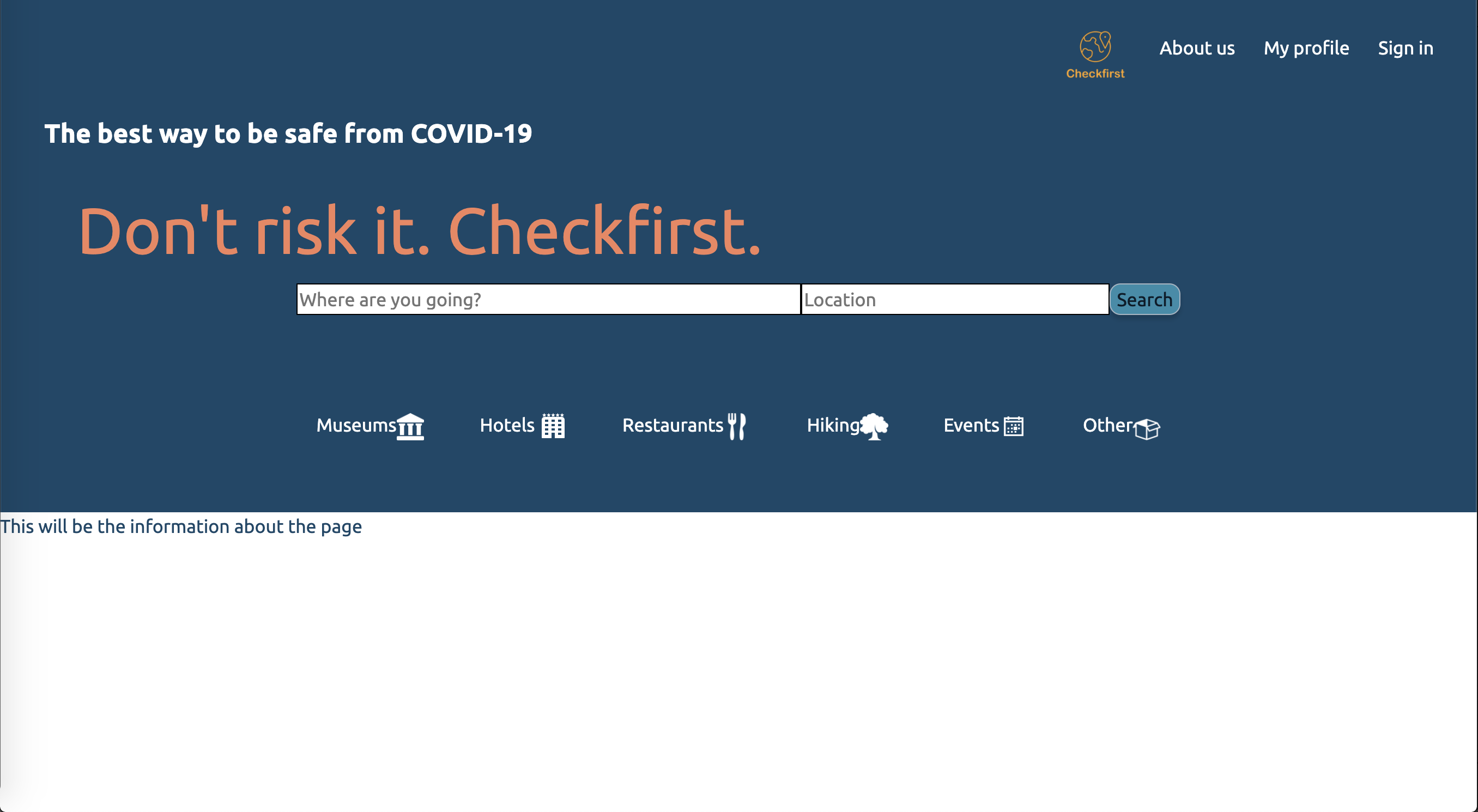
Current Homepage
-
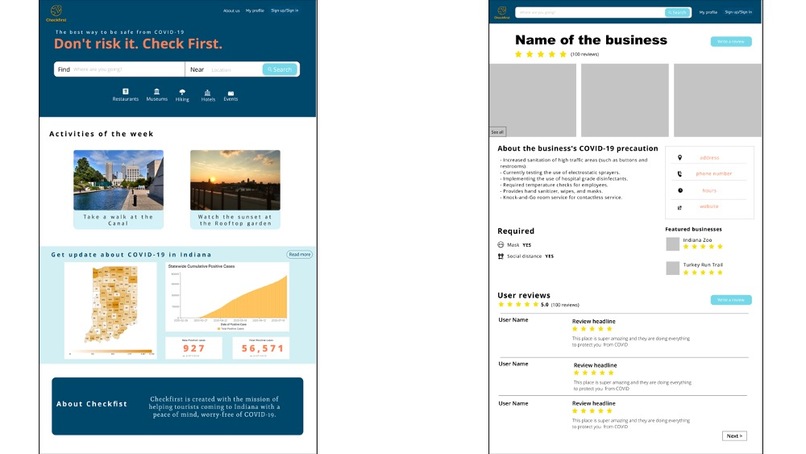
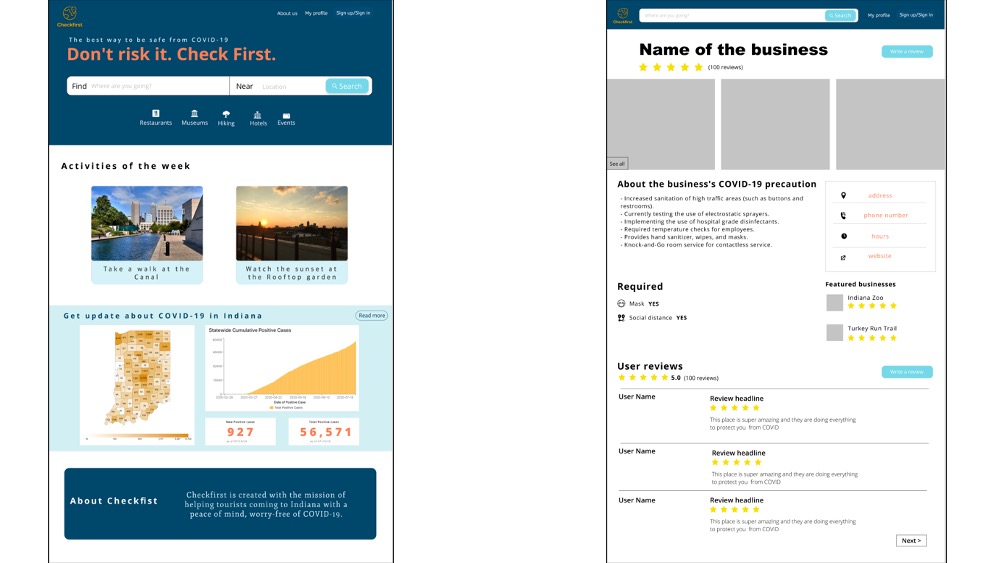
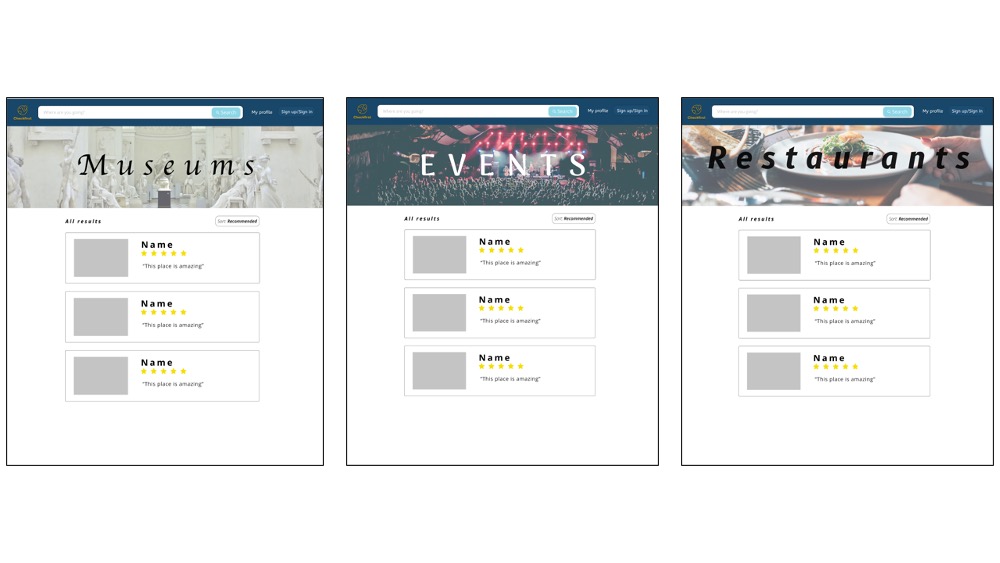
Future Design Mockup
-
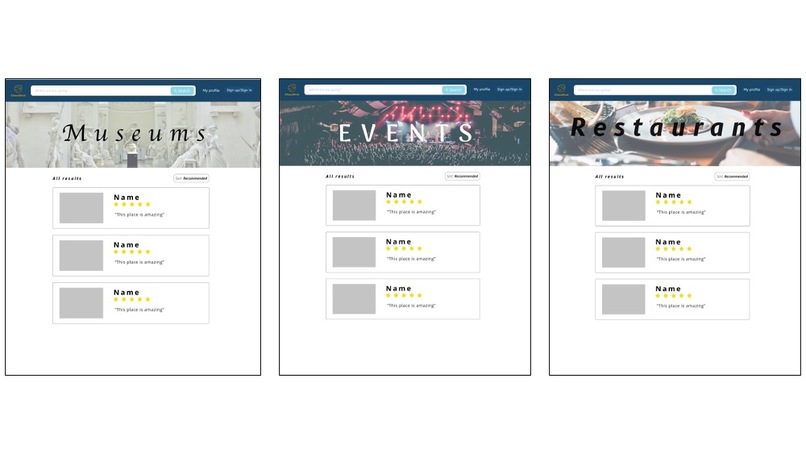
Future Design Mockup
-
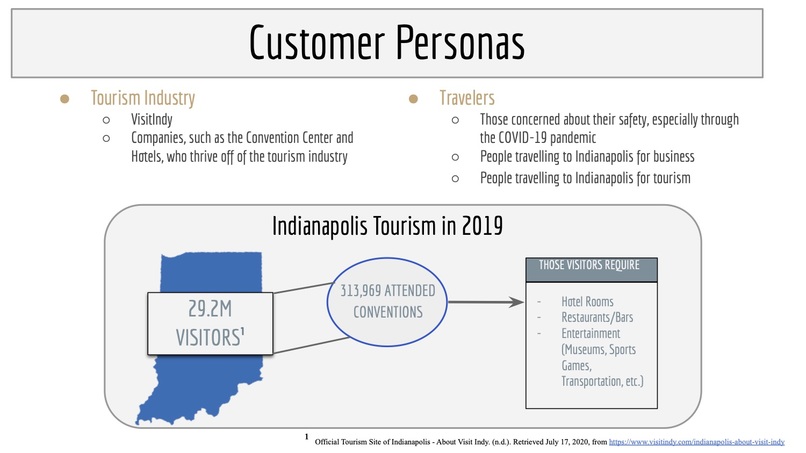
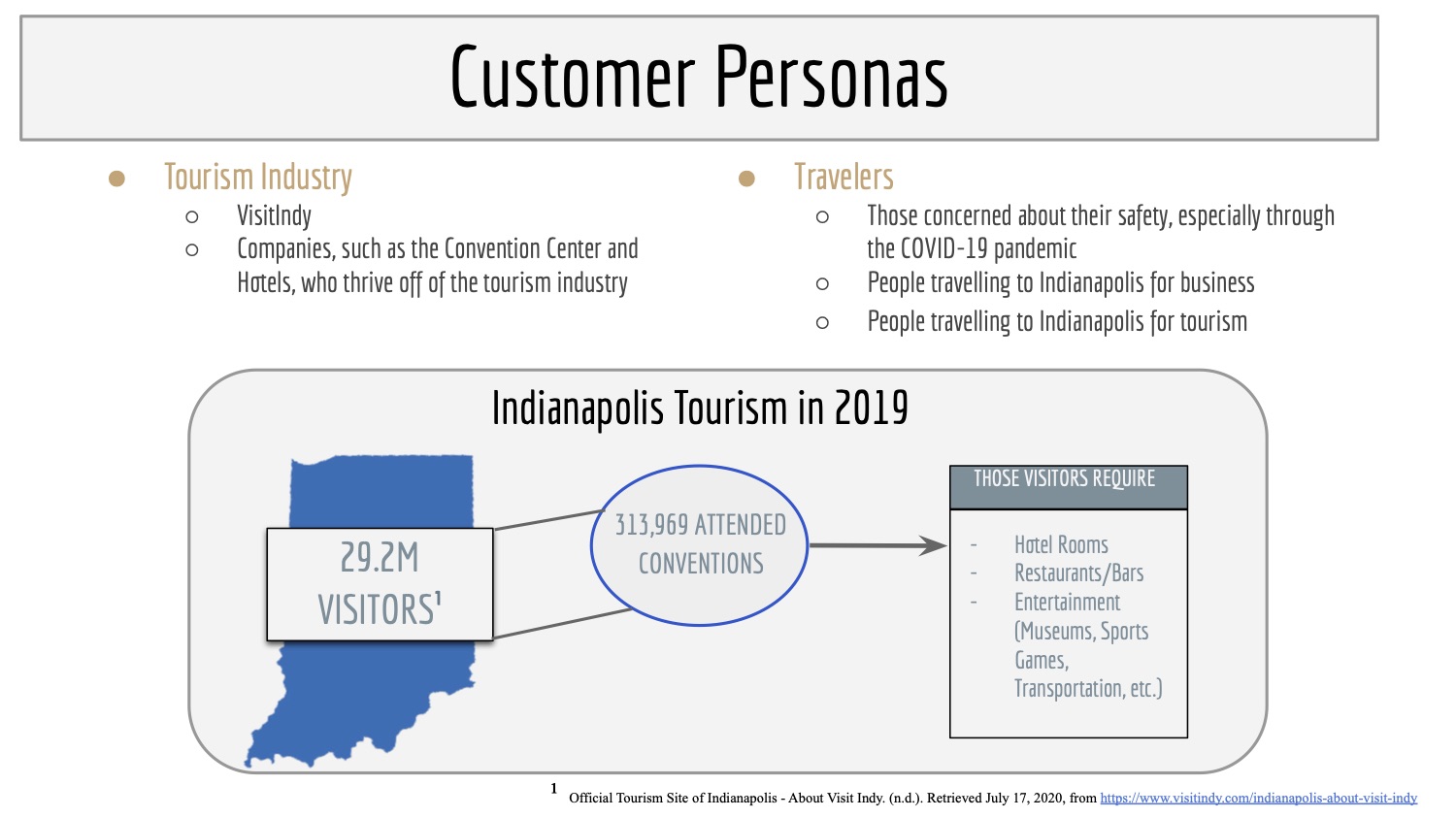
Customer Persona
-
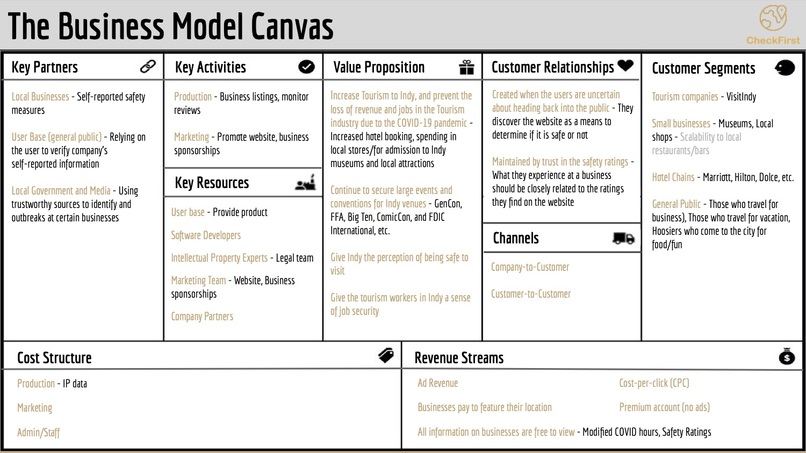
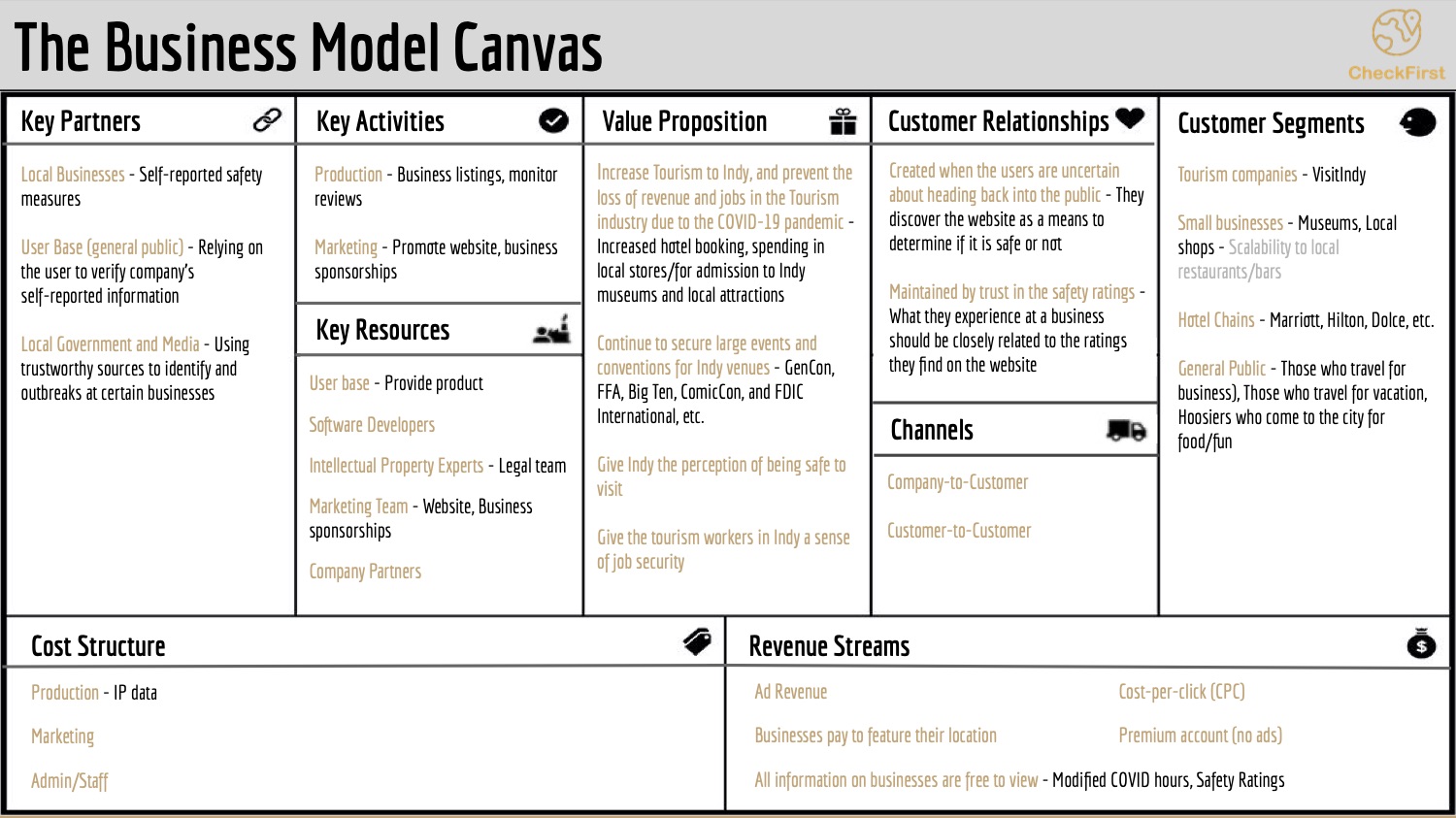
Business Model Canvas
-
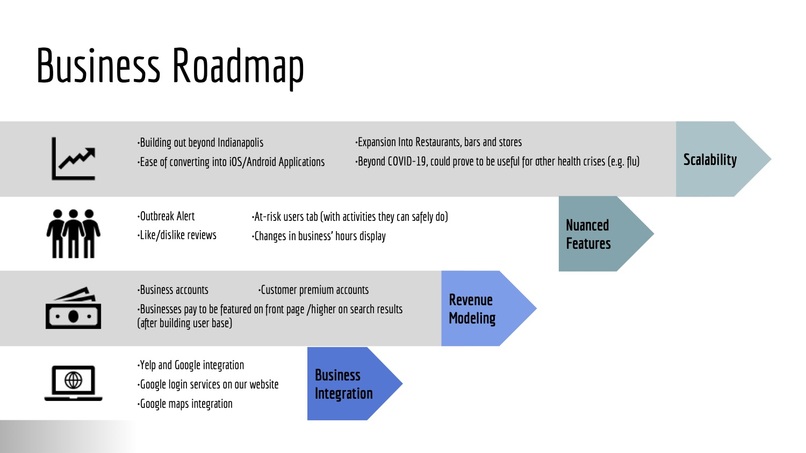
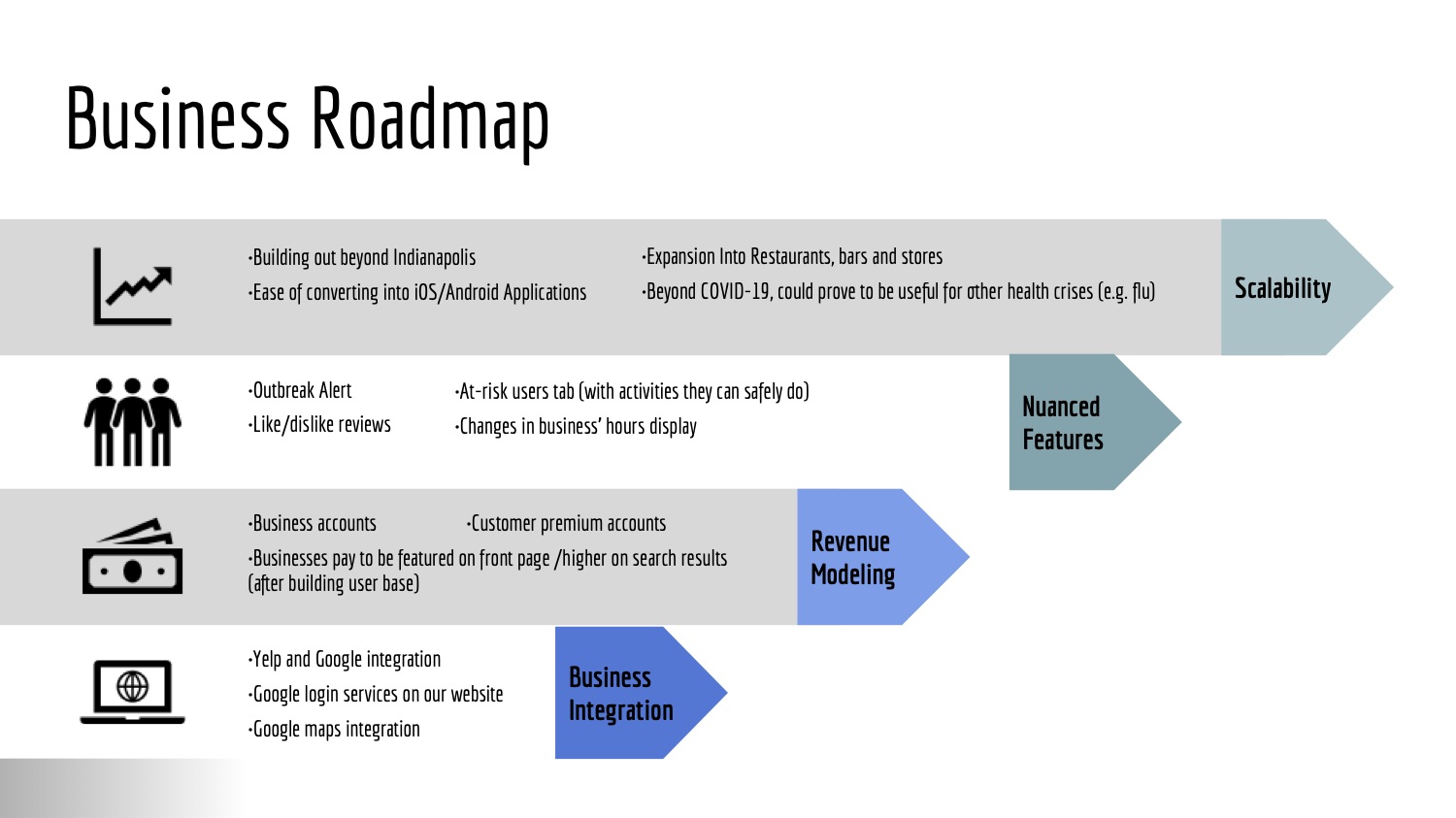
Business Roadmap
Overview
30 million people from around the globe visited Indy in 2019. This brought a record-setting $5.6 billion in economic impact, while supporting a record-setting 83,000 tourism jobs in Indianapolis. However, due to the COVID-19 pandemic and the economic uncertainty it has brought, it has been predicted that nearly half of these tourism jobs have been lost in the past several months. More than 200 conventions have canceled to date, as the Indiana Convention Center has been closed since March 17. Hotels that were closed for months now remain open but empty. Restaurants, museums, and bars are on the verge of closing permanently, even as the state is in the process of reopening. Our team worked with an SME, Chris Gahl from VisitIndy, to come up with a way to ease the public’s mind while visiting Indianapolis - “Checkfirst.”
Checkfirst is a website where tourists, business travelers, and even local Hoosiers can check the safety precautions that each individual business has taken. After visiting, the user then has the opportunity to give that business a rating and write reviews, based on how well they believe the company is following these safety measures. These user ratings average out, providing each business with a score that future travelers can use in order to determine if certain places are safe to visit.
Overall, Checkfirst will help guide users to the safer locations in town, create a perception of safety within Indianapolis, and encourage businesses to take the precautions necessary to slow down the spread of COVID-19. Moreover, this product will also have further purpose if COVID-19 passes, as people are now becoming more precautious of public places and their surroundings.
Team Members
Evan Dile (Project Manager, Marketing at IUPUI) As project manager, Evan was responsible for scheduling all internal and external meetings. He created a Trello board and ran a weekly planning meeting where everyone agreed on a set of tasks for the week. Evan also put this document together with help from the rest of the team. As part of the Go Squad, Evan also helped develop the Business Model Canvas as well as the Value Proposition. Also, Evan helped identify and research information from local businesses in the Indianapolis area.
Vy Hoang (UX/UI Designer, Senior Economics at Depauw) Vy participated in brainstorming and suggesting many solutions within the tourism industry. As a part of the Pro Squad, Vy was responsible for designing UI for Checkfirst’s website. She worked closely with other developers on the team to accommodate the website designs so that they are achievable within a short amount of time. Vy also helped build the product’s features roadmap and marketing strategy.
Juhwan Paeng (Software Developer, Designer. Senior Engineering and Management at Bethel) Juhwan was responsible for both backend and frontend development. Juhwan handled both node js and css to make the best outcome for the project. He communicated between designer’s perspective and programmer's perspective to understand each side. He worked with the designed UI and made the website in a way that it could display the UI model in the best way. Juhwan communicated with other team members to keep the progress with everyone and collect the best idea for the website. Juhwan participated by communicating, programming, and designing for the project.
Lindsey Schwomeyer (Business Development, Senior Economics at DePauw) Lindsey examined the tourism industry and market segments, identified possible clients and assisted in the actualization of our strategy as part of the business-oriented Go Squad. As part of this team, Lindsey delivered the Business Model Canvas, Value Proposition, Environmental Analysis, and Business Roadmap. In the completion of the project, Lindsey participated in the final pitch.
Brenton Strahla (Business Development, Senior Rhetoric & Composition at Wabash) Brent built out our product marketing strategy, prospected key clients and played on our oversight team for go-to-market strategy. Between sales planning and defining competitive positions for market entry, he also provided strategic direction for website modeling. Deliverables included the Business Model Canvas, Value Proposition, Environmental Analysis, Business Roadmap and graphic design elements for UI/UX. Our project also tasked Brent with sourcing & screening fifteen businesses for our final proposal.
Sean Wolfe (Software Developer, Senior in Computer Science at Ball State University) Sean was a full stack developer for this project. His overall purpose was to design and execute communication between the database, backend, and frontend. Sean worked closely with all three throughout the weeks. It was his job to make sure the communication between the three worked smoothly and to the needs/wants of the application being brainstormed by teammates. Additionally, he also made the outline and tables of the database along with the CSS/styling and design of the website.
How did you decide on this customer segment, problem, and solution?
After talking with coaches, friends, families and each other, we noticed that there is a large number of people who are frustrated with traveling during COVID-19. Some are worried for safety reasons, unsure about whether a business is taking the necessary precautions to slow the spread of COVID. Some are confused about business hours, as some businesses are closed or have modified hours that are not easily found. Some are concerned about where to stay overnight in Indianapolis, whether for business or for vacation. This has led to the closure of local businesses and an economic uncertainty within the city.
Based on this, we decided that one designated location for all of this information would provide a solution to Indianapolis’s problem. One website, Checkfirst, can guide the worried users to safer locations, curb confusion by listing any modified hours or services of business, and direct visitors to locations where they can confidently experience an overnight stay in the city.
After explaining our solution to Indy locals and frequent visitors of the city, we realized that Checkfirst has the potential to bring back tourism to the city, and to enhance the public’s perception of the area’s safety.
How did your team build and iterate on the solution?
The current health crisis has potential to change the ways businesses fundamentally operate with new norms such as desk shields, hand sanitizer at every entry and even requiring masks of their guests. As the tourist industry bleeds, our teams build will ameliorate issues consumers might have with public distrust.
Checkfirst was forged out of Indianapolis’ need for updated (and accessible) transparency in the face of COVID-19 amongst small and large businesses. We decided to build out this novel platform that would be a one-stop-shop for all health-related information in the tourist industry. To make this as authentic as possible, we decided a crowdsourced aggregator was the best way to solve issues with business accessibility and for users' pains surrounding COVID-19.
Once our team had an idea of the product we wanted to create, the Pro Squad then looked at the feasibility to make such a working prototype in a short amount of time with only two developers. One of our members had experience in developing web applications and the other had backend coding experience. Because of this, the Pro Squad decided to use Express as our framework. It had a small learning curve, is a lightweight framework, offered flexibility, and could easily be taught to the other developer. Two of our Pro Squad members spent the first 2 weeks learning Express— reading documentation, articles, and watching videos. The other members started to create the primary and secondary workflows, started the UI/UX designs , and a bunch of other information gathering that the developers would ask the team later on.
The biggest hurdle in developing this application was the fact that no members had thorough experience with a front end framework such as React or Angular. That, along with the restricting time constraint, we found a node package called Pug. Though small and having limited commands, it allowed a lot of the basic needs for the client side to communicate with the backend and eventually the database. If time had allowed, we would have wanted to learn and use React with our application.
Our development also depended on what data our team wanted to share on our application. The Pro Squad worked closely with the Go Squad to have a firm understanding on what data should be stored and shared, along with what data the website should ask users and businesses for. The rest of the development revolve around becoming more skillful with Express and implementing the wants and needs of the team for our application, Checkfirst. As the prototype started to come to life, we also used user testing to help improve our website. We had roughly 10 people experiment with our application and test some of the functionality. We learned from their constructive criticism and tried to adapt and improve our application based on the feedback.
- Express - With only one member on the pro squad that had coding experience, we chose Express because it had a low learning curve.
- Pug - All three members had no experience with a frontend framework. Due to this, Pug was a very simple frontend development node package that could be used to have GET and POST requests, show data from the database on the screen, and even use javascript inside the HTML.
- MongoDB and Mongoose - To host our database, we felt MongoDB Atlas would be best for the job because all three members were working remotely. With this, we did not have to worry about running local hosts on our laptops for the database. Mongoose was used to create data models and have Node js interact with MongoDB.
- Figma - With its online cloud storage, ease to learn and vast amount of resources, Figma was best fitted to designing our website in a short amount of time.
If you had another 5 weeks to work on this, what would you do next?
Due to time constraints, we only integrated museums, hotels, and a few other notable landmarks in Indianapolis within the five weeks of the project. The next step would be to expand into restaurants, bars, and even stores.
Secondly, there are several more features that we would add to CheckFirst, such as:
- Modified business hours due to COVID-19
- Outbreak Alerts
- Ability to sign in/ sign up using Facebook or Gmail
- The ability to Like or Dislike comments and reviews
- An “At-Risk” tab that notes special hours at businesses for individuals who are at a higher risk of suffering from COVID-19
- Google Maps integration for a more user friendly search feature
- Articles and recommendations of activities or businesses that customers can do while being safe during the pandemic
- We also would want to improve our UI and create a more intuitive user experience
- Eventually, an expansion to an iOS/Android app may be beneficial to gain a larger, and more loyal, customer base
- Expand out of Indianapolis and into other areas
- Potential integration with Google or Yelp
- Potential partnerships with VisitIndy.com and Indiana’s ISDH to provide the most updated information about COVID-19 in Indiana
Built With
- express.js
- figma
- heroku
- mongodb
- pug


Log in or sign up for Devpost to join the conversation.