-
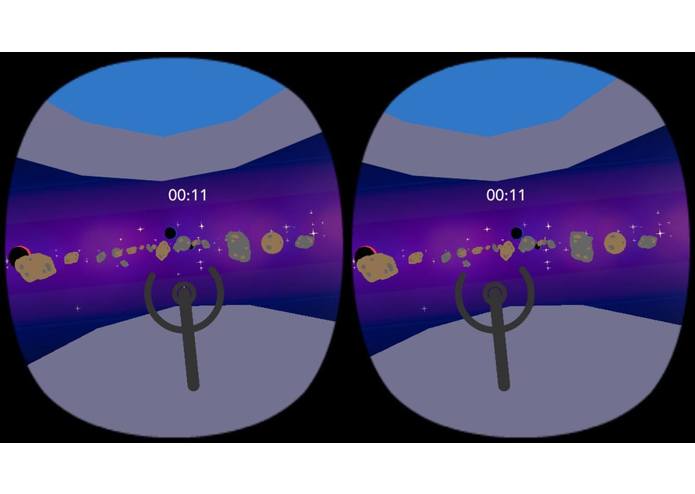
Live game
-
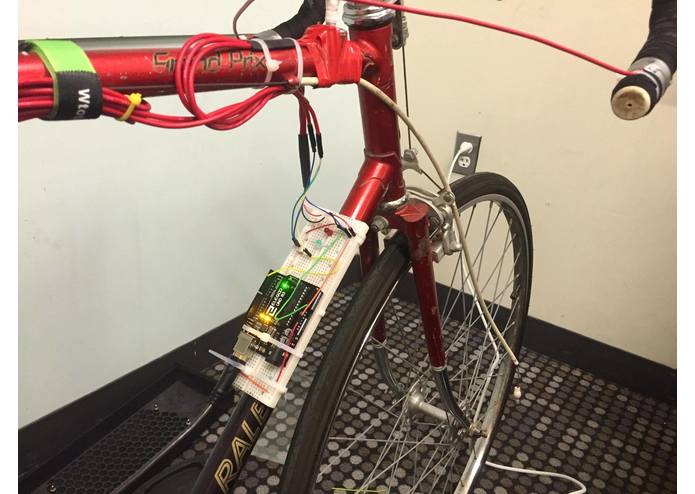
Hardware
-
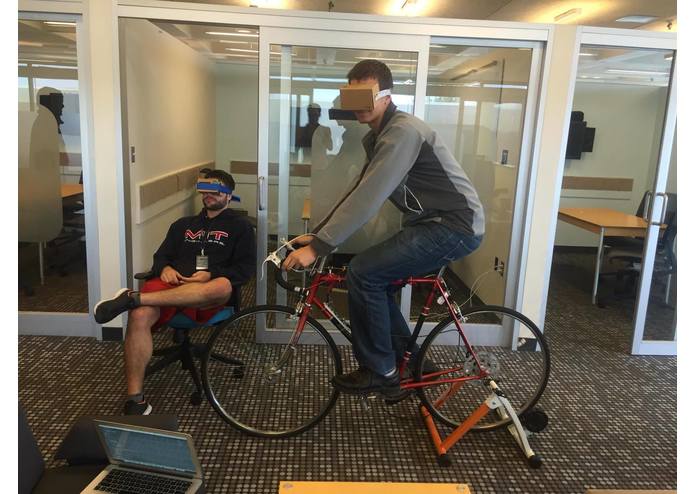
The User Experience
-
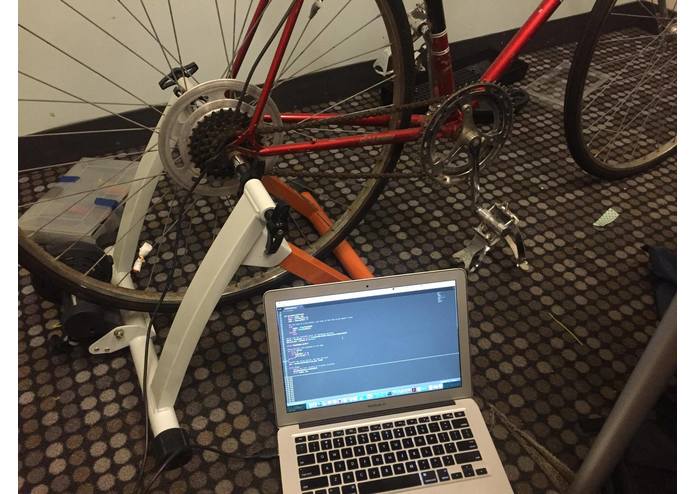
arduino code running


Inspiration
We wanted to give virtual reality a purpose, while pushing its limits and making it a fun experience for the user.
What it does
Our game immerses the user in the middle of an asteroid belt. The user is accompanied by a gunner, and the two players must work together to complete the course in as little time as possible. Player 1 drives the spacecraft using a stationary bike with embedded sensors that provide real-time input to the VR engine. Player 2 controls uses a wireless game controller to blow up asteroids and clear the way to the finish.
How we built it
Our entire system relies on a FireBase server for inter-device communication. Our bike hardware uses a potentiometer and hall-effect sensor running on an Arduino to measure the turn-state and RPMs of the bike. This data is continuously streamed to the FireBase server, where it can be retrieved by the virtual reality engine. Player 1 and Player 2 constantly exchange game state information over the FireBase server to synchronize their virtual reality experiences with virtually no latency.
We had the option to use Unity for our 3D engine, but instead we used the SmokyBay 3D Engine (which was developed from scratch by Magnus Johnson). We chose to use Magnus' engine because it allowed us to more easily at support for FireBase, and additional hardware.
Challenges we ran into
We spent a large amount of time trying to arrive at the correct configuration of hardware for our application. In particular, we spent many hours working with the Particle Photon before realizing that it's high level of latency makes it unsuitable for real time applications. We had no prior experience with FireBase, and spent a lot of time integrating it into our project, but it ultimately turned out to be a very elegant solution.
Accomplishments that we're proud of
We are most proud of the integration aspect of our project. We had to incorporate many sensors, 2 iPhones, a FireBase database, and a game controller into a holistic virtual reality experience. This was in many ways frustrating, but ultimately very rewarding.
What we learned
In retrospect, it would have been very helpful to have a more complete understanding of the hardware available to us and it's limitations.
What's next for TourDeMarsVR
Add more sensors and potentially integrating Leap Motion instead of hand held gaming pad.


Log in or sign up for Devpost to join the conversation.