-
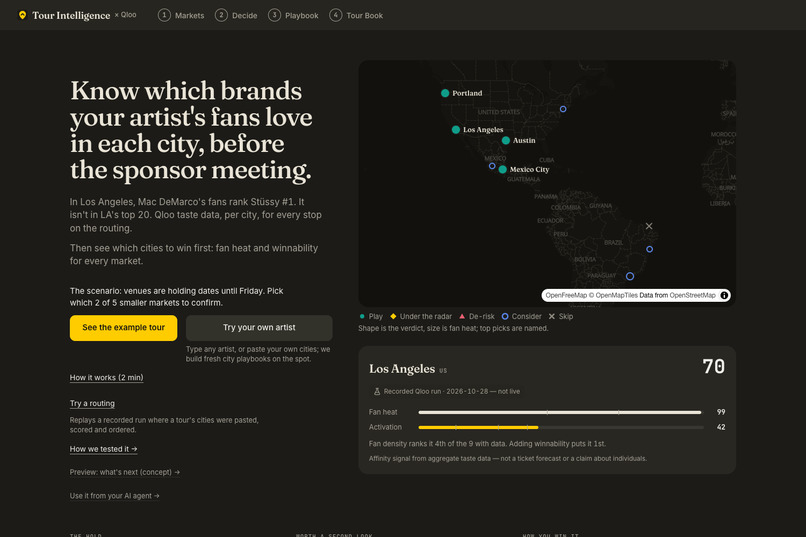
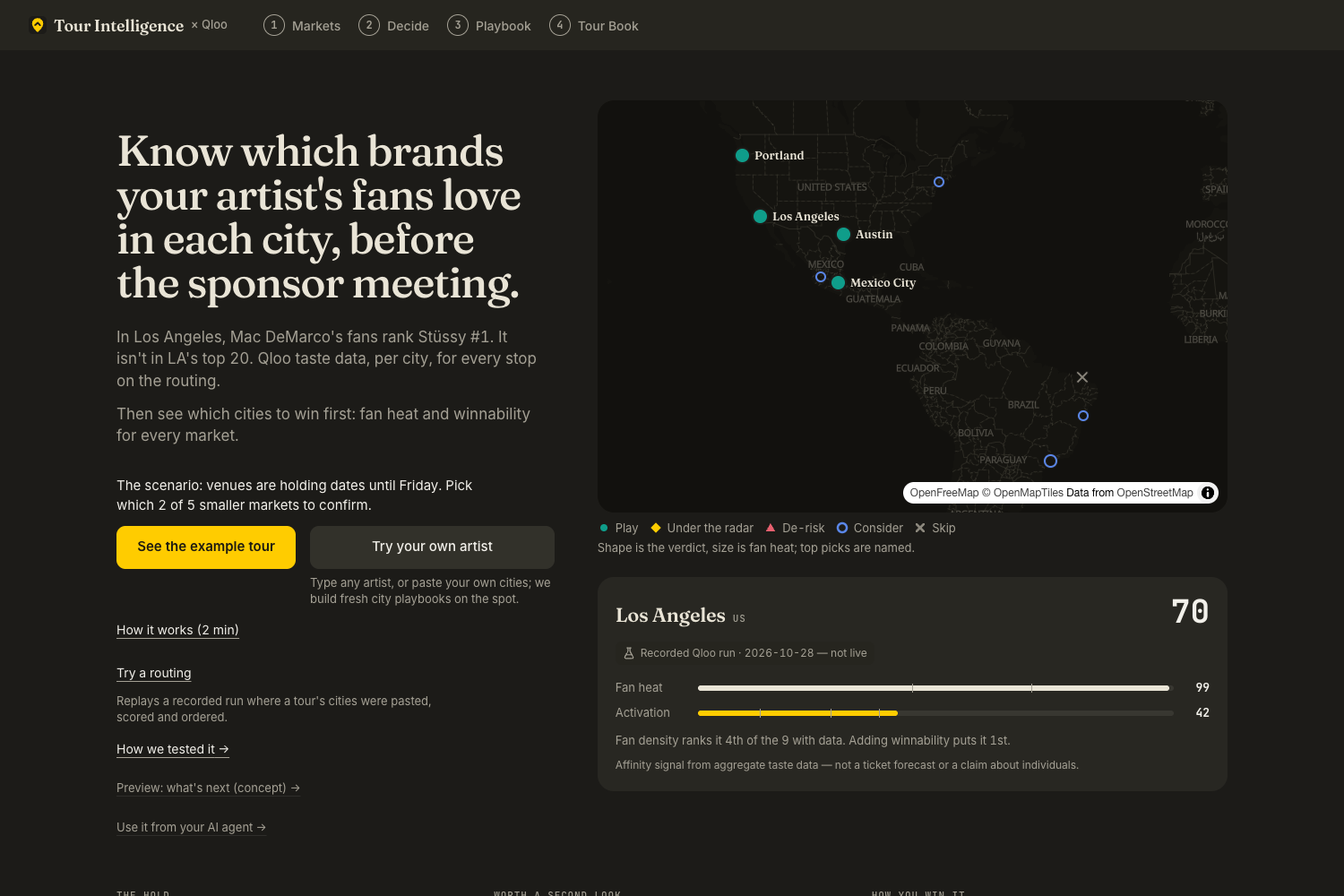
Know which brands your artist's fans love in each city, before the sponsor meeting. Try the example or bring your own artist and cities.
-
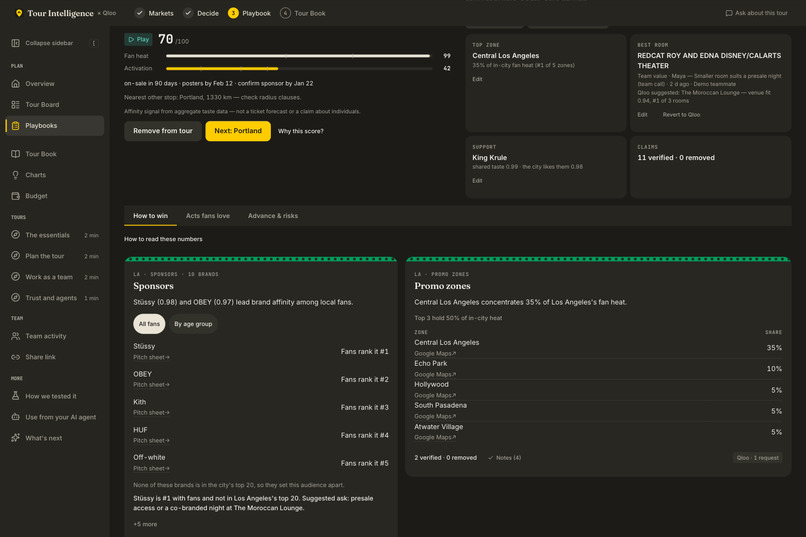
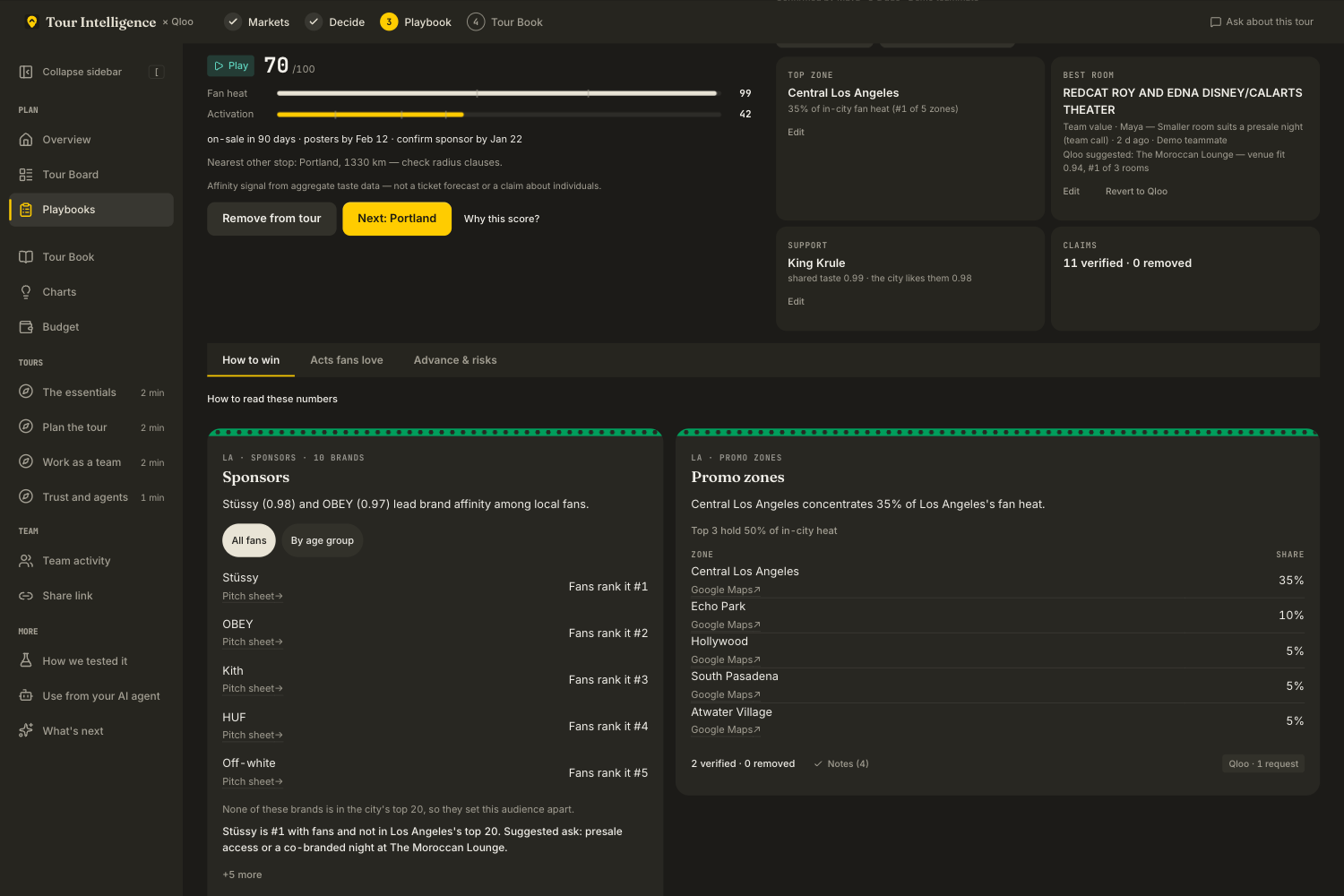
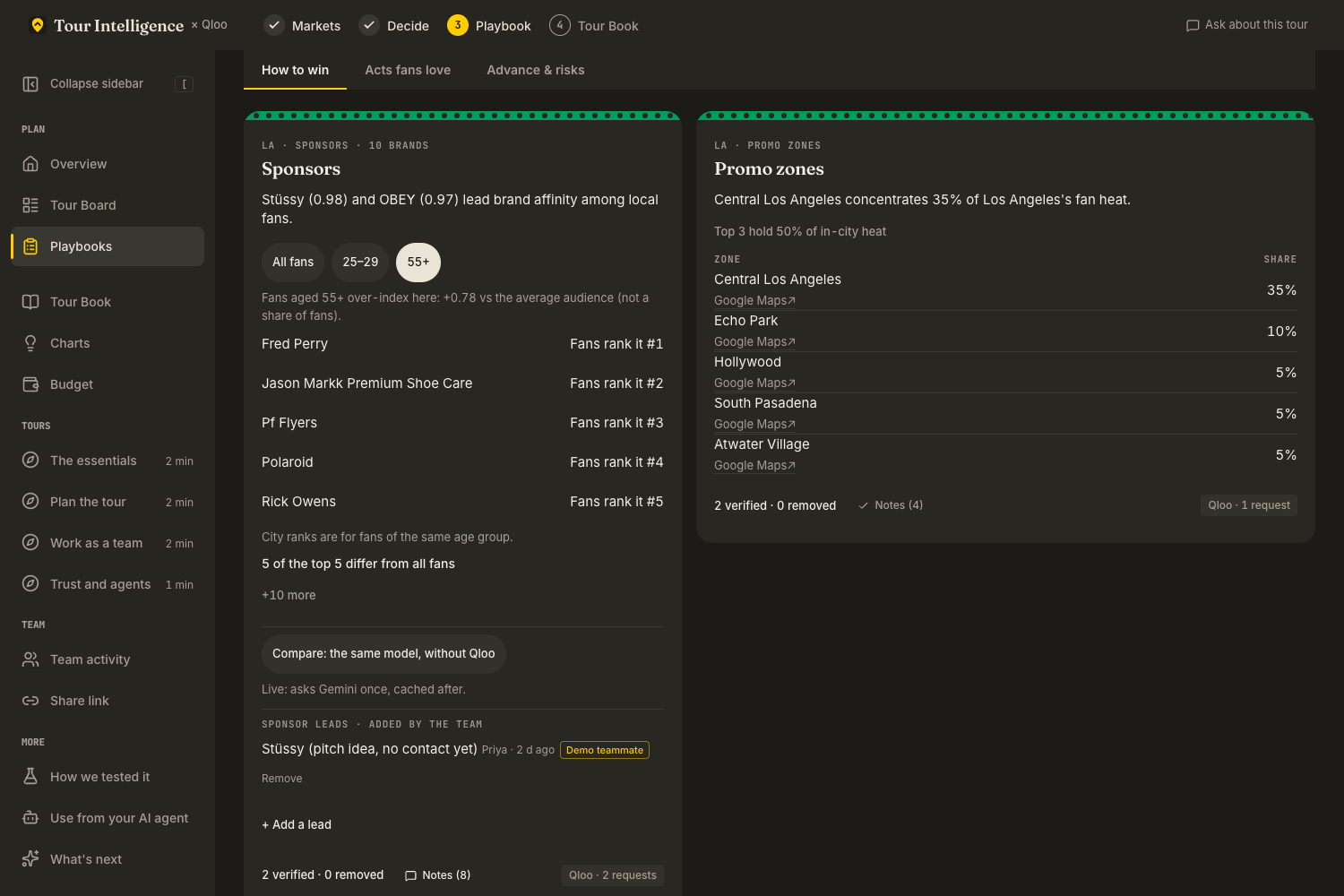
In LA, Mac DeMarco's fans rank Stüssy #1 - it isn't in the city's top 20. That gap is the sponsor pitch.
-
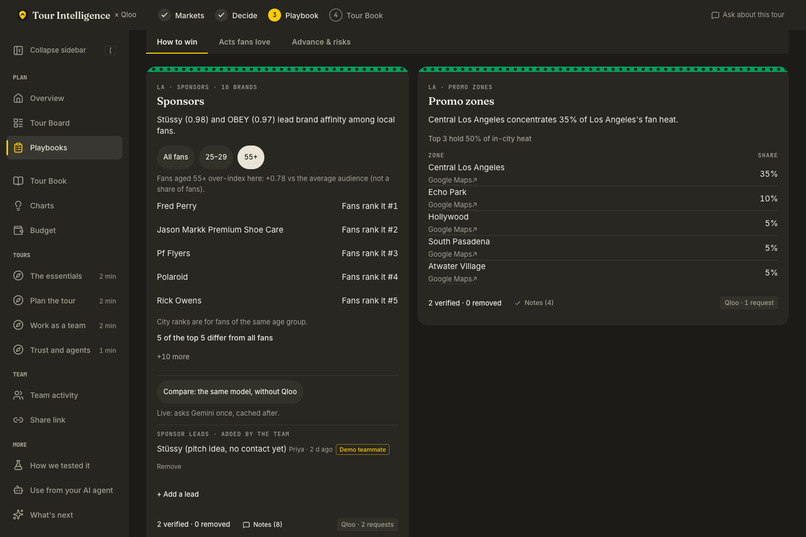
Split the same fans by age and the pitch changes: 55+ fans rank Fred Perry, Jason Markk and Polaroid, not Stüssy.
-
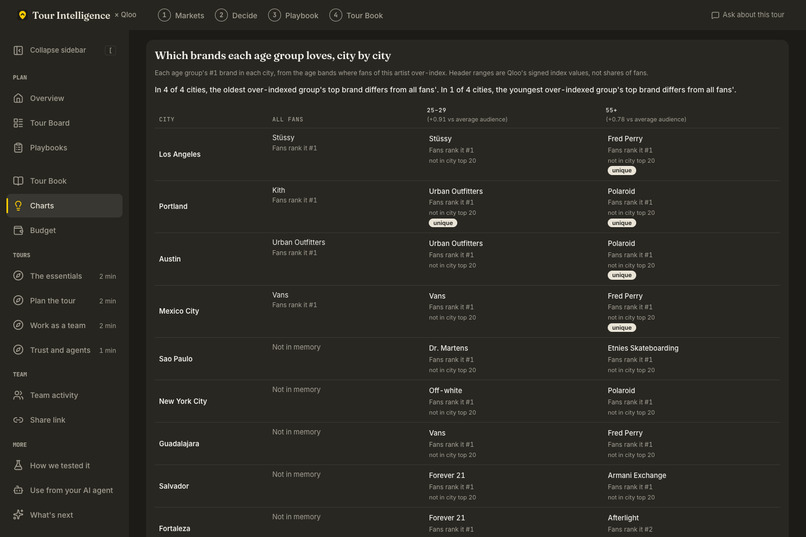
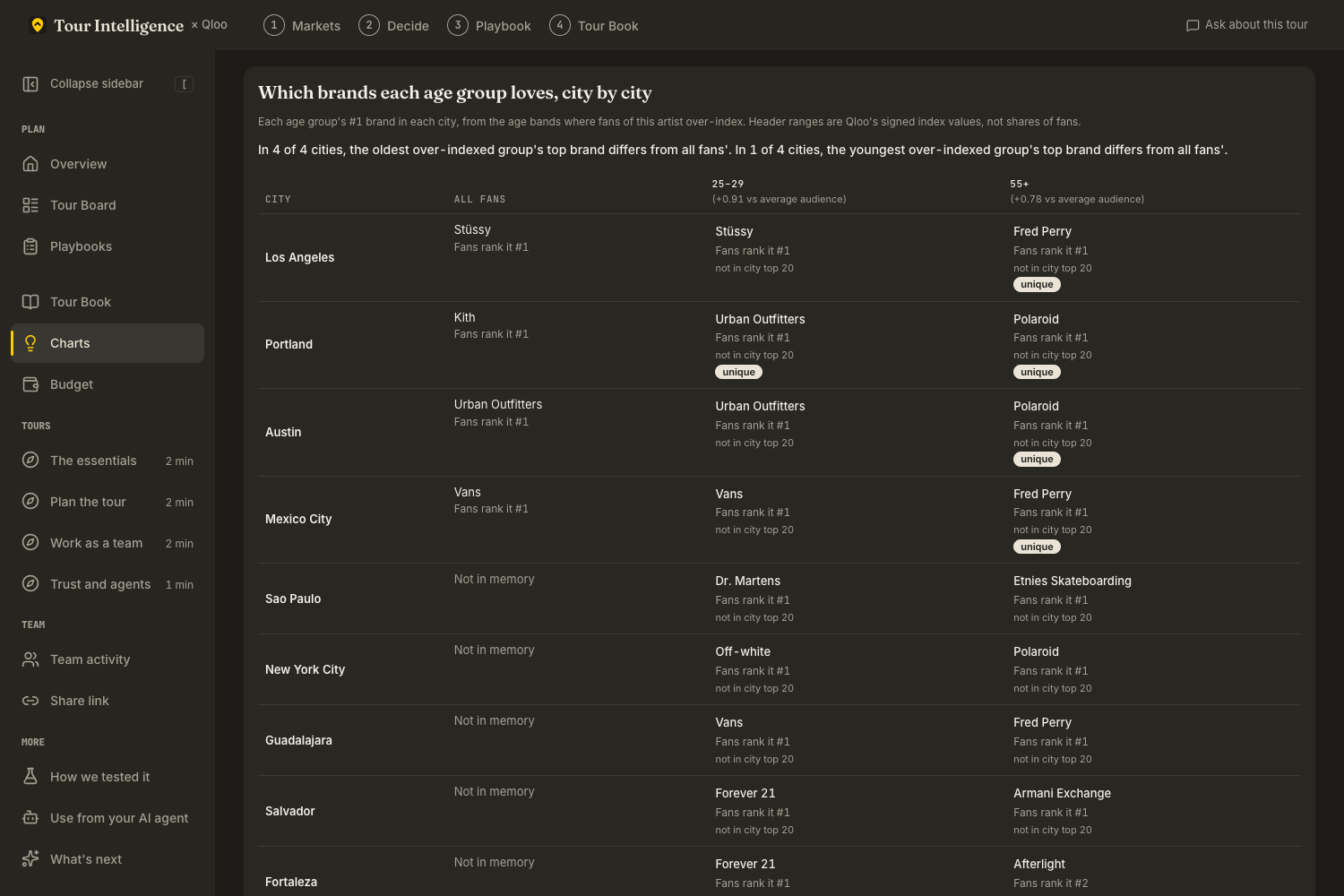
The brand each age group loves, city by city. In all 4 cities with full data, the 55+ fans' top brand differs from all fans'.
-
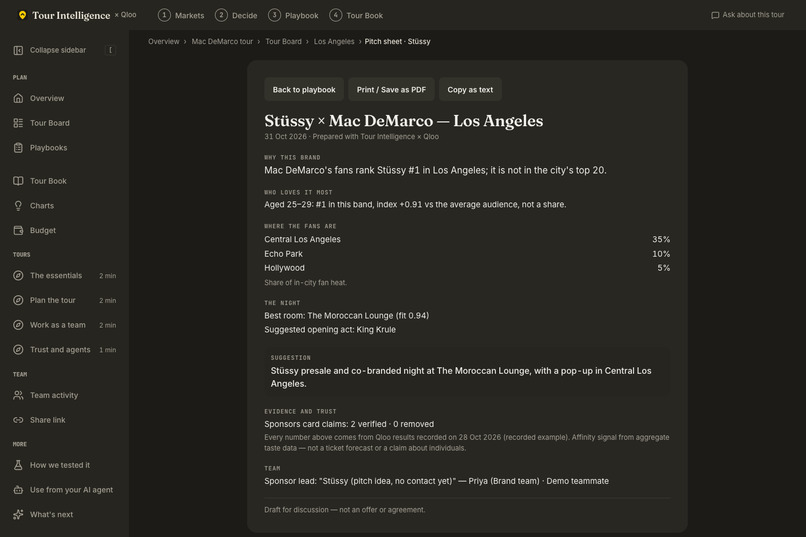
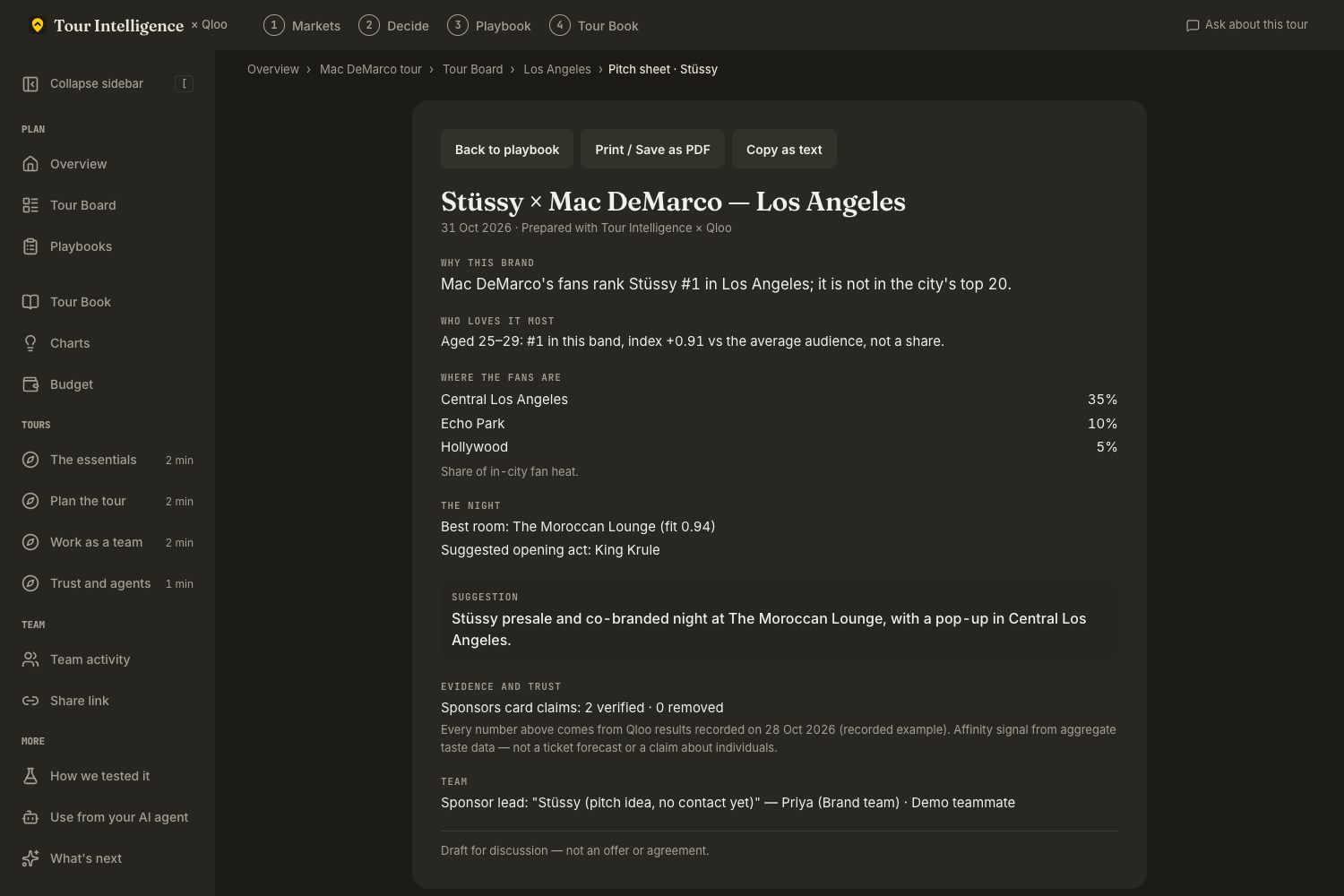
One click turns the finding into a one-page Stüssy pitch sheet: why this brand, where the fans are, the room, the act.
-
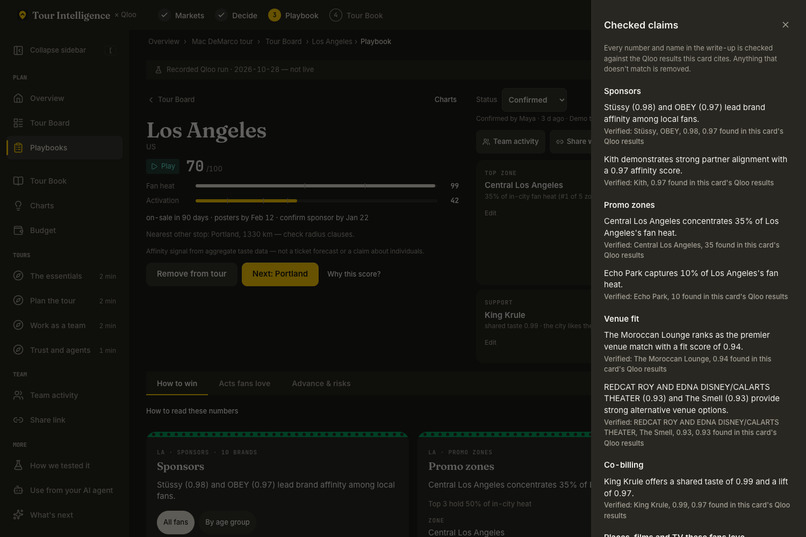
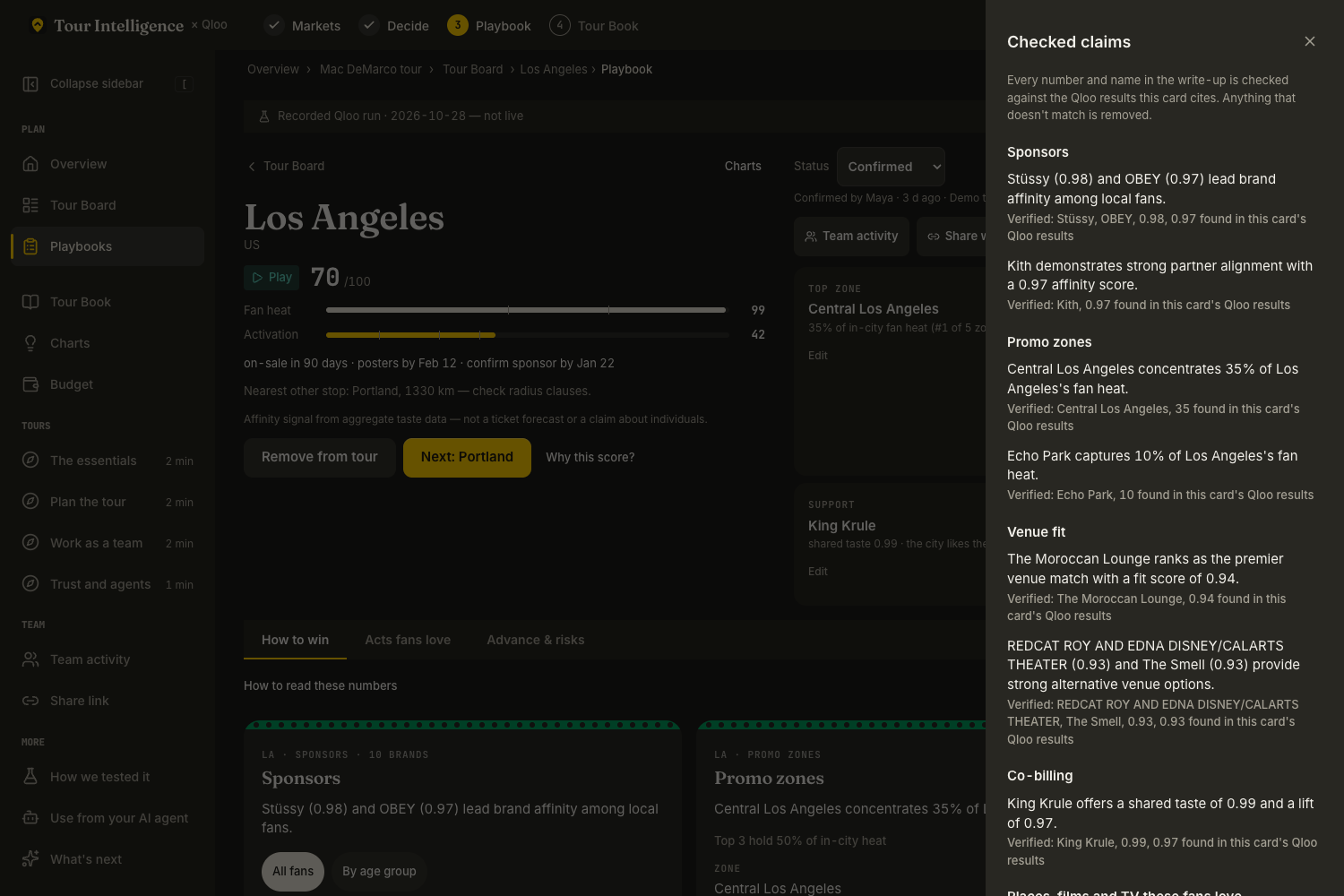
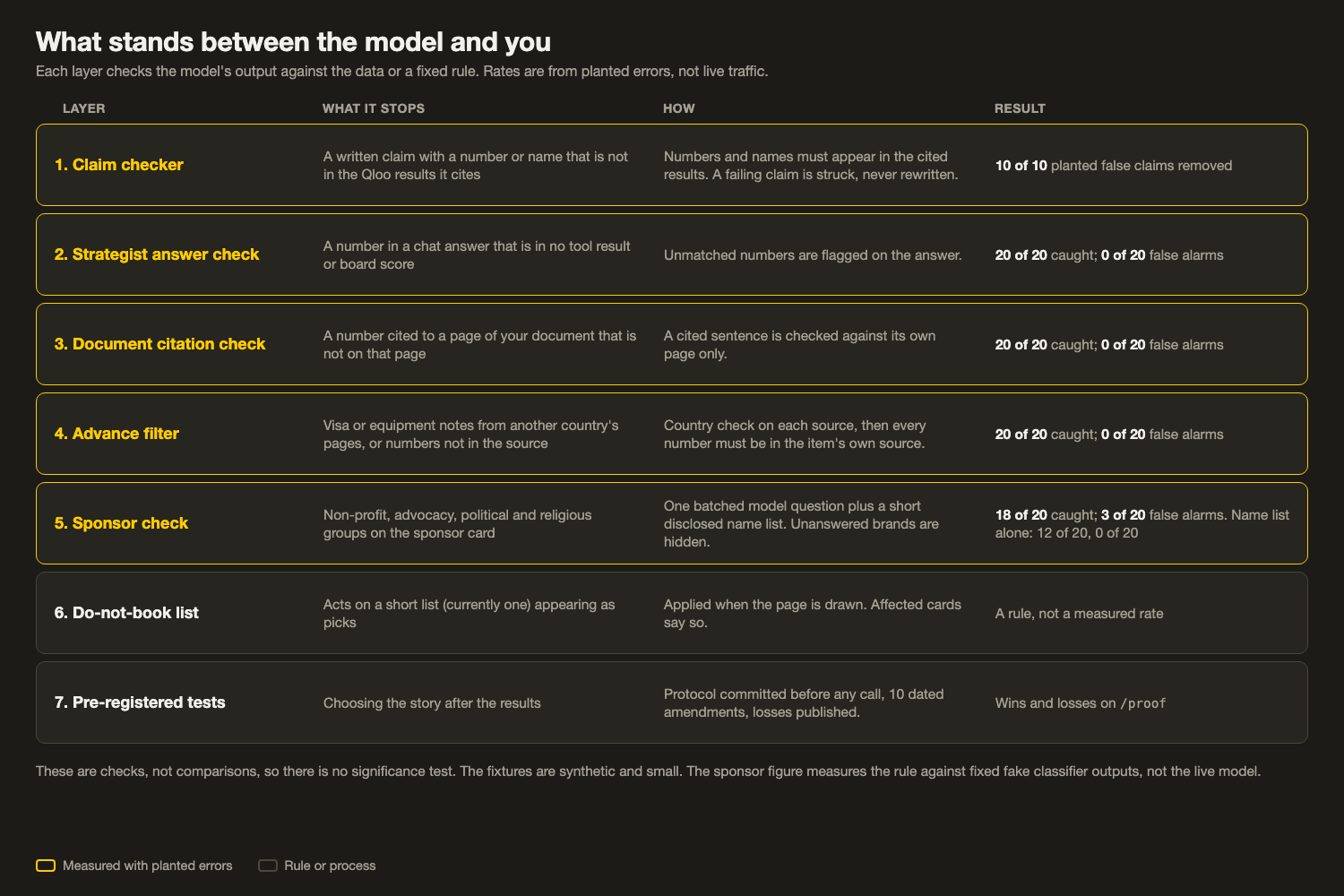
Every number in the write-up is checked against the Qloo results it cites. Anything that doesn't match is removed.
-
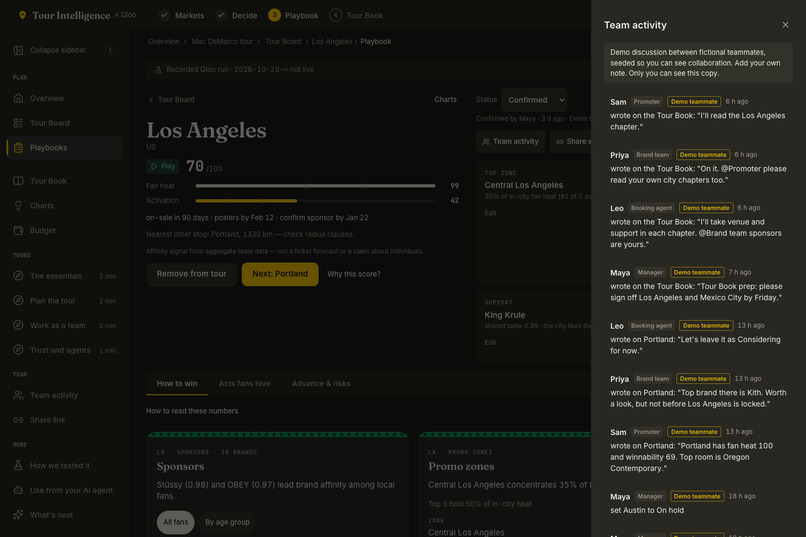
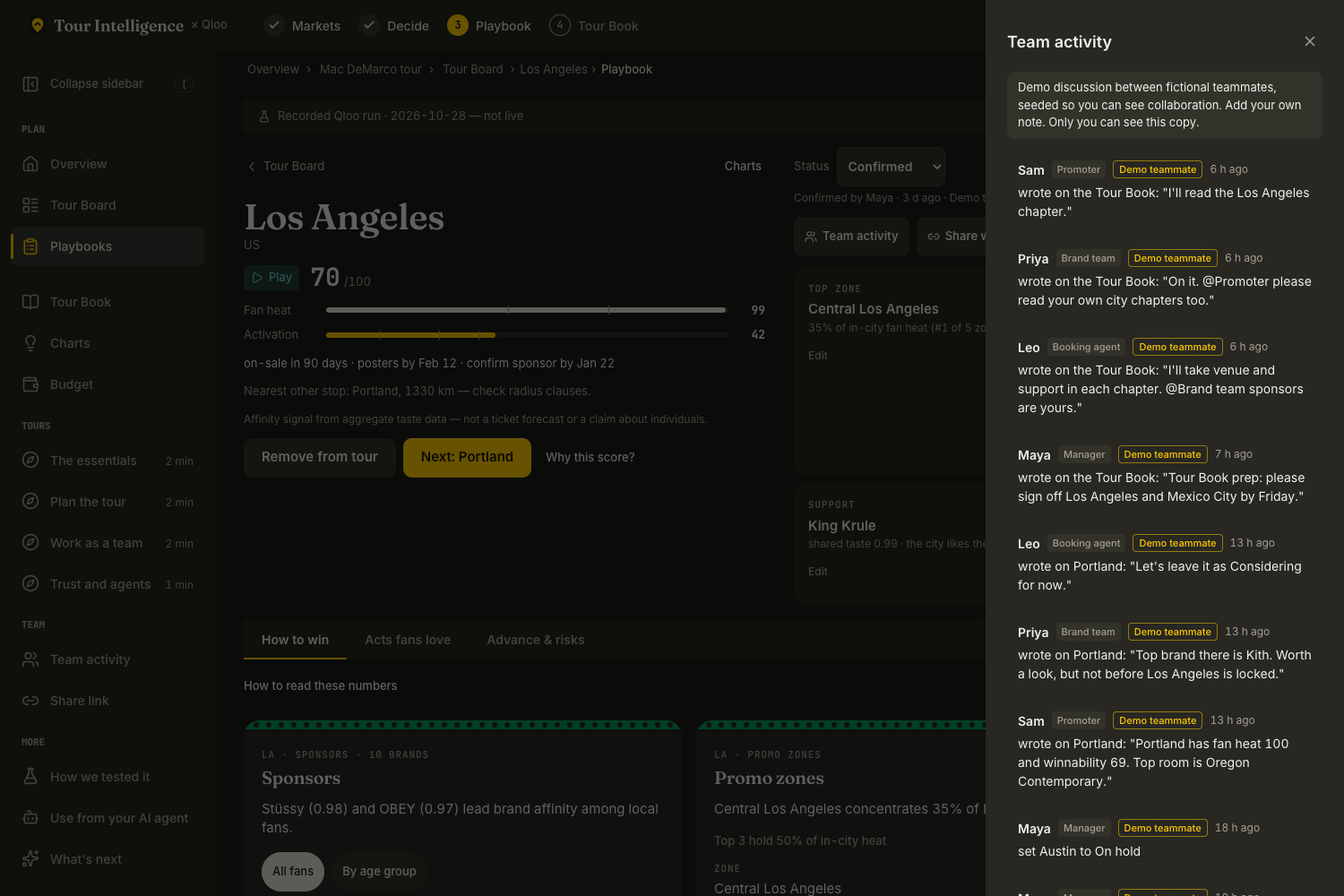
Teammates can discuss, set city status and leave notes. Team activity shows who changed what (demo teammates, fictional).
-
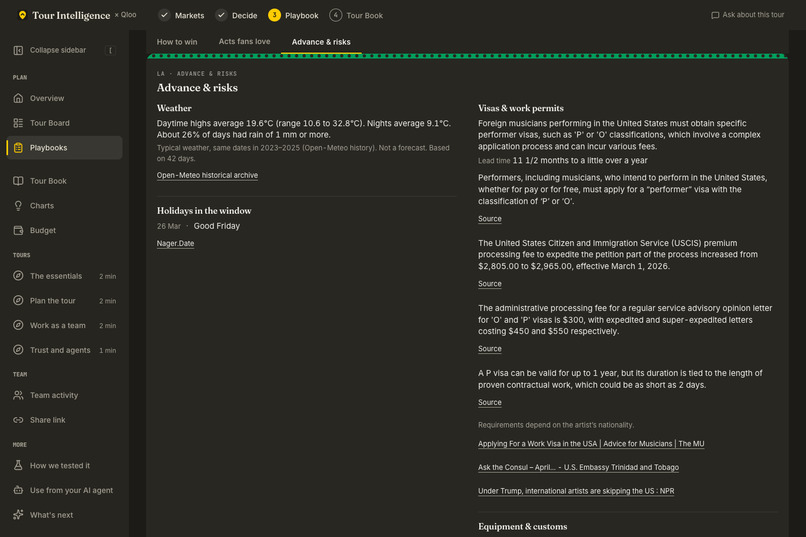
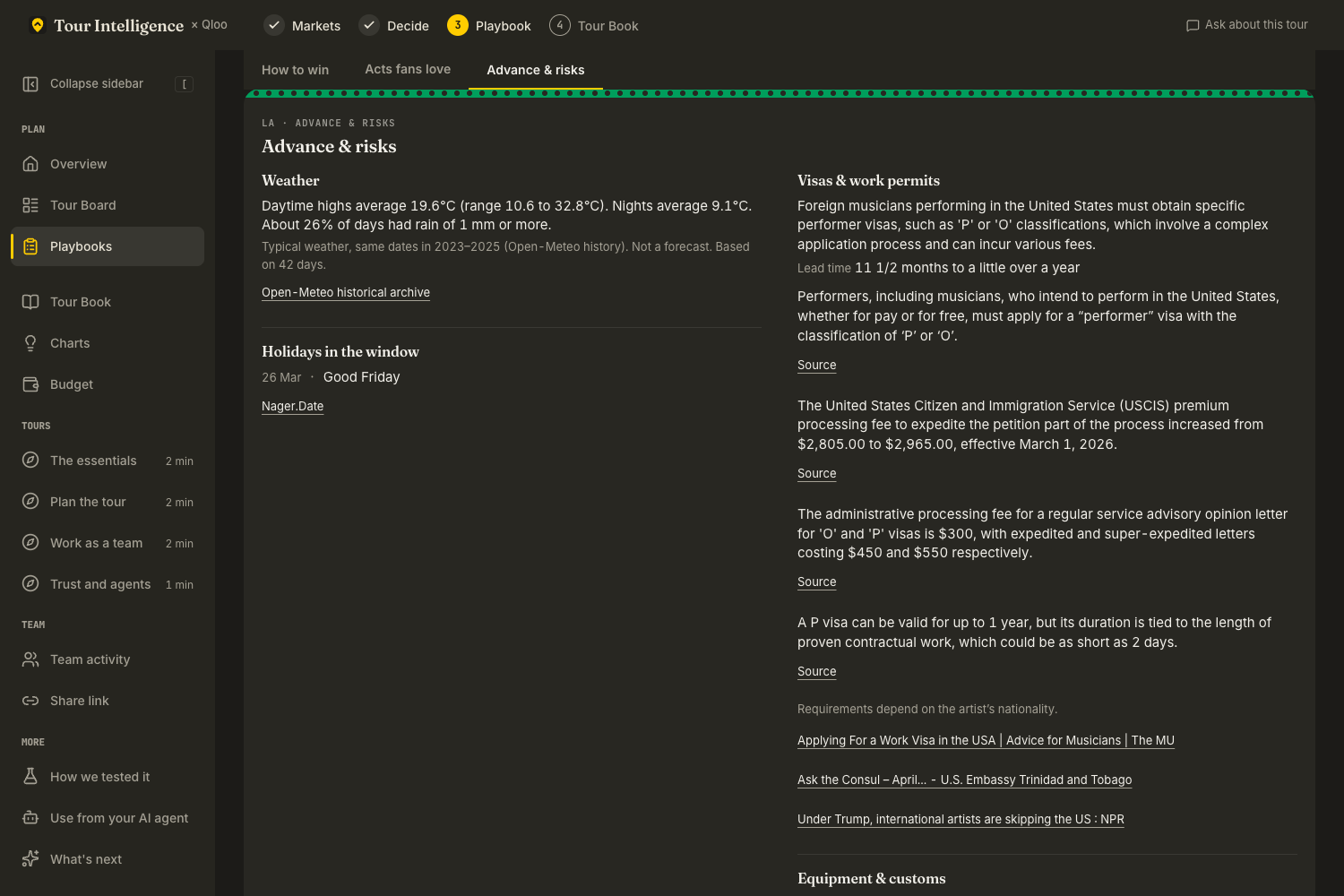
Advance & risks: weather, holidays and visa notes with sources, so the plan covers more than taste data.
-
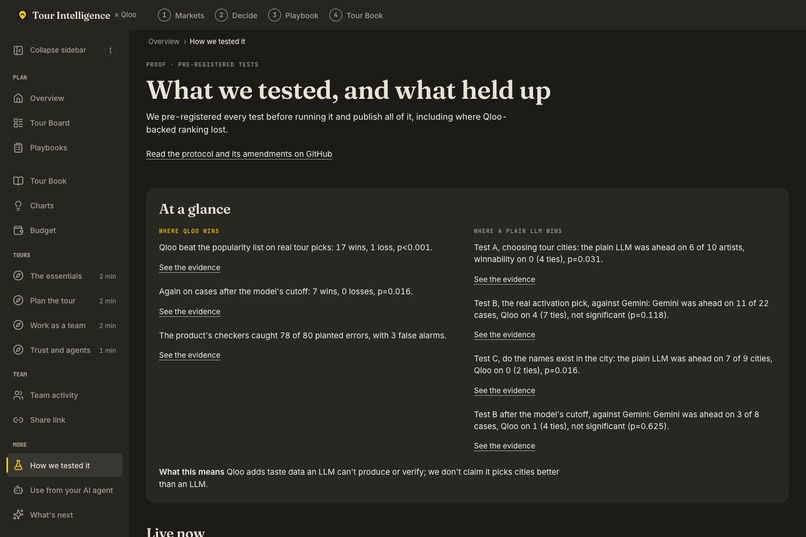
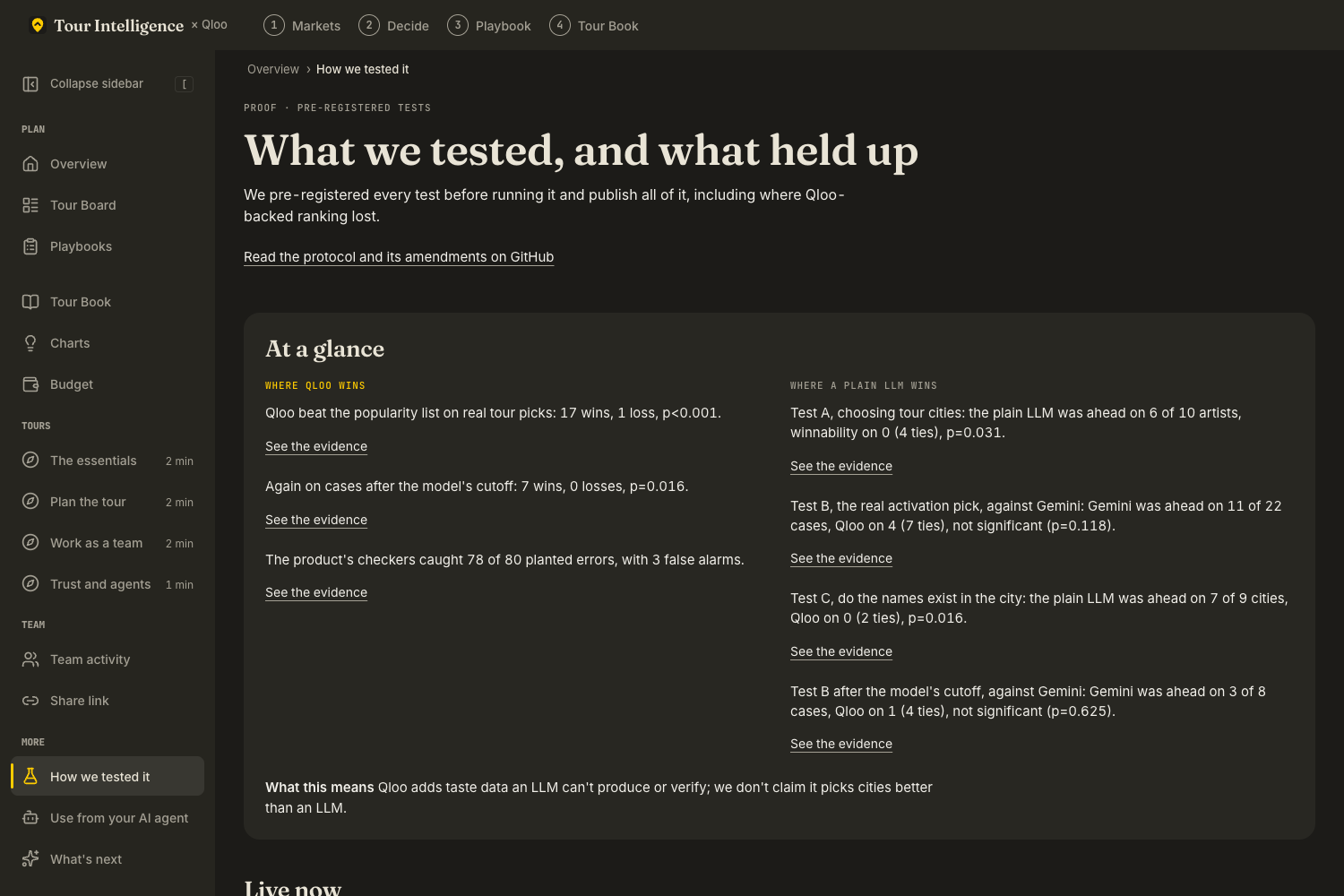
We pre-registered our tests and published all of them, including where a plain LLM beat Qloo.
-
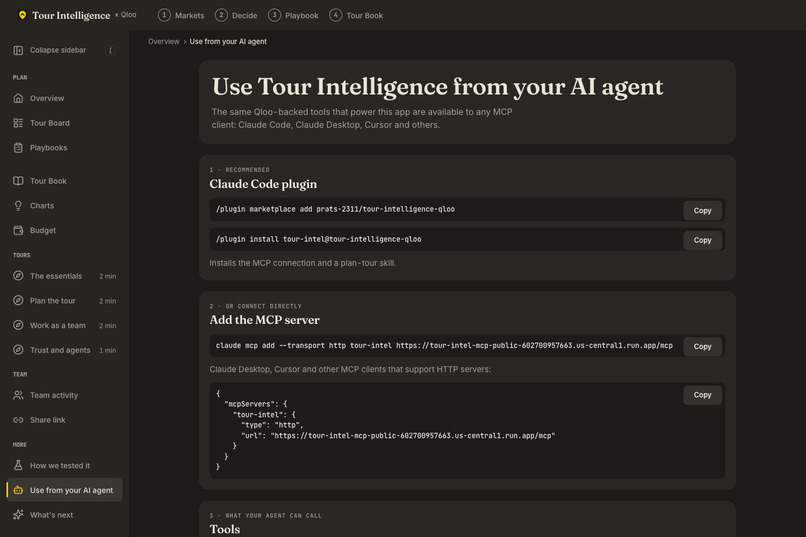
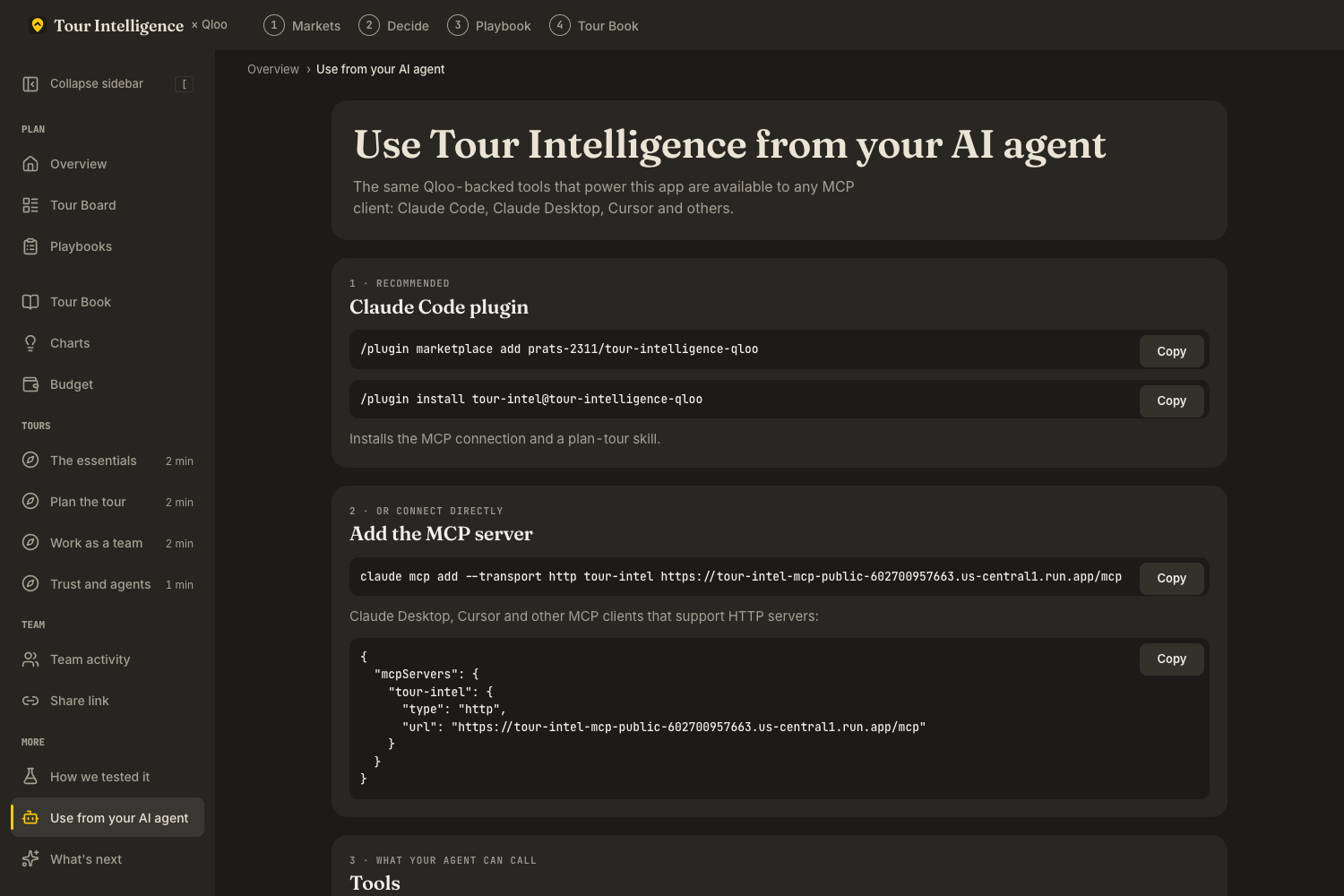
Use it from your own AI agent: install the Claude Code plugin or add the MCP server, then call the same Qloo-backed tools.
-
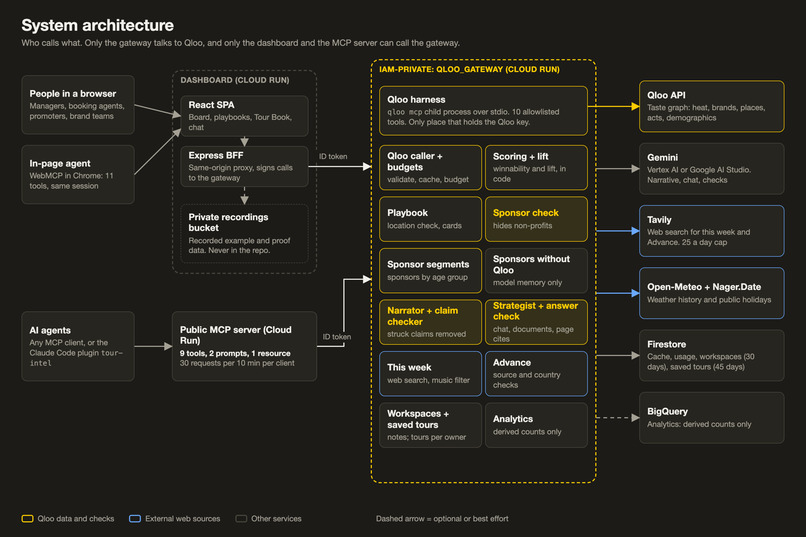
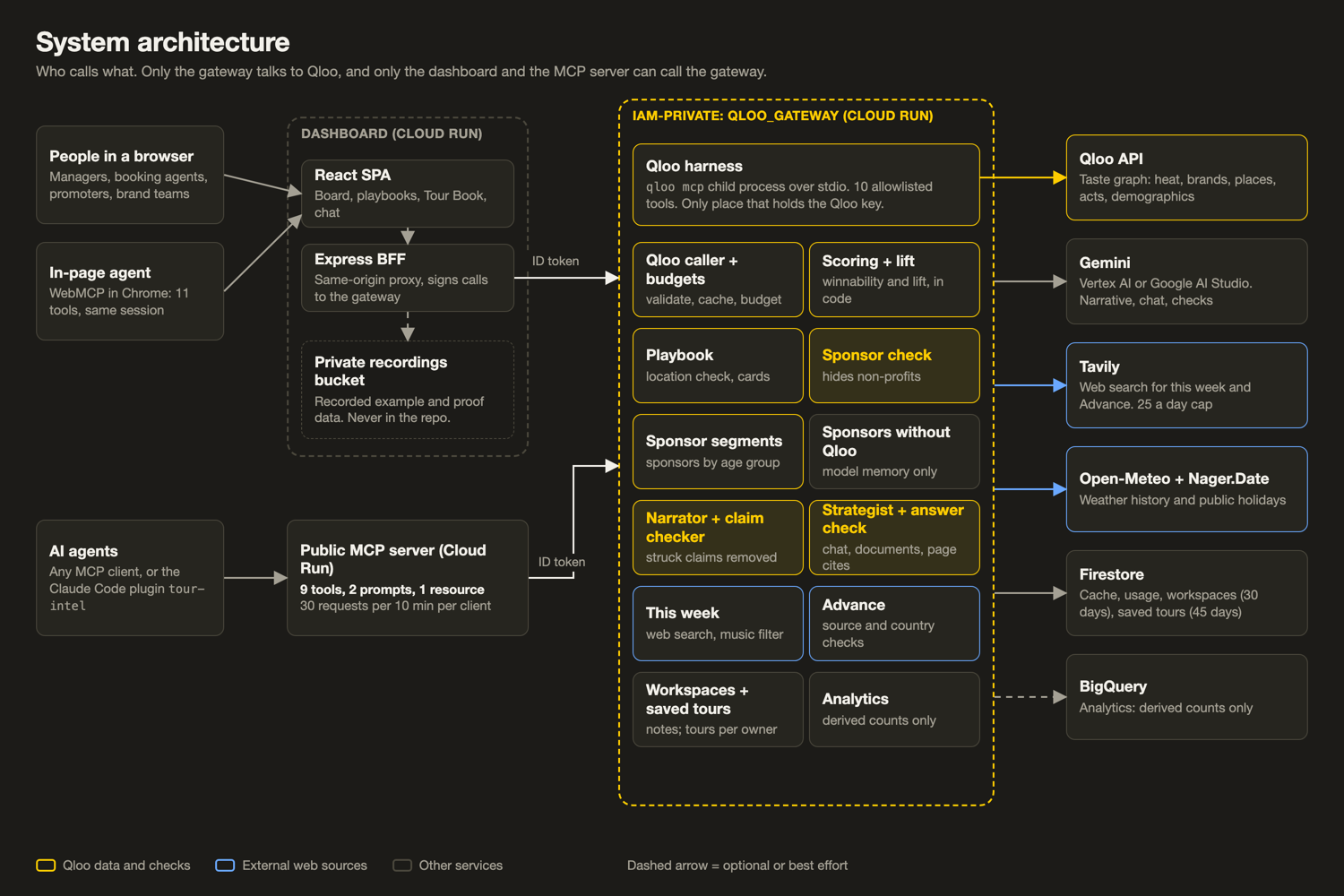
One private gateway fronts Qloo, Gemini, web sources and saved tours; every number in the write-up is checked against Qloo.
-
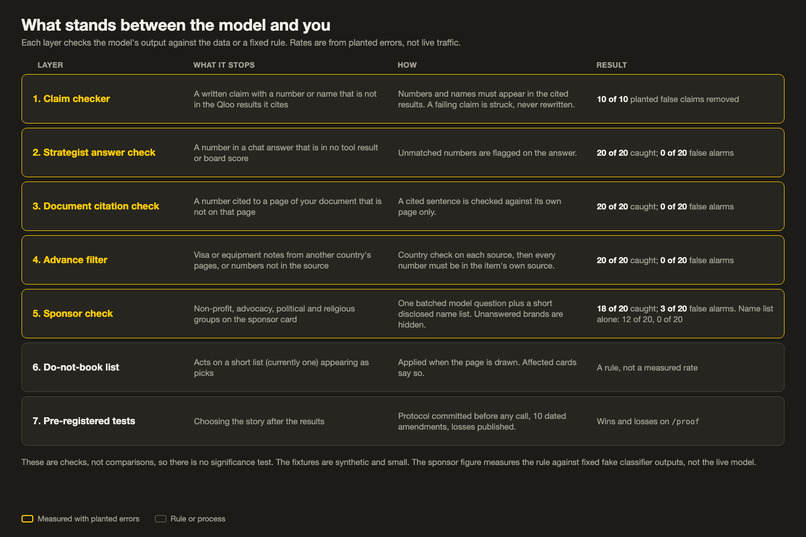
Trust layers: how claims are checked, sourced and labelled before they reach the screen.
-
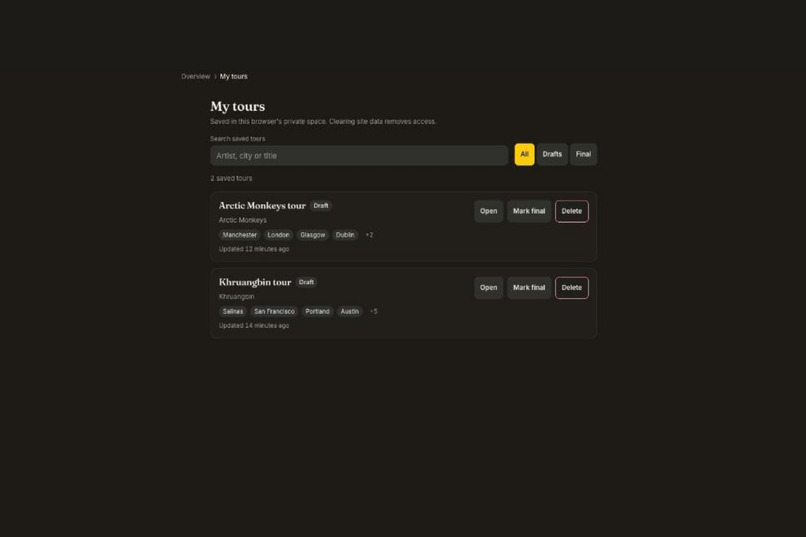
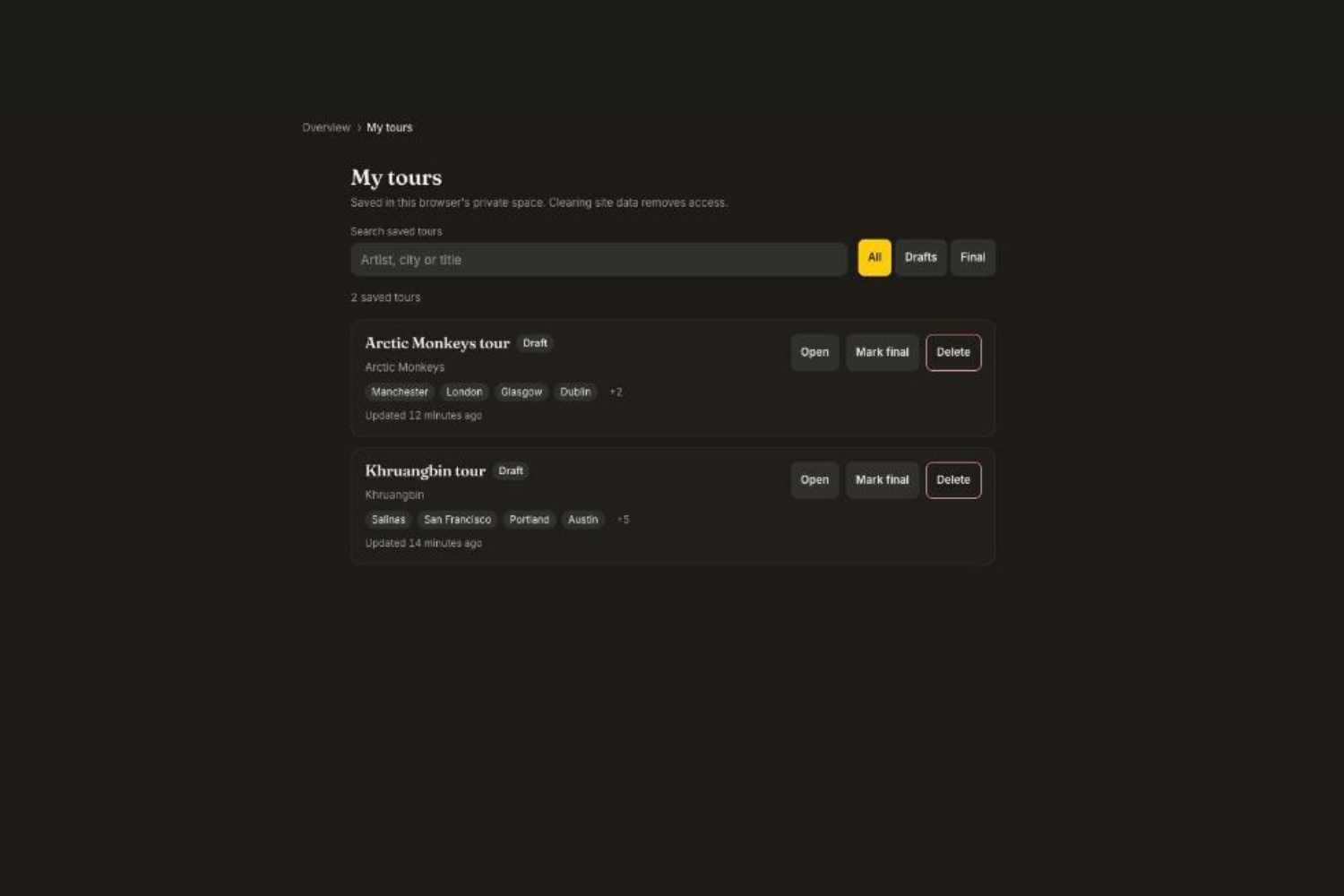
My tours: every tour you plan is saved as a private draft, no sign-in. Search by artist or city, reopen it instantly.
-
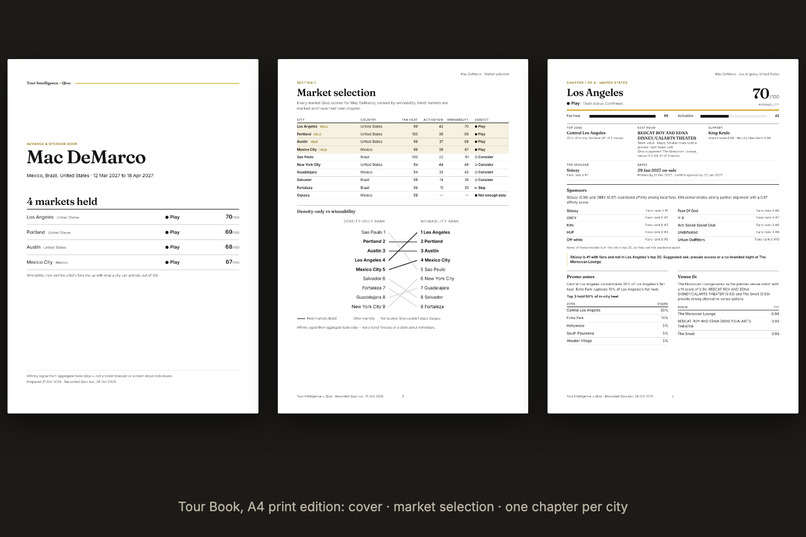
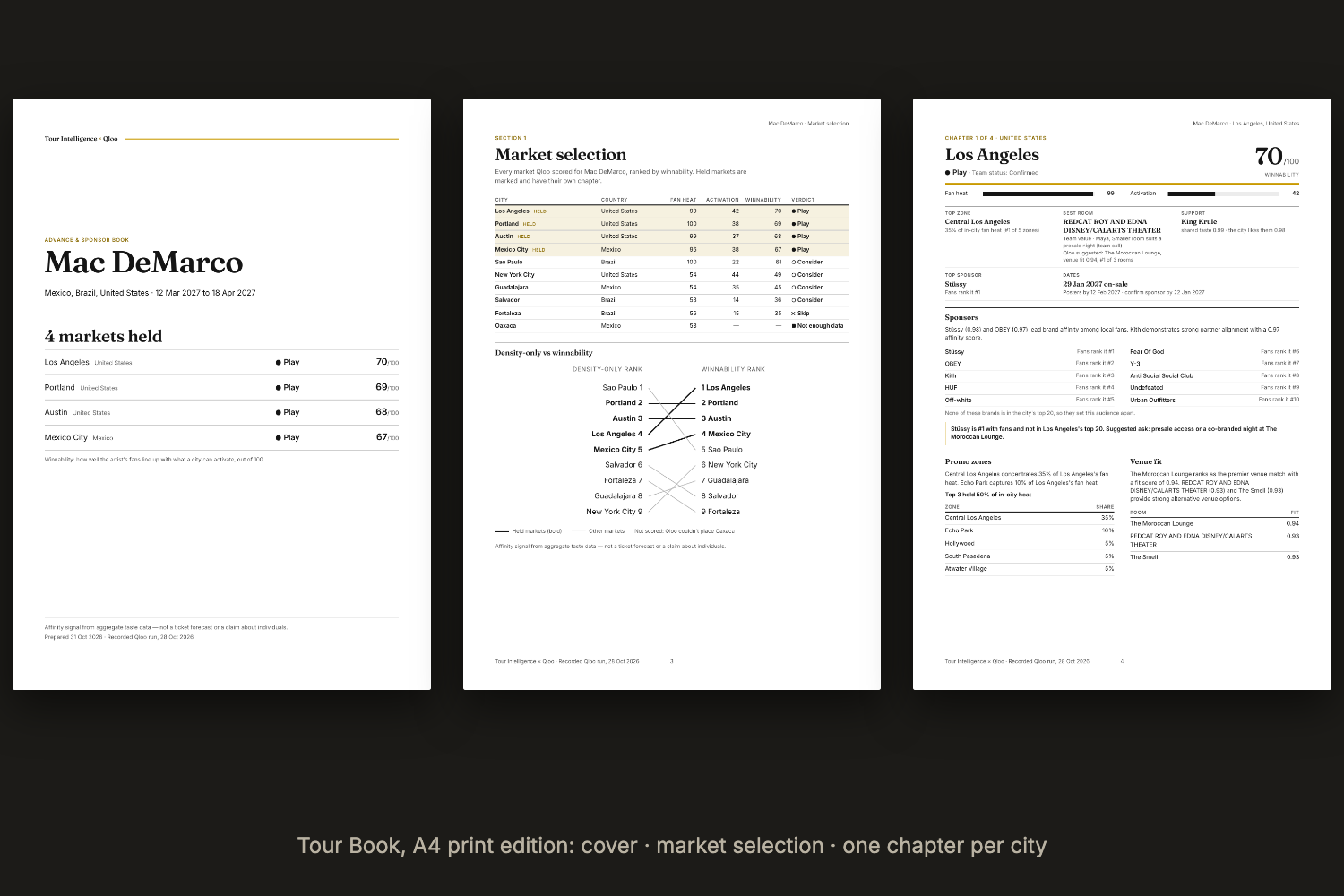
The Tour Book prints as a real A4 document: cover, market selection, then one chapter per city for the sponsor meeting.
Inspiration
Sponsorship is the highest-margin business in live music. Live Nation's sponsorship and advertising arm made $1.3B in 2025 at a 64% margin. Yet the questions "which brand do we pitch in this city?" and "which act do we put on the bill?" are still answered by instinct. A Paradigm agent told Water & Music in 2021 that their gut is "a combination of hundreds of internalized pieces of data". We wanted that data on one page per city, with the reasoning shown and every claim checked.
What it does
Know which brands your artist's fans love in each city, before the sponsor meeting.
In Los Angeles, Mac DeMarco's fans rank Stüssy #1, and it isn't in LA's top 20. That gap is the sponsor pitch. Split the same fans by age and the pitch changes: fans aged 25–29 lean streetwear, while fans 55 and over rank Fred Perry and Polaroid. No language model can produce that from memory; it comes from Qloo's taste data.
For each city on a tour, Tour Intelligence gives a promoter or agent:
- Sponsors with lift: brands the artist's fans rank far above the city overall, plus sponsors by age group (Qloo audience demographics), shown as "vs the average audience", never as a share of fans.
- A one-page pitch sheet for any brand: why it fits, who loves it most, where the fans are, the best room and opening act, a suggested activation. Prints to one A4 page.
- The rest of the playbook: venues by taste fit, acts these fans love, promo zones, places, films and TV these fans love, merch direction (labelled as a model suggestion).
- Advance & risks: typical weather for the show dates (Open-Meteo history, "not a forecast"), public holidays, visa and equipment (ATA Carnet) notes with sources, each checked against its source and the destination country.
- Charts: a sponsors-by-age matrix across every city, a fan heat vs activation quadrant, filters.
- Budget: your numbers, our maths, real distances: travel legs from city coordinates, break-even tickets per city, a sell-through range. Nothing is estimated for you.
- My tours: every tour you plan is saved automatically as a private draft, with no sign-in. Search by artist or city, reopen it instantly (no new Qloo calls), and mark it final. Team notes and statuses come back with it.
- A team workspace: share a link, set city status, add notes on any card, override a pick (Qloo's suggestion stays visible), and see decisions in the Tour Book. No sign-in. Each visitor to the example gets a private copy with a demo discussion between fictional teammates.
- A strategist chat that calls Qloo live and shows its work. You can add your own files (they stay in your browser and never reach Qloo); answers cite "your file, p. N" and those numbers are checked against the page.
- A Tour Book that prints as a real A4 document: cover, market selection, one chapter per city.
- A Tour Board for context: fan heat, activation and winnability per city. We're honest that a plain LLM is better at picking which cities a tour plays; the product is about winning each city.
Four short guided tours explain everything. The judge path takes about 2 minutes: the example opens instantly from a recorded Qloo run.
How we used Qloo and the LLM
Qloo finds the taste; Gemini writes it up and plans with it; checkers make sure the writing never outruns the data.
- One private gateway (Cloud Run) runs every Qloo call through the
qloo mcpharness with an allowlist of tools, per-session and daily budgets, and a Firestore cache. - Rank-based lift. Qloo rescales affinity within each response, so an artist's scores and a city's baseline can't be subtracted. Lift compares the two rankings instead.
- Age groups use Qloo's audience demographics plus its demographic signal on recommendations.
- Location check. Qloo once resolved "Ciudad Juarez, MX" to Mexico City; every city is now checked against its own heat points.
- Gemini writes, a checker verifies. Every number and named entity in the write-up must appear in the Qloo results the card cites; failures are struck and shown ("11 verified · 0 removed"). The same idea checks the chat's answers, document citations and the Advance sources.
- Sponsor check. A batched Gemini call keeps non-profits and advocacy groups off the sponsor card, backed by a short name list.
- Agent-ready. A public MCP server with 9 tools (including a one-call tour report), 2 prompts and a Claude Code plugin; 11 WebMCP tools in the page; a
/agentspage with copy-paste setup. - Privacy-first. Only artist, city, venue and brand names go to Qloo. Analytics in BigQuery store derived counts only, never Qloo data, names, notes or documents.
Proof, honestly
We wrote the test protocol before any Qloo or Gemini call and published every result, including our losses (10 dated amendments; full tables at /proof).
Where Qloo wins
- Picking the real tour's sponsor or guest among 10 candidates, Qloo beat the city's popularity list: 17 wins, 1 loss (p<0.001).
- Again on cases after the model's training cutoff: 7 wins, 0 losses (p=0.016).
- The product's checkers caught 78 of 80 planted errors (strategist answers, document citations and Advance sources 20/20 each, 0 false alarms; the sponsor rule 18/20). The claim checker caught 10 of 10 planted false claims.
Where a plain LLM wins
- Choosing which cities a tour plays: the LLM beat winnability (R-precision 0.82 vs 0.66, p=0.031).
- Picking the real activation from 10 candidates: Gemini ahead of Qloo (0.57 vs 0.47, not significant); also after the cutoff (0.88 vs 0.70, not significant, 8 scored cases).
- Do the names exist in the city? Venues and brands were 100% real for both, but only 48% of Qloo's "local" acts were actually from the city vs 100% for Gemini (p=0.016). We renamed the card "Acts these fans love here" and added a warning.
What this means: Qloo adds taste data an LLM can't produce or verify. We don't claim it picks cities better than an LLM.
Who pays
Promoters and agencies pay per tour. The return comes from sponsor deals and a better-sold room. We give no revenue, customer or price numbers, because we have none.
Built during the hackathon
Forked from the author's Agentic Cinema entry for a Google Cloud hackathon; the legacy parts are kept in archive/. Everything Qloo-based is new since 16 Oct 2026: 648 commits, 3,189 automated tests (plus 366 end-to-end runs), key rules mutation-checked.
Challenges we ran into
- Scores bunched together. Raw affinities saturated near 0.9, so a fixed cut decided cities by noise. We recalibrated from per-component floors.
- Affinity is per-response. Subtracting the city's scores from the artist's made every sponsor look negative. Ranks fixed it.
- Honesty under pressure. Two of our own tests came out significantly against us, and two more leaned that way. We kept them on the page and changed the product's claim instead.
Accomplishments we're proud of
- Sponsors by age, city by city: a pitch no LLM can write from memory.
- Every written claim traces to the Qloo result it cites, and the app shows what it struck.
- A pre-registered proof page that leads with a plain scoreboard of wins and losses.
- It opens finished, explains itself in four short tours, and works from any AI agent.
What we learned
- Qloo's strength is relative taste: what this audience loves more than the city does, and how that changes by age.
- An LLM already knows which markets are big. The value is in pairing it with taste data it can't make up, and in checking its prose against that data.
What's next
A saved taste profile for each artist on a manager's roster (their likes, their no-go brands) and an outcome record of every activation: RSVPs, turnout, would-rebook. Qloo supplies the taste, the profile the intent, and the results make each tour's plan better than the last. The /v2 page previews it.
Built With
- bigquery
- express.js
- firebase-hosting
- firestore
- gemini
- google-cloud
- google-cloud-run
- maplibre
- model-context-protocol
- nager-date
- node.js
- open-meteo
- playwright
- python
- qloo
- qloo-harness
- react
- tailwind
- tavily
- typescript
- vertex-ai
- vite
- vitest
- webmcp

Log in or sign up for Devpost to join the conversation.