Inspiration
Blind students learn from the same diagrams as everyone else, but only after a teacher or transcriber redraws each one as a tactile graphic: print swapped for braille, clutter removed, lines far enough apart for fingers. A science assignment with graphics can take up to 10 hours to transcribe, and in a 2023 survey almost half of these teachers had never been trained to make tactile graphics. I wanted image AI to do the tedious first draft so teachers keep the judgement calls.
What it does
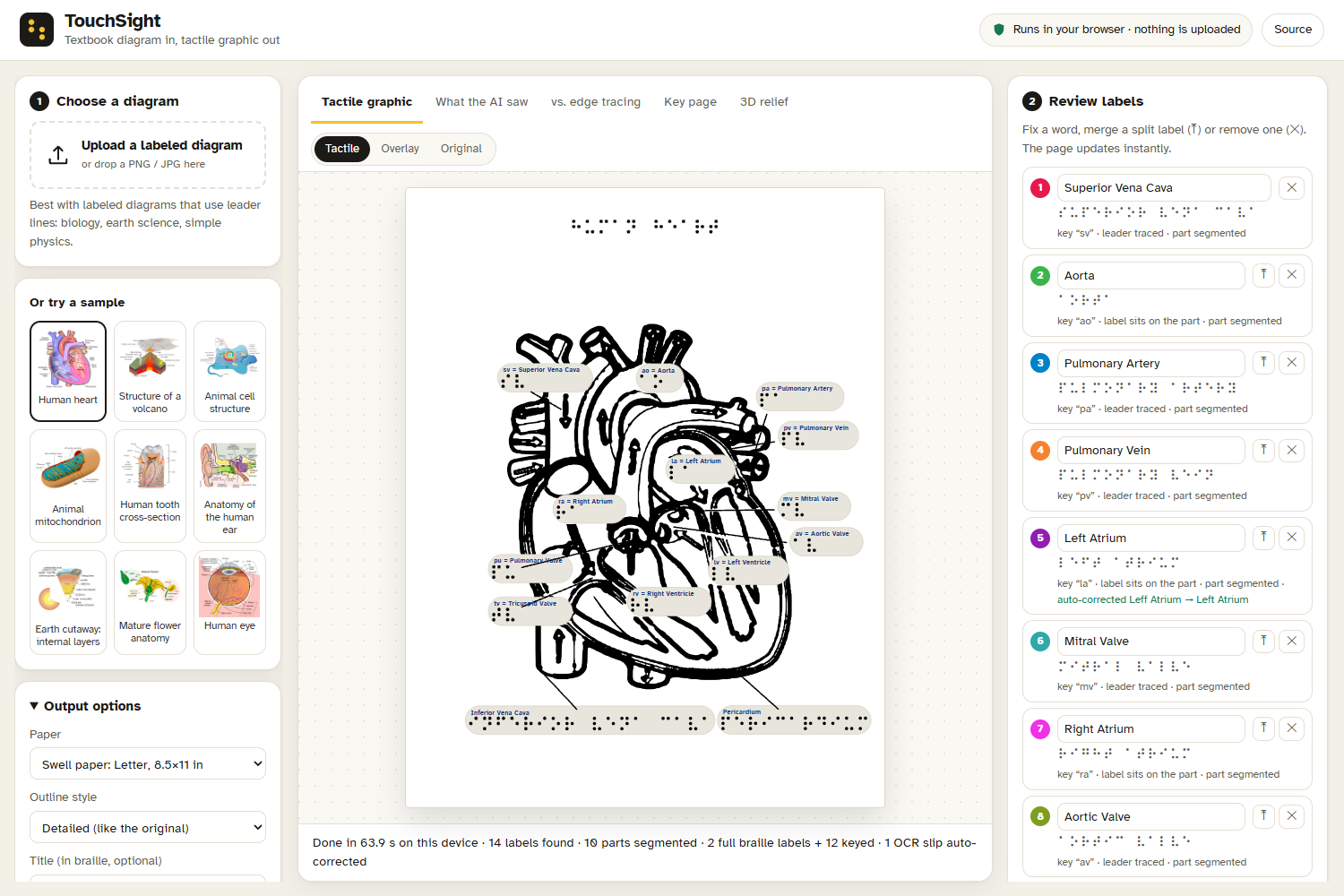
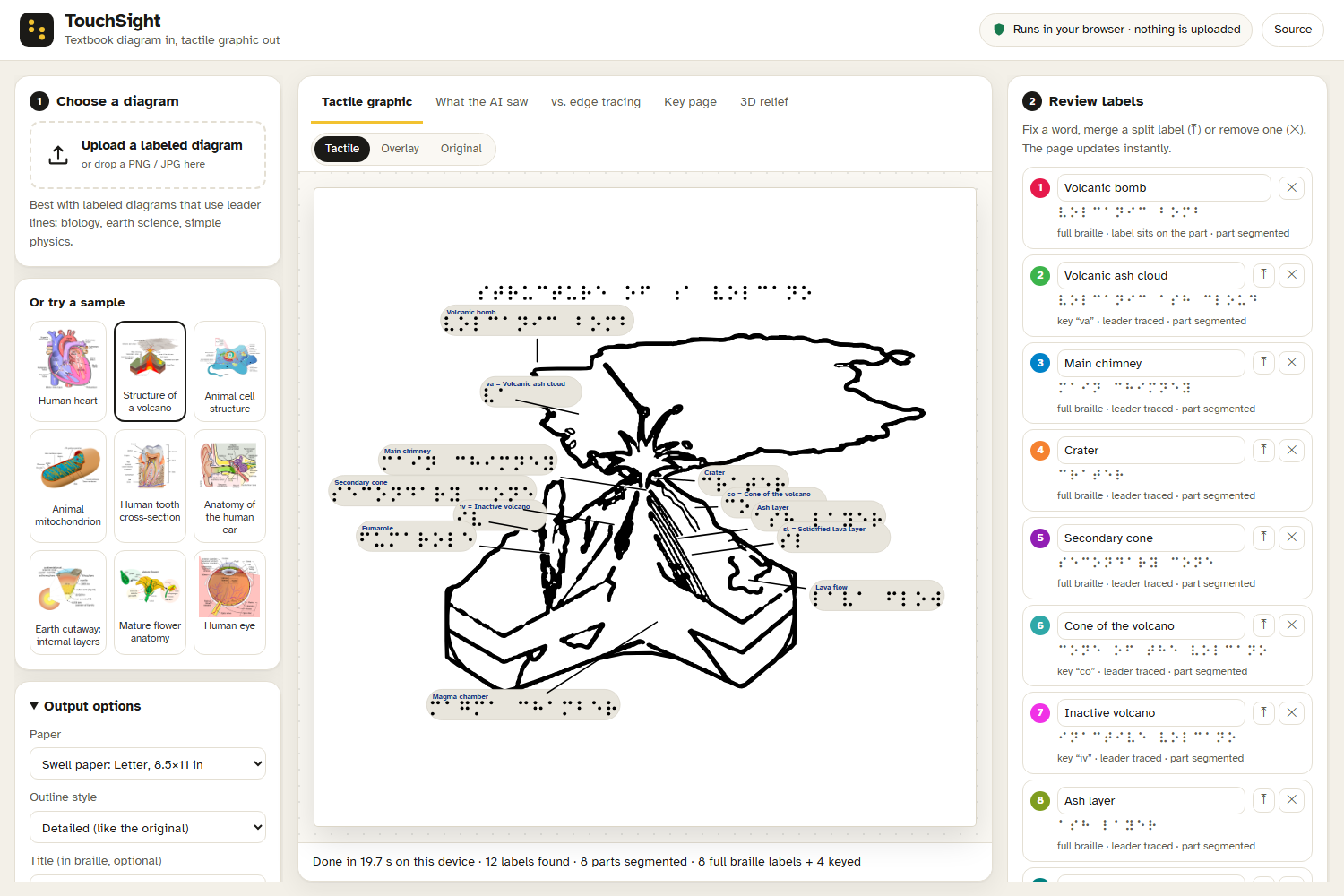
Upload a labeled diagram or pick a sample. In about 10–50 seconds TouchSight:
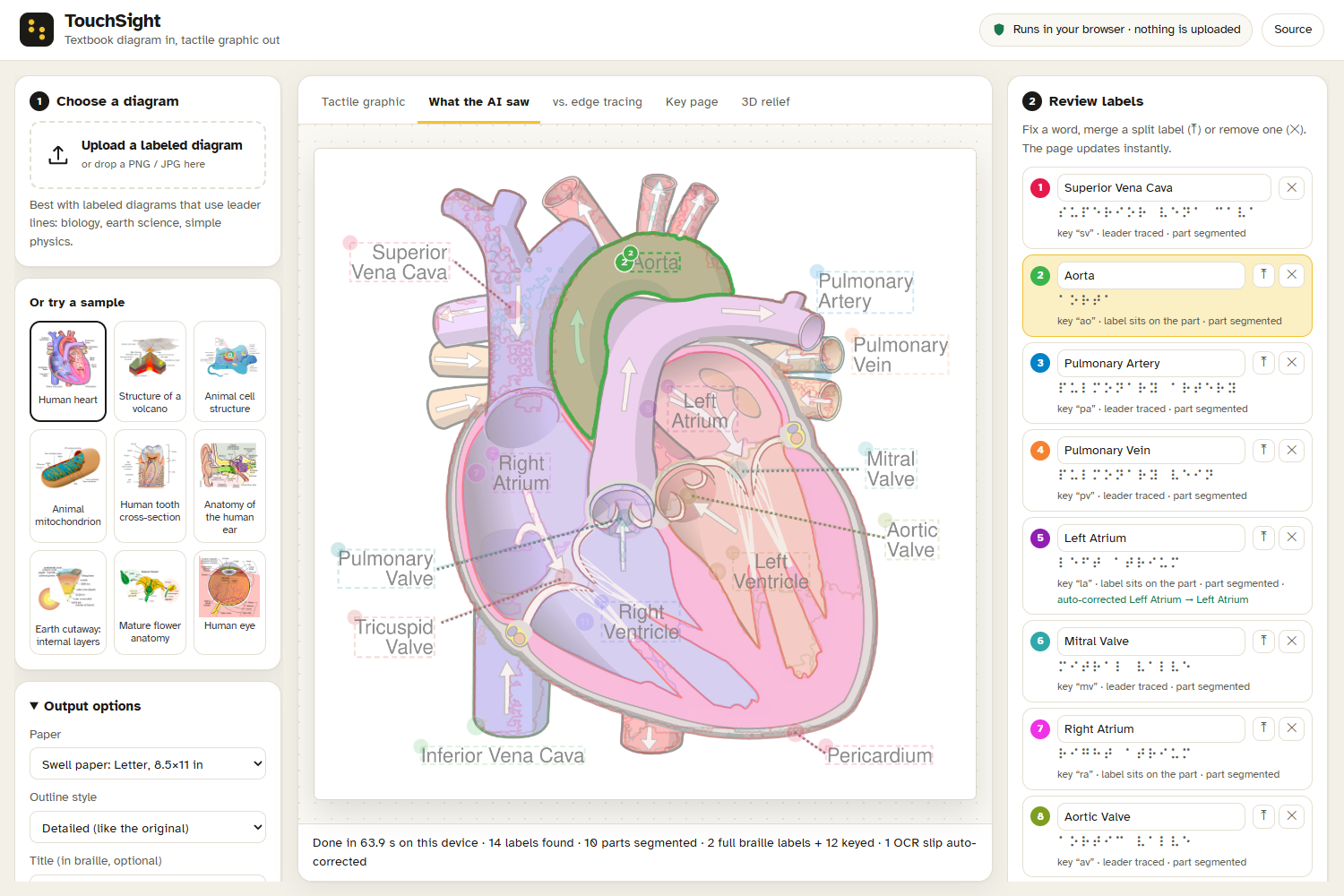
- Reads the labels with PaddleOCR running in the browser (148 of 151 hand-counted labels found on 10 diagrams) and repairs slips like "Leff Atrium" -> "Left Atrium".
- Follows each leader line to the part it names, even dotted ones.
- Segments that part with Segment Anything, prompted at the leader's tip.
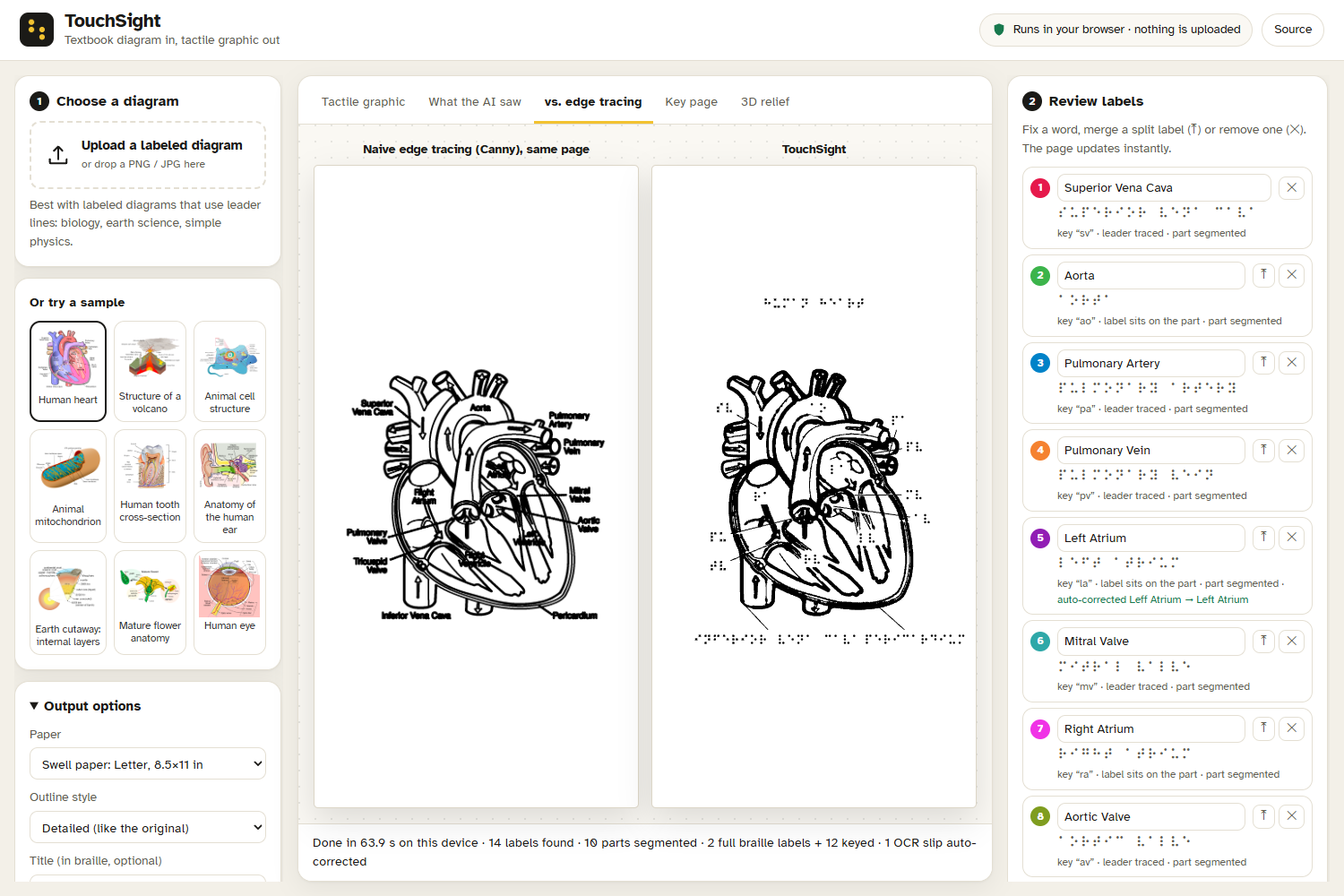
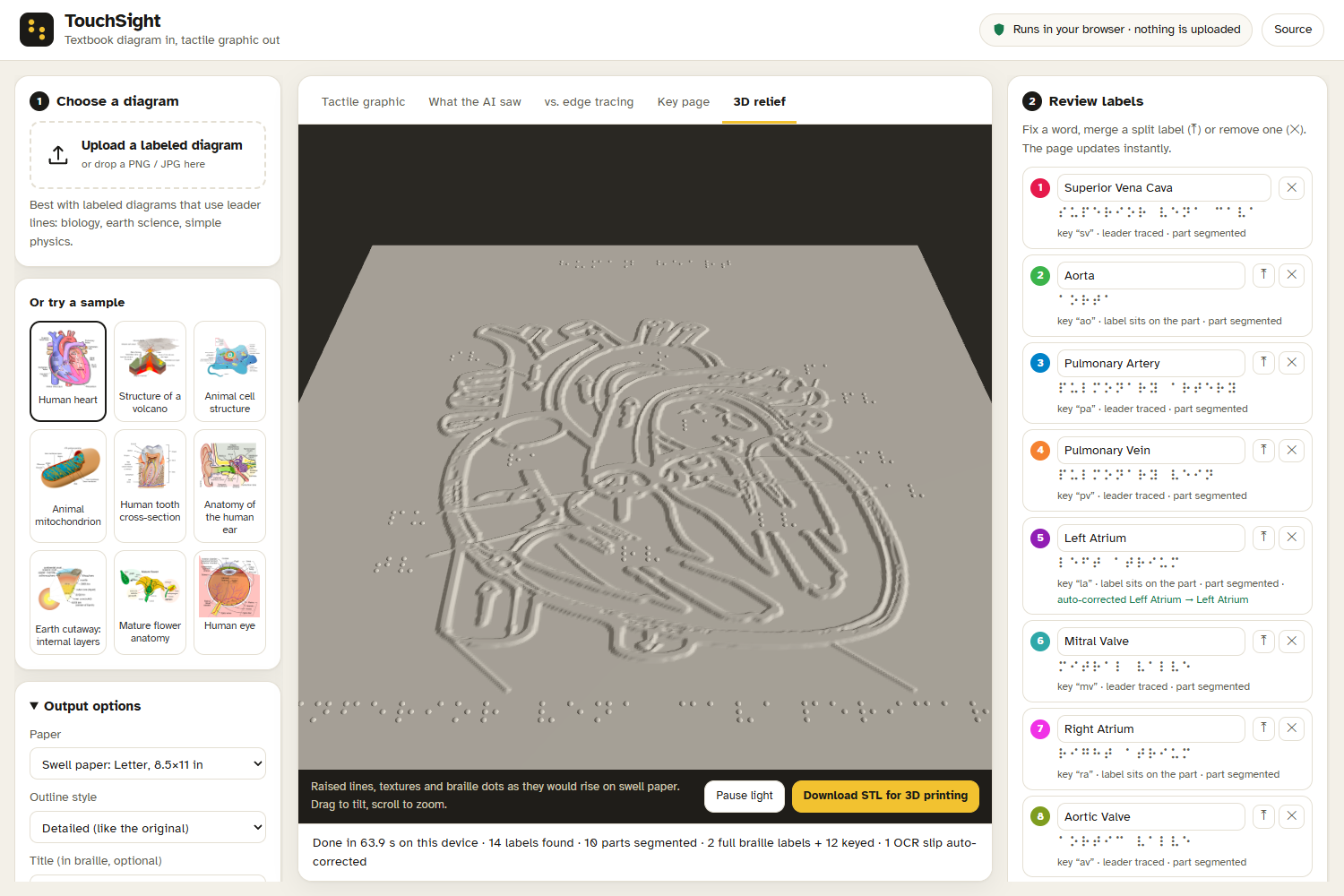
- Redraws the page for touch: traces the original's lines with the print text removed, raises the edges of every labeled part bold so readers can find what was named, and lays out real braille (Spec 800 dot sizes, letter keys when a word won't fit, 3 mm clearance) following the BANA tactile guidelines. A Simplified style merges lines closer than 3 mm.
- Checks itself against those guidelines and lets the teacher fix any label.
- Exports a pure-black SVG for swell paper, a braille key page, or an STL to 3D-print. A 3D relief view shows how it will feel.
How I built it
Everything runs in the browser: PaddleOCR on ONNX Runtime Web, SlimSAM through transformers.js in a worker, OpenCV.js and three.js. No server, uploads or API bill, so it is free and private for schools. A Playwright harness scores the real app on 16 Wikimedia Commons diagrams.
Results (same checker for every method)
- Plain edge tracing turns all 233 print labels into raised squiggles; TouchSight removes them and places 232 as braille.
- Fragments too short to feel: 66 (Detailed) or 14 (Simplified), vs 763 for edge tracing and 336 for edge tracing with text erased.
Challenges
Dotted leaders, labels printed on the drawing, OCR on coloured fills, and braille being about three times wider than print.
Limitations and next steps
These are automated checks, not a qualified transcriber. It has not been tested with blind readers or on physical swell paper; that comes next. Braille is uncontracted, and a label OCR misses can't be added by hand yet. Prior work (UW's Tactile Graphics Assistant, 2007) replaced text with braille; TouchSight adds leader-to-part tracing and label-prompted segmentation.
AI disclosure: built with help from Claude Code for code and docs. The product itself uses only the open models listed, running locally.


Log in or sign up for Devpost to join the conversation.