Inspiration
We built Touchline AI because football apps usually give you a lot of numbers, but not enough explanation. After watching a big match, you can see possession, shots, passes, and player ratings, but it is harder to understand why the match actually went the way it did.
We wanted to build something that could look at the data and explain the tactics behind the game, almost like having a football analyst break down the match for you.
What it does
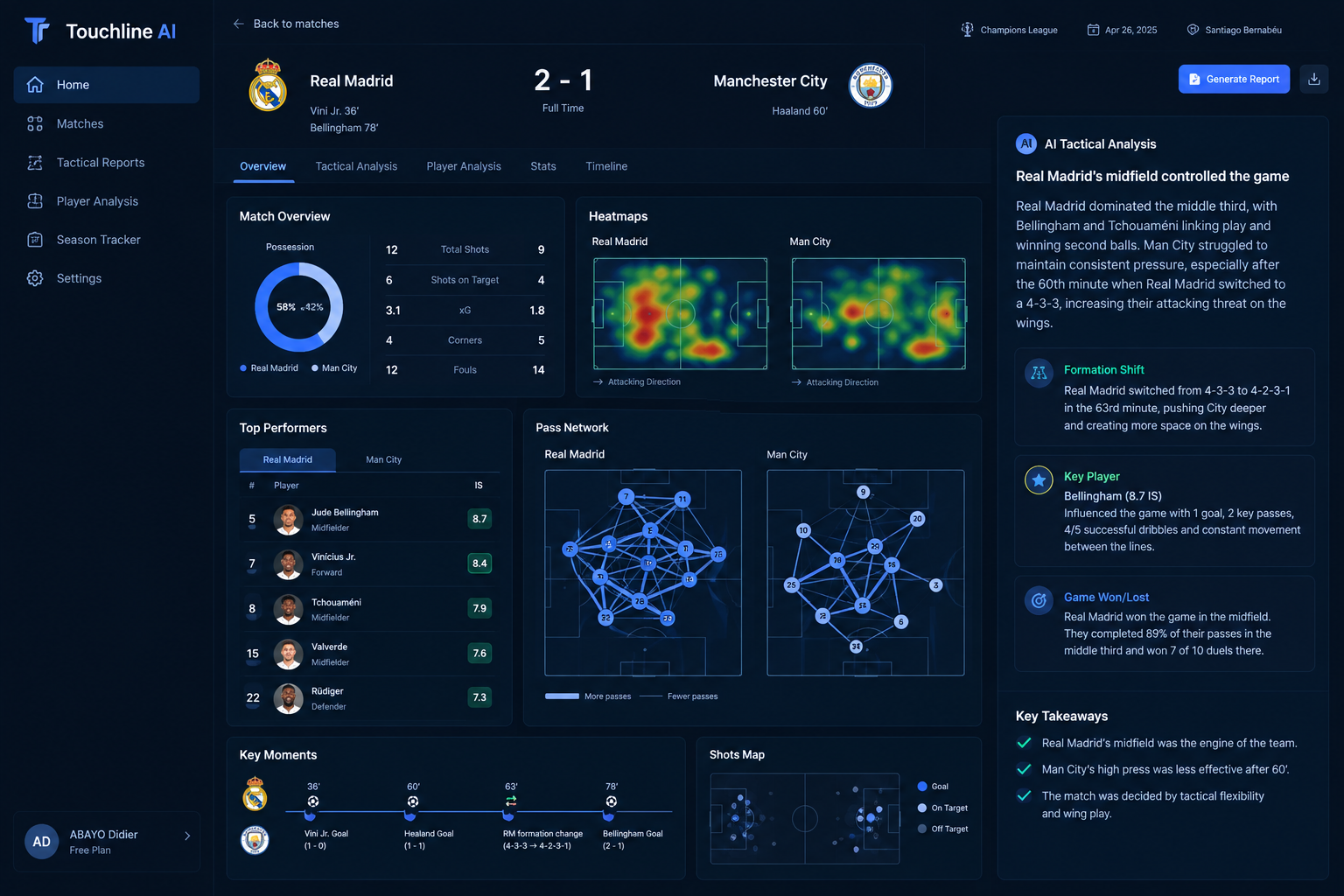
Touchline AI turns football match data into an easy-to-understand tactical report.
It analyzes things such as possession, shots, heatmaps, passing networks, player actions, and important moments in the match. It then uses AI to explain what happened during the game, identify important players, detect tactical changes, and highlight where the match was won or lost.
Instead of only saying that a team had 60% possession, Touchline AI tries to explain what that possession actually meant.
How we built it
We built the frontend using Next.js and used Vercel for deployment. Supabase handles our backend data and user-related functionality.
The main challenge was processing the sports data. A match API can return a huge amount of JSON containing information that is not useful for tactical analysis. We created a data-processing pipeline that extracts the important information before sending it to the AI.
We also created a Player Influence Score to help the system evaluate players using several match actions instead of simply rewarding goals and assists.
Our goal was to make the AI work with structured football data rather than simply generating a report based on the final score.
Challenges we ran into
One of our biggest challenges was dealing with the amount of data coming from the sports API. Sending everything directly to the AI created unnecessary noise and made the analysis less reliable.
We solved this by filtering and organizing the data before passing it to the AI.
Another challenge was making the AI sound like a tactical analyst instead of simply repeating statistics. We spent time improving the prompts and structuring the information given to the model.
Accomplishments we're proud of
We are proud that we were able to connect live football data, data processing, AI analysis, and a complete dashboard into one working project.
Seeing a match go from raw data into a readable tactical report was one of the most satisfying parts of building Touchline AI.
What we learned
We learned that building an AI application is not only about connecting an LLM to an API. The quality of the data given to the model is extremely important.
We also learned more about processing large JSON responses, designing useful dashboards, working with APIs, and building systems where AI works together with traditional algorithms.
What's next
Our next goal is to expand Touchline AI from individual match analysis to full-season analysis.
We want to track how teams change throughout a season, compare tactical patterns across different matches, create visual passing networks, and eventually help users understand how a team might approach its next fixture.

Log in or sign up for Devpost to join the conversation.