TOUCHLINE AI — Bringing Tactical Football Intelligence to the Living Room
Inspiration
Football is more than goals, scores, and possession percentages. Every match is a battle of tactics, positioning, pressing, and split-second decisions. Yet, when watching a match on a television, understanding why a team is winning or losing can be difficult without switching between multiple apps, statistics websites, and analysis platforms.
That inspired me to build TOUCHLINE AI, an AI-powered football tactical analyst designed around the big-screen viewing experience. My vision is to help fans go beyond the final score and explore the tactical ideas behind the game through natural-language questions, match information, and accessible explanations.
I wanted to make tactical analysis feel less like reading a complicated statistics report and more like having a knowledgeable football analyst beside you on the couch.
What It Does
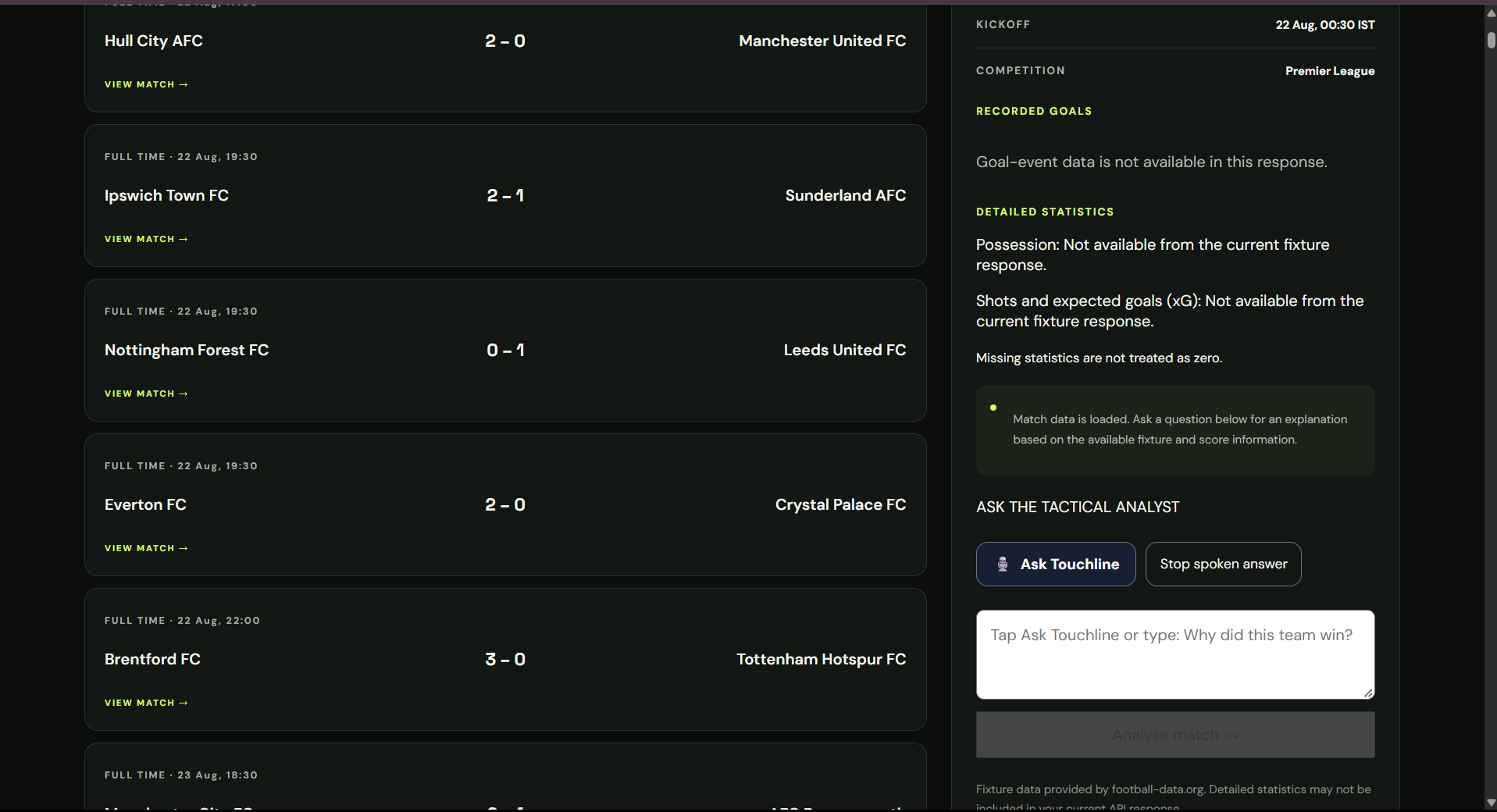
TOUCHLINE AI combines football match information with a conversational tactical-analysis experience. Users can select a match and ask questions about what happened and why. The project is designed with television interaction in mind, including remote-friendly navigation, microphone input, and spoken responses.
The application uses football data from football-data.org where available. It also includes a rules-based analysis fallback so that it can provide cautious, score-based context when detailed match statistics are unavailable. Rather than inventing goalscorers, possession figures, or tactical events, the system is designed to distinguish verified information from conclusions that cannot be supported by the available data.
How I Built It
I developed TOUCHLINE AI as a solo project, using AI-assisted development to move from an initial idea to a working web-based prototype.
The frontend is built with React, TypeScript, and Vite. It provides the match-selection interface and the conversational analyst experience, with attention to keyboard and directional-pad navigation for a television-style interface.
The backend uses Node.js, Express, and TypeScript. It connects to football-data.org for available match information and handles analysis requests. I also integrated Google's Gemini API to explore AI-generated tactical explanations, alongside a rules-based fallback for cases where generative AI is unavailable or the required statistics are missing.
Browser speech capabilities support microphone input and spoken responses in compatible environments. The frontend and backend are deployed separately using Vercel and Render, and the source code is maintained on GitHub.
Challenges I Faced
One of the biggest challenges was working within the limitations of free football-data API access. Some match details and statistics were unavailable, making it important to avoid presenting assumptions as verified facts. This influenced the design of the analysis fallback and the way missing information is communicated.
Another challenge was integrating generative AI within free-tier usage limits. Rate limits can prevent an AI-generated response from being returned, so I worked on maintaining a fallback experience rather than making the entire application dependent on a single model request.
I also encountered frontend-backend integration issues, request validation errors, deployment configuration problems, and GitHub secret-scanning protection. Resolving these issues taught me to validate API requests carefully, separate environment variables from source code, and treat deployment and security as part of the engineering process rather than afterthoughts.
Designing for a television experience introduced another consideration: an interface that works with a mouse is not automatically comfortable to use with a remote. Navigation, readability, and minimizing unnecessary interactions are important to making the experience suitable for the living room.
What I Learned
Building TOUCHLINE AI helped me understand how several parts of a real application fit together: frontend state management, backend API design, external data integration, AI model limitations, browser speech capabilities, deployment, and secret management.
I also learned an important lesson about AI in sports: a convincing explanation is not necessarily an accurate one. Reliable tactical analysis needs verified match context, and the application should clearly communicate when the available data is insufficient to support a conclusion.
Most importantly, I learned how to approach a large idea incrementally as a solo developer—building an MVP, testing each component, diagnosing integration failures, and improving the system without losing sight of the user experience.
What's Next
My next priority is to validate the complete experience in the intended Fire TV development environment, strengthen remote-based navigation, test voice interactions in the target environment, and improve the quality of tactical explanations wherever verified match data supports them.
The long-term vision is for TOUCHLINE AI to make football analysis more accessible to every fan, helping viewers understand not just what happened on the pitch, but the tactical decisions that shaped the match.
TOUCHLINE AI — Don't just watch the game. Understand it.
Built With
- express.js
- football-data.org-api
- github
- google-gemini-api
- node.js
- react
- render
- typescript
- vercel
- vite
- web-speech-api-(speech-recognition-and-speech-synthesis)


Log in or sign up for Devpost to join the conversation.