Inspiration
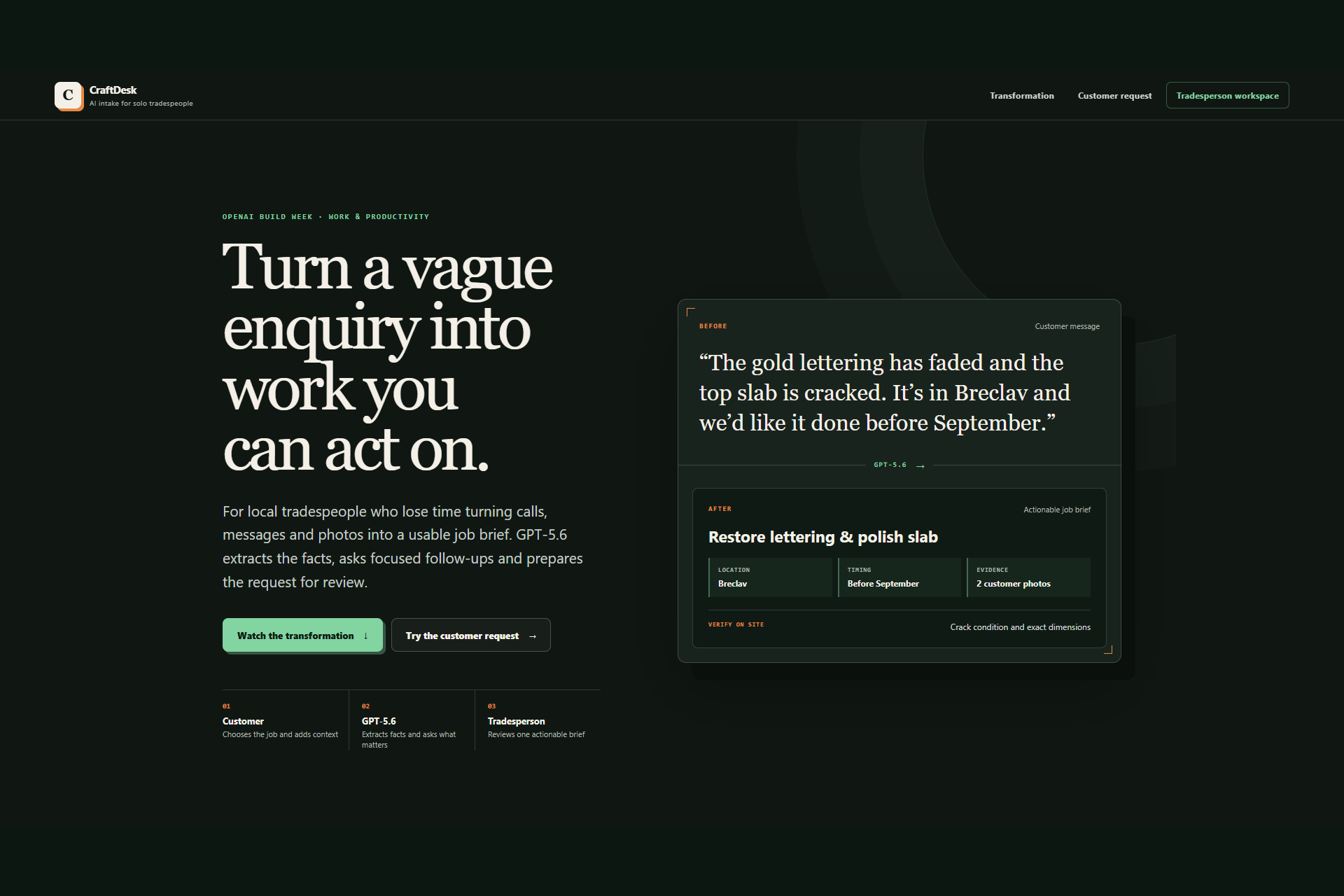
Local trade businesses often receive incomplete customer requests through phone calls, text messages, and messaging apps. Before they can quote a job or even make a useful first call, they have to chase basic details such as location, measurements, timing, and photos.
What it does
CraftDesk gives a local trade business one shareable AI intake link.
The business owner describes their services in plain language. GPT-5.6 proposes a tailored public profile, service list, and follow-up questions. The owner reviews everything before publishing.
Customers choose the type of work, describe the job naturally, and can attach photos. CraftDesk extracts known facts, identifies missing information, and asks only the next relevant question. Unknown information remains explicitly unknown instead of being guessed.
Submitted requests appear in a tradesperson dashboard with a concise title, the original customer message, contact details, photos, field provenance, missing information, and a recommended next action. The business can review the brief, edit a draft reply, update the workflow status, and export the complete request.
How we built it
CraftDesk uses the OpenAI Responses API with GPT-5.6 and strict structured outputs. GPT-5.6 converts unstructured customer descriptions into a reliable schema, identifies missing fields, generates relevant follow-up questions, reports only visible photo facts, and prepares editable replies.
The prototype includes business onboarding, a public customer intake, server-side persistence, photo uploads, a tradesperson dashboard, reply drafting, workflow states, backups, and portable data export.
How Codex was used
Codex was used throughout Build Week to explore and refine the product direction, implement the server and interface, connect the customer flow to the dashboard, integrate GPT-5.6, write automated tests, inspect browser behavior, and iterate on the customer and tradesperson experience.
Generated output was not accepted blindly. Product, wording, and interaction decisions were repeatedly reviewed against the working application, and Codex was used to diagnose and correct the gaps found during those reviews.
Challenges we ran into
The main challenge was separating information for the customer, the tradesperson, and the competition demo. We also had to preserve uncertainty instead of allowing AI to invent missing facts.
Accomplishments that we're proud of
CraftDesk is a functional end-to-end prototype rather than a visual mock-up. The complete request flow works from business setup and customer intake through a structured brief, dashboard, reply drafting, status management, and export. The automated test suite passes all six tests.
What we learned
AI intake is most useful when it preserves uncertainty instead of trying to complete every field. Keeping the customer's original words and the source of each extracted value makes the result more useful and trustworthy for the person making the final decision.
What's next for CraftDesk
The next steps are production authentication, durable database hosting, rate limiting, messaging integrations, and testing with trade businesses outside the demo scenario.
Built With
- codex
- css3
- express.js
- gpt-5.6
- html5
- javascript
- node.js
- openai
- responses

Log in or sign up for Devpost to join the conversation.