Inspiration
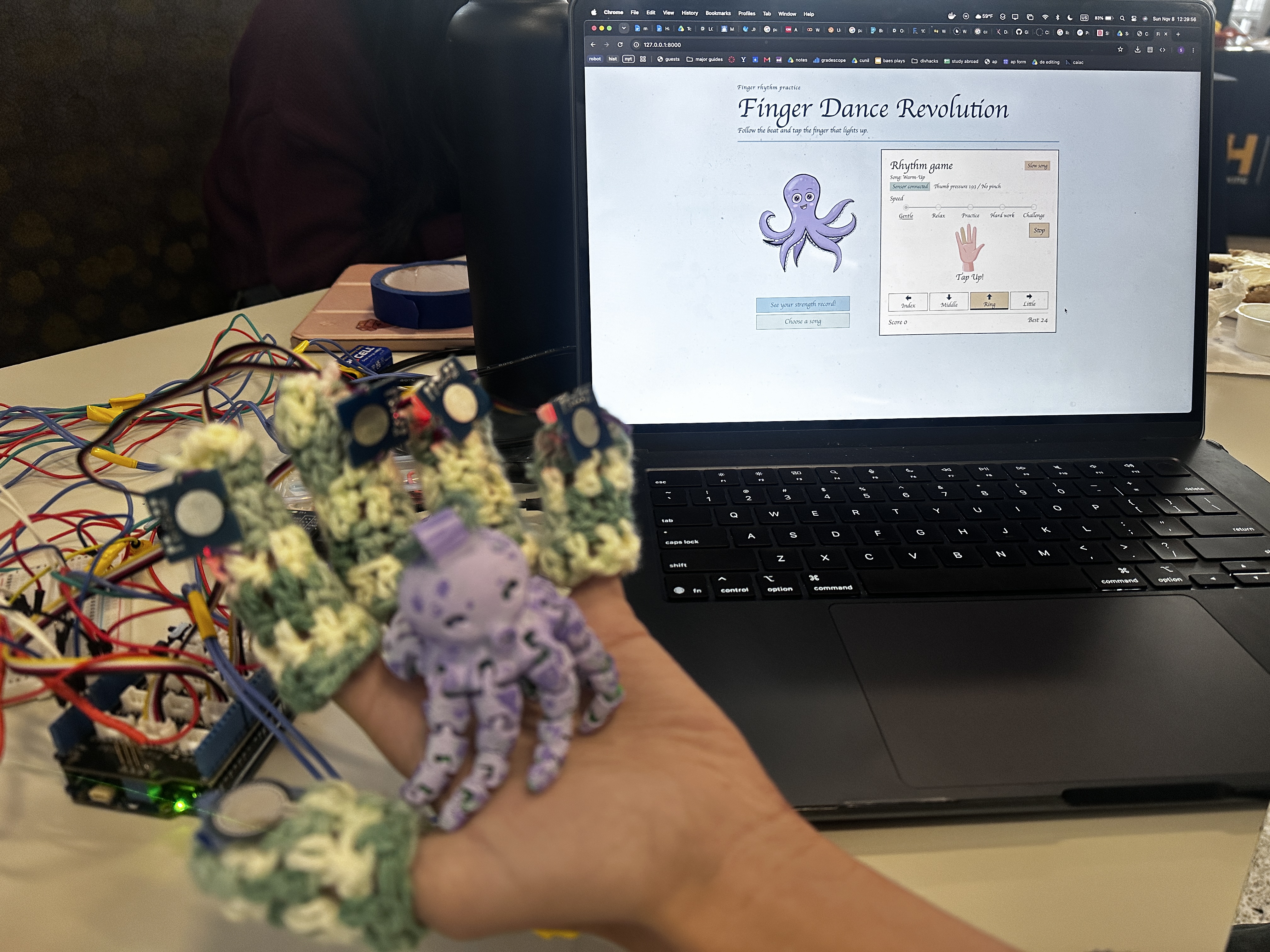
Touch Revolution Glove is a gamified rehab glove that helps patients, both children and adult patients, by encouraging them to continue their rehab through a fun companion (our demo's is a sea creature) and a website that also acts as a tracking device for their progress. This is specifically for any patients that need to complete digit to thumb dexterity exercises. It also measures force exertion for each finger in addition to location of touch and is a good way to track grip strength progress in combination with accuracy for these patients. Due to the nature of the game, it's a great way for patients with Dementia to train their memory because the game provides a pattern to follow.
We started with a simple hand exercise: touch your thumb to each fingertip, one at a time. It’s easy to explain and repetitive to practise. We wondered what would happen if each pinch became a move in a rhythm game.
That idea became Touch Revolution Glove, a hand rehab prototype designed for people with hand tremor or reduced dexterity. We wanted players to know immediately whether they’d made the intended pinch and to be able to practise at a pace that works for them.
What it does
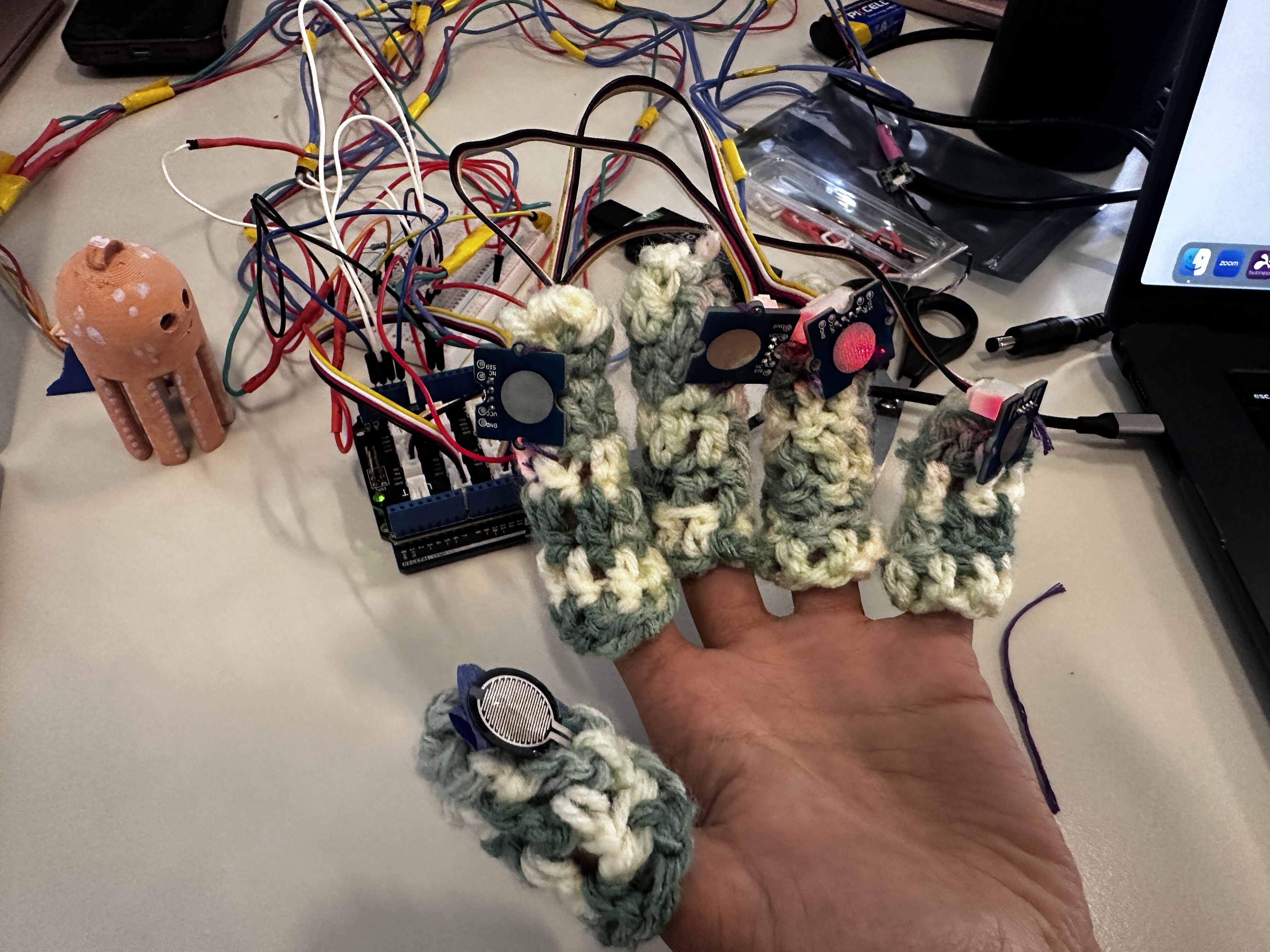
Players choose a hand, learn the pinch motion in a short tutorial, and follow finger cues to music. The glove detects which finger meets the thumb. The game scores the move and sends the result back to an RGB LED on the glove, which flashes the finger’s colour for a correct pinch or red for a wrong one. Players can also try the game with a keyboard or mouse.
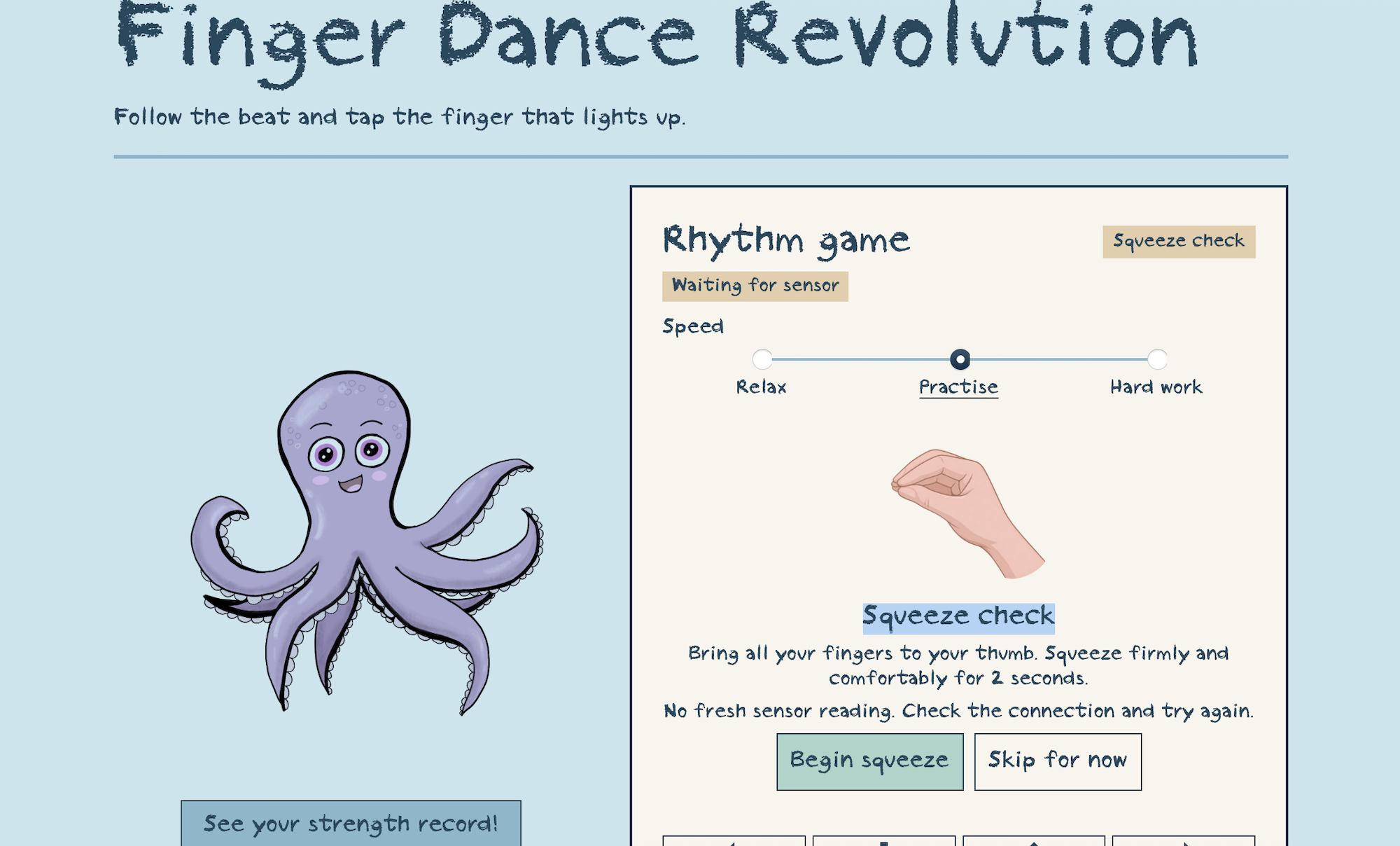
A separate squeeze check saves the highest thumb sensor reading from the first second of a squeeze. Players can revisit their latest measurement in the strength view, where sample history is labelled separately.
Our adaptive algorithm personalizes hand practice as players play. It uses the hit rate over the last 10 notes to adjust the difficulty of upcoming cues. After each song, it checks each finger’s accuracy and reaction time. If a finger is struggling, the player can choose to practise it more often or give it a break.
How we built it
We built the glove with an Arduino Uno R4 WiFi, four capacitive fingertip sensors, a TouchTronix SensX25 pressure sensor on the thumb, and an RGB LED. The SensX25 streams a 5 × 5 pressure grid to the computer through its USB adapter, while the Arduino reports which fingertip is touching.
Our Python bridge combines those two readings to recognize a pinch. For the squeeze check, it adds up the 25 pressure readings in each frame and saves the highest total from the first second of the squeeze.
We built the rhythm game with HTML, CSS, and JavaScript. The browser scores each pinch against the beat and sends the result back through Python to the Arduino, so the glove’s LED reflects what the player sees on screen. We also integrated Dance Dance Convolution to generate playable beat charts from audio.
Challenges we ran into
The glove and the browser initially judged taps separately. If a player held a correct pinch into the next beat, the screen could count it as correct while the LED turned red. We fixed that by making the browser’s score drive both the screen and the LED.
We also found that a pinch could arrive just before a beat ended and reach the browser just after the next one began. We changed the game to use when the server received the tap, so the browser could score it against the intended beat.
What we learned
A pressure reading tells us that the thumb was pressed, while a fingertip reading tells us which finger was involved. Combining the two gave us a way to recognize the exercise as a game input. We also learned how much the experience depends on timing. When the cue, score, and LED agree, it’s easier to understand what happened and try the next move.
Built With
- arduino-uno-r4-wifi
- audio
- capacitive-touch-sensors
- css
- force-sensitive-resistor
- html
- javascript
- pyserial
- python
- rgb-led
- web

