About the project
Try it out: https://public.tableau.com/app/profile/marcello.marcello5067/viz/SDSS_T6/Dashboard12?publish=yes
Inspiration
Toronto’s shelter system often operates close to capacity. We wanted to turn open data into something operationally useful: where is the system most strained, when does it worsen, and can we recommend lower-occupancy options to support “spreadness” (load balancing)?
What we built
We built ShelterPulse Toronto: an end-to-end pipeline that cleans and aggregates shelter occupancy data, visualizes trends and hotspots, trains a model to predict occupancy, and evaluates whether the model can support daily routing decisions.
We focused on two outputs: 1) Awareness: “who/where/when/what” drives high occupancy (sector, geography, seasonality, program area). 2) Spreadness: a predictive ranking tool that recommends the Top-K least-full options for a given day.
How we built it
1) Data cleaning
- Standardized postal codes (uppercase, remove whitespace) and removed invalid/missing entries.
- Aggregated duplicate rows into a stable unit defined by
[ (\text{date}, \text{postal}, \text{sector}, \text{service type}, \text{program model}, \text{program area}, \text{capacity type}) ] - Recomputed: [ \text{Occupancy Rate} = \frac{\text{Occupied Capacity}}{\text{Actual Capacity}} ]
2) Awareness analysis
- Converted postal codes to FSA (first 3 characters) for consistent area-level aggregation and mapping.
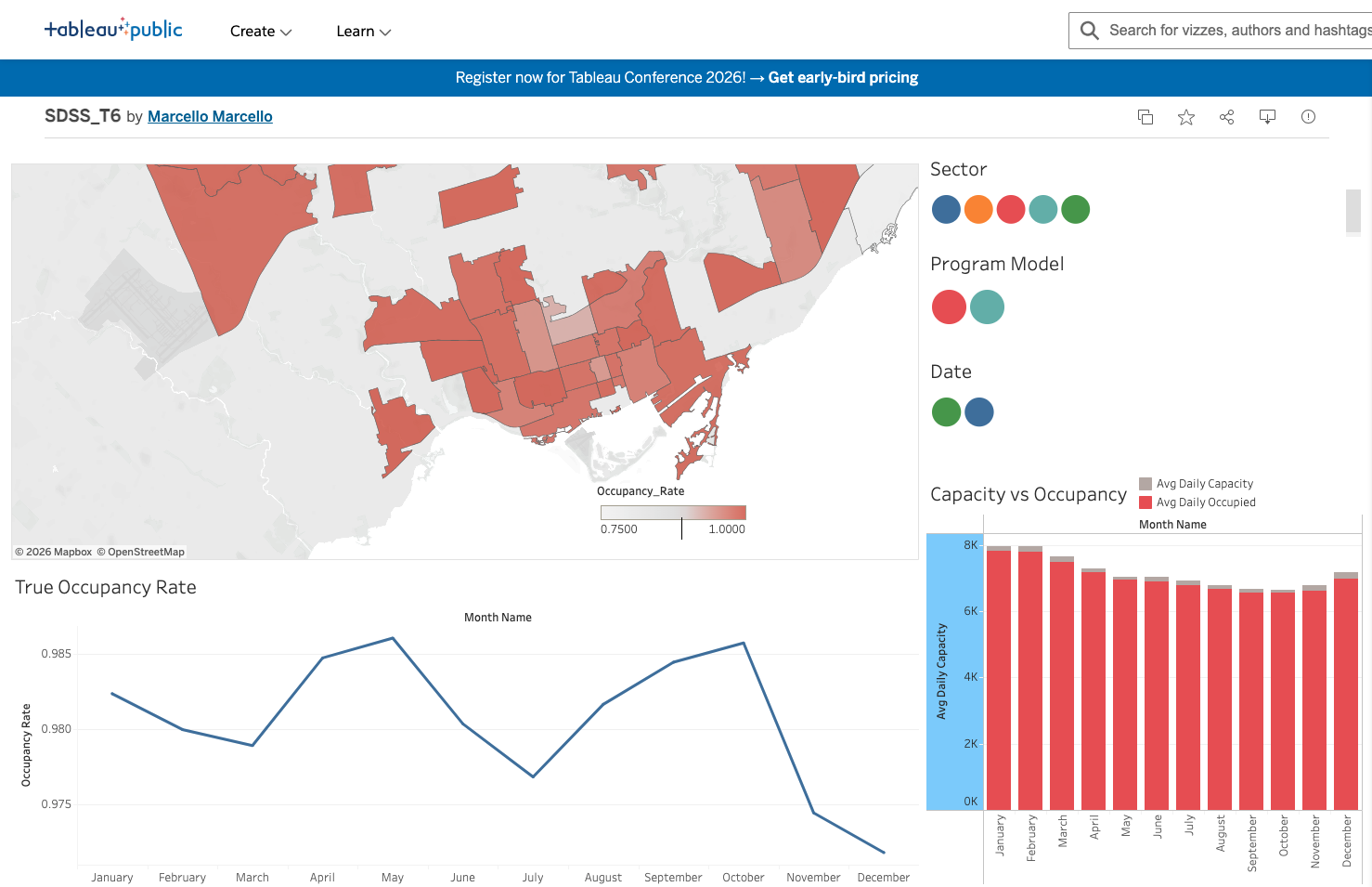
- Built charts for 2025 occupancy by sector, program area, and month (seasonality).
- Optional geo-visualization: merged FSA boundaries with aggregated data to create an interactive choropleth.
3) Modeling for “Spreadness”
- Features: encoded categorical program identifiers + calendar features (month, day of week).
- Model:
HistGradientBoostingRegressorto predictOCCUPANCY_RATE, with guardrails by clipping predictions to ([0,1]).
4) Evaluation We evaluated the model in four ways:
- Core metrics: MAE, RMSE, and sanity checks with predicted-vs-actual and residual plots.
- Error slicing: MAE by sector, capacity type, and near-full status ((\ge 0.95)).
- Ranking metrics for load balancing: Top-K capture + regret compared to an oracle ranking. [ \text{Regret} = \overline{y_{\text{true}}(\text{Predicted Top-K})} - \overline{y_{\text{true}}(\text{Oracle Top-K})} ]
- Feature importance: permutation importance to verify the model is learning sensible drivers (location and program type dominate, weekday is minimal).
What we learned
- In a near-capacity system, ranking quality matters more than perfect point prediction. Measuring Top-K performance + regret is a better evaluation for load balancing.
- Error slicing revealed that performance differs across sectors and that “near-full” cases dominate the dataset—important for both interpretation and future model improvements.
- Postal geography (FSA vs full postal code) is a practical tradeoff between map consistency and granularity.
Challenges
- Imbalanced occupancy: most records are near full, so models can look good overall while struggling on rare low-occupancy cases (which are exactly the cases load balancing cares about).
- Data granularity: no unique shelter ID, so aggregation decisions matter and can change the story.
- Drift and operational changes: performance varies across time windows; we used walk-forward validation to test generalization.
- Geospatial mapping: joining FSA codes to boundary files required extra preprocessing and careful handling of missing FSAs.


Log in or sign up for Devpost to join the conversation.