Inspiration
I was inspired by how people from Toronto instantly recognize the unique way “Toronto mans” talk — it’s rhythmic, expressive, and full of personality. At the same time, I’ve been interested in how AI can transform simple inputs into something much more engaging. I wanted to combine those ideas and explore: what if everyday life could be turned into a dramatic movie trailer, narrated in Toronto slang? The result is a playful, over-engineered experience that turns something ordinary into something cinematic and entertaining.
What it does
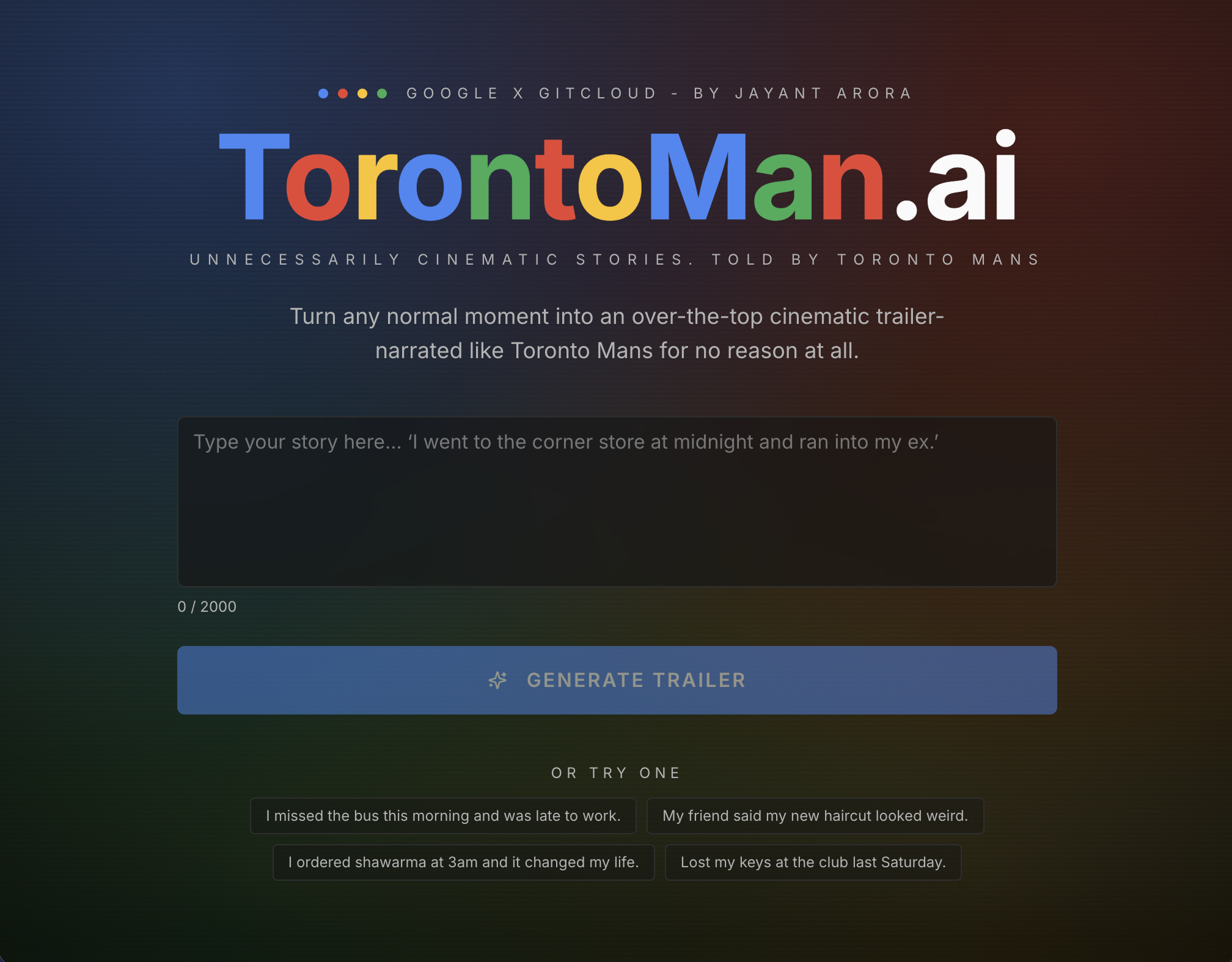
torontotrailer.web.app takes any user input — whether it’s a boring daily routine or a chaotic story — and transforms it into a cinematic trailer. It breaks the input into structured scenes, generates dramatic visuals for each scene, and narrates the story using Toronto slang in a stylized voice. The final output is a slideshow-style trailer that feels like a movie version of your life, complete with pacing, narration, and visuals.
How we built it
I used Google’s Gemini API to power the core intelligence of the app. Gemini takes the user input and converts it into a structured set of scenes, each with narration and a cinematic image prompt. I then generate visuals for each scene and use text-to-speech (via ElevenLabs) to create a Toronto-style voiceover. The frontend presents everything as a timed slideshow, syncing visuals with narration to create a trailer-like experience. Firebase was used for hosting and backend functions.
Challenges we ran into
One of the biggest challenges was getting the tone right. Early outputs sounded more like generic internet slang or even UK slang, rather than authentic Toronto speech. I had to carefully engineer prompts to guide the model toward more natural, subtle Toronto-style language. Another challenge was syncing narration with visuals — trying to align audio with video proved difficult, which led me to pivot toward a slideshow format that was more reliable and controllable. I also had to balance structure and creativity in the AI outputs to ensure consistent scene generation.
Accomplishments that we're proud of
One of the biggest challenges was getting the tone right. Early outputs sounded more like generic internet slang or even UK slang, rather than authentic Toronto speech. I had to carefully engineer prompts to guide the model toward more natural, subtle Toronto-style language. Another challenge was syncing narration with visuals — trying to align audio with video proved difficult, which led me to pivot toward a slideshow format that was more reliable and controllable. I also had to balance structure and creativity in the AI outputs to ensure consistent scene generation.
What we learned
I learned that prompt engineering is critical when working with AI — small wording changes can completely shift tone and output quality. I also learned the importance of scoping: trying to do too much (like perfect video syncing) can slow things down, and simplifying the experience can actually make the product better. Finally, I saw how powerful multimodal AI can be when combining text, images, and audio into a single experience.
What's next for Toronto Man Trailers
I learned that prompt engineering is critical when working with AI — small wording changes can completely shift tone and output quality. I also learned the importance of scoping: trying to do too much (like perfect video syncing) can slow things down, and simplifying the experience can actually make the product better. Finally, I saw how powerful multimodal AI can be when combining text, images, and audio into a single experience.
Built With
- api
- css3
- elevenlabs
- firebase
- firebasehosting
- gemini
- google-cloud
- html5
- javascript
- react
- router
- tailwind
- typescript
- vite

Log in or sign up for Devpost to join the conversation.