-

-
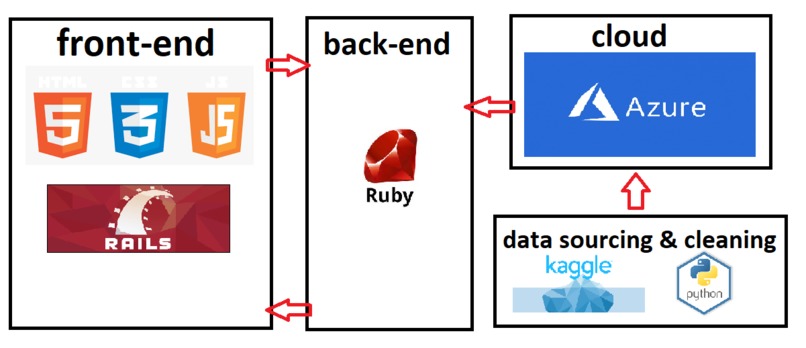
How we built our web application
-
-
-

Inspiration
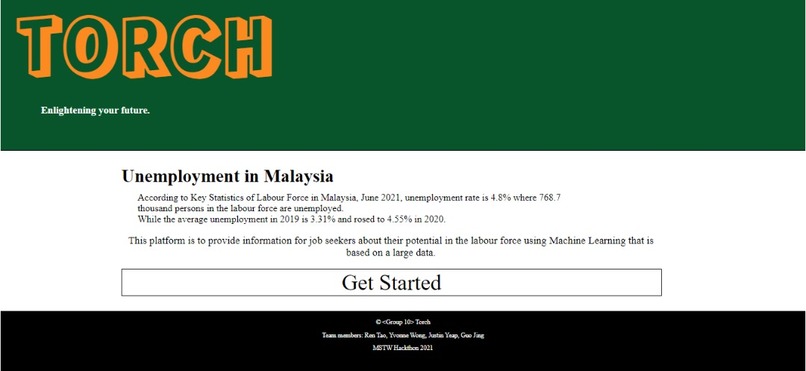
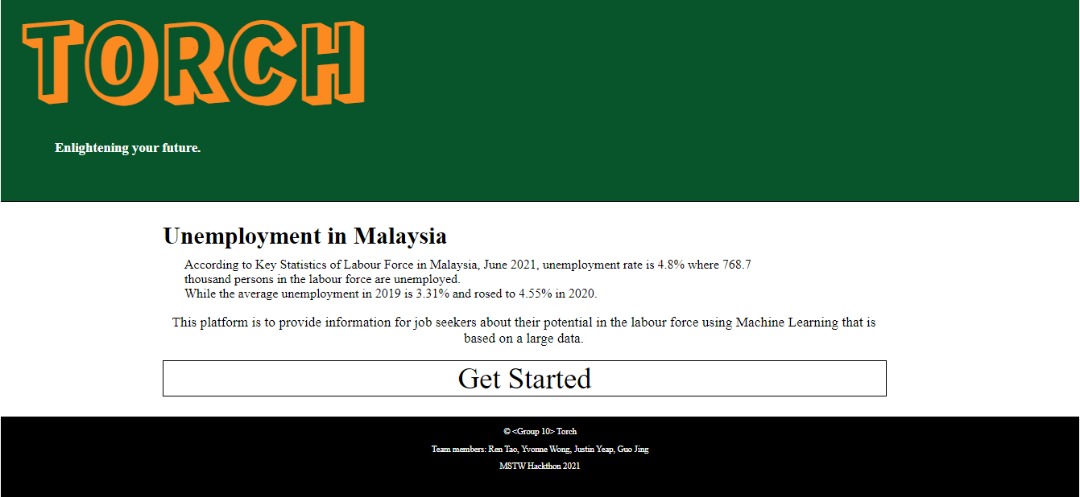
As all of us know, COVID-19 pandemic has significantly impacted Malaysia’s society and economy. The implementation of the Movement Control Order (MCO) had led to the currency devaluation (MYR) and the decline in the country's gross domestic product (GDP) due to several key sectors that are adversely affected such as entertainment, tourism, hospitality, etc. Consequently, it heightens financial market volatility. Hence, the retrenchment rate is increased for some companies to sustain. As a result, the unemployment rate increases which is causing the unemployed citizens to face financial hardship and cash flow risks that give rise to decrease of national expenses. Furthermore, the impact of unemployment rate on society includes negative consequences on mental health, family issues and increasing crime rate.
As university students, we always observe the job market. From there, our team found that a huge amount of people are struggling in finding a job especially when the world was hit by the unprecedented event of COVID-19 where bankruptcy of companies and retrenchment are very common. Moreover, competition to secure a job among the fresh graduates is getting more challenging with the presence of more unemployed persons who lost their jobs during the pandemic. Consequently, the unemployment rate of Malaysia has increased from 3.31% in 2019 to 4.55% in 2020.
What it does
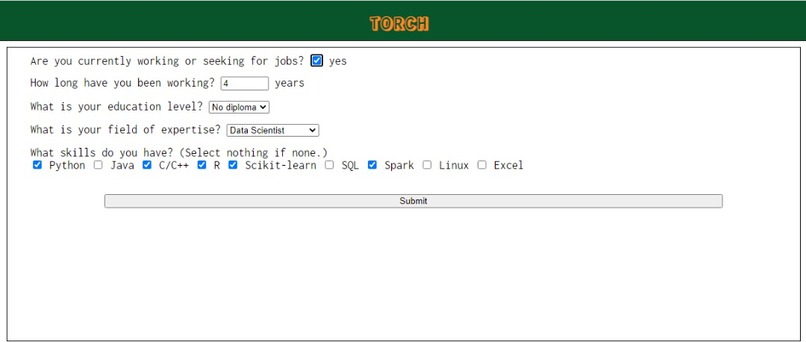
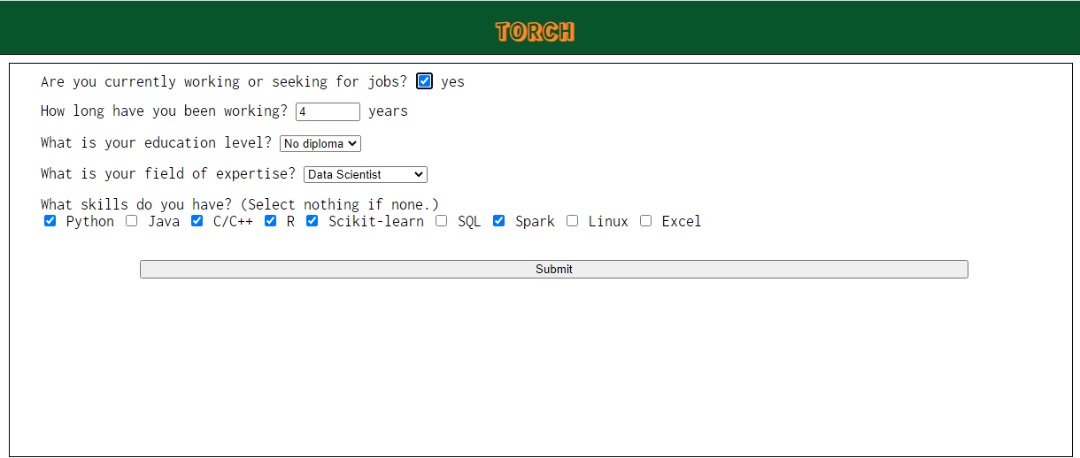
TORCH is a service which accelerates the job matching process by confirming the job scope and skills of job seekers through hundreds of questionnaires. Consequently, suitable job vacancies will be suggested. Additionally, employers who collaborate with us are able to reach out to potential applicants in a faster and simple way.
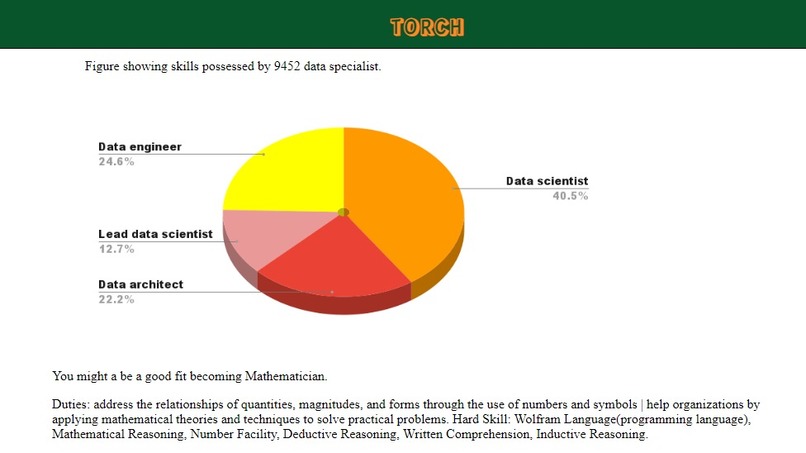
The service aimed to help people find their next ideal job based on the current job they have. During these uncertain times, many people have lost their jobs and are experiencing financial stress. We aim to provide a free service that could help people pursue their ideal careers using machine learning. This service takes the minimal data required from the user. Using machine learning, we suggest the perfect job to the user. We don’t collect more personal data than we need.
How we built it
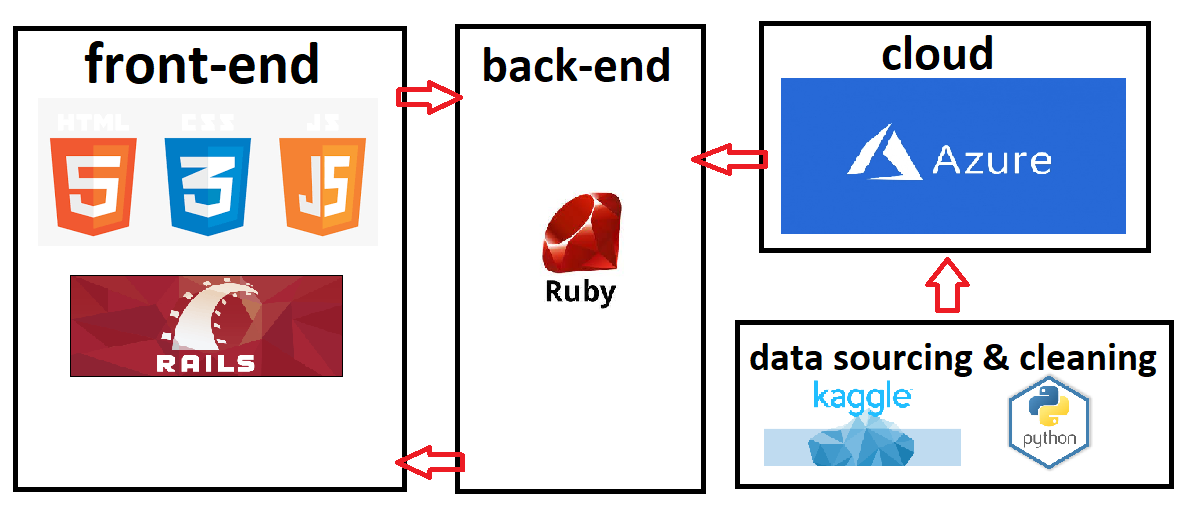
We used Ruby, JavaScript, HTML & CSS to build our website. Ruby is used as the back-end language while JavaScript is used to provide a more interactive experience to our website. HTML & CSS are used for website structuring and layout design. For machine learning, we used Python and Azure Machine Learning API for it. Python is mainly used for data cleaning & tidying, and writing scripts for the model output and deployment of the model. Azure Machine Learning API is used as an integral part in machine learning. We use that to split our data, and train it using one of the Azure Classification Model. We also use Azure Machine Learning to evaluate our model.
Challenges we ran into
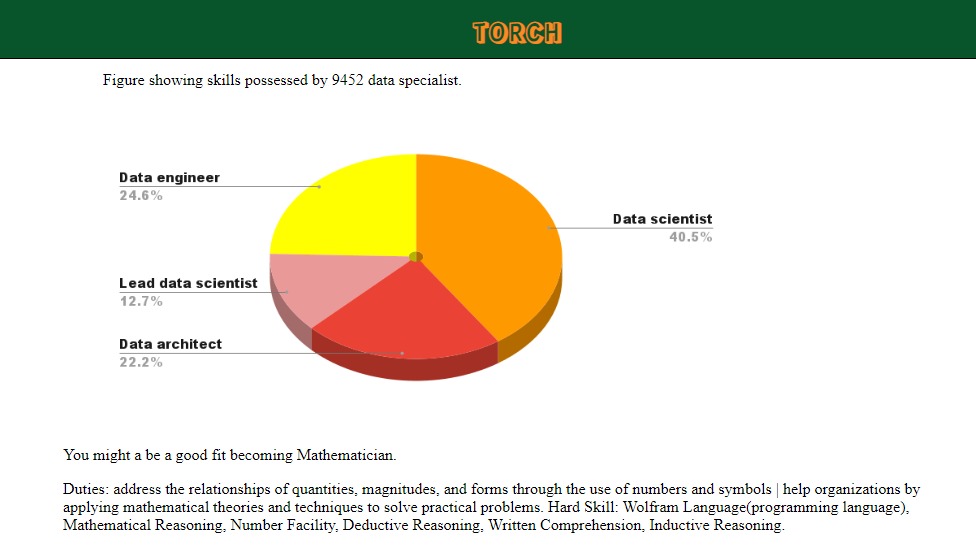
There are several challenges we faced during the process. First of all, we found it is hard to find an ideal data set that fit our purposes. Furthermore, given the 24 hours that we only have, it is not enough to train an advanced model and we are also not very familiar with Azure ML API. To solve these challenges, we decide to create our own data by improving on the current dataset available on Kaggle. To solve the training times problem, we decided to use 500 data out of the 9452 data available in our dataset. To further shorten the training times, we use the Multiclass Boosted Decision Tree model available in Azure ML. This can further shorten our training times while maintaining a high accuracy in our model. As a result, we are able to obtain 83.3% accuracy. (5 out of 6 of the data we tested). We then faced an issue in deploying this model online. Due to the difficulty to collaborate efficiently across different time zones, we choose to host the model locally and only send the output to the web apps. However, in the future, we plan to deploy it to other platforms.
What we learned
The most important thing we have learned in this hackathon is collaboration and teamwork. Having a common goal in mind, we can lay our back to each other and focus on our role. We learned how to create an inspiring pitch deck, how to compile our research topics together, and how to build on each other's ideas. On the technical part, we learn how to use Machine Learning to analyze data and provide meaningful insights from it. Furthermore, we learnt how to use web apps to collect user input and deploy it on the website.
What's next for TORCH
To provide more business values of TORCH, there will be additional key features such as suitable health treatment plans suggested according to the users’ financial budget filled in the system. The suggestion provided will be using machine learning as well. It is optional only if there are health condition requirements by the companies. We would add on another feature to collect customer’s feedback on their experience in using our platform and testimonials from the job seeker who have successfully secured a job with us. If we have more time, we can also use a more advanced learning training model to increase the accuracy of our model.


Log in or sign up for Devpost to join the conversation.