-
-
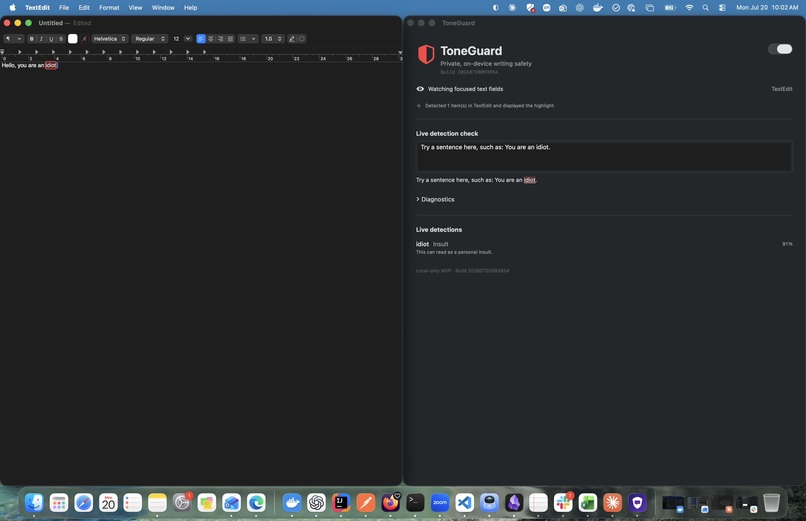
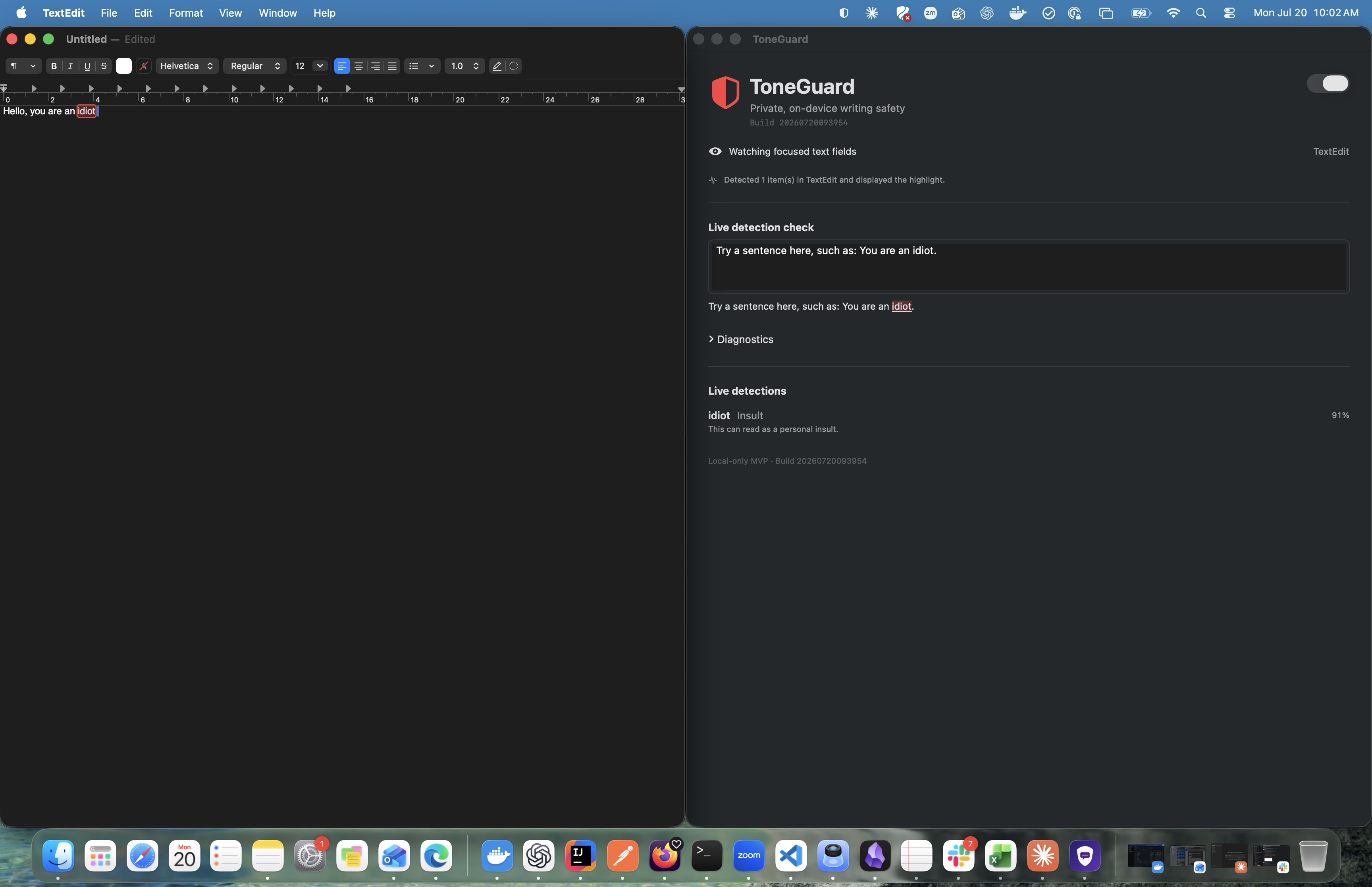
Live working example
Inspiration
Tone shapes how people understand our intentions. A message meant to be direct can sound harsh, and a quick reply can unintentionally feel negative. We built ToneGuard to help people communicate more thoughtfully while keeping their conversations private.
What it does
ToneGuard detects toxic, negative, or off-tone language in text and highlights it before it is shared. It runs entirely on-device, with no internet access or cloud processing, so user text remains private.
How we built it
We built ToneGuard as a native macOS app using Swift and integrated an on-device ML model to analyze text locally. The app provides real-time feedback by identifying language that may be interpreted negatively or differently than intended.
Challenges we ran into
The main challenge was building for Swift and macOS, since this was a new ecosystem for us. Understanding native app development, UI integration, and on-device model inference took time. Codex helped bridge this gap: we defined the problem and product direction, while Codex supported the implementation details.
Accomplishments that we're proud of
We are proud to have created a working privacy-first communication tool that does not rely on the internet. ToneGuard demonstrates that helpful AI does not need to collect or send sensitive user data to be effective.
What we learned
We learned how to build a macOS app, integrate an ML model for local inference, and design around privacy from the start. We also learned that AI products are most valuable when they support people at the exact moment they need help—in this case, before a message is sent.
What's next for ToneGuard
ToneGuard currently supports English. Next, we plan to improve tone detection, provide clearer rewrite suggestions, and extend support to other languages—while preserving its privacy-first, on-device approach.
Built With
- macos
- ml
- swif

Log in or sign up for Devpost to join the conversation.