-
-
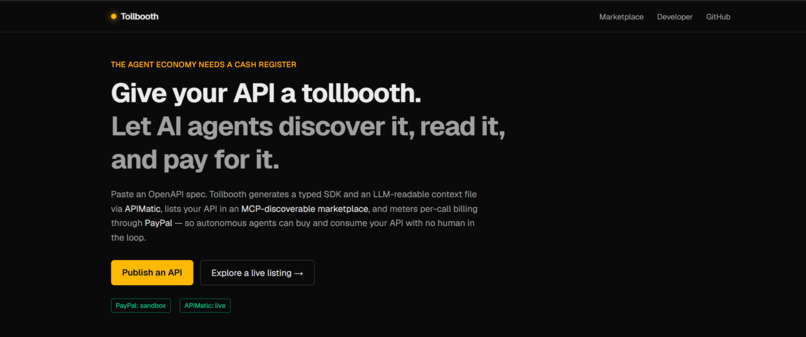
landing page
-
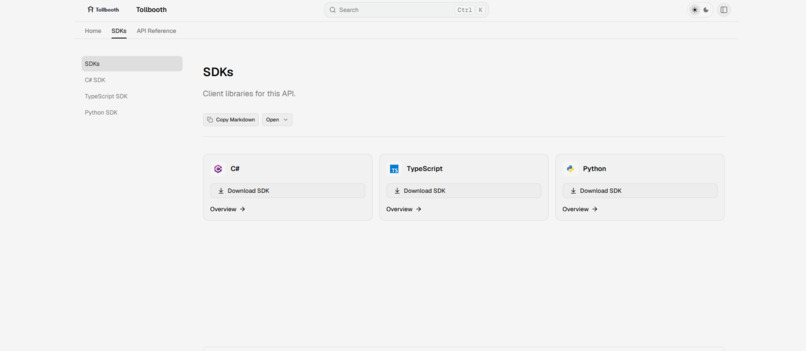
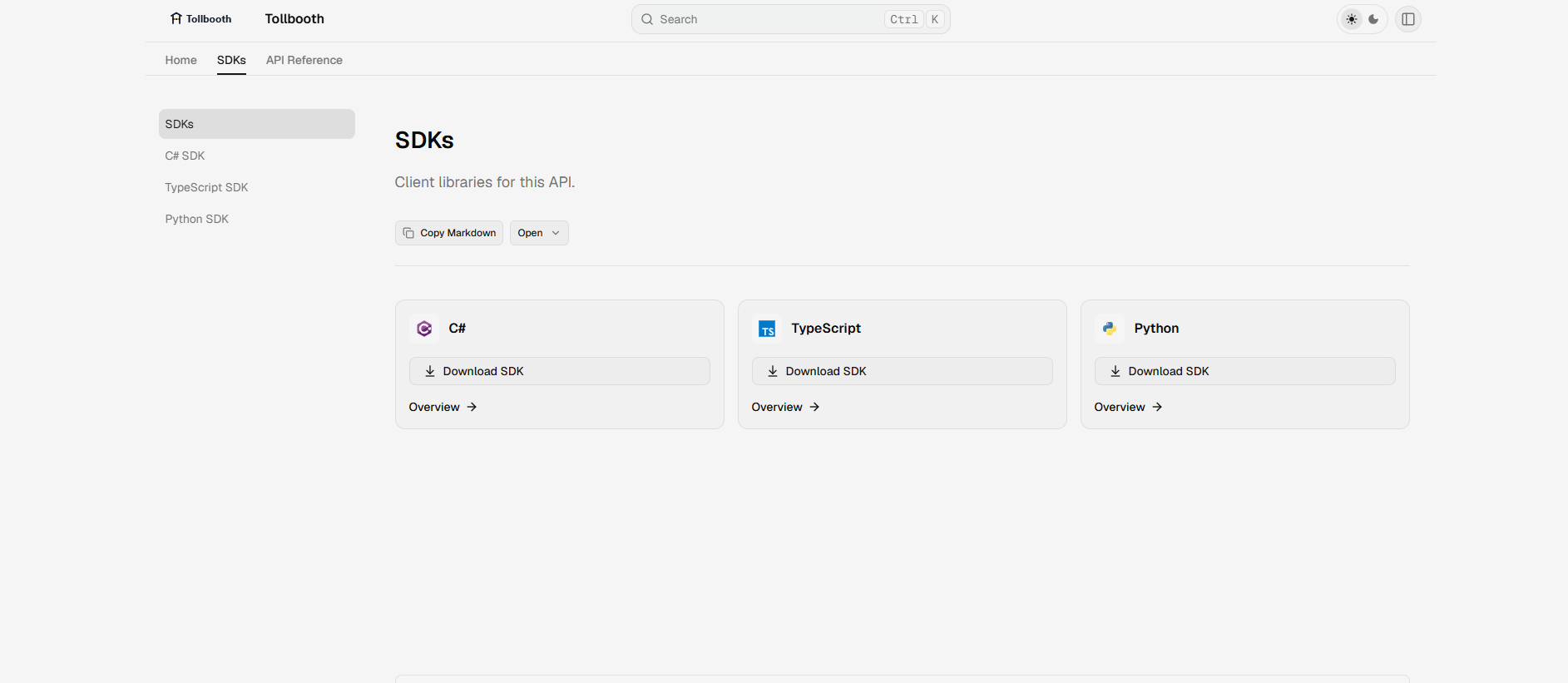
API SDKs
-
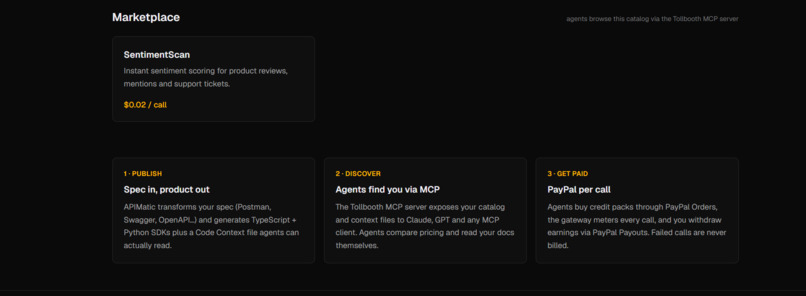
marketplace
-
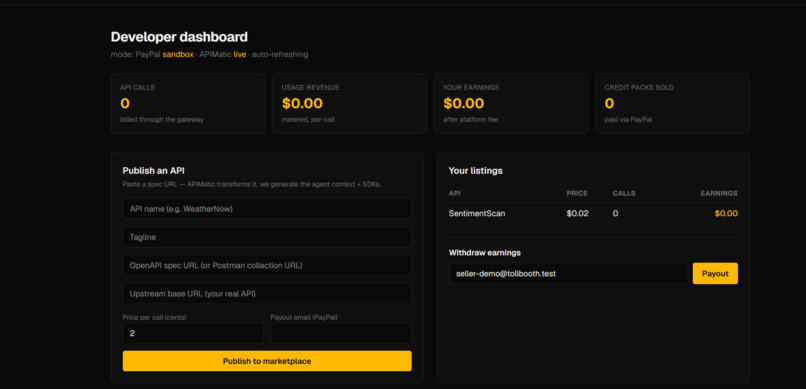
developer dashboard
-
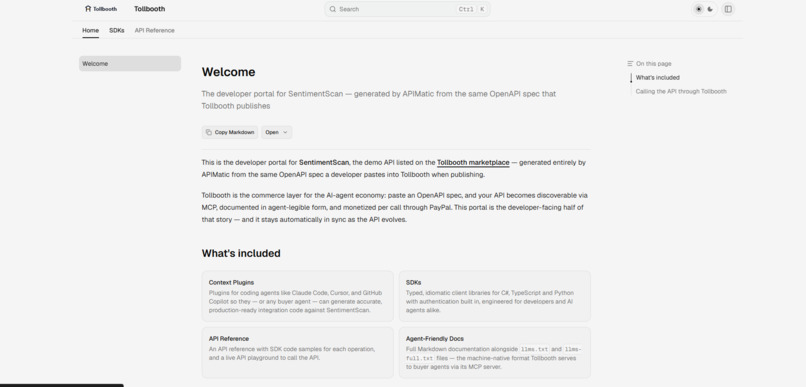
API doc
-
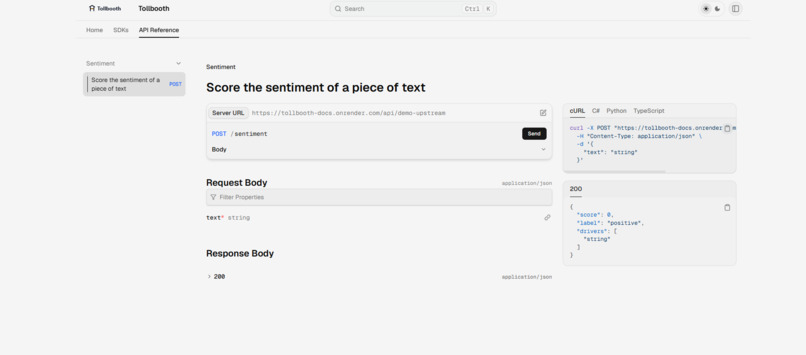
API Reference
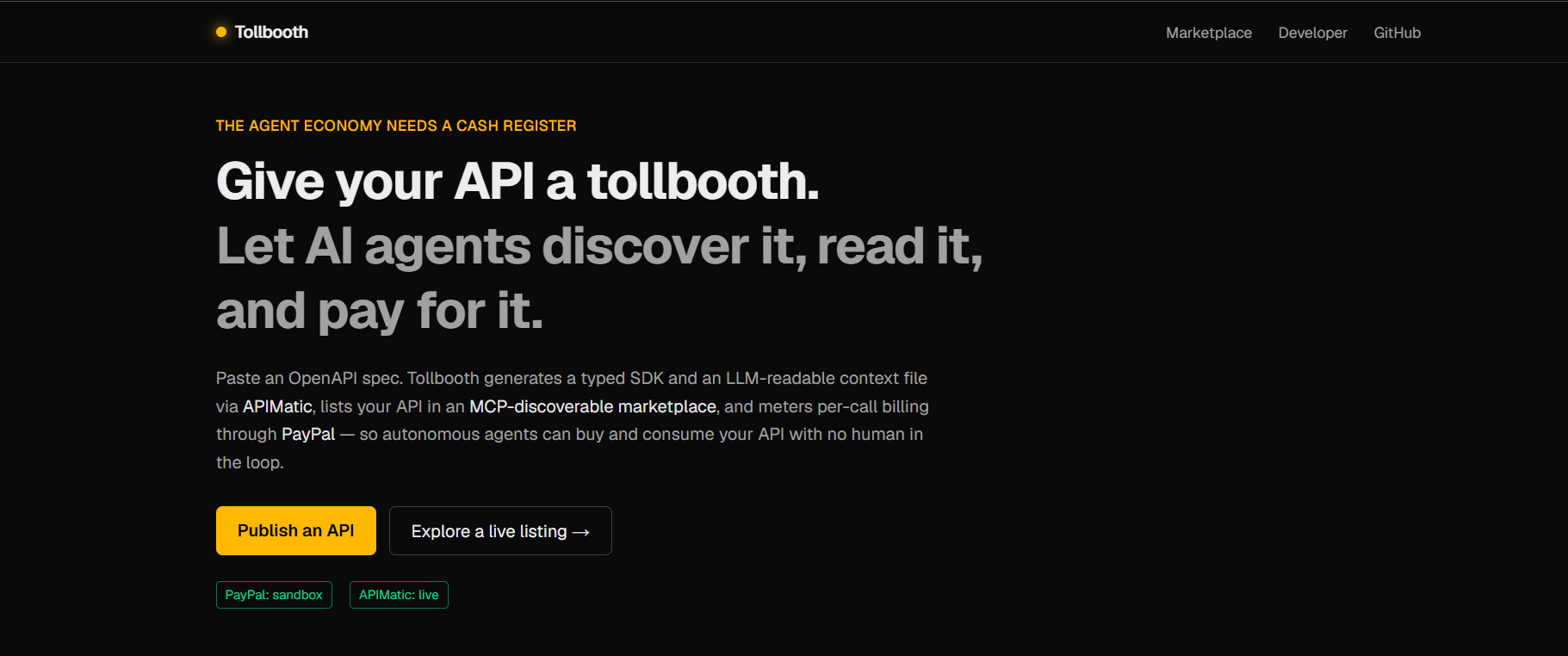
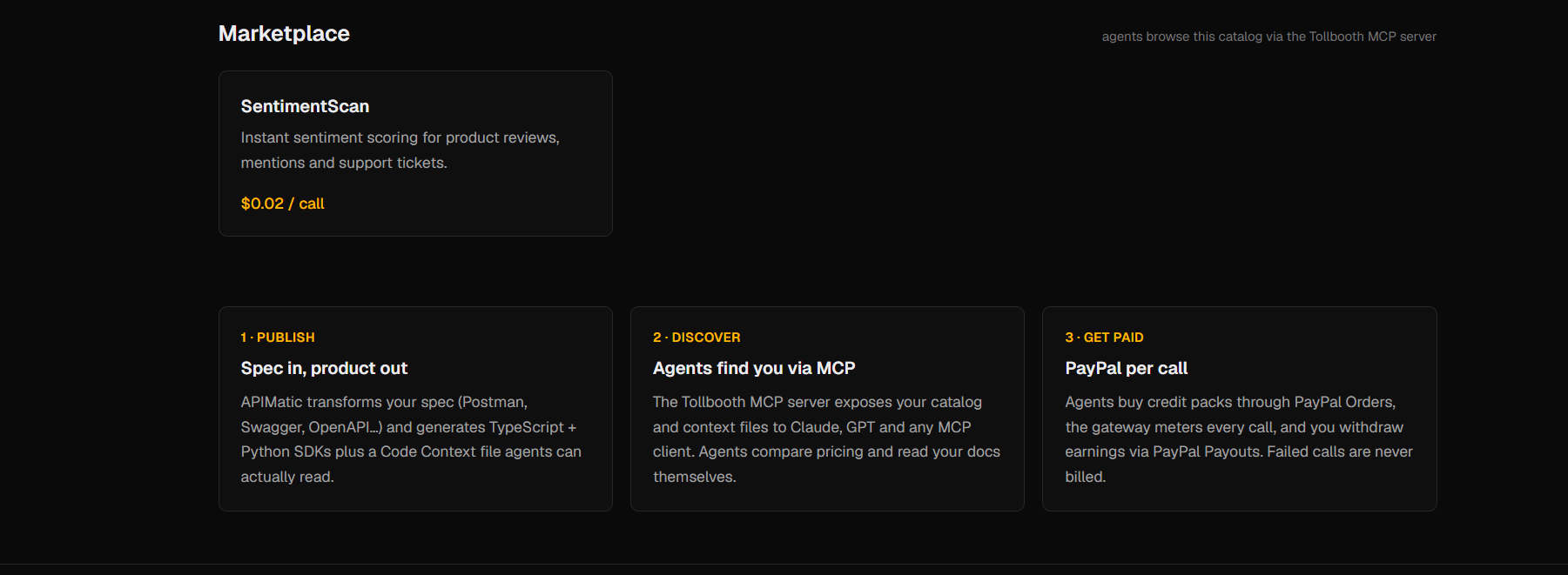
Inspiration AI agents are about to make millions of API calls a day — but the commerce layer for that flow doesn't exist. Today, when an agent needs an API, a human has to find the provider, read HTML docs meant for humans, sign up, copy an API key into a config file, and paste in a credit card. That works when you have five APIs and one developer. It doesn't scale to machines.
I kept hitting the same three gaps, so I built the layer that closes them: agents can't discover APIs (no catalog speaks their language), can't read them (HTML docs are noise to an LLM), and can't pay for them (no per-call billing exists for non-human buyers). Tollbooth is a marketplace that fixes all three: paste an OpenAPI spec, and your API becomes discoverable via MCP, documented in an agent-legible context file, and monetized per call through PayPal — with no human in the transaction loop.
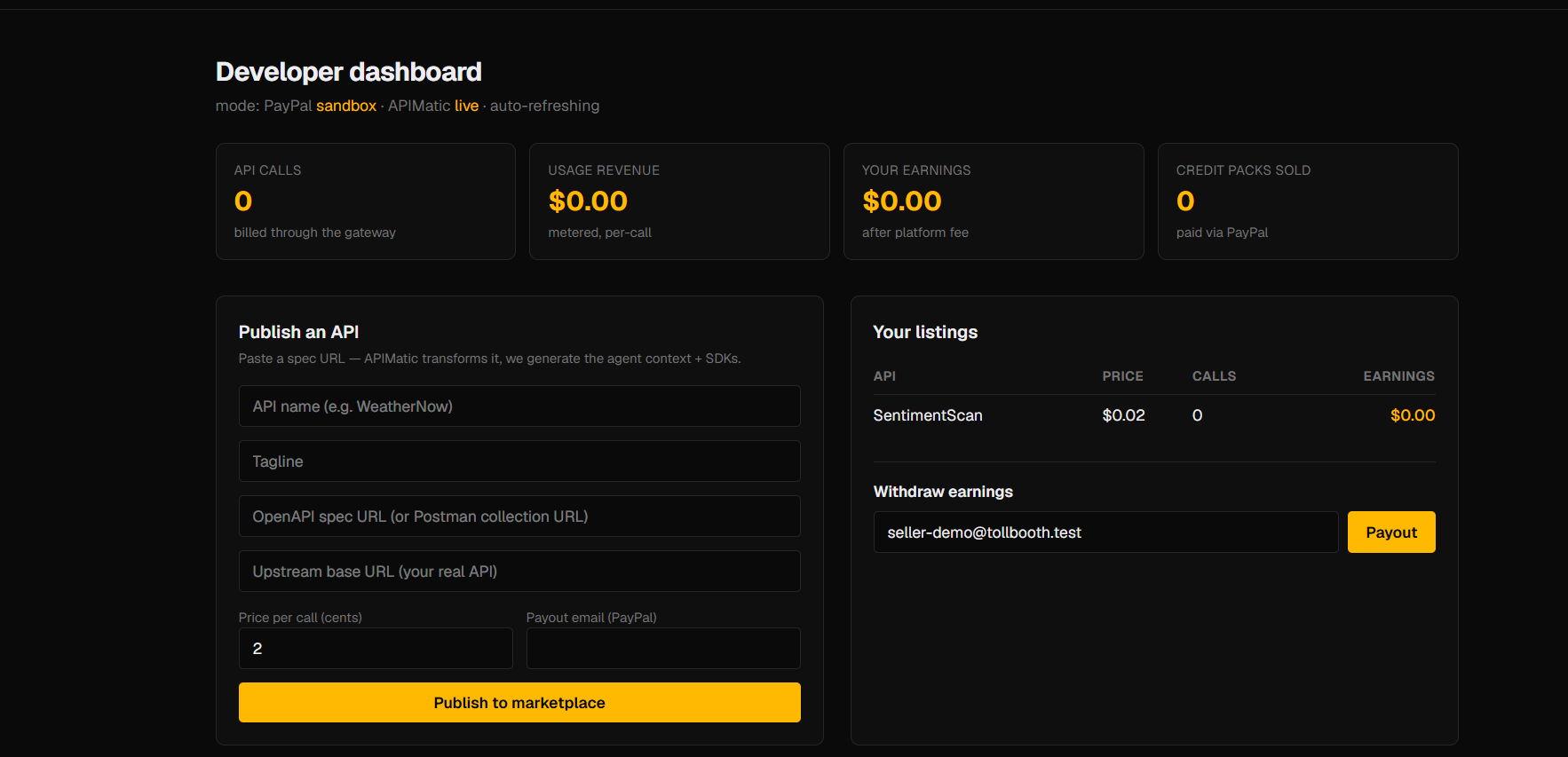
What it does A developer pastes an OpenAPI spec; Tollbooth normalizes it, generates an SDK plus an llms.txt-style context file, and lists the API with per-call pricing. On the other side, an AI agent connects through the Tollbooth MCP server, searches the catalog, reads the context file, buys a credit pack with its own funded card through the PayPal Orders API — order created and captured in a single autonomous call — and then consumes the API through a metered gateway where every successful call is billed from its balance and failed calls are never charged. Developers watch revenue accrue live on a dashboard and withdraw earnings via PayPal Payouts.
How I built it Three components, one monorepo:
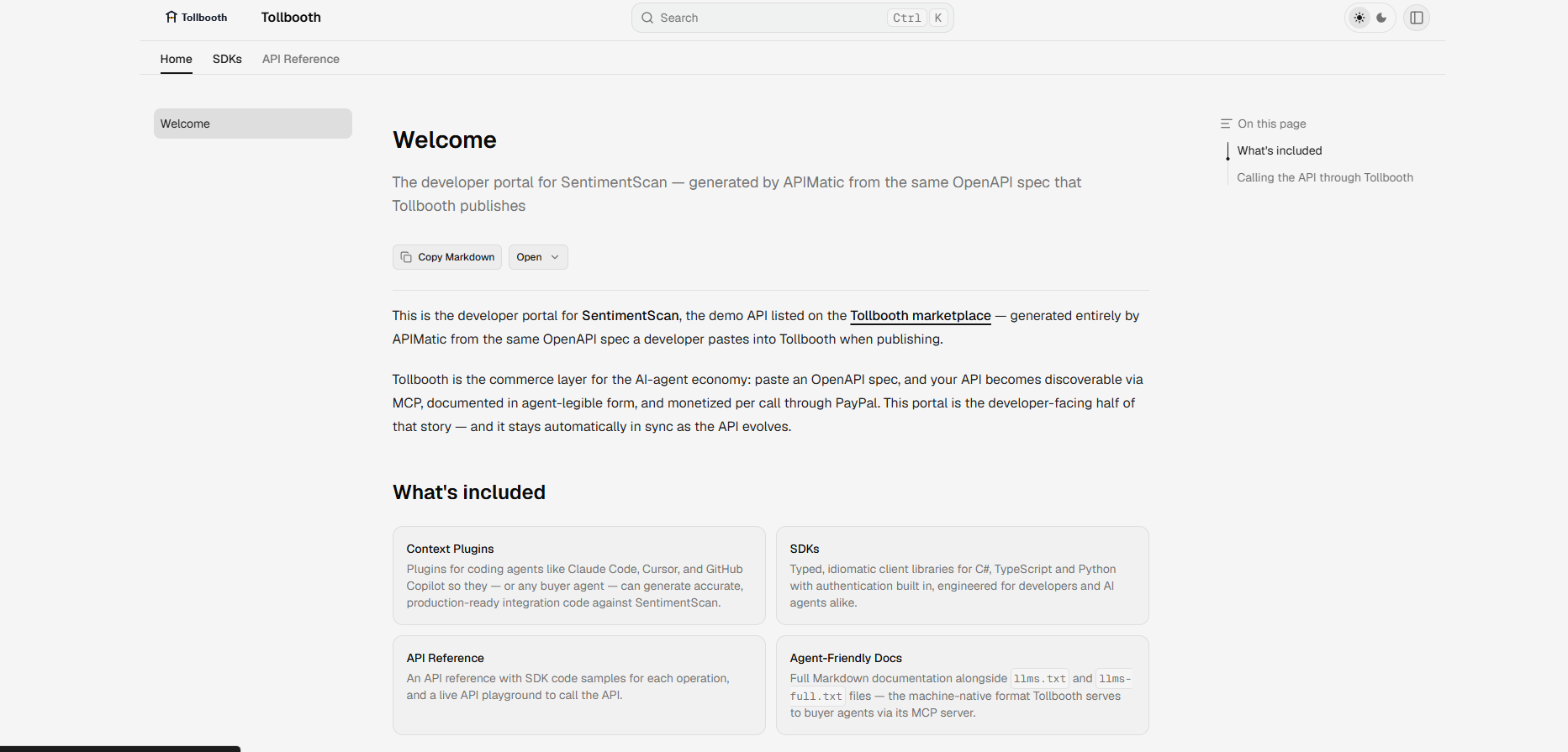
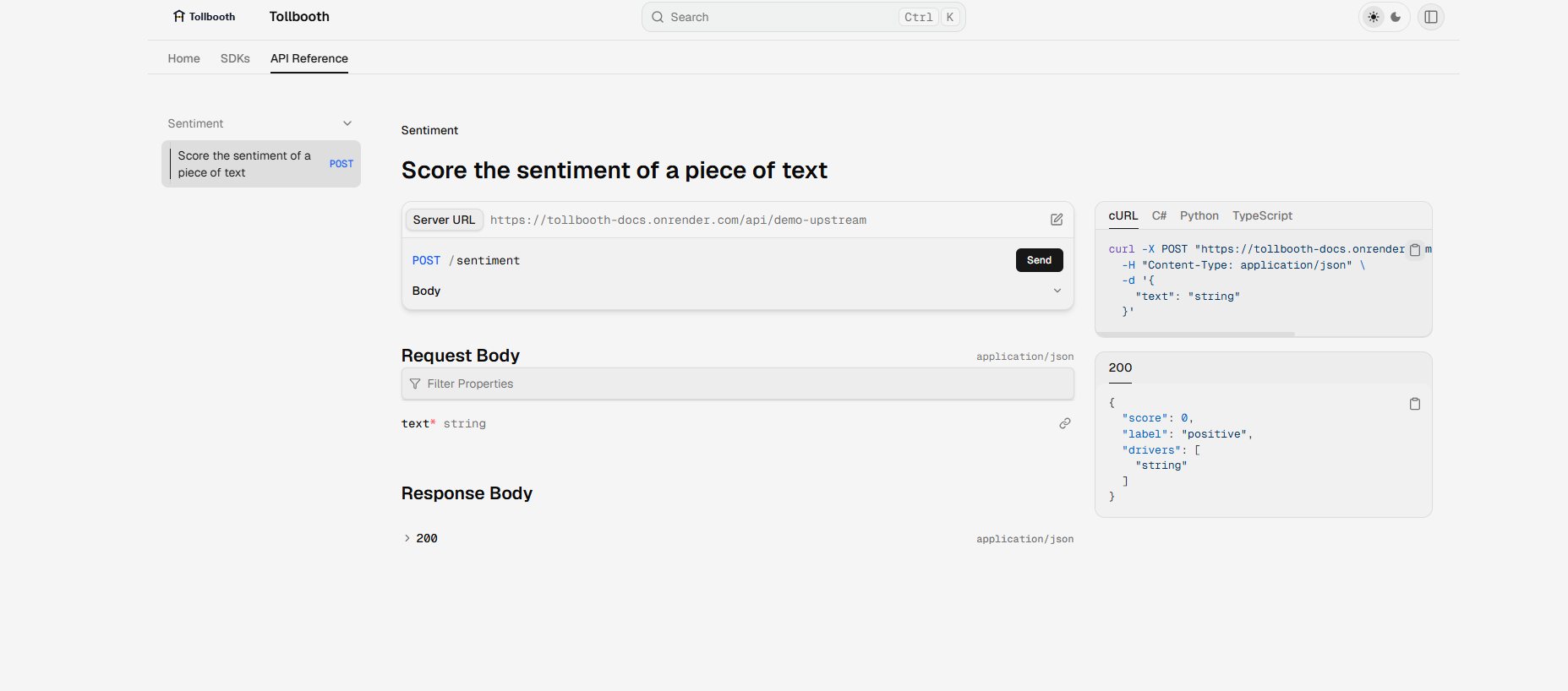
Marketplace + gateway — a Next.js 16 app: listings, developer dashboard, a proxy gateway that authenticates agents (x-api-key), checks credits, forwards calls upstream, and meters billing per successful call. Database is node:sqlite — zero native dependencies. MCP server — a standalone Model Context Protocol server exposing the agent-facing tool surface (tb_search_apis, tb_get_api_context, tb_create_order, tb_call_api, …), so any MCP-capable agent gets a marketplace as a native tool. Buyer agent — an autonomous agent (Gemini or Claude) that takes a mission like "find a sentiment API, run 3 calls, stay under $5" and completes the entire purchase journey unattended. There's also a deterministic scripted demo so the journey can be shown with zero API keys. The supply side runs live on APIMatic's Transformer and Codegen APIs — every published listing is normalized to OpenAPI 3 and gets real TypeScript + Python SDKs generated in APIMatic's cloud, downloadable straight from the listing page — with a key-optional local generator fallback so judges can run everything with no setup. I also used APIMatic's CLI to generate a full developer portal for the demo API — docs, downloadable C#/TypeScript/Python SDKs, llms.txt agent docs, and AI context plugins — all from the same OpenAPI spec the marketplace publishes. One spec in, every artifact a developer or agent needs, out. Everything degrades gracefully: with no credentials at all, PayPal runs in a mock mode and the whole demo still works end-to-end.
Challenges I ran into The hardest one: a browser-based checkout simply doesn't work for an agent. My first implementation used PayPal's standard approval flow — create order, open the approve URL, buyer logs in. Besides the philosophical problem (an autonomous agent can't click through a checkout page), my sandbox facilitator account is in a region that can't receive USD, so browser checkout failed outright no matter what I tried. The fix became the most interesting part of the project: the agent-card flow — the agent pays with its own funded card via payment_source.card in the PayPal Orders API, so the order is created and captured in one API call with no browser at all, while marketplace payee routing (PAYPAL_PAYEE_EMAIL) sends the payment straight to the seller's account. Fully autonomous, and it fixed the regional problem as a side effect.
Webhooks as the trust backbone. For the wallet flow where a human does approve, capture confirmation arrives via the PAYMENT.CAPTURE.COMPLETED webhook — which meant implementing PayPal's signature verification and registering the webhook against my deployed URL.
Making it runnable by anyone. I wanted a judge to be able to clone and run with zero keys, so every external dependency (PayPal, APIMatic, even the LLM) has a local fallback. The hosted free-tier deployment has an ephemeral disk — so I added boot-time seeding via Next's instrumentation hook, meaning the marketplace rebuilds itself on every restart.
The long tail: Next.js 16's cacheComponents conflicting with dynamic routes; node:sqlite's named-parameter typings; Gemini's free-tier rate limits (solved with a model-fallback chain); and an MCP tool timeout that was shorter than a PayPal approval round-trip.
Accomplishments that I'm proud of The moment the whole thing clicked: I gave the agent its mission, went to get coffee, and came back to a completed PayPal capture, a topped-up balance, three metered API calls, and a dashboard showing the revenue — with literally zero human involvement between mission and result. Watching money move because a machine decided to buy something is a very strange, very exciting feeling.
What I learned Agentic commerce is a protocol problem, not a UX problem. Every design decision that mattered was about removing the human from the loop — payments, docs, discovery all had to become machine-native. Graceful degradation is a feature. The zero-credential mock mode ended up making the project more demoable, not less impressive — and the real sandbox keys dropped in without a single code change. LLM-legible documentation is underrated. The llms.txt-style context file did as much for the agent's success rate as any prompt engineering.
Built With
- agentic-commerce
- ai-agents
- anthropic-claude
- api-marketplace
- apimatic
- fintech
- gemini
- javascript
- llms-txt
- mcp
- model-context-protocol
- nextjs
- node-sqlite
- openapi
- payments
- paypal
- react
- stack:
- tailwindcss
- typescript

