-
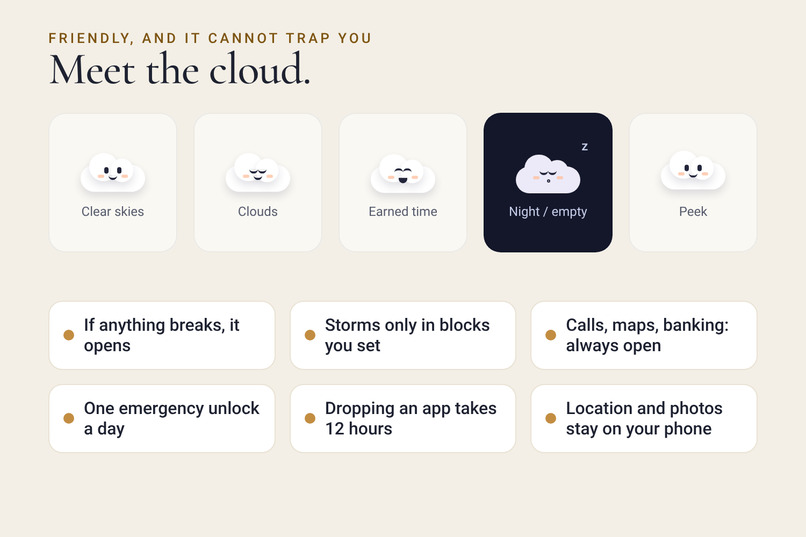
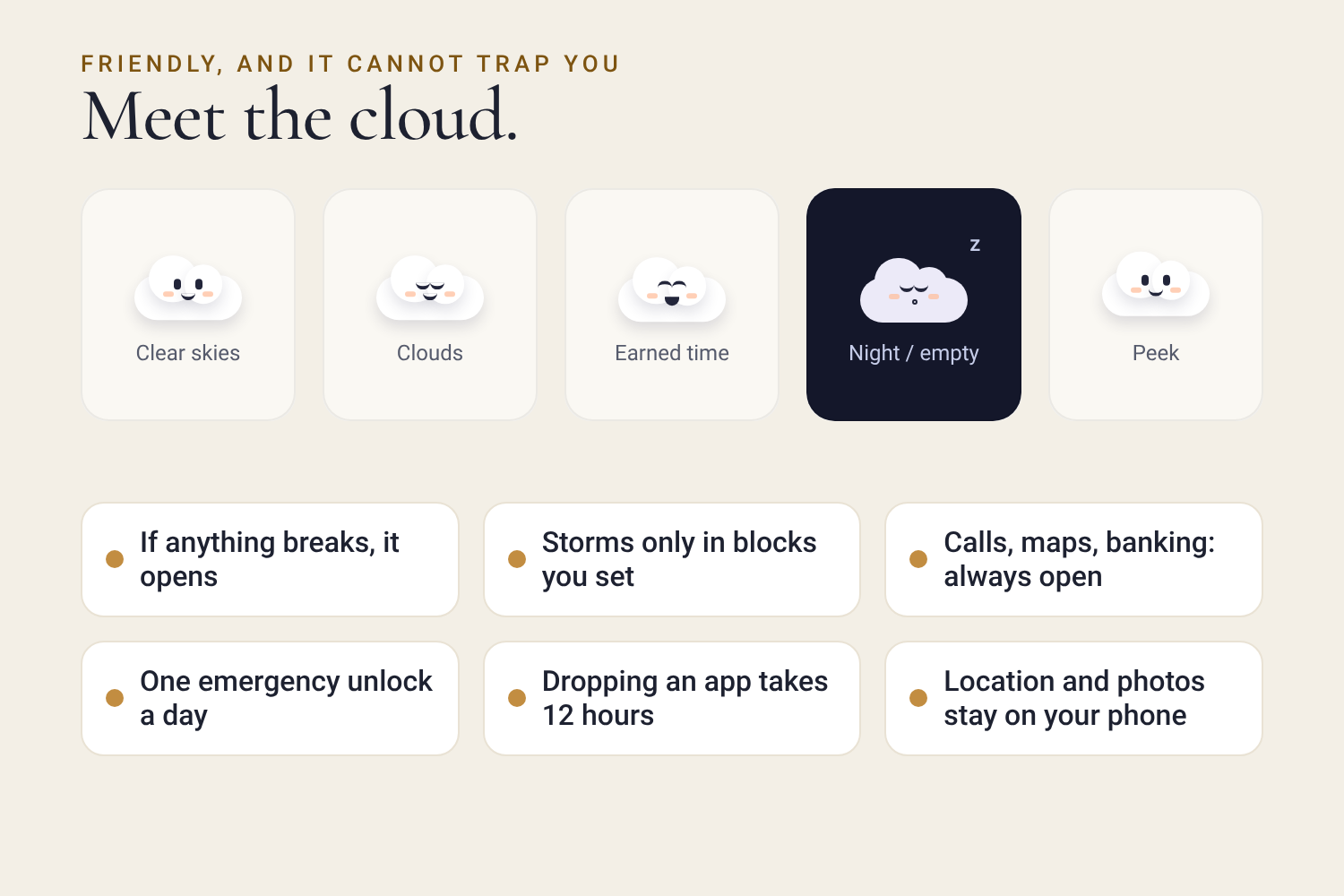
A friendly cloud mascot, plus safeguards: it fails open, Storms only happen in your blocks, essentials stay open.
-
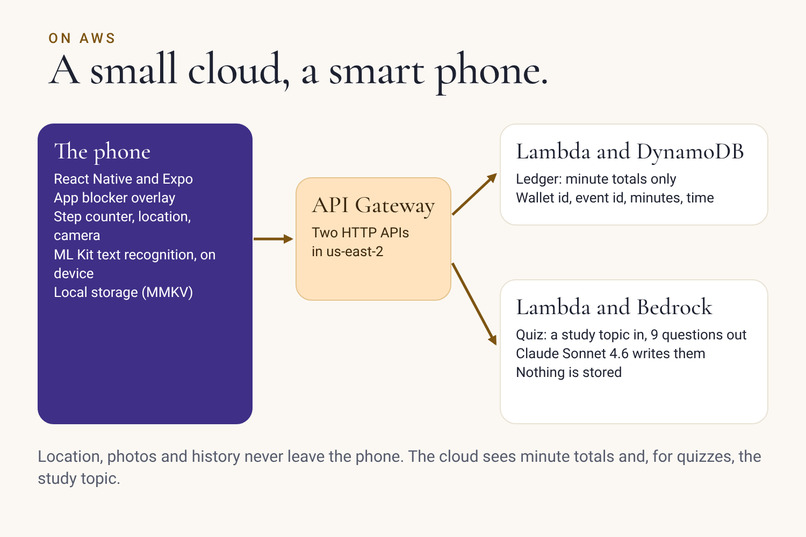
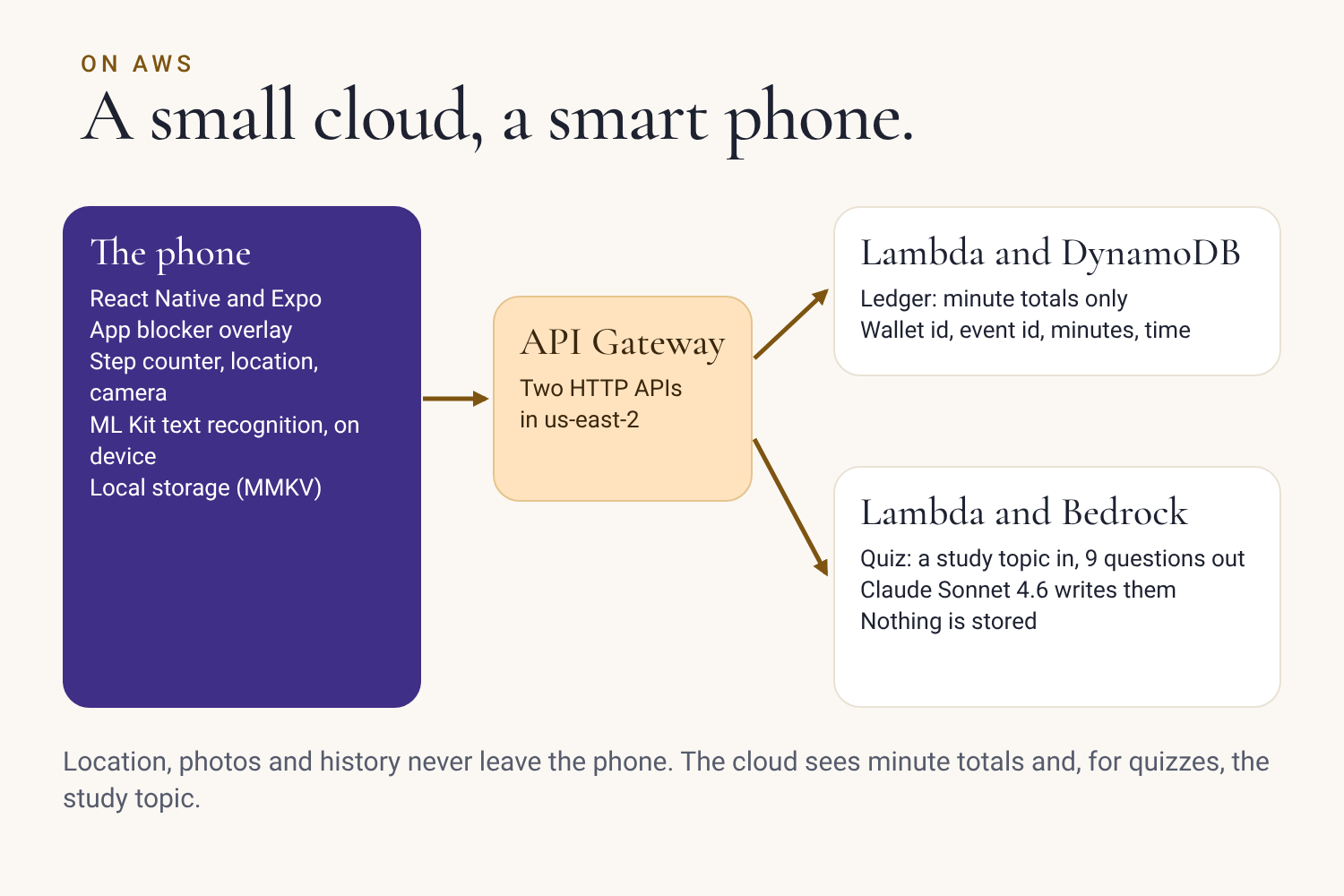
Two small AWS stacks: a ledger on Lambda and DynamoDB, and a quiz function calling Claude on Amazon Bedrock.
-
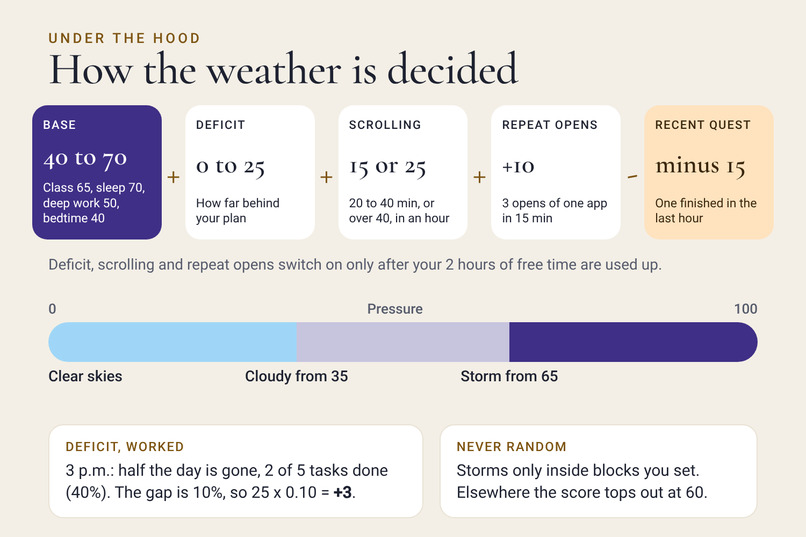
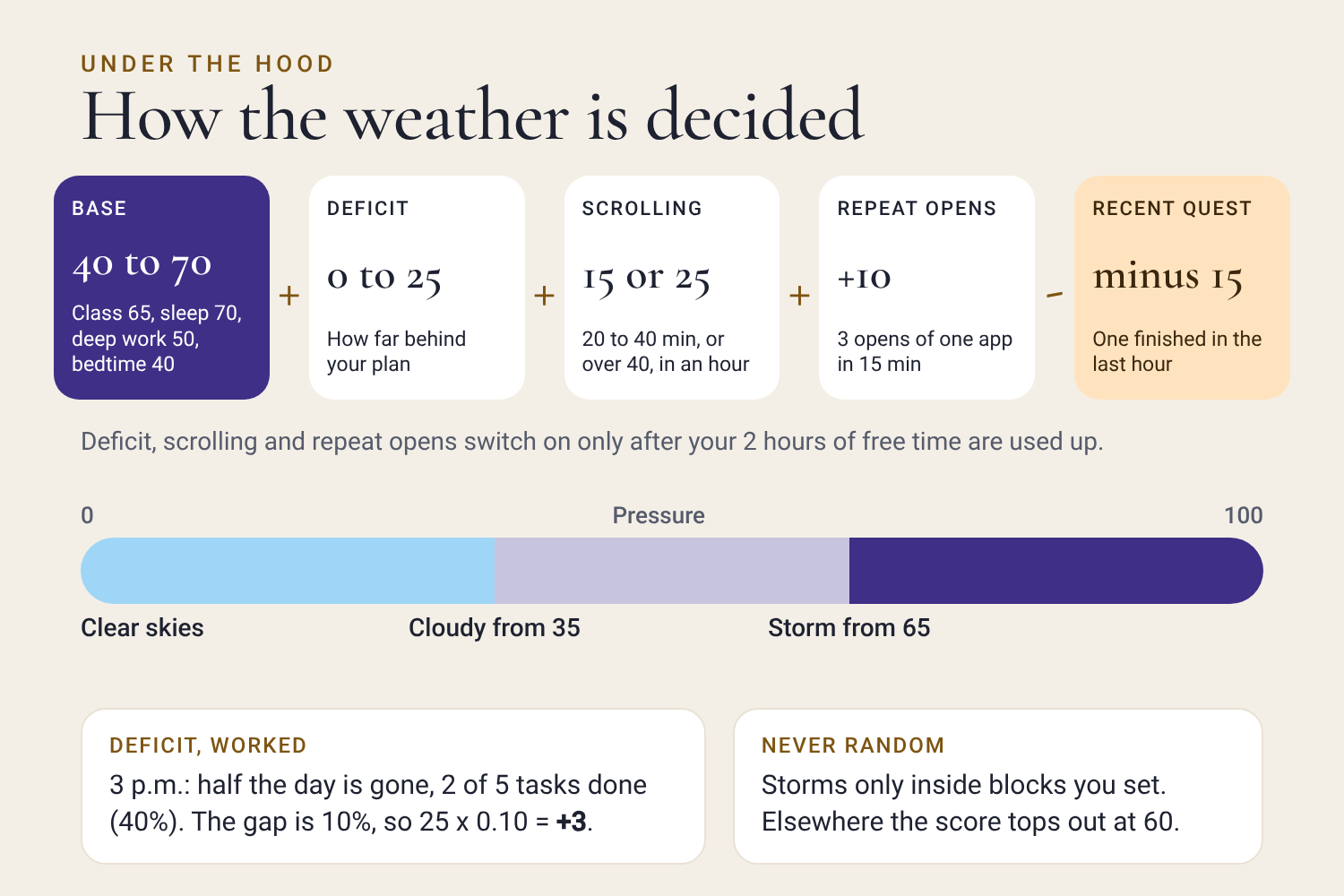
How the sky is decided: your schedule, plan deficit, scrolling and repeat opens, minus any recent quest.
-
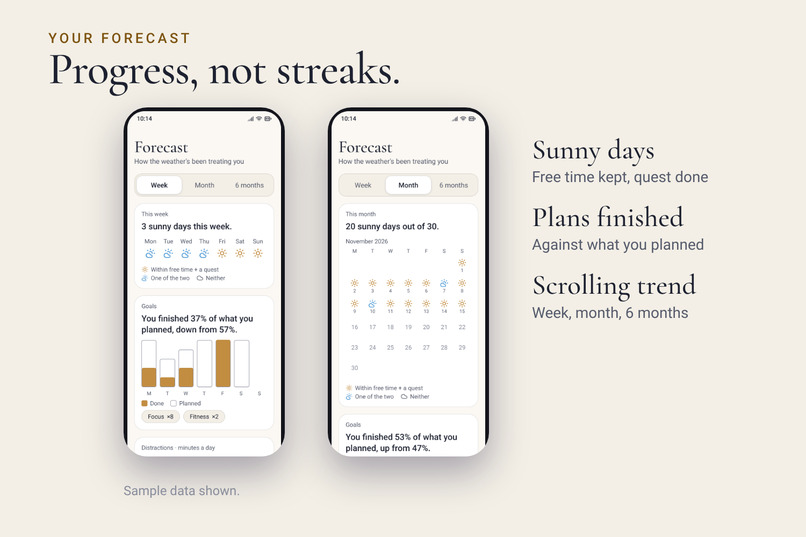
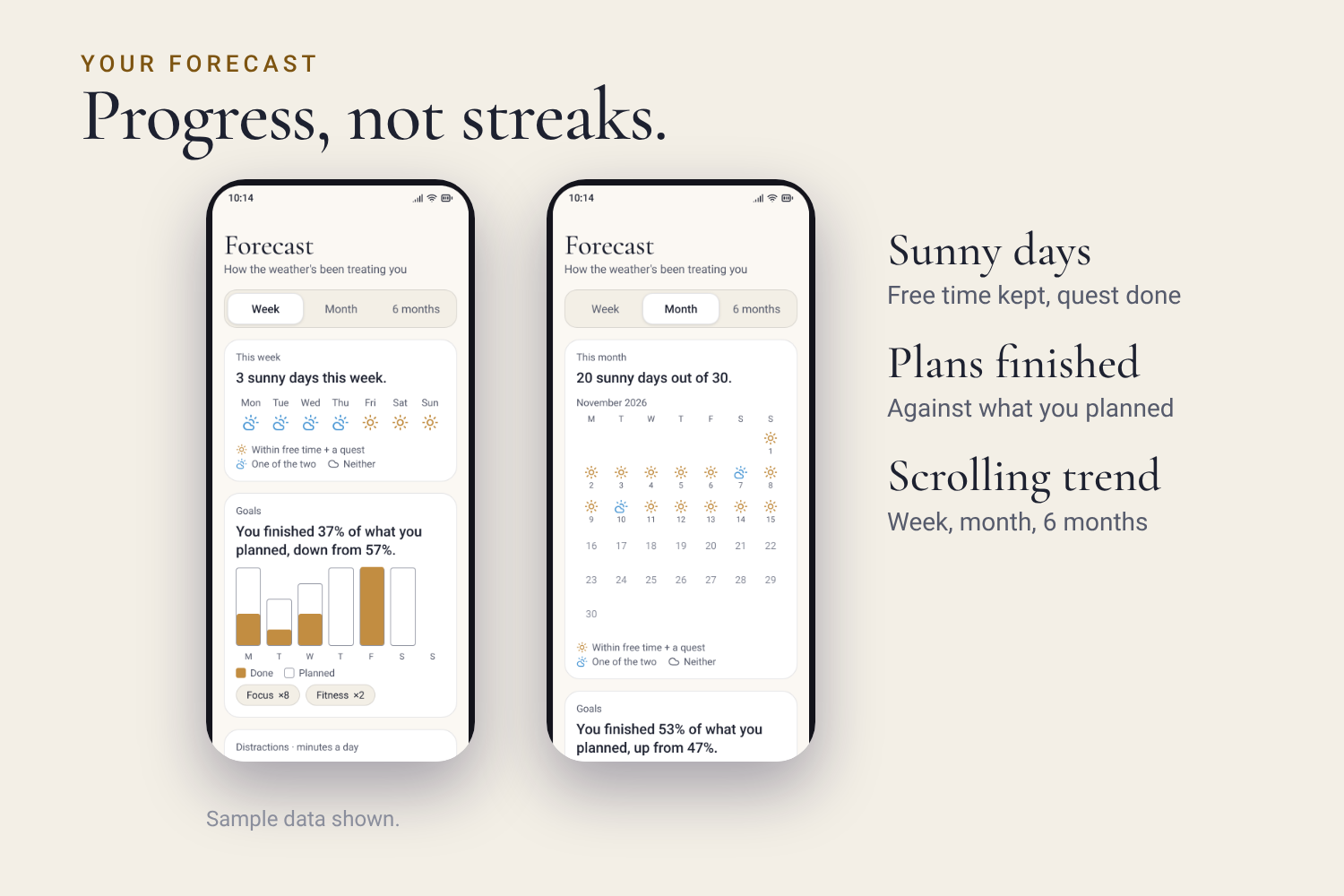
Your Forecast shows sunny days, plans finished and your scrolling trend. Progress, not streaks.
-
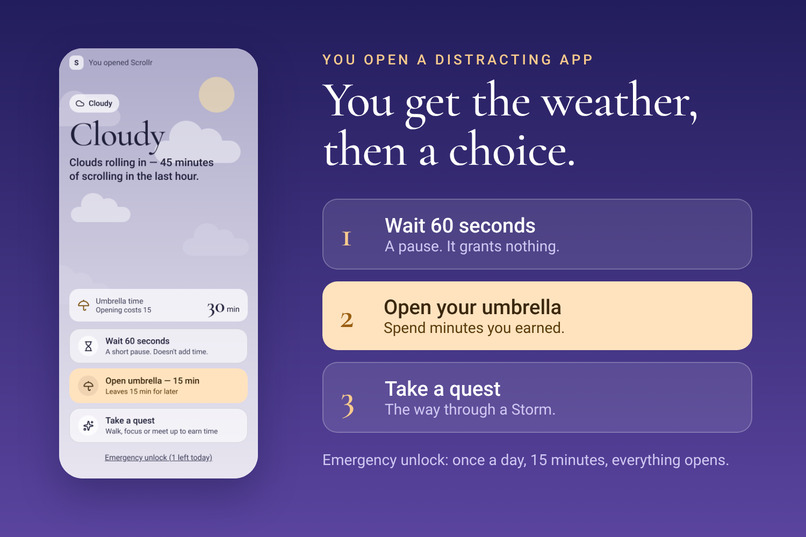
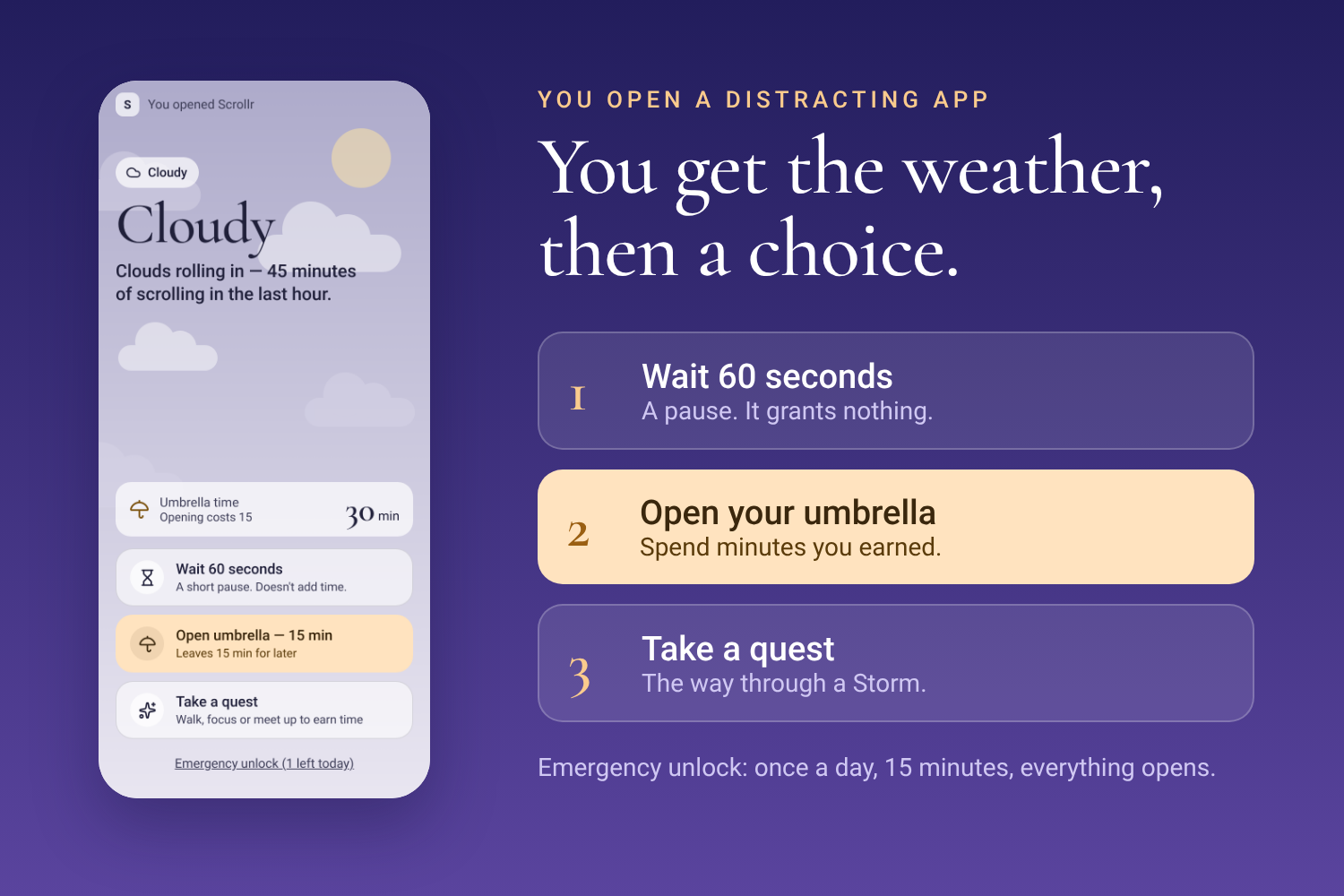
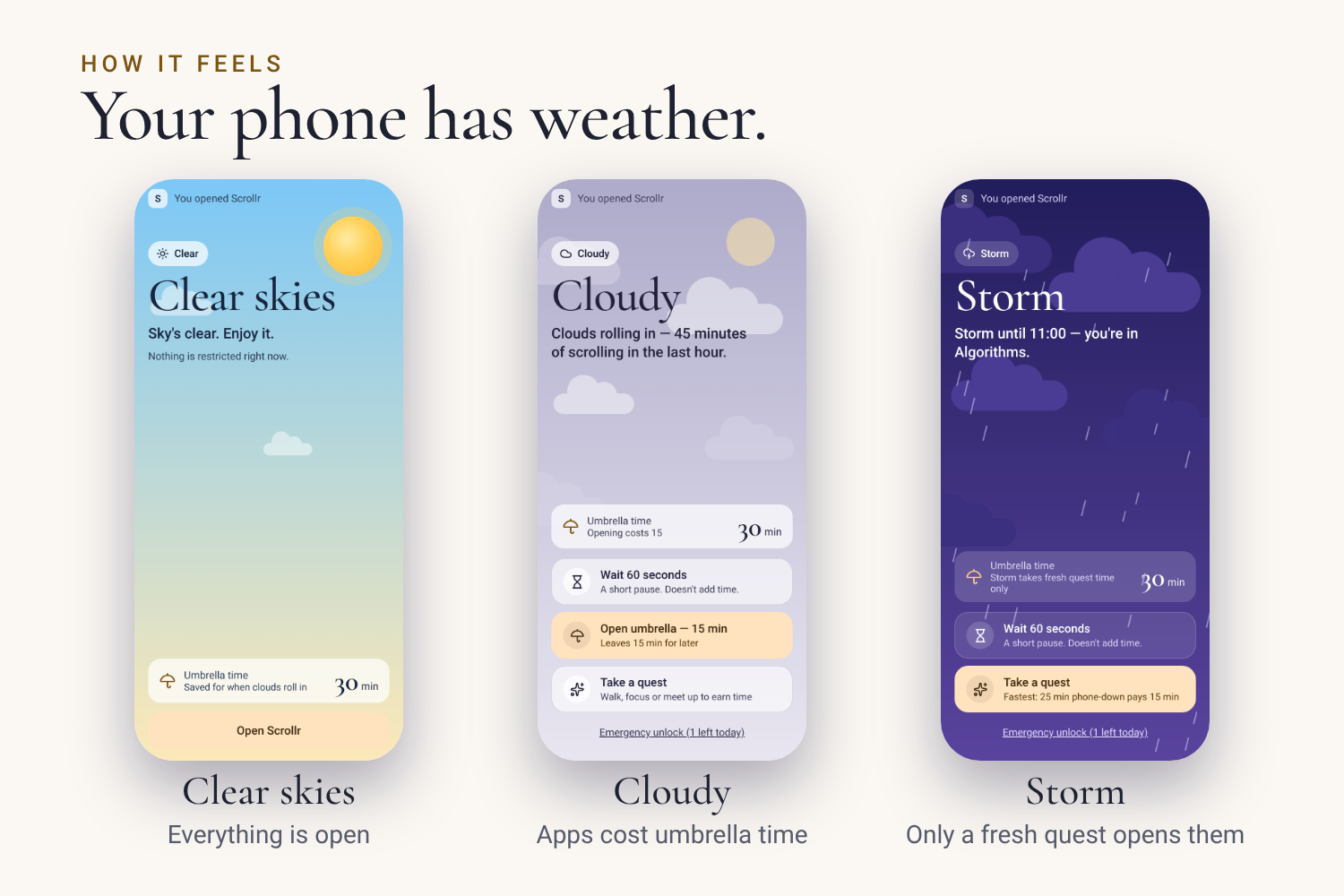
Open a distracting app and get the weather, then a choice: wait, open your umbrella, or take a quest.
-
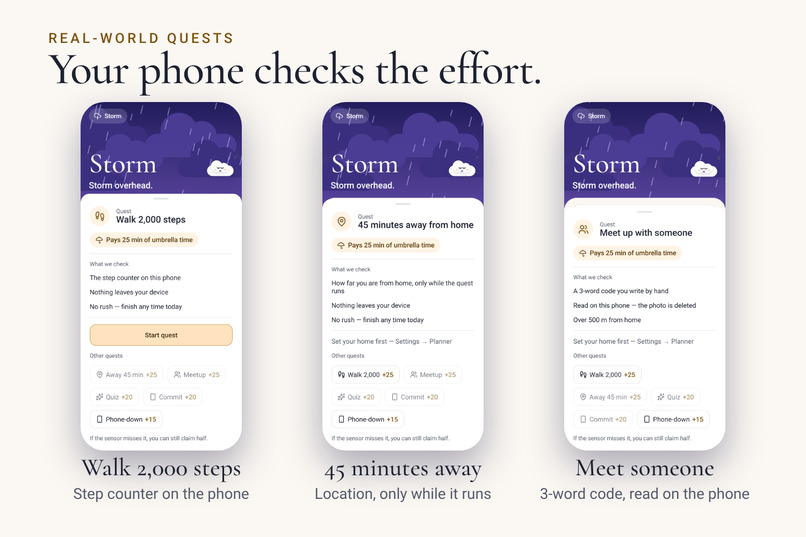
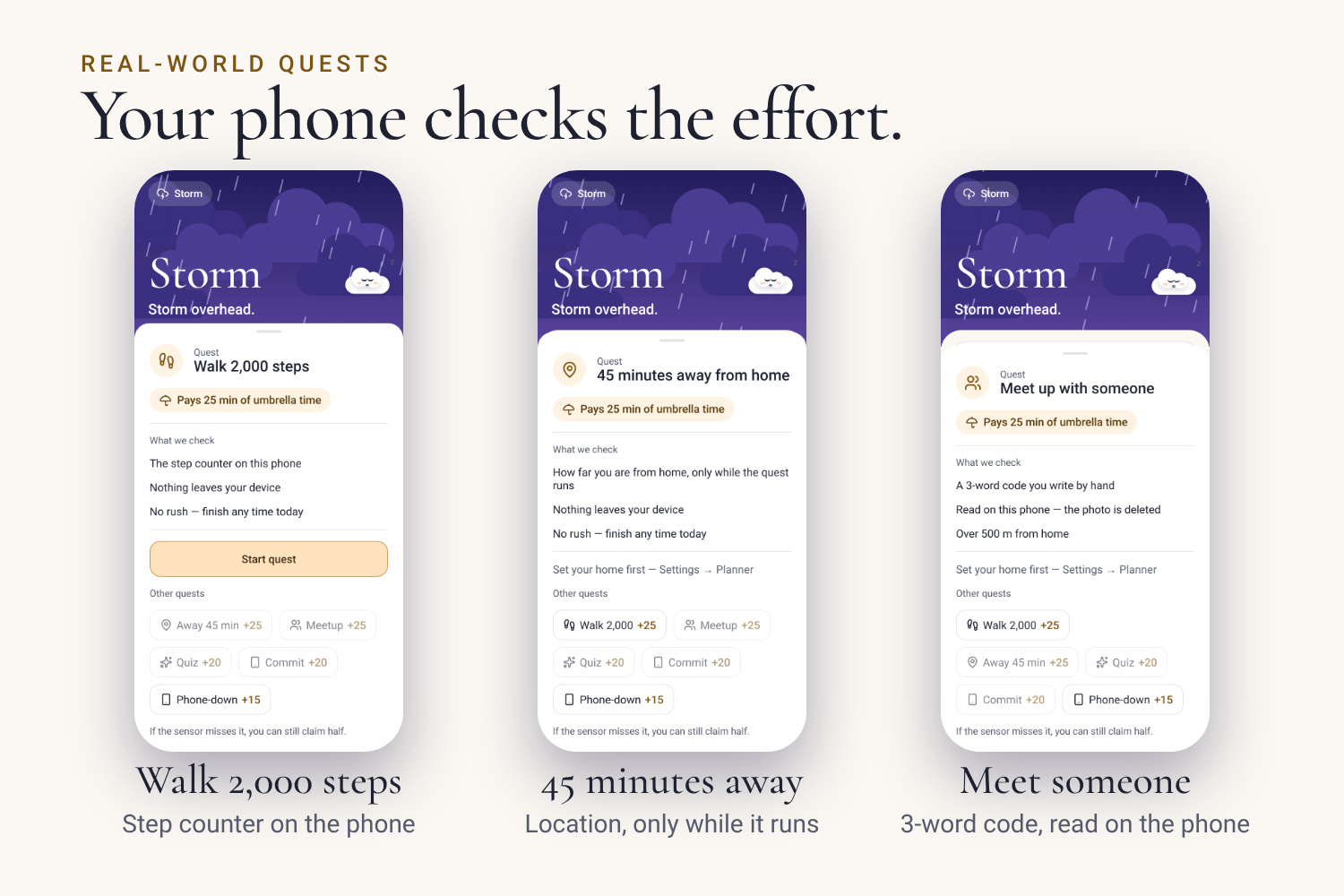
Quests are checked on the phone: steps counted, time away measured, a handwritten 3-word code read on the device.
-
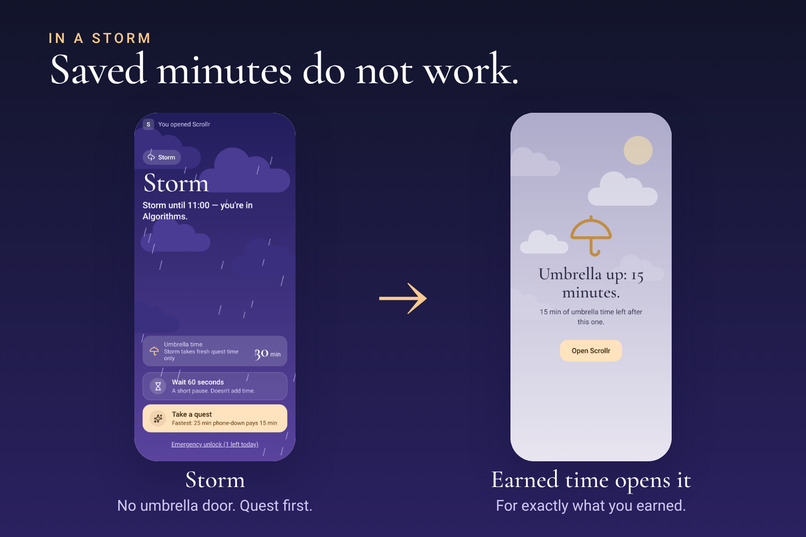
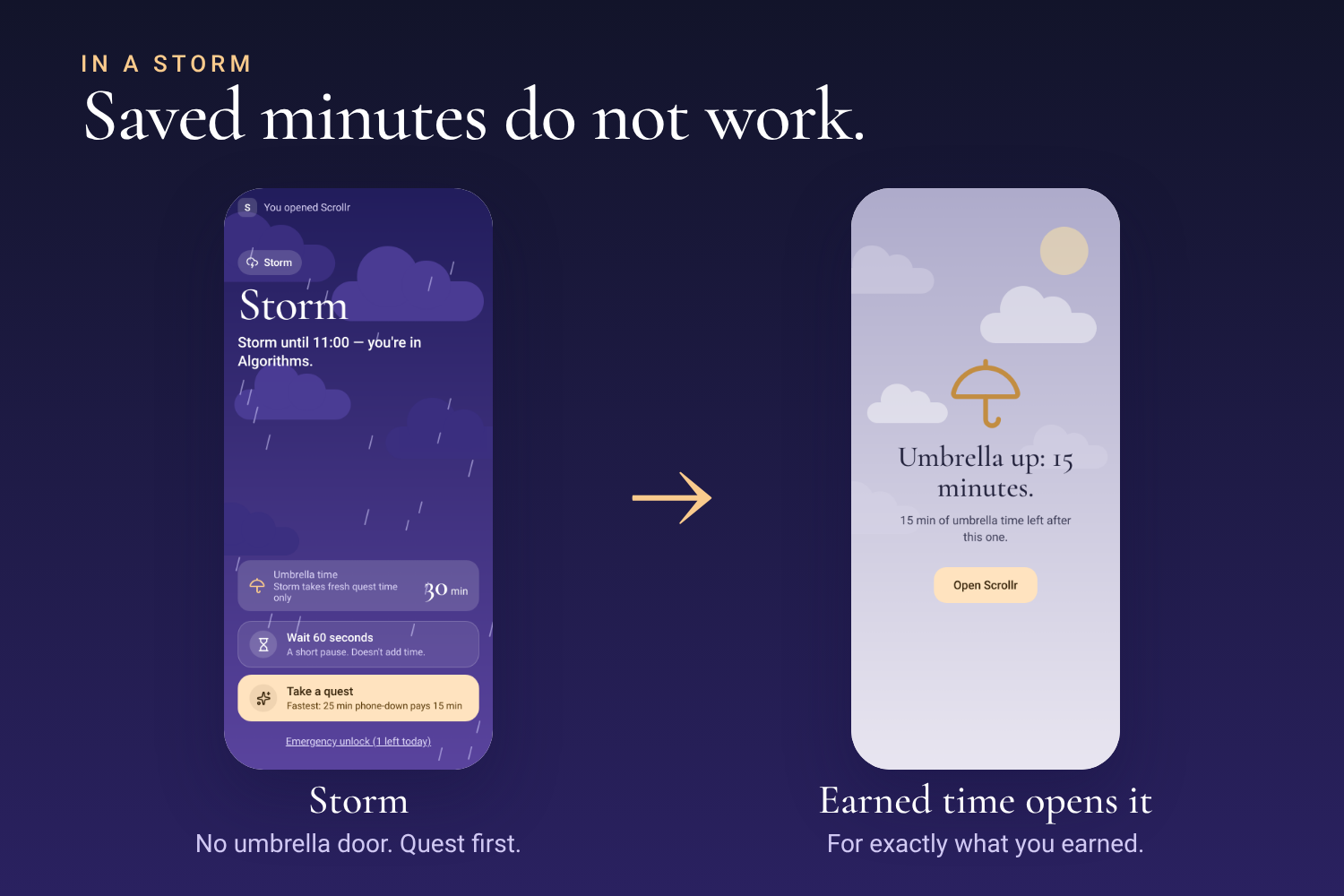
In a Storm, saved minutes do not work. Earned time opens the app for exactly what it earned.
-
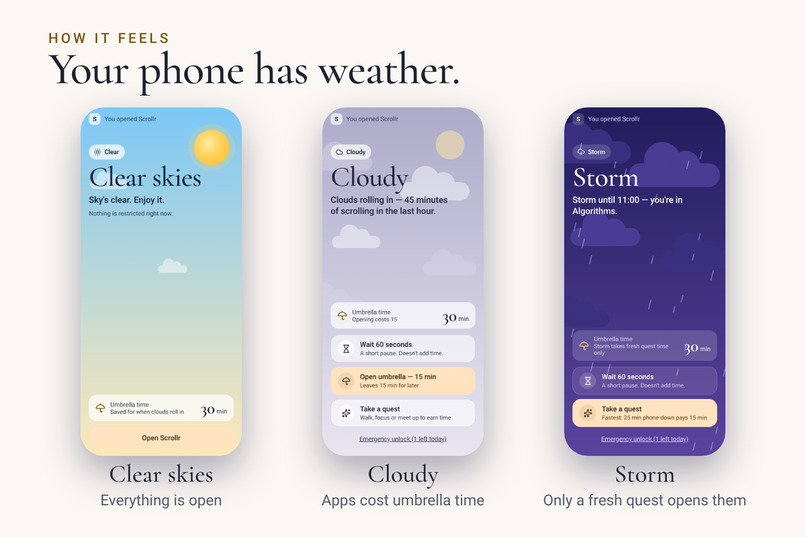
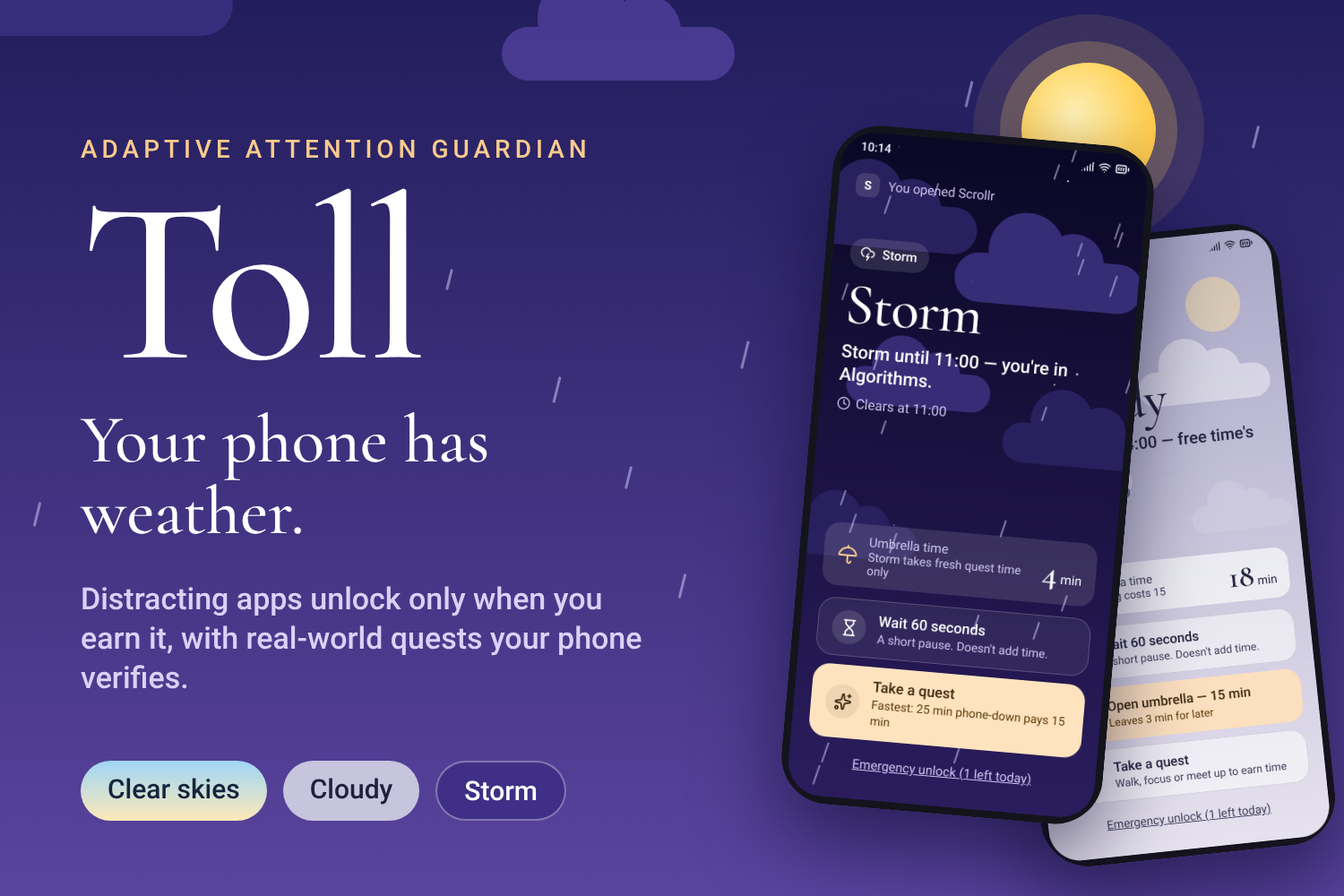
Clear skies, Cloudy or Storm sets how strict your phone is, based on your day.
-
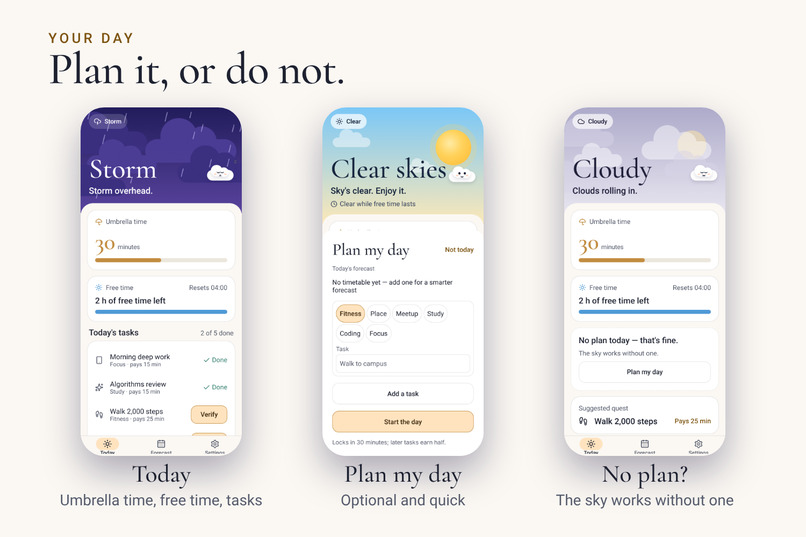
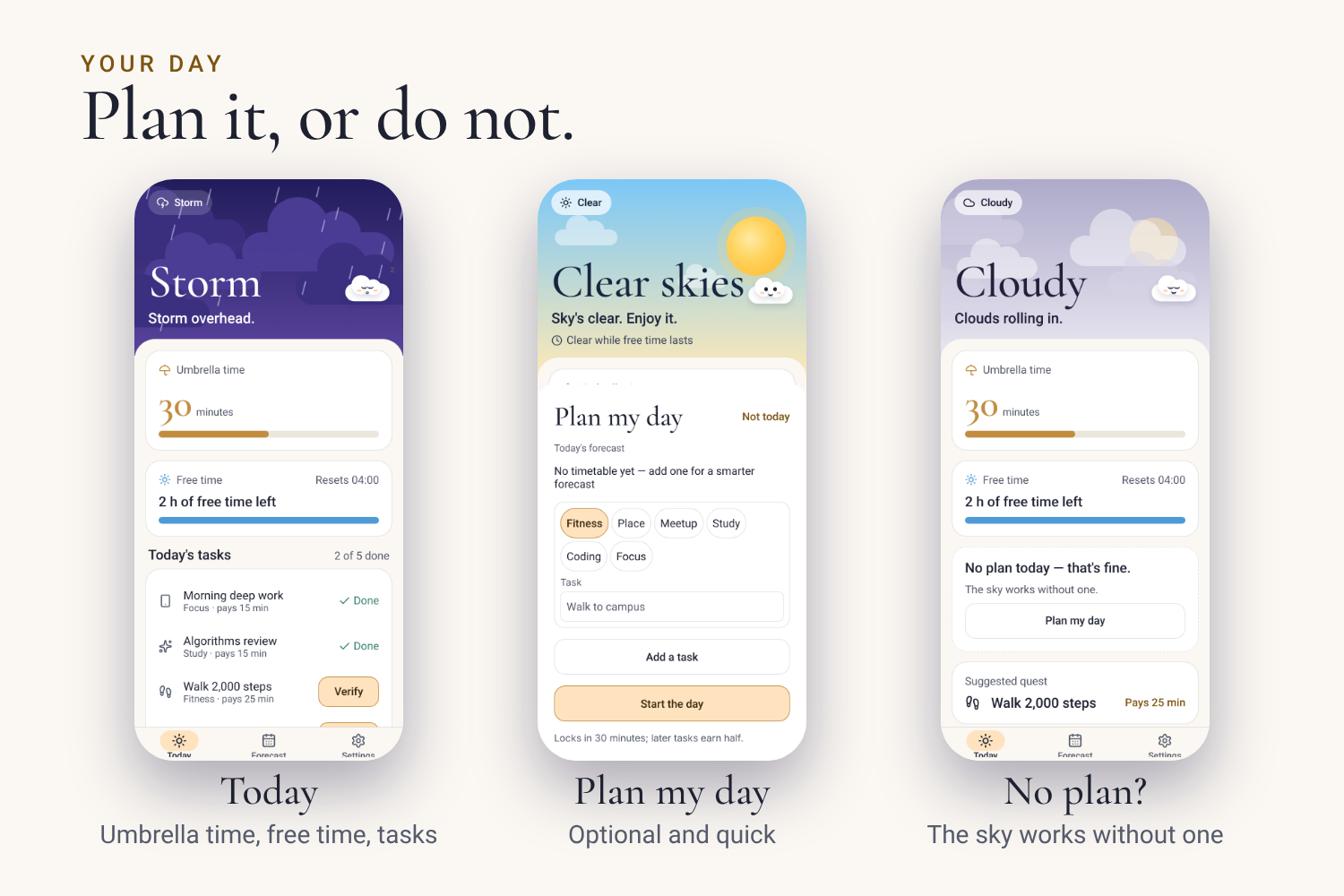
Today shows umbrella time, free time and tasks. Planning is optional, and the sky works without it.
-
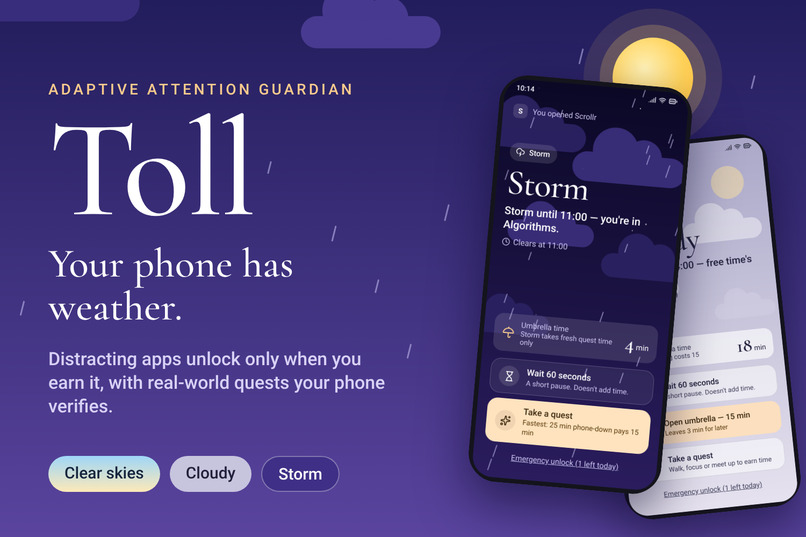
Toll: your phone has weather. Distracting apps unlock only when you earn it.
Inspiration
All of us have sat down to do real work and looked up an hour later from a feed. We tried everything: switching the phone off, deleting apps, focus modes, and blocker and tracking apps. They all failed in the same three ways:
- Weak. One tap lifts the barrier, right when you are weakest.
- Narrow. Tracking only counted a few kinds of activity.
- Rigid. Fixed timers that ignore the day you are actually having.
We wanted a guardian that is strict when it matters and invisible when it doesn't, where getting your apps back means doing something real. So we gave the phone weather.
What it does
Toll sets your phone's weather from your day. You never set it yourself.
- Clear skies: everything is open, with 2 hours of free time a day.
- Cloudy: distracting apps cost umbrella time, minutes of app access you earned.
- Storm: saved minutes do not work. Only a quest you finish right now opens the app, for exactly what it earned.
The weather comes from a Focus Pressure score from 0 to 100:
$$\text{pressure} = \text{base} + \text{deficit} + \text{scrolling} + \text{repeat opens} - \text{recent quest}$$
Plain text: pressure = base + deficit + scrolling + repeat opens - recent quest.
- Base comes from your own schedule: class or meeting 65, sleep 70, deep work 50, the hour before bed 40, nothing scheduled 0.
- After your 2 free hours are used, behaviour counts:
- falling behind your plan: up to +25;
- heavy scrolling: +15 for 20 to 40 minutes in the last hour, +25 past 40 minutes;
- opening the same blocked app 3 or more times in 15 minutes: +10.
- A quest finished in the last hour takes 15 off.
- Thresholds: Cloudy at 35, Storm at 65. You can change both in Settings.
- No flickering: the weather only eases off 5 points lower, a change has to hold for two readings, and every tightening starts with a 90-second "clouds gathering" warning. Nothing new is restricted until the warning ends.
- Storms only happen inside blocks you declared. Outside them the score tops out at 60. With no plan at all, the strictest it gets outside sleep is Cloudy.
The deficit is how far behind your plan you are:
$$\text{deficit points} = \operatorname{round}\Big(25 \times \max\big(0,\ \text{share of the day gone} - \text{share of tasks done}\big)\Big)$$
For example, at 3 p.m. half of your waking day is gone and you have finished 2 of 5 tasks (40%). The gap is 10%, so the deficit adds 3 points.
Quests are verified on the phone:
- Walk 2,000 steps (+25 min). Counted by the step counter. An implausible pace pays less instead of passing in full.
- Spend 45 minutes away from home (+25 min). Checked by location, and fake GPS is rejected.
- Meet someone (+25 min). Photograph a 3-word code they write by hand. The text is read on the phone, and the photo is deleted straight after.
- Study quiz (+20 min). For each study topic in your plan, AI (Claude on AWS Bedrock) writes 9 questions, which are saved for offline use. You get 3, with 90 seconds; 2 right passes.
- Code (+20 min). Push a commit to GitHub. Toll checks your public commit count every 5 minutes.
The economy:
- In a Storm, a passed quest opens the app straight away for the minutes it earned.
- Quests can pay up to 150 minutes a day.
- Repeating the same kind of quest pays less each time: 100%, 60%, 30%, then nothing.
- Umbrella time costs double between 23:00 and 04:00.
- Everything resets at 04:00 local time.
It cannot trap you:
- If Toll's engine goes quiet for 3 minutes or a permission is revoked, it fails open and blocks nothing.
- Calls, SMS, maps, banking, health, the camera and two messaging apps you choose are always open.
- One 15-minute emergency unlock a day opens everything.
- Dropping an app from your list takes 12 hours, so a weak moment cannot undo a good decision.
- Location, photos and history stay on your phone. Two things leave it:
- To the cloud ledger: each umbrella-time change, as an anonymous wallet ID, the minutes and a timestamp. No account and no app names.
- To the quiz service: your study topics, to write questions. Nothing is stored there.
A Forecast tab shows your sunny days, how much of your plan you finished, distractions and umbrella time. It covers a week, a month and 6 months, with no streaks or badges.
How we built it
The app:
- React Native on Expo (SDK 58), in TypeScript, with Expo Router.
- On Android,
expo-app-blockerreads usage stats and draws the overlay that brings Toll to the front. - Quests use the step counter, location and the camera, with ML Kit text recognition running on the device.
- Local storage is MMKV.
The cloud, both on AWS with API Gateway, Lambda and DynamoDB, deployed with SAM:
- A small ledger that backs up umbrella-time changes. It accepts each change only once, keeps changes made offline until the phone reconnects, and lets a second device link with a 6-digit code.
- A quiz service that calls Claude on Amazon Bedrock.
How we worked:
- One shared contract: a single contract for every interface between the device layer, the day-and-quests layer and the scoring engine, plus a fake for each, so nobody waited on anyone. Integration was flipping one switch per module.
- Pure, tested rules: every decision (scoring, the umbrella-time economy, the blocking plan, fail-open, notifications, quest verification) is a pure function. Over 750 automated tests cover them, so we could prove the rules without a phone.
- Our own design system: an animated sky, a small cloud mascot, light and dark themes, and reduced motion respected.
Challenges we ran into
- The blocker has no "which app is in front" signal. We measure time in distracting apps through the blocker's unlock budget instead.
- Making a strict app safe. Fail-open, always-open essentials and Storms only inside declared blocks all had to be designed in from day one.
- Keeping the weather steady. A 5-point gap before easing off, a two-reading hold and a 90-second warning stop it flickering. On the phone we found the blocker acting before the 90 seconds were up and fixed it, so the warning really is a warning.
- Time zones. Our first build reset the day at 04:00 UTC instead of local time. Tests run across time zones caught it.
- Android task quirks. Each blocked-app intercept was starting a second copy of the app. We fixed it with a small native module.
- Keeping three builders in sync without merge conflicts in shared code.
What we learned
- When the barrier appears matters more than how hard it is, so adaptive beats strict.
- Safety rules are features: people only keep an app they trust.
- Contract-first with fakes lets a team move fast without waiting on each other.
What's next for Toll
- A screen-off signal on Android for the 25-minute phone-down quest. Today that quest can't verify on a phone.
- Background location, so the away-from-home quest keeps counting while Toll isn't open.
- A browser extension, so your umbrella time follows you to your laptop. The cloud ledger and the 6-digit linking are already built for it.
- Quizzes from your own notes, not just topics.
- More Android testing, then iOS.
Built With
- amazon-bedrock
- amazon-dynamodb
- android
- aws-lambda
- claude
- expo-app-blocker
- expo-camera
- expo-location
- expo-router
- expo-sensors
- expo.io
- google-ml-kit
- react-native
- typescript


