Track: Developer Tools
Why I built it
Coding agents have become a core part of how I build software, yet the experience still feels fragmented. I constantly switch between terminals, dashboards, GitHub, X, Reddit, documentation and other Apps just to understand what is happening around my development workflow (or discover new ones). Resumes are not as useful unless I have done a finished project end to end. But why should it stop there? Your personal builder identity is more important than any resume in the age of coding agents.
Questions like How much of my Codex quota have I used?, Who is building interesting tools today? Can I contribute?, What new open source projects and workflows/skills/plugins worth exploring? or How do I quickly launch my coding environment? all require leaving the place where I am actually working.
I wanted to build the developer companion I wished already existed: something that lives quietly in the background, keeps me aware of my AI development workflow and gradually grows into a home for builders.
What it does
TokenBar starts as a lightweight macOS menu bar application that visualises local OpenAI Codex usage.
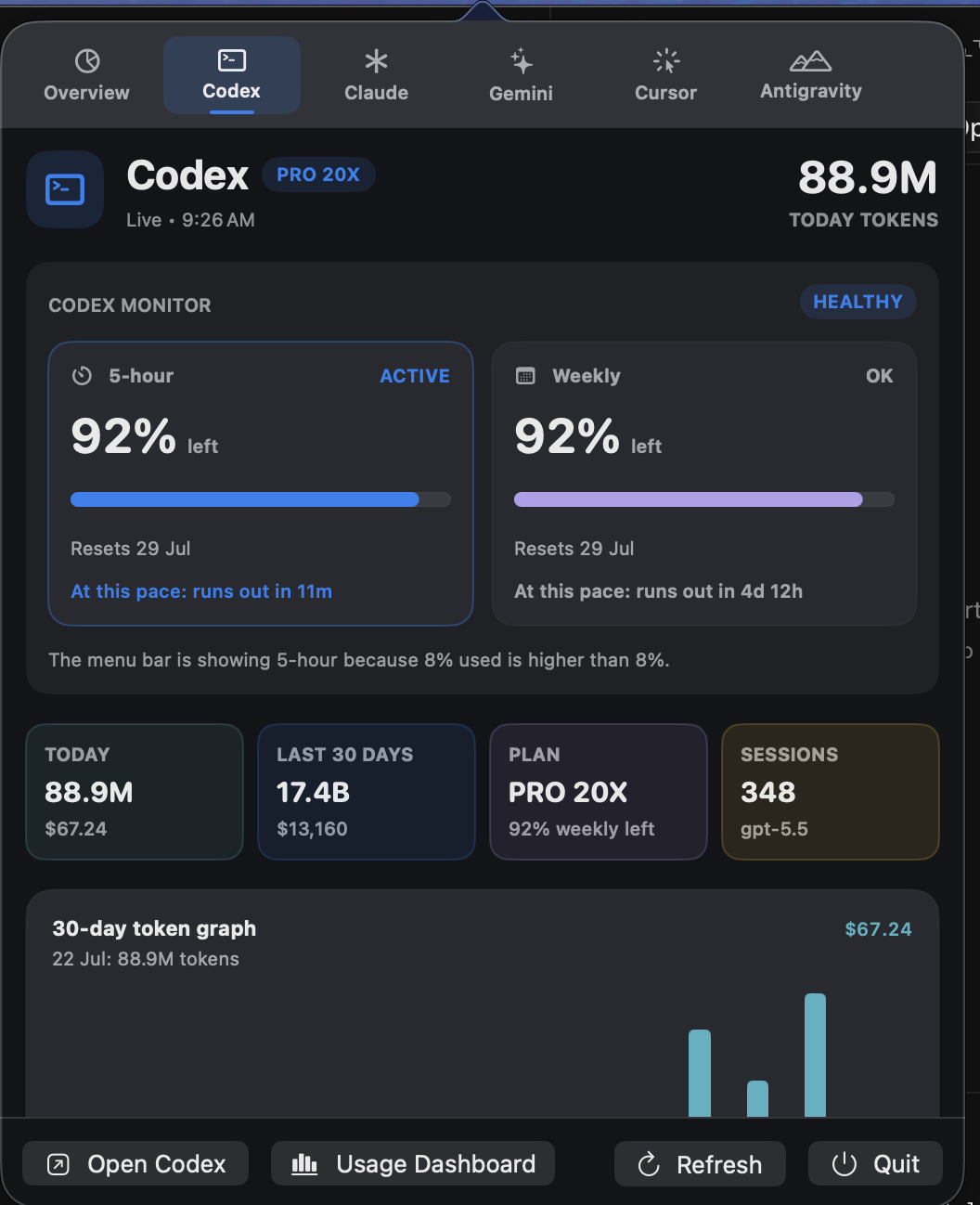
It reads local Codex session logs and presents token history, five-hour and weekly quota pressure, reset timing, estimated spend, projected usage pace and work patterns through compact visualisations designed for glanceable information.
The application also exposes a terminal interface. After installing with pip install tokenbar, developers can simply run tokenbar to launch the application or access a growing command surface for usage statistics, diagnostics, cost estimation and developer utilities.
Beyond monitoring, TokenBar introduces the beginning of a builder ecosystem.
The roadmap includes builder identities, a community "For You" feed highlighting interesting open-source projects and experiments, curated developer resources discovered by other builders, provider integrations beyond Codex and a richer CLI experience. Instead of searching X, GitHub and Discord separately, developers should eventually be able to discover what the community is creating directly from within their AI development environment.
Everything is designed to remain local-first wherever possible. TokenBar never reads browser cookies, passwords, authentication tokens or account secrets. Official billing information remains the source of truth for provider charges.
How I used Codex and GPT-5.6
Codex was used throughout the engineering process to build a complete macOS application rather than isolated code snippets. It helped implement local session parsing, SwiftUI menu bar architecture, forecasting algorithms, installation tooling, packaging, diagnostics, CLI integration and privacy-safe data processing.
GPT-5.6 acted as a product design partner. It helped refine the information hierarchy, simplify visualisations and continuously challenge which metrics actually help developers make decisions. Rather than overwhelming users with dozens of numbers, the interface focuses on the signals that answer practical questions like whether to continue working, slow down or wait for the next quota reset.
What judges can try
Install TokenBar with pip install tokenbar, launch it using the tokenbar command and explore the different menu bar views using your own local Codex session history.
The application runs locally without requiring a separate backend and demonstrates usage analytics, forecasting, diagnostics and the integrated command-line experience.
Current status
TokenBar is an early public macOS (Apple Silicon) release focused on OpenAI Codex.
The long-term vision is significantly broader: a developer companion that combines AI usage intelligence, builder identities, community discovery, provider integrations, resource recommendations and a unified command-line experience into one place for people building with AI.
Today it solves the immediate problem of understanding AI development usage. Tomorrow it aims to become the operating layer around AI-powered software development. Share Builder Identities, have a social media of workflows without leaving and hire people based on their interests and usage level.
Why this stands out
Unlike traditional dashboards that simply report usage after the fact, TokenBar lives where developers already work. It combines local-first privacy, real-time AI workflow awareness, a native macOS experience and a vision for connecting builders around the tools, projects and knowledge emerging from the coding-agent ecosystem.
It is not just a quota tracker. It is the beginning of a developer operating system for the AI era.

Log in or sign up for Devpost to join the conversation.