-
-
Together — AI Journey Partner | OpenAI Proposes, Qloo Verifies
Inspiration
Choosing what to experience next together often flattens two people into a taste score or an endless recommendation list. Together preserves the nuance in each person’s reaction while making uncertainty explicit.
What it does
Together starts with something two people already experienced together—a film, book, meal, concert, place, show, or podcast. Each person describes what stayed with them in free-form language.
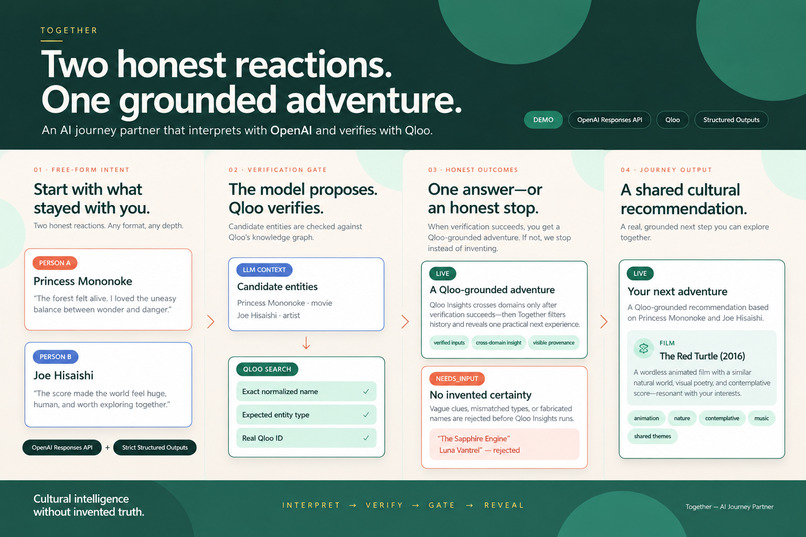
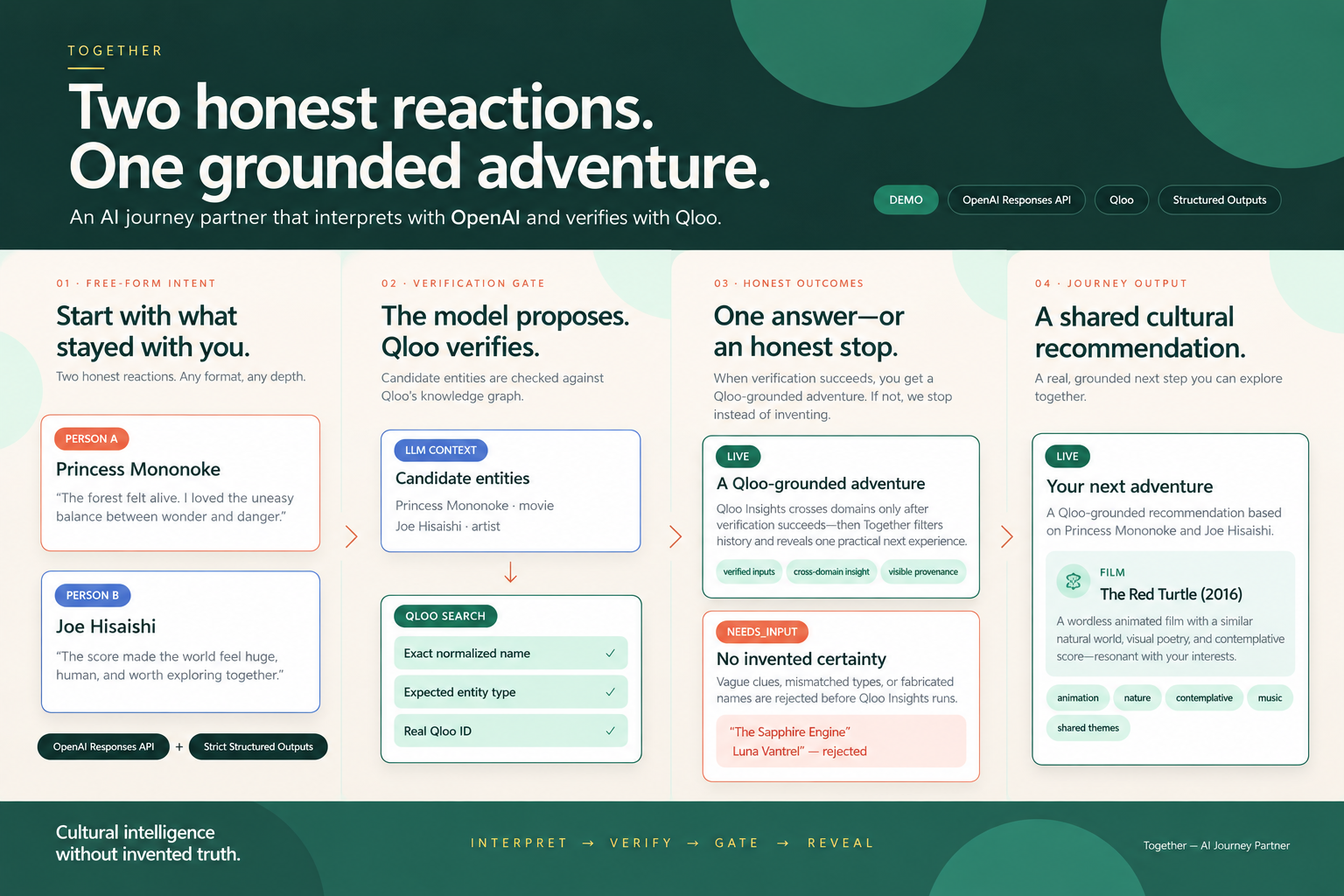
The OpenAI Responses API converts those reflections into strict Structured Outputs. Proposed cultural entities are never treated as facts: Together searches Qloo for every candidate and accepts only an exact normalized name match with the expected entity type and a real Qloo ID. Low-confidence, mismatched, unresolved, and duplicate entities are rejected.
After both people contribute verified signals, Qloo Insights crosses domains to find real places, books, or destinations. Together filters prior Journey history, applies a practicality preference, and reveals exactly one adventure. The explanation view separates what the LLM extracted, what Qloo verified, what Qloo inferred, and what Together selected.
How it is agentic
- Interpret two free-form reflections with strict Structured Outputs.
- Verify every proposed entity through Qloo Search exact matching.
- Stop with
NEEDS_INPUTwhen there is not enough verified evidence. - Query Qloo Insights only after the confidence gate passes.
- Filter previous experiences and choose one practical new candidate.
- Explain provenance and save the reaction for the next decision.
The model supplies context, not cultural facts. Qloo supplies the grounded cross-domain intelligence.
Why Qloo matters
Together cannot produce a LIVE adventure without Qloo. Qloo verifies that candidate films, artists, books, food, and places exist and match the expected type. Its Insights API supplies every cross-domain candidate considered by the selector. A fabricated or weak entity is excluded before Insights runs.
Honest result states
LIVE: OpenAI extraction and Qloo grounding succeeded.DEMO: credentials are unavailable, so only prepared sample content is shown.NEEDS_INPUT: there is not enough verified evidence to continue.
The UI never presents prepared or unresolved content as a live result.
How we built it
Together uses TypeScript, React, a Next.js-compatible Vinext stack, Cloudflare Workers and D1, the OpenAI Responses API with strict Structured Outputs, Qloo Search and Insights, Zod validation, and GitHub Actions.
Challenges
The hardest part was grounding flexible human language to real typed entities without letting a persuasive model response become product truth. We added exact-match resolution, expected-type checks, confidence gates, duplicate removal, explicit tool boundaries, and visible provenance.
What we learned
LLMs are excellent at interpreting context, but they should not be the source of cultural truth. Separating interpretation from verification creates a more reliable agentic workflow and a clearer user experience.
Privacy and responsible design
Conversation text is sent server-side to the configured LLM provider for extraction. Only verified Qloo entity IDs are sent to Qloo Insights. API keys remain server-side. Saved reactions and optional reflections are scoped to a random HttpOnly Journey cookie. The MVP has no public profile, stranger matching, taste score, social feed, or leaderboard.
Try it
Use Princess Mononoke with Joe Hisaishi, or Norwegian Wood with Blue Bottle Coffee, and confirm the result is LIVE. Vague clues or fabricated entities such as The Sapphire Engines and Luna Vantrel produce NEEDS_INPUT instead of invented recommendations.
License
MIT
Built With
- cloudflare-d1
- cloudflare-workers
- github-actions
- openai-responses-api
- qloo-api
- react
- typescript
- vinext
- zod

