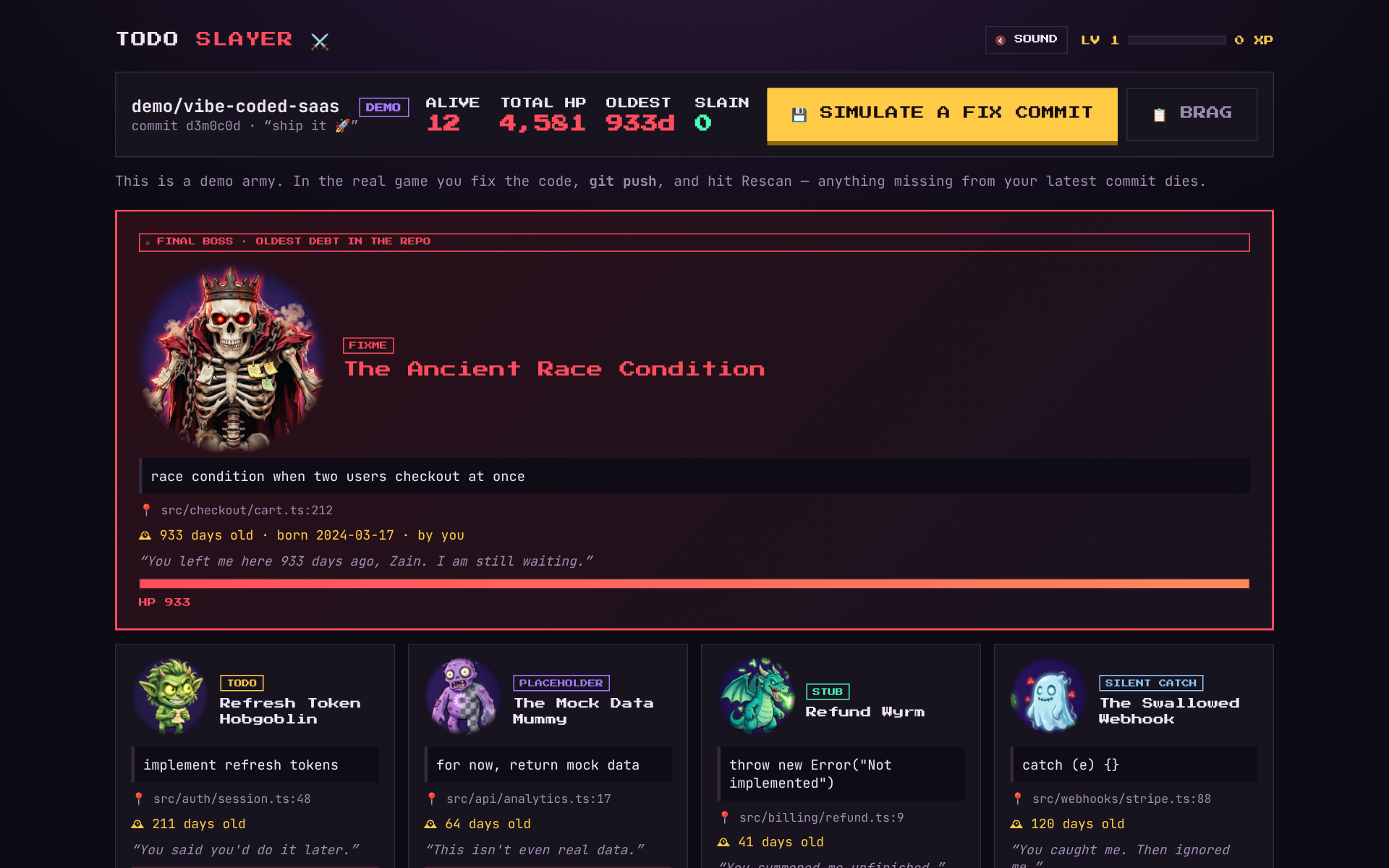
⚔️ TODO Slayer
Your AI left IOUs in your code. Now they're monsters.
Paste a public GitHub repo. Every unfinished thing in it spawns a monster. Fix the real code, push, and hit Rescan: anything that's gone from your latest commit dies. Git is the referee, not an AI.
Built solo for Hackyard Yard #4: Gamification (Oct 5–9, 2026). All code was written during build week.
The bestiary
| Monster | What it is | Example |
|---|---|---|
| 👺 TODO Goblin | TODO in a comment |
// TODO: implement refresh tokens |
| 👹 FIXME Troll | FIXME in a comment |
# FIXME handle null user |
| 💀 Hack Beast | HACK / XXX in a comment |
/* HACK: add 5 hours for UTC */ |
| 🧟 Placeholder Zombie | Placeholder language common in AI-assisted code | // In a real application you would validate this |
| 🐉 Stub Dragon | Code that claims to exist but doesn't | raise NotImplementedError, throw new Error("Not implemented") |
| 👻 Silent Exception | Errors swallowed whole | catch (e) {}, except: pass |
The oldest monster in the repo (by git blame) becomes the Final Boss. Its HP equals its age in days.
Sound & art
- Hit 🔊 SOUND in the header. Monsters growl when they spawn. Click any monster to hear its taunt, using the browser's own speech engine pitched way down. Kills get synthesized hit and explosion effects, and leveling up plays a fanfare. All audio is generated in the browser: no audio files and no voice API.
- Monster art was generated with ZenCreator (Qwen Image) for this build and lives in
img/.
How it works
- Scan. The scanner pins to your branch's latest commit SHA, reads source files from GitHub, and runs deterministic detectors (
api/_detect.js). A small string-aware parser finds real comments using each language's syntax. As a result,todoList,"https://x.com/TODO"and a CSS#TODOselector never spawn monsters. Vendored and build folders are skipped.- Deliberate patterns aren't treated as debt. That covers abstract/interface methods that raise
NotImplementedError, narrowexcept FileNotFoundError: passidioms, and swallowed errors that carry an explanatory comment. - These rules were tuned against real code (npm's source and Python's standard library) to keep false positives low.
- Deliberate patterns aren't treated as debt. That covers abstract/interface methods that raise
- Identify. Each monster's ID is
file + type + text, not the line number, so editing code above a TODO doesn't "kill" it. - Verify. A rescan compares the new commit with the last one. Missing IDs die (HP becomes XP). New ones spawn as reinforcements.
- Flavor (optional). With
OPENAI_API_KEYset, an LLM writes each monster's name and taunt. It never decides type, difficulty or death.
The detectors find common patterns. They don't claim to know whether code was AI-generated.
Run / deploy
No build step. It's a static index.html plus one serverless function.
npm i -g vercel
vercel dev        # local
vercel --prod     # deploy
Environment variables (see .env.example):
GITHUB_TOKEN: recommended. It raises GitHub's rate limit from 60 to 5,000 requests per hour and enables monster ages (git blame). Public read access is enough.OPENAI_API_KEY: optional, for AI monster names and taunts.
Tests: npm test
License
MIT

Log in or sign up for Devpost to join the conversation.