-
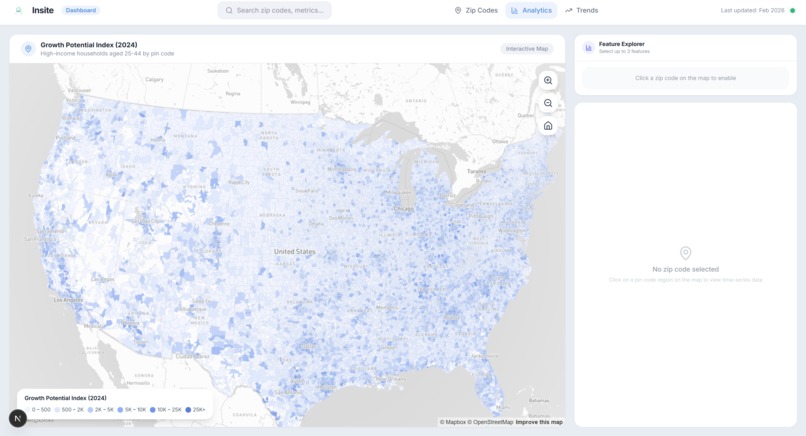
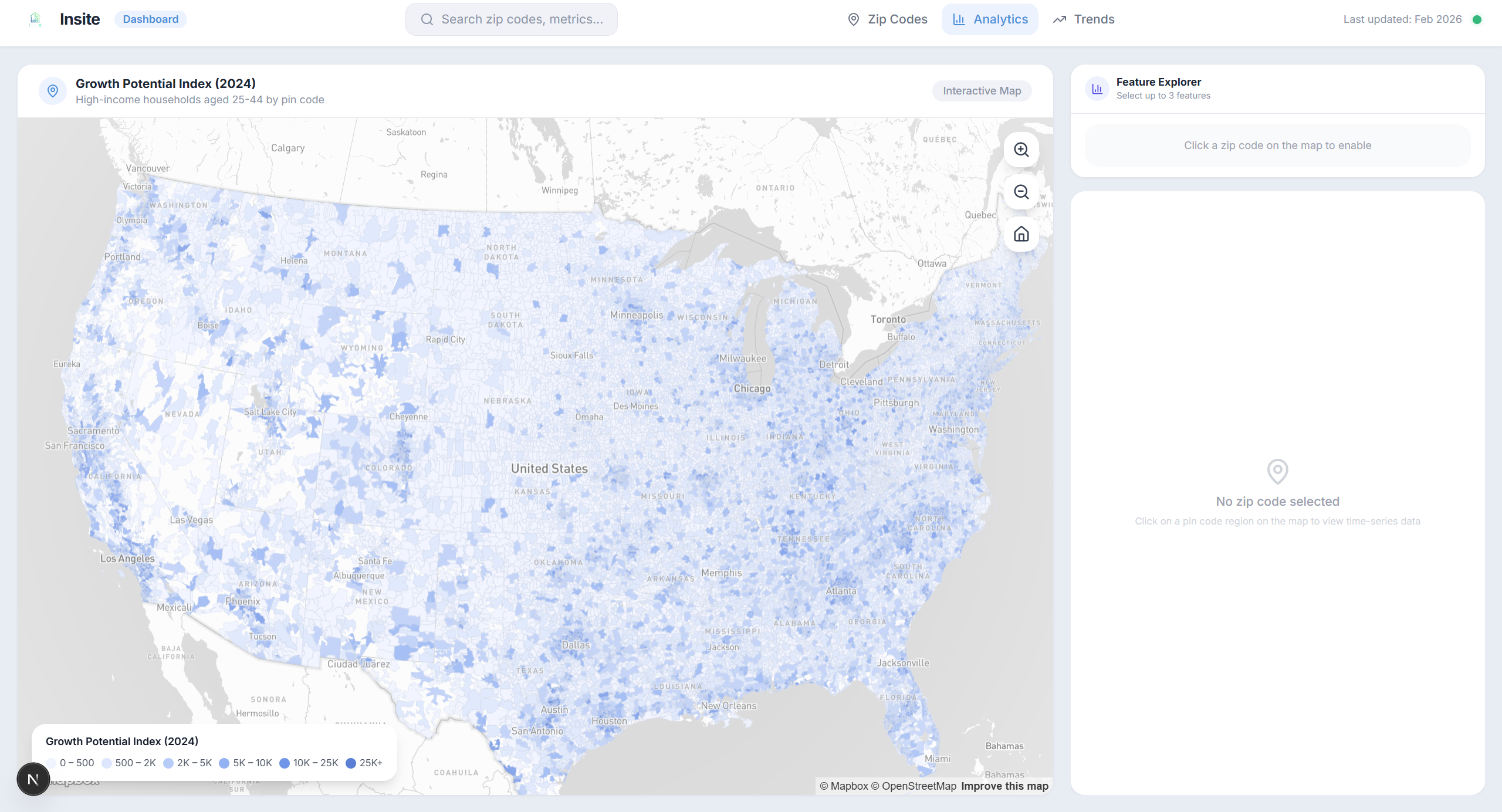
Insite UI: An interactive heatmap showing the Growth Potential Index (i..e, a profitability prediction) for every Zip Code
-
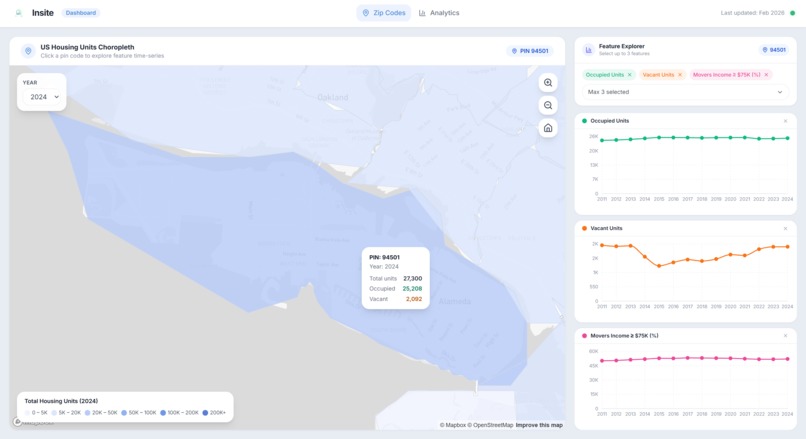
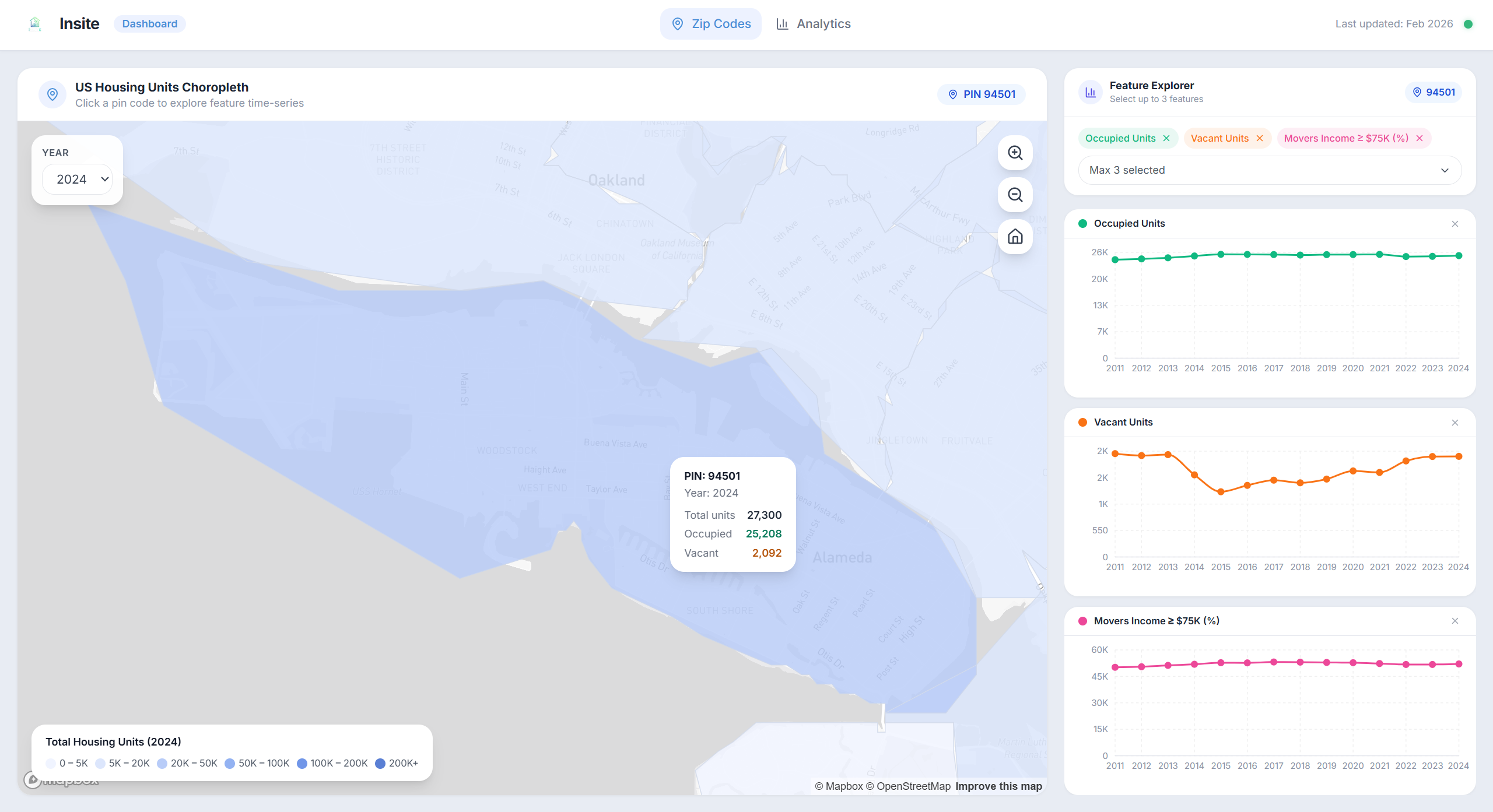
Insite UI: Current Statistics: Zooming into a Zip Code shows that area's numerical stats over the map and visuals on the right.
-
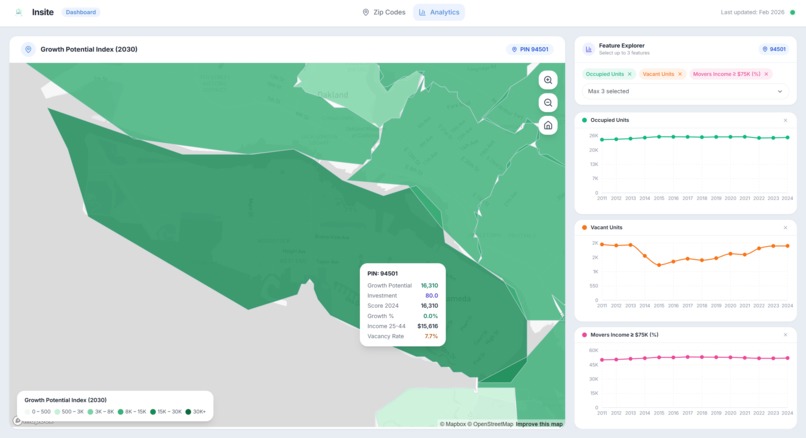
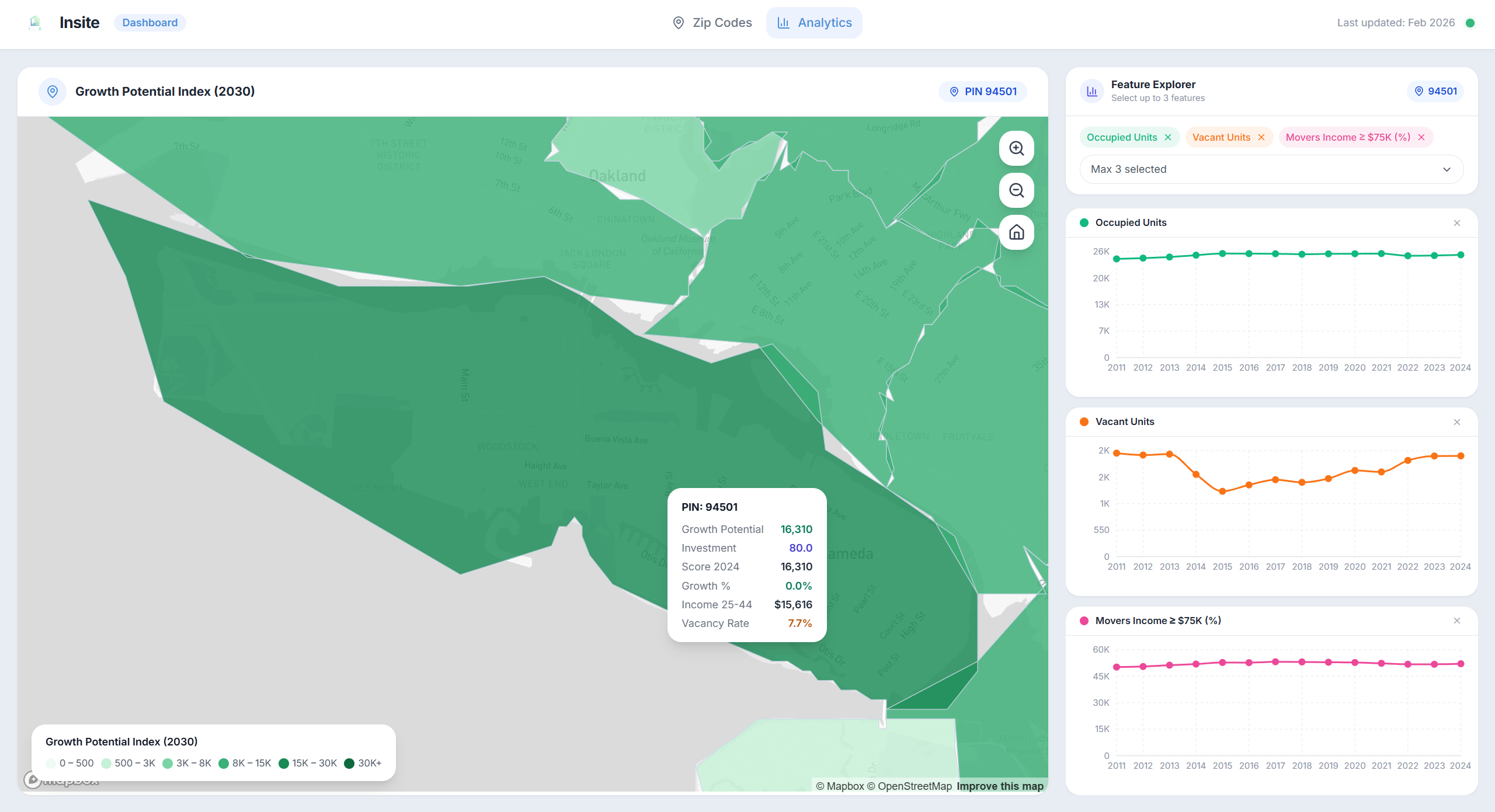
Insite UI: Prediction for 2030: Zooming into a Zip Code shows that area's numerical stats over the map and visuals on the right.
Demo Video
Please follow this Google Drive link.
Inspiration
Traditional housing development often relies on historical data and intuition. We wanted to build a tool that uses the power of data science to predict the next decade of growth, helping developers find the most profitable zip codes in the USA before the rest of the market catches up.
What it does
Insite is a predictive site selection engine. It analyzes demographic (ages 25-45) and income trends (> $100K) to identify high-yield locations for new single-family residential projects to generate a Profitability Score for every zip code. This allows users to visualize future demand and make data-backed decisions on where to invest for the highest returns through the year 2030.
How we built it
The core of Insite is a multi-stage data pipeline that ingests and synchronizes a variety datasets. We built an automated ingestion engine to pull median household income, population density, and employment metrics from the US Census Bureau. To add depth, we integrated vacancy rates, migration patterns, and location centrality factors such as average commute times. We then layered in historical housing price time-series data from Zillow to feed our prediction module, which identifies growth trends through 2030.
For visualization, we developed a high-performance geospatial dashboard. This interface renders a dynamic heatmap that ranks zip code profitability in real time. We focused on a seamless user experience, allowing developers to zoom across regions or use a targeted search to drill down into specific zip code statistics. The result is a professional-grade tool that converts raw data into an interactive investment roadmap.
Challenges we ran into
- Data Availability Gaps: We audited 25 key real estate ROI parameters (including average age of houses in that area, number of new housing permits issued, school district ratings, proximity to major employment hubs, fitness centers, grocery stores, restaurants, crime rate, insurance costs, interest rates, etc.) but found much of the data, such as school ratings and local amenities, was gated or lacked API access, forcing us to narrow our scope to the most reliable datasets.
- Complex Data Integration: Synchronizing unstructured information from the Census Bureau and Zillow required extensive data cleaning and complex joins across disconnected tables to maintain accuracy across different zip codes.
- Zoning Access Hurdles: We explored the National Zoning Atlas for critical land-use data, but because it lacked an API and web scraping was too time-intensive for a 24-hour sprint, we pivoted to demographic and price trends.
- Technical Pivot: The time required for data synchronization meant we could not train a full machine learning model; instead, we developed a sophisticated mathematical scoring formula to power our prototype.
- Geospatial Visualization: Creating a clean UI while rendering high-resolution zip code boundary polygons was a major hurdle, requiring multiple iterations to successfully implement our responsive, color-coded profitability heatmap.
Accomplishments that we're proud of
We successfully transformed abstract demographic data into an actionable financial metric. Our team built a fully functional map interface that can render tens of thousands of data points with virtually zero lag. We are also proud of our predictive scoring logic, which provides a clear and objective way to compare different regions for investment potential.
What we learned
We gained deep insights into what makes a real estate investment profitable and how demographic migration follows economic hubs. On the technical side, we improved our skills in geospatial data visualization and learned how to optimize complex API queries. We also learned that for real estate firms, clarity and speed of decision-making are just as important as the depth of the underlying data (i.e., "find the most profitable zip codes in the USA before the rest of the market catches up").
What's next for Insite
- Model Sophistication: We plan to replace our current mathematical scoring system with a trained machine learning model to improve predictive accuracy and better account for non-linear market shifts.
- Dataset Expansion: We will integrate the remaining parameters from our original research list, including crime rates and school district quality, to provide a more holistic view of site potential.
- Advanced User Filtering: To increase the platform's versatility, we will add adjustable filters for zoning, specific age ranges, and household income brackets, as well as toggles for single-family versus multi-family development.
- Platform Interoperability: We aim to add an export feature that allows users to download visual data and zip code rankings into Excel or CSV formats for further internal analysis and reporting.
- Zoning Integration: We intend to find a scalable way to pull land-use and zoning data, which is critical for developers to understand buildable density and legal constraints.
Built With
- mapbox
- nextjs
- postcss
- react
- tailwind
- typescript
- v0
- vercel


Log in or sign up for Devpost to join the conversation.