TOBY: Design, Hardware, and Challenges
Inspiration & Design
TOBY was inspired by wheeled-legged robots featured in the ARC Robotics and RoboMaster competitions. We wanted to combine the efficiency of wheeled locomotion with the adaptability of legged movement, creating a wheeled-legged bipedal robot capable of balancing on two wheels and navigating uneven terrain.
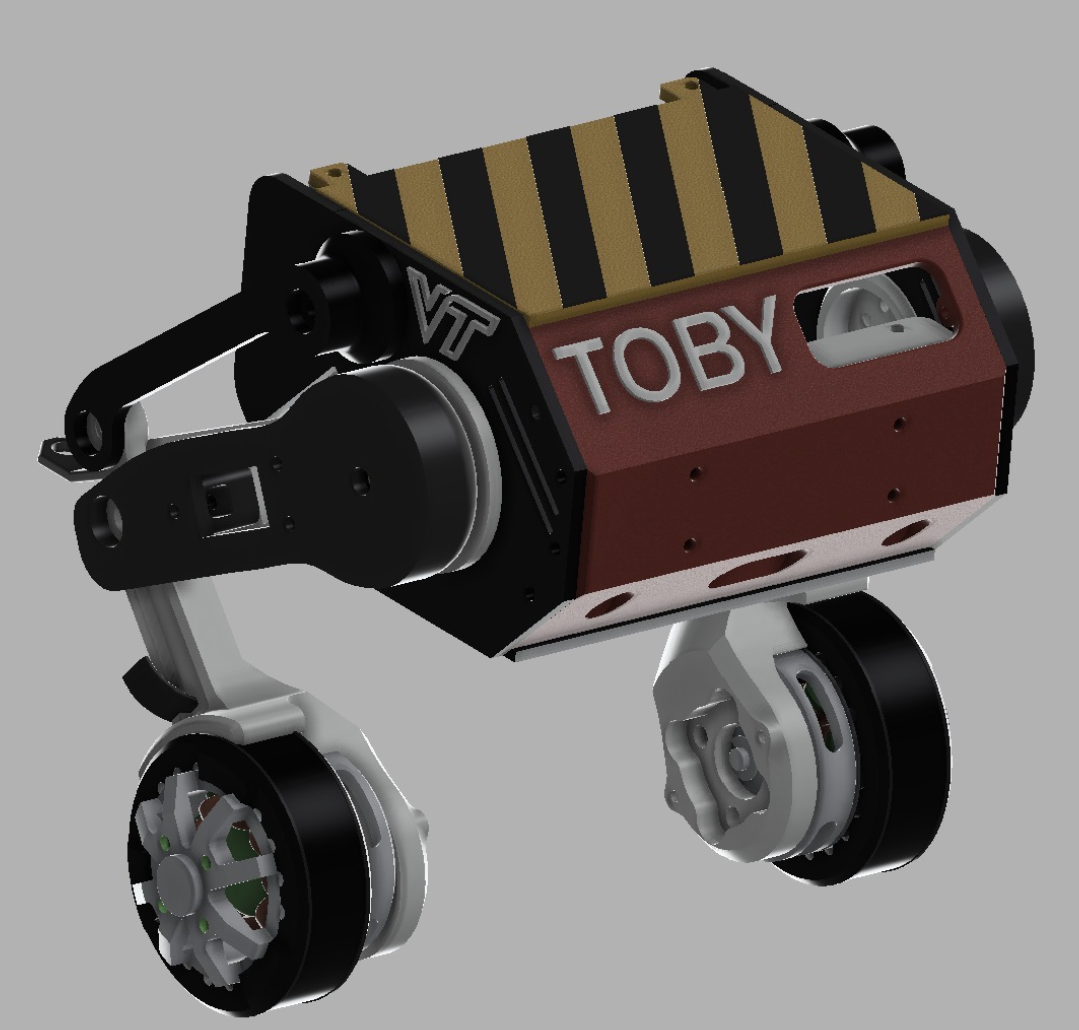
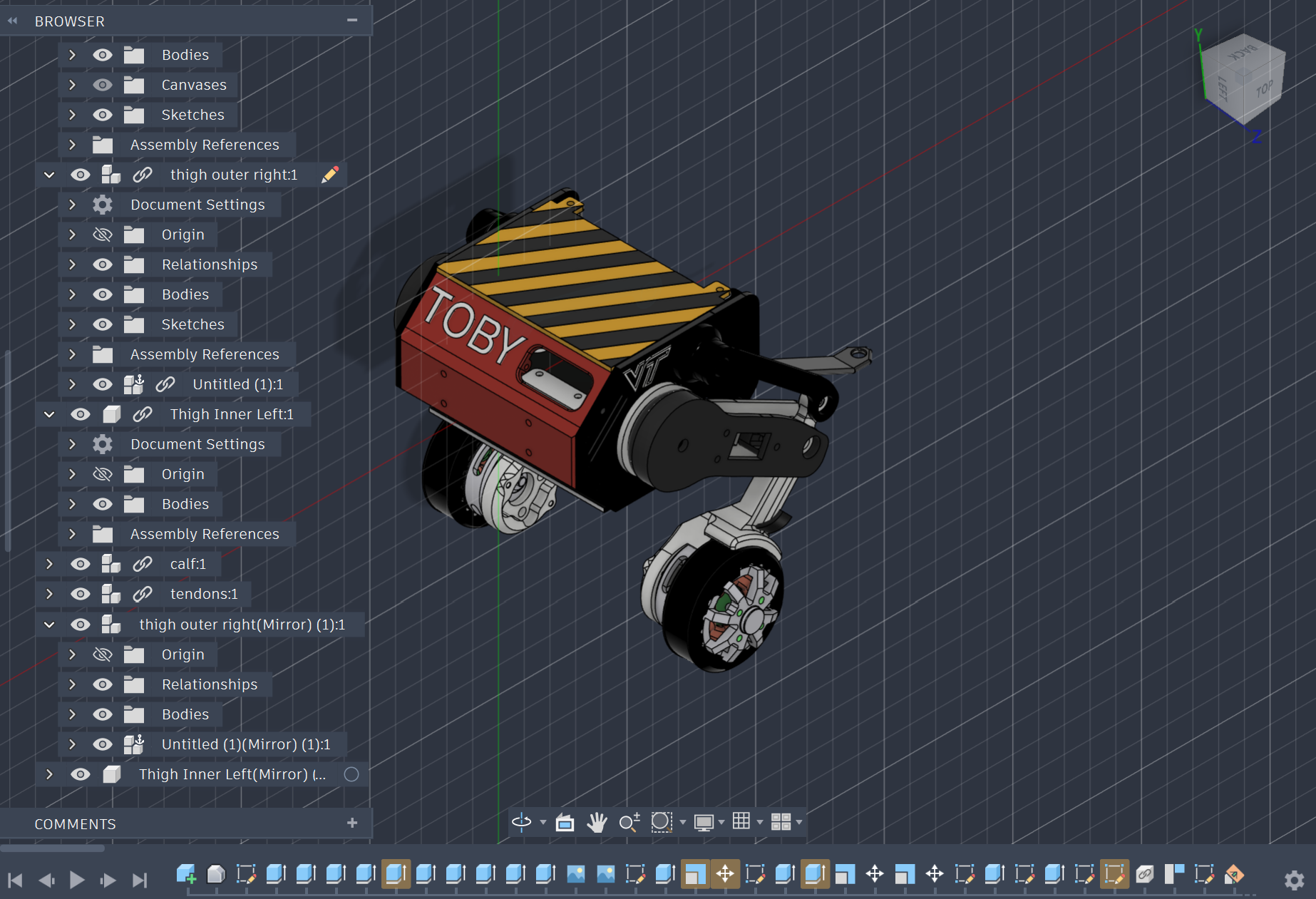
TOBY was designed in Fusion 360, with each component individually modelled based on previously proven concepts.
Why Wheeled-Legged?
Traditional wheeled robots are efficient and fast on relatively smooth terrain, but they can struggle with large obstacles, steep inclines, and uneven surfaces. Conventional legged robots can step over obstacles and adjust their footholds, but walking often requires more energy and more complex control.
Wheeled-legged robots combine the advantages of both approaches. Wheels enable efficient movement across traversable terrain, while articulated legs allow the robot to adjust its posture, shift its centre of mass, and respond to changes in ground elevation. This hybrid approach offers a promising balance between mobility, adaptability, and energy efficiency.
Compared with conventional legged bipeds, wheeled-legged robots can reduce the need for repeated stepping when rolling is possible. Compared with humanoid robots, they can avoid the additional mechanical complexity of a human-like upper body and arms when manipulation is not a primary mission requirement.
For TOBY, this design is particularly relevant to planetary exploration. A rover may encounter relatively flat ground, loose soil, slopes, and scattered rocks within the same journey. By combining wheels with articulated legs, we hope to develop a platform that can travel efficiently across suitable terrain while adjusting its stance to handle more challenging sections.
However, wheeled-legged locomotion also introduces trade-offs. A two-wheeled robot must actively maintain its balance, and its wheels can still lose traction on loose or steep terrain. Our goal is to investigate whether adaptive leg positioning and intelligent control can help address these limitations.
SpaceX AI: Planetary Exploration & Adaptive Locomotion
One of our original goals was to pursue the SpaceX AI track, exploring how AI could enable autonomous rovers to navigate extraterrestrial environments. We envisioned TOBY as a wheeled-legged bipedal robot capable of adapting its movement to the challenging and unpredictable terrain found on planets such as Mars and the Moon.
Our idea was to use planetary terrain data and gravitational parameters to train a model that could help the rover understand its environment and adapt its locomotion accordingly. By incorporating terrain characteristics such as slope, elevation, surface irregularity, and potential obstacles, we hoped to develop a system that could determine how to adjust the robot's stance, balance, and wheel movement to navigate different landscapes.
Gravity was another factor we wanted to explore. The gravitational differences between Earth, Mars, and the Moon affect a rover's weight, traction, stability, and interaction with the ground. By accounting for these differences in simulation, we envisioned training the robot to anticipate how its movement and balance would change under different gravitational conditions before deploying it in unfamiliar environments.
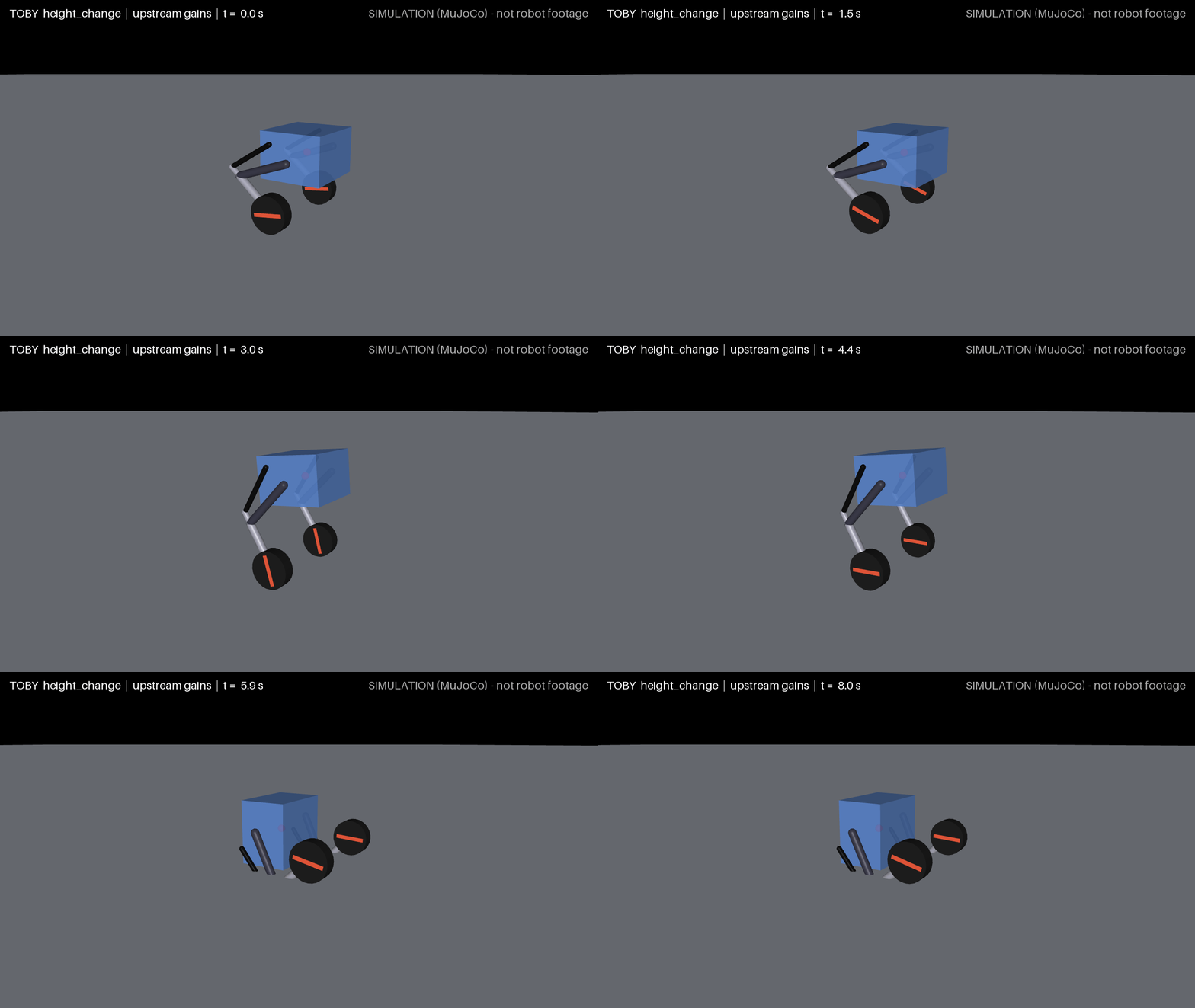
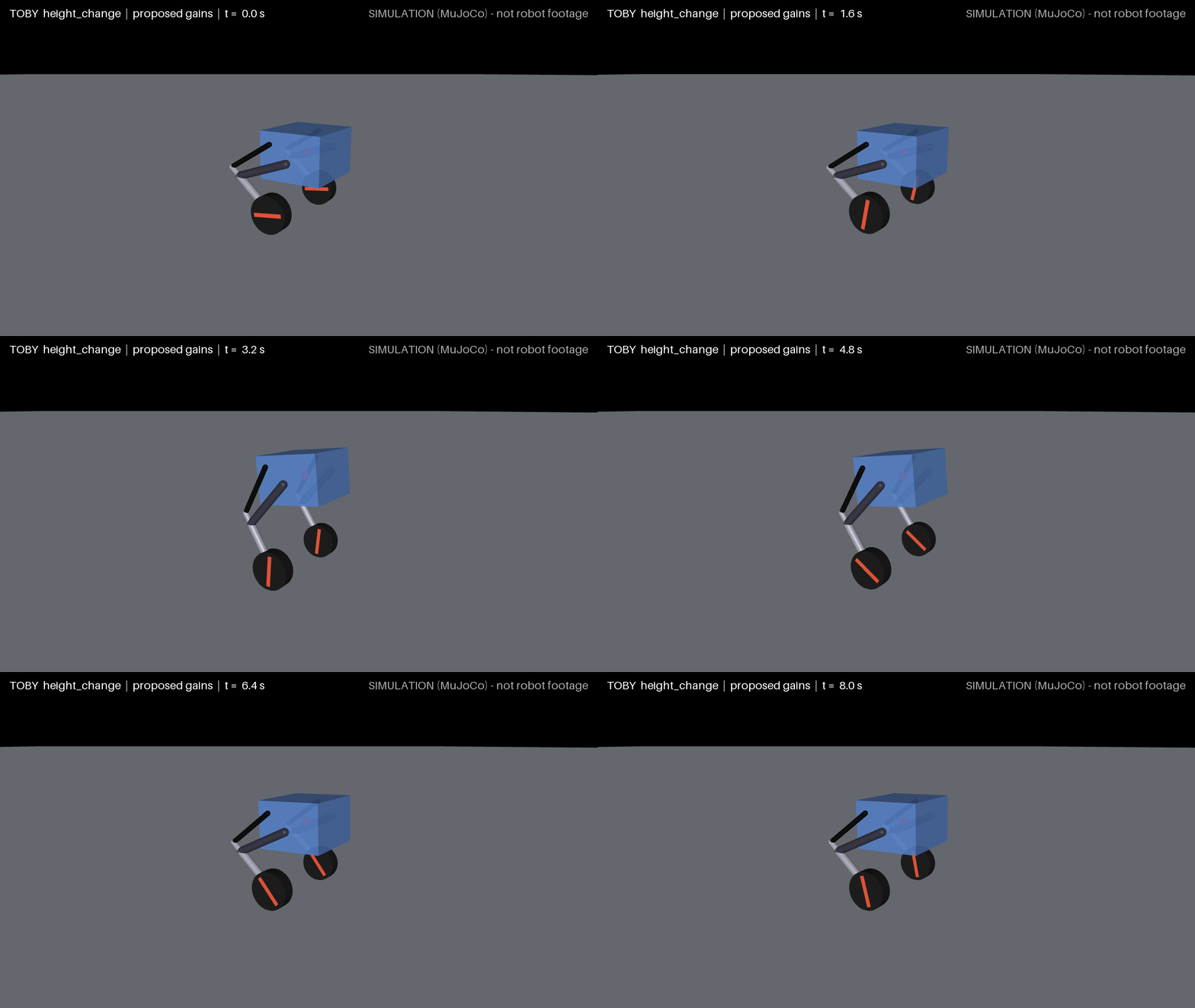
We also wanted to explore reinforcement learning as a way to teach TOBY adaptive locomotion. Rather than relying entirely on predefined movements, the robot could learn through simulated trial and error, receiving rewards for maintaining balance, traversing uneven terrain, and reaching its destination efficiently. By training across a variety of terrain profiles and simulated environmental conditions, we hoped to develop a controller that could generalise to landscapes it had not encountered before.
TOBY's wheeled-legged design was central to this vision. Wheels provide efficient movement across relatively smooth surfaces, while its articulated legs allow it to adjust its body posture and maintain stability when encountering slopes and uneven ground. Combining these capabilities with terrain-aware planning and reinforcement learning could make the robot more versatile than a conventional wheeled rover.
Although time constraints and hardware integration challenges prevented us from fully realising this vision during the hackathon, it remains a central direction for future development. Our long-term goal is to build a rover that can use environmental data and learned control policies to adapt its locomotion autonomously, bringing us closer to robots capable of exploring planetary landscapes with minimal human intervention.
Mechanical Design
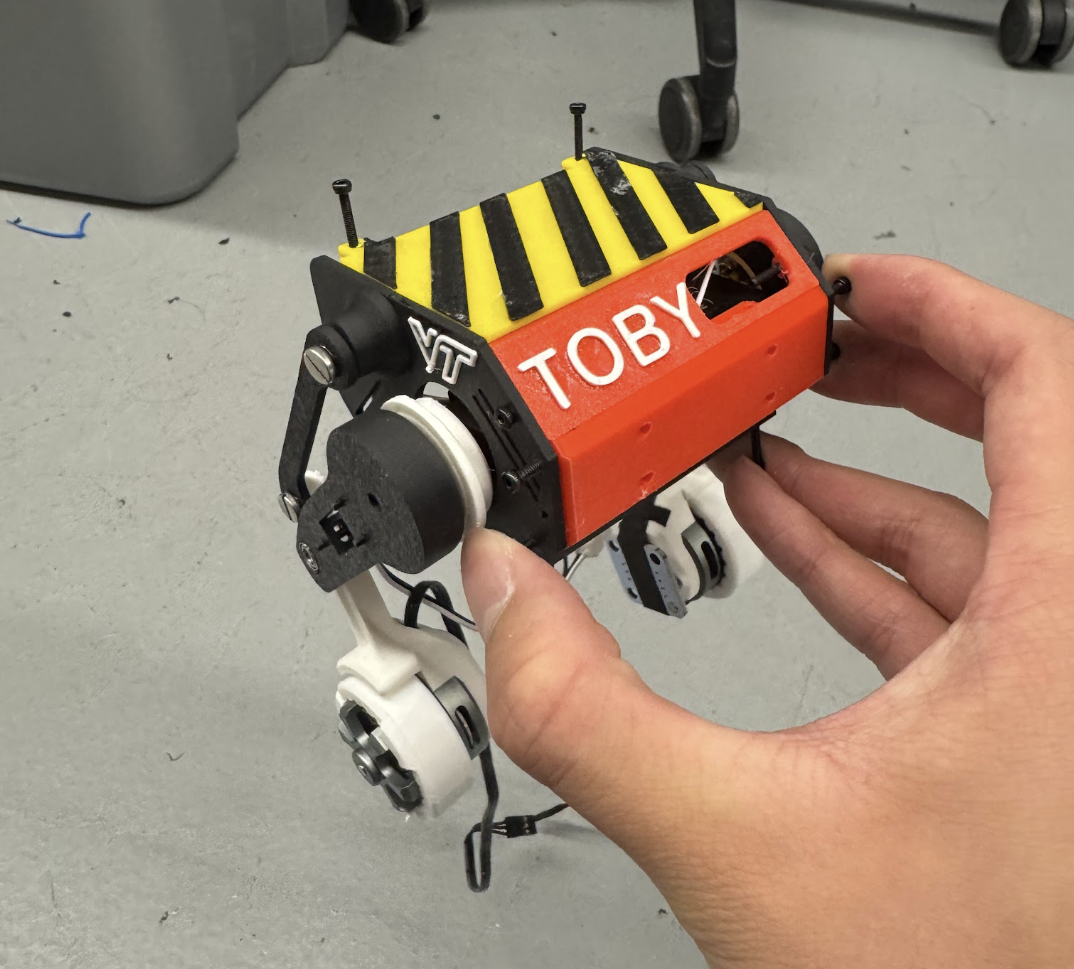
The legs are based on a three-part mechanism consisting of a thigh, a tendon that acts as a pivot, and a calf. An STS-3032 servo actuates the leg mechanism, while a 2208 brushless DC motor provides wheel propulsion and contributes to the robot's balancing system.
The body consists of five plates held together by M2 screws. It was originally designed to house all the electronics, with the dimensions intended to accommodate the control system, motor drivers, power distribution, and other onboard components.
Hardware & Technical Implementation
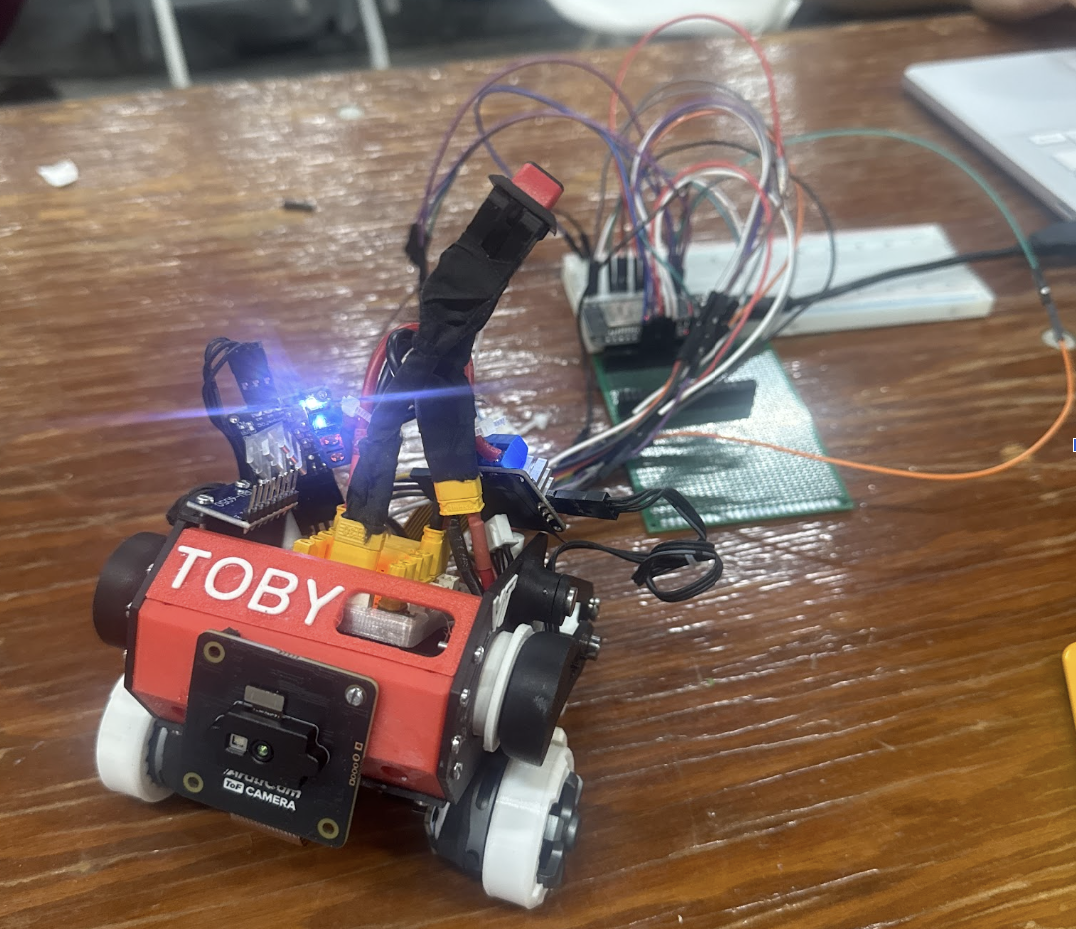
Initially, we planned to use a Raspberry Pi 5 and a 120° RGB Arducam camera to detect and map the surrounding environment. This vision system was intended to support future autonomous navigation and terrain awareness.
Our hardware setup also included a SimpleFOC Mini v2.3 BLDC motor driver, an ESP32-WROOM-32, an MPU-6050 inertial measurement unit (IMU), and an 11.1 V LiPo battery.
Motor Control and Feedback
The DC motors are connected to magnetic encoders that measure wheel rotation and provide position feedback. These encoders send signals to the ESP32, which uses SimpleFOC to control the motors through the motor driver.
The MPU-6050 IMU provides inertial measurements that can be used to estimate the robot's orientation and motion. These measurements are particularly important for developing a balancing controller that keeps the robot stable while moving on two wheels.
Power Distribution
We use two voltage regulators: one steps down the 11.1 V battery output to 5 V, while the other regulates it to 6 V. The 5 V regulator powers the ESP32 and other logic components, while the 6 V regulator supplies power to the STS-3032 servo.
Challenges We Ran Into
During the hackathon, we encountered several significant challenges. Given the time constraints, organising the team and building a hardware project almost from scratch proved difficult.
Our team consisted of four members: Tien Vu and Nishk Shah worked on the robot's control systems and reinforcement learning, Rhema Zhang handled the electronics, and Yujie Ma served as the mechanical and design engineer. Two of our team members were first-time hackers, and this was our first hardware hackathon, which added another layer of difficulty.
We encountered two major challenges: communication between departments and time management and planning.
1. Communication Between Departments
Communication was a major factor in the challenges we faced. Miscommunication and a lack of meaningful discussion between the mechanical and electrical teams led to incorrect assumptions, causing problems during circuit integration.
In a typical engineering workflow, the electrical circuit is mapped out first, and its dimensions and component requirements are then communicated to the mechanical engineer. However, in an attempt to save time, the mechanical design began in CAD before the electrical circuit layout was finalised.
As a result, the robot's body was too small to accommodate all the electronics. During integration, this also contributed to a short circuit in the servo serial communication board, damaging several components, including the robot's leg servo actuators.
2. Time Management and Planning
Time management and forward planning were also significant challenges.
During the planning phase, we struggled to agree on a realistic and achievable goal. Our initial vision extended beyond building a functional robot to include autonomous navigation, reinforcement learning, and planetary terrain adaptation.
In hindsight, we set our expectations too high and underestimated the time required to integrate all the components into a working system. We attempted to tackle mechanical design, electronics, motor control, balancing, and AI development within a limited timeframe, making it difficult to complete each stage reliably.
What We Learned & What's Next
For future projects, we plan to break our goals into smaller, achievable milestones and build on each success before moving on to more complex features.
We also learned two important lessons from this experience:
Always bring spare components. Hardware components can become damaged during integration, and having spare parts available can prevent a single failure from bringing the entire project to a halt.
Plan the circuitry early. Finalising the electrical circuit layout before beginning the mechanical CAD design helps ensure that the robot's body has sufficient space for all the electronics and reduces integration issues.
Future Development
Our next step is to establish a reliable hardware foundation before pursuing more advanced autonomy.
- Reliable actuation: Get the servos and wheel motors working consistently, and verify that the motor drivers, encoders, and power system operate correctly.
- Self-balancing: Develop a feedback controller using IMU measurements and wheel encoder data to maintain balance while moving.
- Simulation and reinforcement learning: Create a simulated environment where TOBY can learn to balance, traverse slopes, and navigate uneven terrain through reinforcement learning.
- Planetary terrain adaptation: Incorporate planetary terrain datasets and simulated gravitational conditions to investigate how different environments affect locomotion and stability.
- Autonomous navigation: Integrate a camera and perception system to identify obstacles, estimate terrain conditions, and select suitable movement strategies.
For example, we could have focused on getting the servo working reliably before moving on to making the robot self-balancing. Once the robot could balance consistently, we could then have introduced reinforcement learning and terrain-aware navigation as successive milestones.
Ultimately, we want TOBY to evolve from a wheeled-legged bipedal robot into an autonomous planetary rover capable of adapting its locomotion to unfamiliar terrain. By combining mechanical versatility, reliable control, and AI-driven adaptation, we hope to explore how robots can navigate environments where conventional wheeled rovers may struggle.
Built With
- as5600
- autodesk-fusion-360
- c
- c++
- mojoco
- mpu6050
- numpy


Log in or sign up for Devpost to join the conversation.